
Ramadan Quran Learning Plan for Families, Kids and Beginners

A Ramadan Quran learning plan should help the family come closer to the Quran without turning the month into an exhausting academic challenge. Children still have school, adults still have work and household responsibilities, beginners need patient repetition, and fasting changes energy throughout the day. The strongest plan therefore combines a small number of meaningful goals, short live lessons, calm home practice, family recitation, realistic Hifz revision, and enough flexibility for weekends, guests, illness, travel, and the last ten nights.
What is the best Ramadan Quran learning plan for a family?
The best Ramadan Quran learning plan gives each family member one clear level-appropriate goal, places Quran time beside a predictable daily anchor, and uses three versions of the routine: a minimum plan for difficult days, a standard plan for most days, and a focused plan for days with extra capacity. Children may take short online lessons and complete five to fifteen minutes of home practice. Beginners should strengthen the first weak skill—Qaida, reading, Tajweed, or a small memorization target—rather than trying to do everything at once. Hifz students should protect recent and older revision before increasing new work. Families can add one brief shared recitation or listening period without forcing every learner into the same assignment.
What should a Ramadan Quran learning plan actually achieve?
Ramadan naturally encourages families to increase worship, but increased intention does not always mean that every learner should receive a larger academic target. A useful Quran plan should make recitation, understanding, memorization, and revision more regular. It should also strengthen the learner’s relationship with the Quran so that the routine feels worth continuing after Ramadan. A plan that creates several intense days followed by exhaustion has not served that purpose, even if the first week looked impressive.
The first goal is continuity. A child who reads for ten focused minutes on most days may gain more than a child assigned a long daily page but completing it only twice a week. An adult beginner who attends two reliable lessons and reviews briefly between them may progress more than someone who begins a complicated self-study schedule that does not fit work, family, and sleep. A Hifz student who strengthens older memorization may make more meaningful progress than one who adds several weak new pages.
Use the month to identify a repeatable rhythm, improve one important skill, and experience the Quran as part of family life. The strongest result is a routine that remains recognizable after Eid.
Families should also separate shared worship from individual coursework. A family recitation circle can build warmth and connection, but a six-year-old learning short vowels, a ten-year-old revising Hifz, and a mother beginning Tajweed do not need the same technical assignment. Let the family share a time, theme, or short passage while each learner keeps a level-based plan.
Set one family goal and one personal Quran goal for each learner
A broad statement such as “We will read more Quran this Ramadan” is sincere but difficult to manage. A useful goal describes what the learner will do, how often it will happen, and what evidence will show progress. The goal should match the learner’s starting level. A complete beginner may focus on letter recognition and joined forms. A developing reader may work on one page with fewer pauses. A Tajweed learner may correct one recurring pronunciation pattern. A child in Hifz may protect recent and older revision while keeping the new portion small.
Family goal
Share one short Quran habit such as ten minutes of listening, recitation, or reflection on most days.
Child goal
Choose one age-appropriate reading, Tajweed, memorization, or revision target with a clear weekly check.
Beginner goal
Strengthen the first weak skill rather than trying to complete Qaida, Tajweed, translation, and Hifz together.

Keep the number of goals small enough that the family can remember them without consulting a complicated chart. For example, the shared goal may be a ten-minute family Quran circle five days a week. One child may review two short Surahs, another may complete a section of Noorani Qaida, and a parent may attend two Tajweed lessons. These goals support one another without becoming identical.
Write the goals in positive, observable language. “Read one assigned passage with fewer teacher prompts” is clearer than “become fluent.” “Complete recent Hifz revision before new memorization” is clearer than “memorize faster.” “Attend two live lessons and practise for ten minutes on four other days” is clearer than “study every day.”
Use a minimum, standard, and focused Ramadan Quran routine
Ramadan days are not equal. School tests, work deadlines, guests, community programs, illness, travel, and changing sleep can make one day very different from another. A single rigid plan often fails because the family assumes that anything less than the full target does not count. A three-level routine protects continuity.
The routine for a difficult day
Use five minutes of familiar recitation, one Qaida exercise, yesterday’s Hifz revision, or a short listen-and-repeat task. The purpose is to keep the relationship with the routine intact.
The plan for most weekdays
Complete the assigned live lesson or home practice, review recent work, and join the family Quran time. This is the schedule the household should be able to repeat without strain.
The plan for a high-capacity day
Add a longer personal recitation, an extra revision block, a teacher assessment, or family reflection. This is optional capacity, not the standard against which every day is judged.
This model is especially helpful for children. The parent can say, “Today is a minimum day,” without making the child feel that the month has been ruined. On another day, the child may have enough energy for the standard lesson. The family can use a focused weekend session when sleep and responsibilities allow. Flexibility becomes part of the plan rather than evidence that the plan failed.
Choose Quran class times around fasting, school, work, prayer, and sleep
The best time for Quran learning is not automatically the same for every person. Fasting changes energy, but so do age, school hours, work, sleep, meal preparation, and the local timing of Fajr and Maghrib. A child may be alert shortly after school on one day and tired on another. An adult may concentrate well after Fajr but need that time for sleep because of late work. The family should test the schedule rather than assuming one “ideal” hour will suit everyone.
| Time window | Best for | Possible strength | Main caution |
|---|---|---|---|
| After Fajr | Adults, teens, some early-rising children | Quiet environment and fresh attention | Do not reduce essential sleep |
| Late morning | Homeschooled children, weekends, adults with flexible work | Good focus before late-day fatigue | May conflict with school or work |
| After school and a short break | School-age children | Class finishes before Iftar preparation intensifies | Allow food-free rest and emotional transition first |
| Late afternoon | Short review or familiar recitation | Useful daily anchor before Iftar | Energy may be lowest for demanding new work |
| Early evening after Iftar | Children, families, adult beginners | Energy improves and family can gather | Protect prayer, digestion, and bedtime |
| After Taraweeh | Some adults and older teens | Quiet personal review | Usually too late for young children and may harm sleep |
A good child schedule usually includes a transition period after school. The child may need to change clothes, rest, pray, and settle before an online class. Starting immediately at the school-day door can make the lesson feel like an extension of pressure. A short, predictable transition often improves attention more than moving the class to a much later hour.
For adults, consistency may matter more than the theoretically best time. A mother who can protect fifteen minutes before the household wakes may use that time well. Another may need an online lesson after the children sleep. The schedule should be judged by actual attendance, attention, and home review—not by how spiritually impressive the hour sounds.
A realistic daily Ramadan Quran routine for kids and beginners
The daily routine should be short enough to complete and structured enough that the learner knows what comes next. It can be divided across the day. A child may complete recent revision in the morning, attend an online class after school, and join a brief family recitation after Iftar. An adult beginner may listen during a quiet morning period and practise aloud later. The activities do not need to fit into one long block.
| Daily anchor | Suggested activity | Approximate length | Purpose |
|---|---|---|---|
| Morning or after Fajr | Familiar recitation, listening, or recent Hifz review | 5–15 minutes | Begin with confidence and protect continuity |
| After school or work transition | Live online Quran class or focused reading practice | 20–35 minutes | Receive correction and complete the main technical work |
| Before Iftar | Light listening, familiar Surah, or minimum-plan review | 5–10 minutes | Use a low-demand task during lower energy |
| Early evening | Family Quran circle, revision, or short reflection | 10–20 minutes | Create shared family connection |
| Before sleep | One-minute recall or tomorrow’s assignment check | 1–5 minutes | Close the day and prepare the next step |

Do not place every activity into the schedule simply because it is beneficial. The table provides options, not a requirement to complete five separate sessions. A younger child may use only one live class, one five-minute review, and a short family circle. A busy adult may use one personal lesson and one brief daily practice. The standard plan should remain smaller than the family’s maximum possible effort.
Ramadan Quran plans for young children, school-age kids, teens, adults, and complete beginners
Different learners need different session lengths, correction styles, and goals. Age alone does not decide the plan, but it gives a useful starting point. Attention, fasting experience, reading level, school demands, and motivation should also be considered.
| Learner | Good main goal | Live lesson pattern | Home practice |
|---|---|---|---|
| Young child, approximately 4–6 | Love of Quran, listening, letters, short Surahs | 15–20 minutes, interactive and highly guided | 3–7 minutes with a parent protecting the routine |
| School-age child, approximately 7–10 | Qaida, connected reading, Tajweed foundation, small Hifz target | 20–30 minutes, two to four times weekly | 5–12 minutes on most non-class days |
| Older child or teen | Fluency, Tajweed, Hifz revision, independent reading | 25–40 minutes with clear goals and respectful feedback | 10–20 minutes with increasing independence |
| Adult beginner | Qaida, basic reading, pronunciation, selected Surahs | 25–40 minutes with private correction and written next steps | 10–20 minutes around work and family duties |
| Returning reader | Assessment, repair, confidence, transfer to unfamiliar text | Targeted lesson based on recurring errors | Short unfamiliar passage plus corrected-skill review |
| Hifz student | Stable recent and older revision | Testing, correction, random starts, limited new work | Sabaq, Sabqi, and Manzil adjusted to energy |
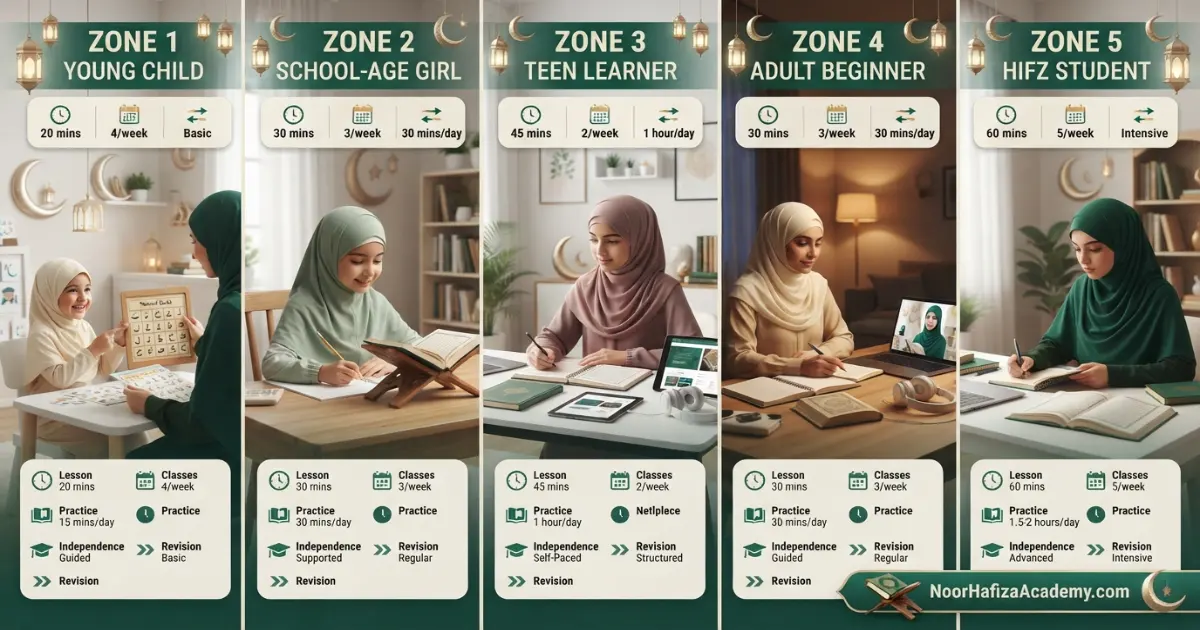
Young children should not be expected to copy an adult Ramadan routine. Their progress may appear through better listening, accurate repetition, willingness to sit for a short lesson, and familiarity with several Surahs. Older children may take more responsibility, but parents should still monitor sleep, schoolwork, and emotional pressure. Adult beginners need privacy and realistic progression; many hesitate because they believe they should already read fluently. A respectful level assessment is more useful than an ambitious public target.
A Ramadan Hifz plan for new memorization, recent revision, and older revision
Ramadan can be a meaningful time for Hifz, but the month should not be used to hide weak revision behind a larger new target. Fasting, changed sleep, school, Taraweeh, and family commitments can reduce recall at certain times of day. The teacher should adjust the new portion according to actual retention.
Sabaq
Keep the new portion small enough to read accurately, recall later, and carry into the next day.
Sabqi
Review recent memorization frequently because it is still fragile and easily affected by missed days.
Manzil
Keep older Surahs or pages in rotation so the month strengthens long-term recall instead of only adding new material.

A simple Ramadan rule is to revise before adding. The student should recite yesterday’s lesson and the assigned recent revision before beginning a new portion. If the recent work needs many prompts, the teacher may reduce or pause the new assignment. The student can still make progress through error repair, verse connections, random beginnings, and stronger older revision.
Parents should listen without becoming the primary Hifz teacher. Give the child thinking time before supplying the first word. Mark the exact place where recall breaks and share the pattern with the teacher. Avoid restarting the entire Surah after every mistake. Repair the smallest useful phrase, reconnect it, and test it again after a delay.
The last ten nights may require a lighter Hifz load. Families often change sleep, attend community programs, or spend more time in worship. Protect the minimum revision and allow the new portion to remain smaller. This keeps the student connected without turning the final nights into a backlog.
How beginners can improve Quran reading and Tajweed during Ramadan
A complete beginner does not need to finish an entire reading or Tajweed curriculum in one month. The best Ramadan goal is often the first skill that makes independent reading easier. That may be recognizing joined letters, reading short vowels correctly, understanding sukoon and shaddah, distinguishing a pair of similar letters, or reading a short phrase without stopping after every word.
For Noorani Qaida learners
- Keep the lesson short and frequent
- Review only the assigned pattern
- Read aloud rather than looking silently
- Use the same Qaida and teacher model consistently
For developing Quran readers
- Use one manageable passage
- Preview signs and difficult words
- Read slowly before increasing pace
- Practise one pronunciation target at a time
Listening can support reading, but it should not replace independent attempts. The learner should follow the text, pause the model, read aloud, compare one feature, and try again. A child who only repeats after audio may sound smooth while remaining unable to decode a nearby unfamiliar line. Live teacher correction helps separate memorized imitation from real reading progress.
Families can use the related guides on Noorani Qaida, improving Quran recitation, and Tajweed rules for beginners to choose the most suitable entry point.
How to create family Quran time without making every learner do the same work
A family Quran circle should feel simple enough to repeat. It can begin with one short recitation, a few minutes of listening, or each person sharing what she practised. The purpose is not to replace individual classes. It is to create a visible family culture in which the Quran has a regular place.
A simple 15-minute family Quran circle
- Two minutes: settle, remove distractions, and choose the shared passage or listening clip.
- Five minutes: one family member recites or the family follows a reliable recitation.
- Five minutes: learners divide into their individual level tasks while a parent supervises calmly.
- Three minutes: each learner shares one completed step or one question for the teacher.
Avoid using the circle for public correction that embarrasses a beginner or child. Technical errors can be noted and discussed privately with the teacher. Parents can praise observable effort: sitting on time, attempting independently, using the correct page, repeating after correction, or completing revision before asking for new work.
Siblings may share the same study space while using headphones or taking turns. A family with several online learners can stagger lessons so one child attends class while another completes quiet practice. The shared schedule should reduce household conflict rather than requiring every person to be available at once.
A weekly Ramadan Quran learning plan with lessons, review, family time, and recovery
A weekly structure prevents parents and learners from renegotiating the routine every day. It also creates space for live correction, home practice, revision, and one lighter day. The exact days can change according to the teacher’s availability and the family’s school or work schedule.
Live lesson
Assess recent work, teach one main target, and assign a small clear practice step.
Short home review
Repeat the exact lesson target and complete recent revision without adding extra material.
Second lesson or test
Check whether the skill remains, transfer it to a fresh line, and adjust the assignment.
Family Quran circle
Share brief recitation or listening while keeping individual tasks level-based.
Revision emphasis
Reduce new work, repair weak passages, and protect confidence before the weekend.
Flexible recovery
Use a minimum plan, reschedule a missed lesson, or complete a calm weekly review.

Do not double the next assignment after a missed day. Resume from the stable point. A child who misses Tuesday’s review should not be expected to complete Tuesday and Wednesday’s new work together. Test the most recent lesson, repair weakness, and continue with a reduced target.
How online Quran classes can fit a Ramadan family schedule
Online Quran classes can reduce travel and make it easier to find a lesson time around school, work, Iftar, prayer, and sleep. They are most useful when the teacher hears the learner independently, corrects specific errors, and assigns a realistic home step. The lesson should not consist only of repeating after the teacher.
Before Ramadan, families can share expected schedule changes with the academy. Mention school dismissal, work hours, local Iftar time, Taraweeh plans, weekend commitments, and whether the child is fasting. Ask whether the class can remain at the same time throughout the month or whether one planned adjustment is necessary. Too many weekly changes can reduce attendance and make the routine feel uncertain.
Share age, level, time zone, school or work hours, fasting status, current course, preferred lesson window, and the family’s main Ramadan Quran goal.
For children, a mother or female guardian may remain nearby to manage technology and routine. She should avoid giving the next word too quickly, because the teacher needs to see where independent reading or recall breaks. Adults should use headphones, a stable device, good lighting, and the same Mushaf or Qaida whenever possible.
How to adjust Quran classes and family learning during the last ten nights
The final part of Ramadan may bring more worship, community programs, family commitments, and changes to sleep. The learning plan should become simpler, not more crowded. Preserve the essential assignment, recent revision, and attendance at the most important live lesson. Optional extra coursework can be reduced.
Young children usually benefit from keeping an earlier lesson time and a stable bedtime. They should not be expected to follow an adult late-night routine. Older teens and adults may add personal recitation after Taraweeh if they remain alert and still protect sleep. The family should distinguish voluntary extra capacity from the learner’s required classwork.
A family may increase personal recitation, dua, reflection, or listening while keeping a child’s technical Quran assignment steady. More worship does not require a larger worksheet, page target, or memorization load.
Common mistakes in Ramadan Quran plans for families and children
Starting with too many goals
The family tries to complete reading, Tajweed, translation, Hifz, Islamic Studies, and a long daily recitation at once. Choose one main learning goal and keep other activities light.
Scheduling young children too late
A late class may appear convenient after Taraweeh but can reduce attention, sleep, and school readiness. Use an earlier window whenever possible.
Treating every missed day as failure
One difficult day becomes a complete break. Use the minimum plan and resume from the stable point.
Adding new Hifz while revision weakens
The visible page count grows while recent and older memorization disappear. Protect revision before new work.
Comparing siblings
Different ages, levels, attention, and school loads make comparison unfair. Measure each learner against her own starting point.
Parents correcting beyond their confidence
Conflicting pronunciation or Tajweed guidance confuses the child. Reinforce the assigned practice and leave technical correction to the teacher.
Using screen time without independent reading
The learner watches or repeats but does not read alone. Every lesson should include a fresh independent attempt.
Ending the routine completely after Eid
The family treats Ramadan as a temporary project. Choose the post-Ramadan minimum plan before the month ends.
How parents and teachers should review Ramadan Quran progress
A useful progress review looks beyond page count. The teacher and parent should ask whether attendance remained realistic, the learner needed fewer prompts, pronunciation improved, recent revision became more stable, the family protected the schedule, and the child’s attitude remained positive. One stable improvement may be more valuable than several unfinished targets.
| Area | Useful evidence | Question to ask | Possible adjustment |
|---|---|---|---|
| Attendance | Classes attended and rescheduled successfully | Was the lesson window realistic? | Move once to a more reliable time |
| Reading | Fewer pauses, guesses, or repeated restarts | Which foundation improved? | Keep the same target or transfer it to new text |
| Tajweed | One correction remains inside connected recitation | Can the learner apply it independently? | Add one new target only after stability |
| Hifz | Better next-day recall and stronger older review | Is new work still small enough? | Reduce or increase modestly |
| Routine | Minimum plan used instead of complete breaks | Which daily anchor worked best? | Carry that anchor after Eid |
| Wellbeing | Calm participation, adequate sleep, manageable pressure | Did the plan support the learner? | Shorten sessions or reduce frequency |

The review should produce one practical decision. The student may keep the same lesson time, reduce new Hifz, move from Qaida to short Quran reading, continue one Tajweed target, or protect a specific family routine. Avoid ending the meeting with a long list of general advice that nobody knows how to implement.
Turn the Ramadan Quran plan into a sustainable post-Ramadan habit
The family should choose the post-Ramadan routine before Eid. After a month of changed schedules, it can be difficult to restart if the plan disappears completely. The new routine does not need to match Ramadan. It should preserve the strongest habit at a smaller level.
Keep one anchor
Continue the most reliable time, such as after school, after Fajr, or early evening.
Keep one goal
Carry forward the skill that showed the clearest improvement rather than starting a new project immediately.
Keep one review
Schedule a teacher or parent progress check during the first weeks after Eid.
A child may return to a school-year schedule with fewer weekly lessons but continue five-minute review on non-class days. An adult beginner may keep two lessons and a short morning practice. A Hifz student may restore the standard new portion only after revision remains stable. The family Quran circle may move from daily to two or three times weekly.
FAQs about Ramadan Quran learning for families, kids, and beginners
How should a family plan Quran learning during Ramadan?
How long should children study Quran during Ramadan?
What is the best time for kids to take online Quran classes in Ramadan?
Should a beginner focus on reading, Tajweed, or memorization in Ramadan?
Can a child continue Hifz while fasting?
How can parents create a Ramadan Quran routine without pressure?
What should a family do on a very busy Ramadan day?
How can families balance Quran learning with Taraweeh and sleep?
Should the Quran learning target increase during the last ten nights?
Can families study Quran together if everyone is at a different level?
Are online Quran classes suitable during Ramadan?
How should a Ramadan Quran plan continue after Eid?
Build a Ramadan Quran routine your family can actually keep
Share each learner’s age, level, course, school or work schedule, time zone, preferred lesson window, current Hifz or reading target, and the family’s main Ramadan goal. Noor Hafiza Academy can discuss a realistic plan with a suitable female Quran teacher.