
Ghunnah in Tajweed: Meaning, Letters and Practice Tips

Ghunnah in Tajweed is a nasal resonance associated mainly with the letters Noon (ن) and Meem (م). Beginners usually hear it most clearly when Noon or Meem carries Shaddah, where the nasal sound is commonly held for about two counts. Ghunnah also appears in selected rules involving Noon Sakinah, Tanween, and Meem Sakinah, including Ikhfa, Iqlab, Idgham with Ghunnah, Ikhfa Shafawi, and Idgham Shafawi. The exact strength and quality depend on the rule and recitation context, so a learner should not hold every Noon or Meem in exactly the same way. The practical goal is a controlled nasal sound with correct letter articulation, even timing, and no extra vowel.
What is Ghunnah in Tajweed?
Ghunnah is a nasal resonance associated mainly with Noon (ن) and Meem (م). Beginners usually learn it first with Noon or Meem carrying Shaddah, where the sound is commonly held for about two counts. Ghunnah also appears in selected rules of Noon Sakinah and Tanween, such as Ikhfa, Iqlab, and Idgham with Ghunnah, and in selected Meem Sakinah rules such as Ikhfa Shafawi and Idgham Shafawi. The sound should resonate through the nose without becoming a separate vowel or exaggerated hum. “Two counts” describes relative recitation timing, not a fixed number of seconds.
What does Ghunnah mean in Tajweed?
Ghunnah refers to nasal resonance that is naturally connected with Noon and Meem. In practical Tajweed learning, the sound is heard through the nasal passage while the oral articulation of the letter remains correct. It is not a third letter, a hidden vowel, or a decorative sound added to make recitation more melodic.
For complete beginners, “gentle nasal hum” can be a useful description, but it is only an approximation. The learner should listen to a teacher because the exact balance between nasal resonance, letter articulation, and timing cannot be learned reliably from English spelling alone.
Ghunnah belongs to the letter and the Tajweed rule. It should sound integrated into recitation rather than added after the word.
Which letters have Ghunnah?
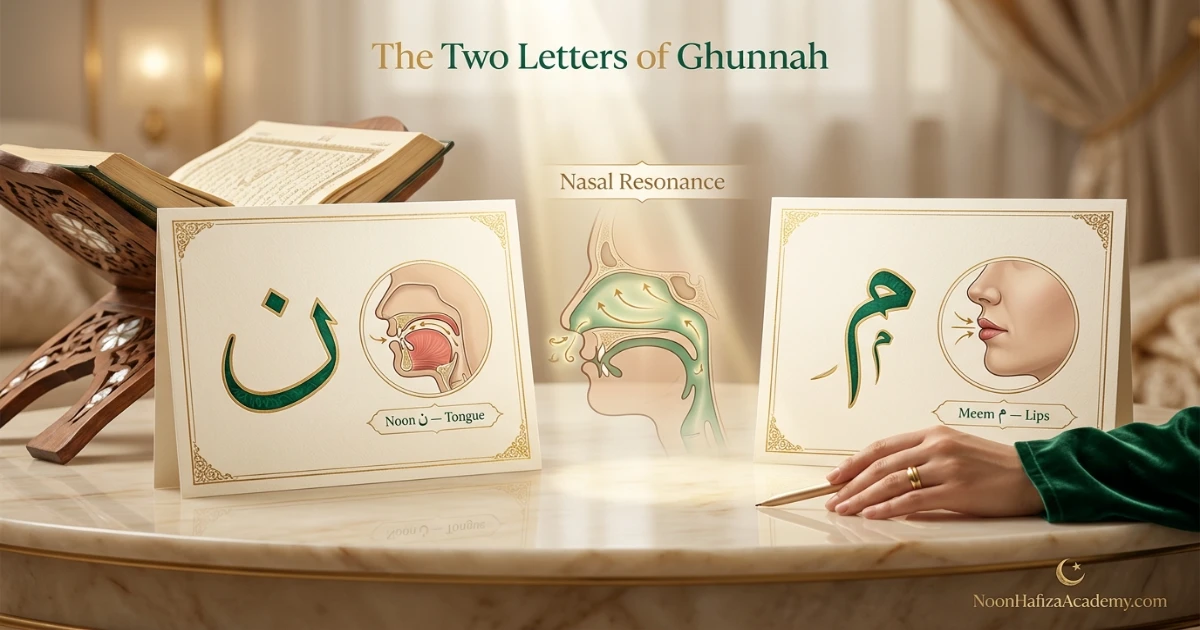
The two main Ghunnah letters are Noon and Meem. They both use nasal resonance, but their oral points of articulation are not the same. This is important because a learner should not simply “hum through the nose” and forget the consonant itself.
Noon
Noon uses the tongue in its proper articulation while the nasal resonance is present according to the rule. In some connected rules, the Noon sound is clear; in others it is merged or concealed.
Meem
Meem uses the lips. When Ghunnah applies, the lips still perform the Meem correctly while the nasal sound continues through the relevant count.
Ghunnah with Noon Mushaddadah and Meem Mushaddadah
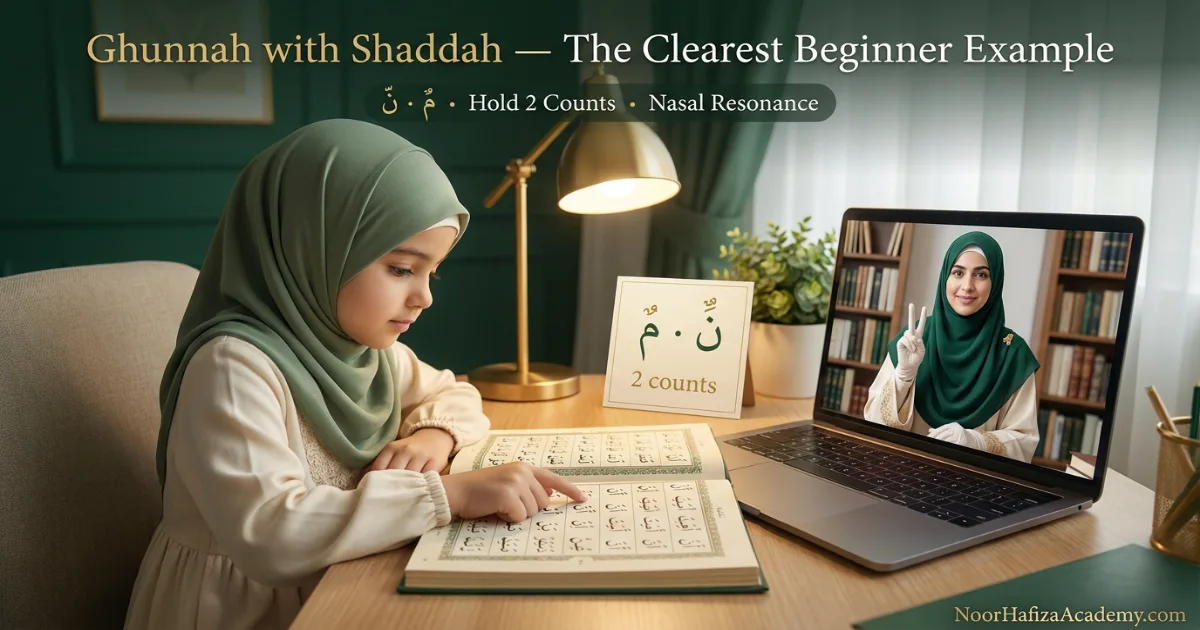
Noon with Shaddah and Meem with Shaddah are the easiest places for a beginner to hear Ghunnah clearly. When نّ or مّ appears, the letter is doubled and the nasal resonance is commonly held for about two counts.
Maintain the correct Noon quality while holding the nasal resonance.
Maintain correct lip closure while the nasal resonance continues.
Hold evenly according to the natural pace of recitation.
Make the sound clear without turning it into a dramatic hum.
Shaddah itself means the consonant is doubled. Ghunnah does not replace the doubling. The learner needs both the correct Mushaddad consonant and the nasal resonance.
What does two-count Ghunnah mean?
Two counts are two even timing units at the reader’s current pace. They are not two fixed seconds. If the recitation is slower, the counts naturally stretch slightly; if the recitation is faster but controlled, the counts become shorter while staying proportionate.
Teachers may demonstrate timing by moving two fingers, tapping twice, or using a simple “one-two” rhythm. The goal is consistency. A learner should not hold one Ghunnah for a very short moment and the next for an exaggerated length.
Correct idea
Use two even beats linked to the recitation pace. Keep the sound stable from the first count to the second.
Avoid this
Do not use a stopwatch or force every Ghunnah to last the same number of seconds regardless of speed.

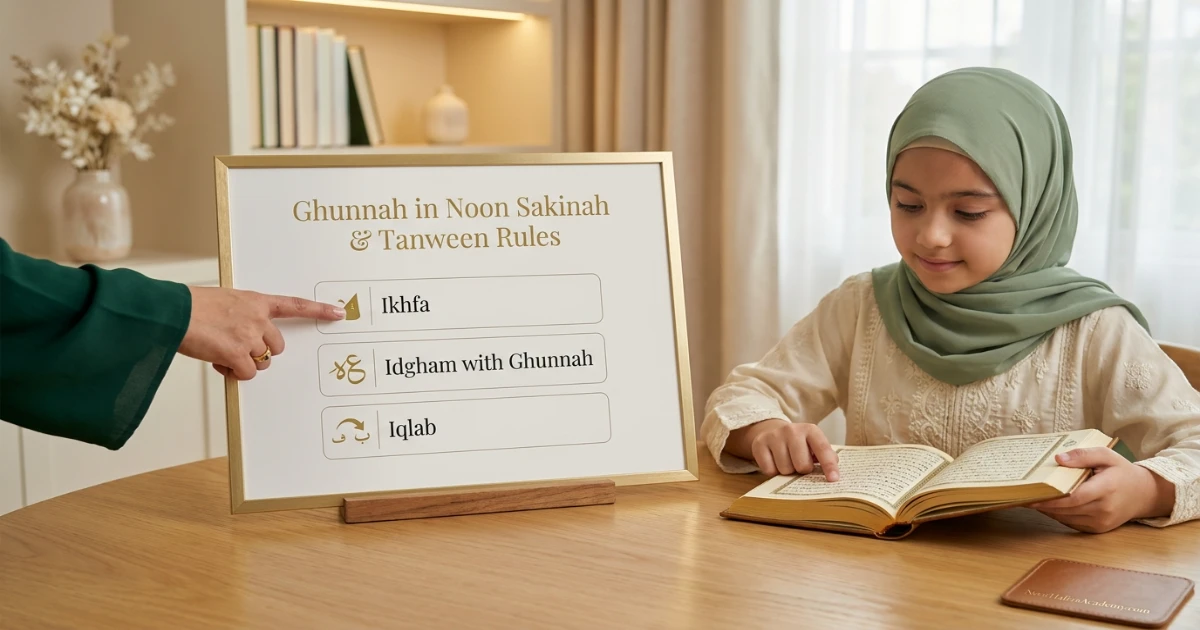
Ghunnah in Noon Sakinah and Tanween rules
Once beginners understand Ghunnah with Shaddah, they meet nasal resonance again in the connected rules of Noon Sakinah and Tanween. These rules change how the Noon sound relates to the following letter.
| Rule | Ghunnah? | Beginner explanation | Key note |
|---|---|---|---|
| Izhar Halqi | No added rule-based hold | Noon or Tanween is pronounced clearly | Do not turn it into Ikhfa |
| Idgham with Ghunnah | Yes | Noon/Tanween merges into selected letters while nasal resonance remains | Commonly taught with ي ن م و |
| Idgham without Ghunnah | No sustained rule-based Ghunnah | The merge occurs without the same nasal hold | Commonly taught with ل and ر |
| Iqlab | Yes | Noon/Tanween changes toward a concealed Meem-like sound before ب | Avoid an exaggerated lip closure |
| Ikhfa Haqiqi | Yes | Noon/Tanween is concealed while nasal resonance remains | The following letter affects oral positioning |
A common beginner misunderstanding is to call the following Ikhfa or Idgham letters “Ghunnah letters.” It is clearer to say that the Ghunnah belongs to the treatment of Noon Sakinah or Tanween in the rule.
Ghunnah in Meem Sakinah rules
Meem Sakinah also has connected-reading rules. Beginners should learn the three main categories and notice where a clear Ghunnah hold is used.
| Rule | Condition | Ghunnah | Beginner focus |
|---|---|---|---|
| Ikhfa Shafawi | Meem Sakinah before ب | Yes | Conceal Meem with nasal resonance and controlled lips |
| Idgham Shafawi | Meem Sakinah before another م | Yes | Merge the two Meems with clear nasal resonance |
| Izhar Shafawi | Meem Sakinah before most other letters | No extra rule-based hold | Pronounce the Meem clearly |

How should Ghunnah sound and feel?
The sound should be nasal, steady, and connected to the letter. A learner may feel vibration or resonance in the nasal area, but the mouth still performs the correct articulation. Meem still uses the lips. Noon still retains its proper consonant identity or the specific modified treatment required by the connected rule.
The sound should not be produced only from the mouth.
The sound should not pulse, wobble, or break into two syllables.
Ghunnah belongs inside the recitation, not after the consonant.
A clear Ghunnah does not require excessive volume or dramatic humming.
Common Ghunnah mistakes beginners make
Ghunnah disappears
Noon or Meem with Shaddah is read too quickly and the nasal quality is barely heard.
Overholding
The learner turns a two-count Ghunnah into a long artificial hum.
Adding a vowel
The sound ends with an extra “a,” “i,” or “u” that is not part of the rule.
Every Noon and Meem is held
The learner applies the same two-count hold even where the rule requires clear or different treatment.
Meem lip position is weak
The learner focuses on the nose and forgets proper Meem articulation.
Noon becomes only a hum
The learner loses the correct consonant identity while nasalizing.
Counting in seconds
Timing becomes rigid and disconnected from the pace of recitation.
Confusing the rules
Ghunnah is added to Izhar or Idgham without Ghunnah simply because Noon appears.
Easy Ghunnah practice tips for beginners
Start with نّ and مّ
These are the clearest patterns for hearing the nasal sound and learning a steady hold.
Use a two-beat rhythm
Hold the sound evenly across two teacher-guided counts.
Compare with normal Noon and Meem
Hear the difference between an ordinary letter and a Mushaddad form.
Add connected rules slowly
Practise Idgham with Ghunnah, Ikhfa, Iqlab, and Meem Sakinah rules one at a time.
Record a short sample
Listen for weak resonance, overholding, uneven timing, or an added vowel.
Transfer into Quran reading
Apply Ghunnah naturally in short passages without pausing to perform every rule.

A simple 30-day Ghunnah practice plan
| Week | Main focus | Home practice | Teacher checkpoint |
|---|---|---|---|
| Week 1 | Noon and Meem with Shaddah | Short two-count drills with نّ and مّ | Check nasal quality and even timing |
| Week 2 | Ikhfa and Idgham with Ghunnah | Short controlled connected examples | Check rule recognition and natural flow |
| Week 3 | Iqlab and Meem Sakinah rules | Compare concealed Meem, merged Meem, and clear Meem | Check lip position and timing |
| Week 4 | Natural Quran reading | Find Ghunnah examples in a short passage and recite continuously | Check transfer, consistency, and fluency |
What parents should notice when a child learns Ghunnah
Parents do not need to judge advanced Tajweed detail. They can notice whether the broad skill is becoming more consistent.
Simple parent checklist
- Can the child recognize Noon and Meem?
- Does نّ or مّ have a clearly held nasal sound?
- Is the hold roughly consistent rather than random?
- Does the child add an extra vowel afterward?
- Does Meem keep correct lip closure?
- Does Noon retain its proper quality?
- Can the child find Ghunnah in a fresh example?
- Does the rule remain correct without teacher modeling every word?
Questions to ask a Tajweed teacher about Ghunnah
Use these during a trial or Tajweed lesson
- How do you explain Ghunnah to a complete beginner?
- How do you teach the difference between nasal resonance and an extra vowel?
- How do you count two beats at different recitation speeds?
- How do you teach Noon Mushaddadah and Meem Mushaddadah?
- Which Noon Sakinah and Tanween rules use Ghunnah?
- Which Meem Sakinah rules use Ghunnah?
- How do you correct overholding?
- How do you correct weak Ghunnah that disappears?
- How do you prevent students from holding every Noon and Meem?
- Do you test Ghunnah in unfamiliar Quran examples?
- How much home practice should a beginner do?
- How do you decide when the learner is ready for the next Tajweed rule?
Online Tajweed classes for beginners learning Ghunnah
Noor Hafiza Academy offers live online Quran learning for girls, women, children, adults, new Muslims, complete beginners, and returning readers with female Quran teachers. A Tajweed assessment can review Arabic letters, Makharij, Harkaat, Sukoon, Shaddah, Qalqalah, Ghunnah, Noon Sakinah, Tanween, Meem Sakinah, stopping, and current Quran reading level.
A suitable beginner plan may include Noorani Qaida, Quran reading, Tajweed foundations, Makharij correction, Ghunnah, Qalqalah, Noon and Meem rules, and controlled fluency. Current female-teacher qualifications, availability, schedules, trial arrangements, fees, privacy practices, policies, and enrollment terms should be confirmed directly.
Share the learner’s age, current Quran level, Tajweed experience, time zone, schedule, and whether the main challenge is Noon, Meem, Shaddah, two-count timing, or connected Ghunnah rules.
FAQs about Ghunnah in Tajweed
What is Ghunnah in Tajweed?
What are the Ghunnah letters?
How long is Ghunnah held?
Does every Noon and Meem have two-count Ghunnah?
What is Ghunnah with Shaddah?
Does Ikhfa have Ghunnah?
Does Idgham always have Ghunnah?
Does Iqlab have Ghunnah?
Which Meem Sakinah rules use Ghunnah?
Should Ghunnah sound like humming?
How can I practise Ghunnah at home?
Can children learn Ghunnah online?
Build a clear, controlled Ghunnah and strengthen your beginner Tajweed foundation
Share the learner’s age, current Quran level, Tajweed experience, time zone, schedule, and whether the main difficulty is Noon, Meem, Shaddah, two-count timing, or connected Ghunnah rules.