
What to Do When a Child Does Not Want to Attend Quran Class

When a child does not want to attend Quran class, parents often feel worried, disappointed, or unsure whether to insist. The most useful response is neither immediate punishment nor complete withdrawal. First identify what the child is reacting to. The real problem may be tiredness, an unsuitable class time, work that feels too difficult, too much correction at once, fear of making mistakes, a poor teacher match, weak technology, an unrealistic Hifz target, or a routine built around conflict. Once the cause is clearer, parents and the teacher can create a smaller, calmer plan that protects both the child’s relationship with the Quran and the habit of regular learning.
What should parents do when a child refuses Quran class?
Stay calm, avoid arguing immediately before the lesson, and ask specific questions at a neutral time. Find out whether the child is tired, confused, afraid of correction, bored, overloaded, uncomfortable with the teacher, or struggling with the class schedule or technology. Share the pattern with the Quran teacher and change one variable at a time: shorten the lesson, move it to a better time, reduce the assignment, add more guided practice, or use a trial with another female teacher when the fit is weak. Keep a small minimum routine while the issue is being solved so the habit does not disappear. Review the plan after two or three weeks using the child’s calm participation, attendance, independent attempts, and skill progress—not obedience alone.
A child’s refusal is a signal—not a complete explanation
“I do not want Quran class” may sound like a clear statement, but it does not tell parents why the child is resisting. Two children can use the same words for very different reasons. One child may be mentally tired after school. Another may be anxious about being corrected. A third may understand very little and has learned to avoid the lesson before feeling embarrassed. Another may simply prefer play at that moment and needs a more predictable transition. The first task is therefore diagnosis, not judgment.
Parents should avoid attaching a permanent label such as lazy, disrespectful, unmotivated, or not interested in the Quran. Those labels usually hide the practical problem. A child who repeatedly avoids one teacher may participate well with another. A child who resists a forty-minute evening class may cooperate in a twenty-five-minute earlier lesson. A Hifz student who appears careless may be carrying a revision load that is too large. A Qaida learner who looks bored may actually be repeating material she already understands without enough independent reading.
The Quran, the teacher, the schedule, the lesson design, the homework, and the child’s current energy are different parts of the experience. A problem in one part should not be described as rejection of the Quran itself.
At the same time, parents do not need to remove every expectation as soon as a child protests. Children sometimes resist ordinary responsibilities. The goal is balanced firmness: keep learning important, listen seriously, and make the routine developmentally realistic. This approach avoids both extremes—forcing a failing system every week or abandoning Quran learning before the real cause is understood.
Why a child may not want to attend Quran class
The most effective solution depends on the reason. Parents should observe when resistance begins, what the child says, how the lesson unfolds, and whether the same difficulty appears in other activities. A pattern that begins only on school days suggests a different issue from resistance that begins when a specific assignment or teacher appears.
Poor timing
The child may be hungry, sleepy, overstimulated after school, rushing from another activity, or taking class too close to bedtime.
Work feels too difficult
The page may require reading foundations, pronunciation, or memorization skills the child has not yet developed.
Correction feels overwhelming
Too many interruptions or repeated criticism can make the child expect failure before class begins.
Teacher fit is weak
The teacher may be qualified but not the best match for the child’s age, pace, communication style, or confidence.
Lesson is too long or passive
A long session with little variety, movement, independent participation, or visible success can reduce engagement.
Home pressure is attached
Arguments, comparisons, threats, oversized homework, or constant prompting may make the entire routine feel unsafe.
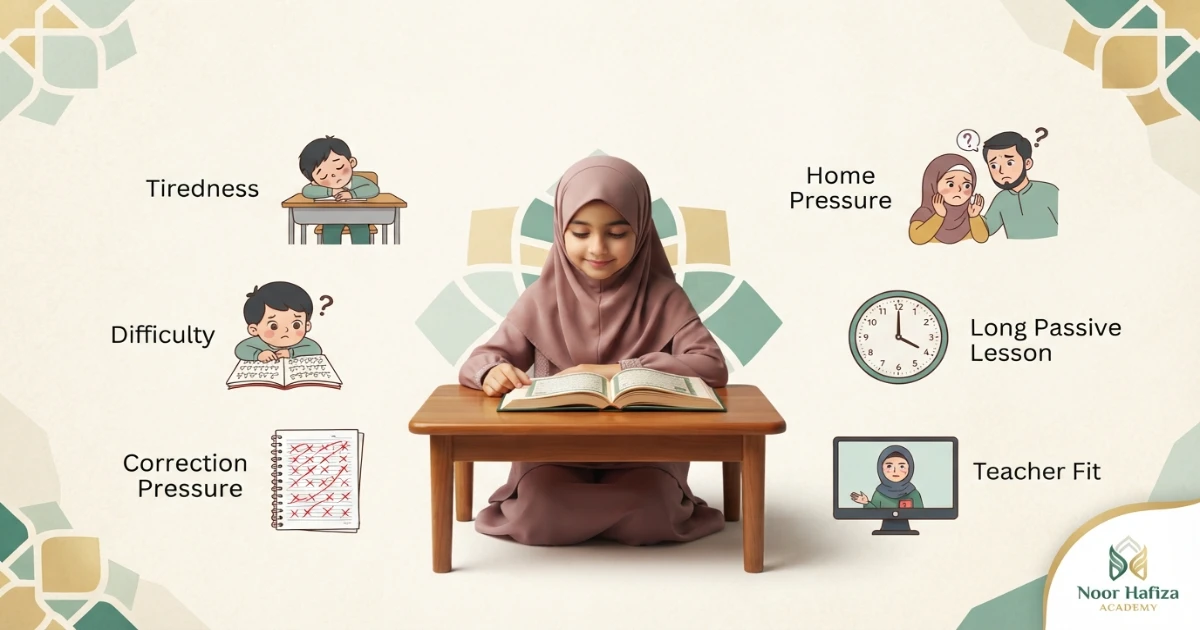
Other causes may include unstable internet, audio delay, a small phone screen, background noise, lack of privacy, siblings interrupting, a missing book, or a lesson that starts differently every week. These details can look minor to an adult but may make the child feel confused and unprepared. For an online learner, the environment is part of the class.
How to ask a child why she does not want Quran class
Choose a neutral time. Do not begin the conversation two minutes before the lesson while the teacher is waiting. A calm time after dinner, during a walk, or on a non-class day gives the child more space to explain. Keep the first question simple: “What is the hardest part of Quran class right now?” This is usually easier to answer than “Why do you hate class?”
Offer choices when the child struggles to explain. Ask whether the main problem is the time, the length, the page, the amount of homework, fear of mistakes, understanding the teacher, or something else. Do not insist that one answer must be correct. A child may need several conversations to separate tiredness from embarrassment or difficulty from dislike.
Let the child describe the class in her own words
Avoid correcting every exaggeration immediately. First identify the feeling and the event behind it.
Ask for one recent example
“What happened in the last lesson that made you not want the next one?” turns a broad complaint into something observable.
Repeat the concern without agreeing to every conclusion
“You felt embarrassed when you were corrected many times” shows understanding without deciding that class must stop.
Choose one change to test
Tell the child what will change, what will stay, and when the family will review the result.

Match the solution to the reason for Quran class resistance
| What the parent notices | Possible cause | First adjustment | What to review |
|---|---|---|---|
| Resistance begins after school | Fatigue and no transition | Add a 30–60 minute calm break or choose another time | Attention during the first ten minutes |
| Child cries about one page or lesson | Work above current level | Return to the missing foundation and reduce the assignment | Independent success on easier material |
| Child becomes silent after correction | Correction load feels too heavy | Prioritize one main correction and add fresh attempts | Willingness to try again |
| Child avoids only one teacher | Communication or personality mismatch | Parent–teacher review, observed lesson, or trial with another teacher | Comfort, clarity, and participation |
| Child leaves the screen near the end | Class is too long or passive | Shorten the lesson and use active segments | Focus across the full class |
| Resistance follows large homework | Unrealistic home workload | Use one small teacher-assigned task | Completion without conflict |
| Class starts with device problems | Technology stress | Prepare the device, book, camera, and link early | Calm start and usable audio |
A seven-step plan when a child refuses online Quran lessons
Stop repeating the same argument
Keep the immediate response brief. Avoid long lectures, threats, or religious guilt while the child is already dysregulated or defensive.
Record the pattern for one week
Note the class day, time, sleep, school load, food, transition, assignment, device problems, and the point when resistance begins.
Speak with the child at a neutral time
Ask what feels hardest, what feels easier, and what one change might help. Keep expectations clear but the tone curious.
Share specific evidence with the teacher
Replace “She hates class” with useful information such as “She participates for fifteen minutes, then shuts down when the new page starts.”
Change one variable
Adjust time, duration, difficulty, homework, correction density, teacher interaction, or technology. One change makes the result easier to understand.
Keep a minimum routine
Use five minutes of familiar recitation, one Qaida line, or recent Hifz review on difficult days so learning does not disappear completely.
Review after two or three weeks
Ask whether attendance, calm participation, independent attempts, teacher connection, and progress have improved. Keep, adjust, or replace the plan based on evidence.

What a child-friendly Quran class should feel like
A child-friendly class is not a class with no correction, no goals, or no responsibility. It is a lesson designed so the learner understands the task, receives manageable feedback, attempts the skill independently, and experiences enough success to continue. The teacher should adjust the pace without removing standards.
A clear beginning
The teacher greets the child, checks the assigned material, and explains today’s small target before introducing new work.
Short active segments
Reading, listening, repetition, recall, correction, and review are divided into manageable parts rather than one long passive task.
Prioritized correction
Major reading, pronunciation, and memorization errors are corrected, but the learner is not interrupted for every small issue at once.
Independent attempts
The child receives thinking time and tries a fresh word, phrase, or passage without the teacher supplying every answer.
Visible progress
The teacher identifies what improved and gives one precise next step instead of ending with a broad instruction to practise more.
A calm ending
The final minutes review something the child can do, confirm the home assignment, and allow the learner to leave with clarity.

Check whether the Quran class time is creating the problem
Timing can turn a suitable teacher and reasonable lesson into a repeated conflict. A school-age child may need food, prayer, movement, and emotional transition before another screen-based responsibility. A class placed immediately after school, after a long sports practice, or near bedtime may fail even when the child values Quran learning.
Test a new window for at least two or three lessons before judging it. A slightly earlier lesson may help one child, while another needs a longer post-school break. Weekend classes may improve energy but can compete with family events. The right time is the window that produces reliable attendance and active learning—not simply the time that is easiest to book.
Schedule review checklist
- Has the child eaten, rested, moved, and prayed as needed?
- Is the lesson immediately after school, tutoring, sports, or another demanding activity?
- Does class end too close to dinner or bedtime?
- Is the same lesson time protected every week?
- Does the family rush or argue during the ten minutes before class?
- Would a shorter lesson at a better time produce more learning?
The guide on the best Quran class schedule for school-age children explains how to balance school, homework, prayer, meals, activities, and sleep.
How refusal may look different in Qaida, reading, Tajweed, Hifz, and Islamic Studies
Noorani Qaida
A Qaida learner may resist because letter patterns feel repetitive or because one missing foundation makes every new line difficult. The teacher should confirm recognition, vowels, joining, sukoon, shaddah, and blending rather than moving forward only because pages have been completed. Short, frequent practice usually works better than one large weekly homework block.
Quran reading
A developing reader may avoid class when she is repeatedly stopped after every word. The teacher can use short phrases, preview difficult signs, and choose one main fluency target. A familiar passage can rebuild confidence, but the lesson should also include a manageable unfamiliar line so progress reflects real decoding.
Tajweed
Tajweed resistance often grows when the lesson contains too many rule names or technical corrections at once. One practical pronunciation target applied inside real recitation is easier to understand. The child needs to hear what changed, try again, and use the correction in a fresh example.
Hifz
A Hifz student may refuse because new memorization has grown while recent and older revision remain weak. She may expect every class to expose forgotten passages. Reduce new work, repair weak joins, use random beginnings carefully, and rebuild confidence through stable revision. Parents should avoid supplying the first word immediately, because prompt dependence can hide the real retention problem.
Islamic Studies
A child may resist Islamic Studies when it feels like another school lecture. Stories, questions, discussion, examples from daily life, simple reflection, and a short activity can make the lesson more age-appropriate without reducing meaningful learning.
Support Quran class without becoming the second teacher
Parents should prepare the environment, protect the schedule, help with technology, and communicate patterns to the teacher. They should not answer every question, repeat instructions over the teacher, or correct Tajweed beyond their confidence. Too much parent involvement can make the child perform for the parent instead of learning from the teacher.
- Prepare the device, lesson link, Mushaf or Qaida, notebook, pencil, and headphones before class.
- Stay nearby for younger children without sitting directly beside them unless needed.
- Allow the teacher to give correction and the child to attempt again.
- Do not threaten consequences within the teacher’s hearing.
- Record important patterns after class rather than interrupting repeatedly.
- Ask the teacher for one clear home assignment and the expected level of support.
- Praise effort, correction, attendance, and independent attempts rather than perfection.
For memorization-specific support, see how parents can help a child memorize the Quran.
How to motivate a child without bribery, comparison, or religious guilt
Motivation grows when the child experiences competence, connection, predictability, and a clear reason for the task. Rewards may support a routine temporarily, but they should not become the only reason the child attends. Use small, specific recognition: “You joined the class on time,” “You tried the difficult word again,” or “You completed revision before asking for help.” These comments teach the child what successful effort looks like.
Avoid comparing siblings, classmates, or cousins. Comparison changes the goal from personal growth to social ranking. It can also hide different ages, levels, attention spans, teachers, and schedules. Measure each child against her own previous performance.
Parents can say, “Quran learning remains part of our family routine, and we are going to make the class work better,” instead of either threatening the child or promising that she never has to attend again.
How to know whether the child needs a different Quran teacher
A qualified teacher may still be a poor match for a particular child. Teacher fit includes pace, tone, patience, age experience, correction style, language clarity, ability to explain, and comfort with online learning. Before changing teachers, parents should share specific concerns and allow a reasonable adjustment period when the issue appears fixable.
A trial with another female Quran teacher may be appropriate when the child consistently cannot understand instructions, feels afraid to attempt, receives little independent practice, or the teacher cannot adjust the lesson after clear feedback. Changing teachers should not be used every time the child meets ordinary correction or challenge. The aim is a better learning fit, not a class with no standards.

What parents should discuss with the Quran teacher
| Review area | Useful question | Evidence to share | Possible response |
|---|---|---|---|
| Timing | When does attention begin to fall? | Sleep, school, food, transition, and lesson start | Move or shorten the class |
| Difficulty | Which skill breaks first? | Joined letters, pronunciation, reading flow, recall, or homework | Return to the missing foundation |
| Correction | How many targets are active? | Child response after repeated interruptions | Prioritize one main correction |
| Participation | How much of the lesson is independent? | Prompt dependence and passive repetition | Add fresh attempts and choice |
| Home practice | Is the assignment realistic? | Time needed, conflict, completion, and retention | Reduce to one clear task |
| Teacher fit | Can the communication style be adjusted? | Specific moments of confusion or fear | Adapt the lesson or test another teacher |
A two-week reset plan for a child who avoids Quran class
A reset should make the routine smaller and clearer, not remove learning entirely. The following model can be adapted with the teacher.
Week 1: reduce friction
Use the best available class time, prepare the device early, shorten the lesson if needed, begin with familiar material, and assign one small home task.
Week 1: observe
Track the calm start, first resistance point, correction response, independent participation, and whether the child finishes with clarity.
Week 2: add one challenge
Keep the improved structure and introduce one manageable new word, phrase, rule, or memorization target.
Week 2: review
Ask the child and teacher what improved, what remains difficult, and whether the new plan should continue or change again.

When parents should seek additional support
Sometimes Quran class resistance is part of a wider pattern. The child may be struggling across school, tutoring, social situations, sleep, transitions, or other responsibilities. Parents should not expect the Quran teacher to diagnose concerns outside her role. Share relevant information with the teacher, reduce avoidable pressure, and seek appropriate local support when the difficulty extends beyond Quran class or causes significant distress in daily life.
The immediate aim remains practical: keep the child safe, listen carefully, avoid shame, and use a manageable learning plan. A temporary reduction in lesson length or frequency may be appropriate while the family addresses the broader concern. This is different from abandoning Quran learning; it is adjusting the method to the child’s current capacity.
Child-friendly online Quran classes with female teachers
Noor Hafiza Academy offers live online Quran learning with female Quran teachers for children, girls, women, sisters, complete beginners, readers, Tajweed students, and Hifz learners. When a child is resisting class, a useful review begins with age, current level, school schedule, previous lesson experience, attention pattern, class duration, home practice, teacher communication, and the first moment when resistance appears.
The academy can discuss whether the learner needs a different time, shorter session, level reassessment, lighter homework, more interactive teaching, revision-focused Hifz plan, or a trial with another suitable female teacher. Current teacher availability, schedules, programs, trial arrangements, fees, policies, and enrollment terms should be confirmed directly.
Share the child’s age, Quran level, course, school schedule, class time, lesson length, recent behavior, teacher feedback, and the one change you believe may help.
FAQs when a child does not want to attend Quran class
What should I do if my child refuses Quran class?
Should I force my child to attend Quran class?
How do I know whether my child is lazy or genuinely struggling?
Can the Quran class time cause resistance?
What if my child is afraid of making mistakes in Quran class?
Should I change the Quran teacher?
What if my child says Quran class is boring?
How can I motivate my child to attend Quran class?
How long should a child’s Quran class be when she is resisting?
Should we pause Quran classes completely?
What should I tell the Quran teacher?
How long should we test a new plan?
Rebuild Quran class around calm progress, clear support, and a routine your child can keep
Share the child’s age, current level, course, class time, lesson length, school schedule, recent resistance pattern, previous teacher experience, and the first change you would like to test. Noor Hafiza Academy can discuss a suitable plan with a female Quran teacher.