Female Quran Teacher Online: What Parents and Sisters Should Check

Choosing a female Quran teacher online should involve more than finding a convenient time or reading a short tutor biography. Parents and sisters should assess Quran accuracy, Tajweed knowledge, course-specific experience, teaching style, respectful correction, privacy, professional boundaries, reliability, communication, and the learner’s response during a live trial. This guide provides a practical checklist for children, girls, women, beginners, Tajweed learners, and Hifz students.
What should you check before choosing a female Quran teacher online?
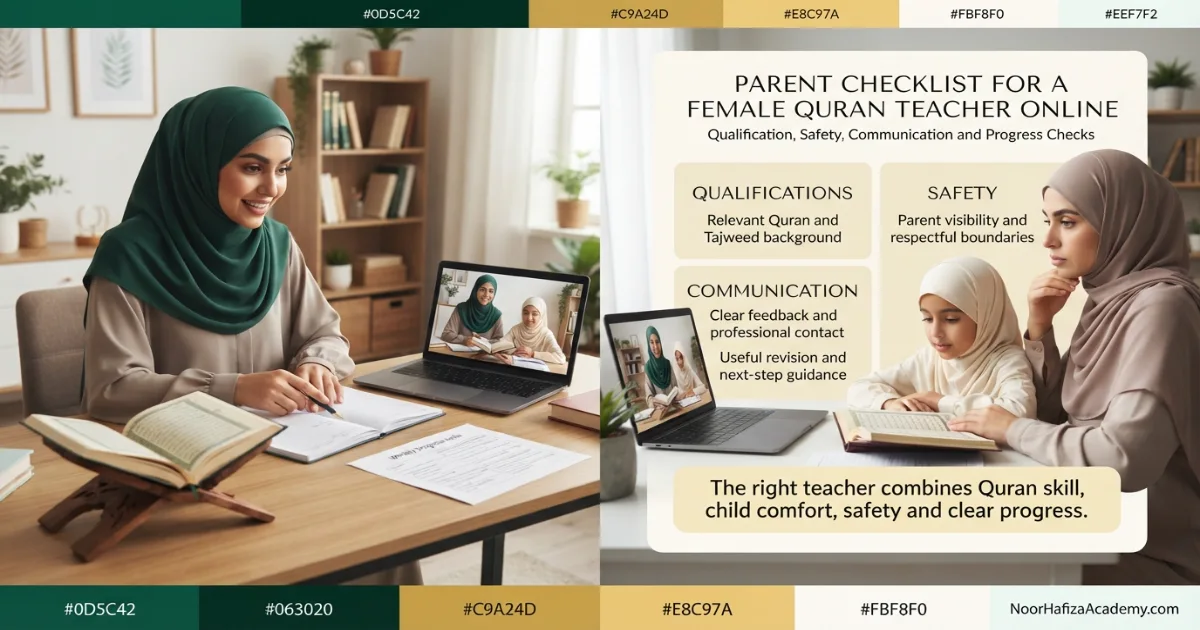
Before choosing a female Quran teacher online, confirm that she can recite and model the learner’s course accurately, explain in an understandable way, correct mistakes respectfully, and adapt to the student’s age, level, confidence, and goal. Parents should verify the teacher through an official academy route, remain informed about the platform and schedule, and keep child communication parent-visible. Adult sisters should check privacy, language comfort, course specialization, lesson structure, and whether the teacher understands their goals without making assumptions. Everyone should attend a live trial, observe one full correction cycle, ask how progress is measured, review missed-class and teacher-change policies, and compare the complete learning plan rather than choosing by price, accent, nationality, or availability alone.
Why choose a female Quran teacher online?
Many parents prefer a female Quran teacher for daughters, young children, and family learning because the arrangement can support comfort, modesty, communication, and a women-led learning environment. Adult sisters may also feel more at ease asking pronunciation questions, discussing confidence, arranging private lessons, or learning around work, caregiving, pregnancy, family responsibilities, and changing schedules with another woman.
A female teacher can be an excellent choice, but gender alone does not establish teaching quality. A parent or sister should still verify Quran accuracy, relevant Tajweed knowledge, course experience, patience, lesson planning, privacy, reliability, and communication. A warm personality without precise correction can allow mistakes to continue. Strong qualifications without learner-aware teaching can make lessons confusing or discouraging. The right choice combines subject knowledge, instructional skill, professional conduct, and a suitable learner-teacher match.
Online learning also expands access. A family may be unable to find a suitable female tutor locally, may need lessons across a USA time zone, or may prefer to avoid regular travel. Adult women may want a private class from home rather than fitting into a fixed local group. The online format can offer flexibility, but the same convenience makes verification, privacy, and clear boundaries essential.
A female teacher may satisfy an important family or personal preference, while a live trial confirms whether her recitation, teaching style, correction, communication, and course experience fit the learner.
Twelve qualities to check in a female Quran teacher online
A useful selection process looks beyond one certificate or attractive profile. These twelve qualities help parents and sisters evaluate the complete teaching relationship.
Accurate recitation
The teacher should model letters, vowels, articulation, elongation, stops, and connected reading clearly enough for the learner to imitate.
Relevant Tajweed knowledge
She should understand the rules required for the course and explain them through practical examples rather than theory alone.
Course specialization
Qaida, Quran reading, Tajweed, Hifz, Ijazah, Tafseer, Islamic Studies, and Arabic require different experience and lesson planning.
Learner-aware teaching
The teacher should adjust explanation, pace, repetition, and homework for a child, teen, adult beginner, or advanced sister.
Specific correction
She identifies the exact issue, models the improved version, allows another attempt, and checks whether the correction transfers.
Patient structure
Patience should remain purposeful. The teacher repeats calmly while protecting lesson time and keeping the learner engaged.
Clear communication
Instructions, goals, revision, attendance, and scheduling should be explained in language the learner and family understand.
Professional boundaries
Contact stays relevant to learning, scheduling, and progress through agreed channels without secrecy or unnecessary personal requests.
Privacy awareness
The teacher and academy should explain platform use, recordings, screenshots, lesson links, and protection of personal information.
Reliable attendance
Regular punctual lessons help learners build trust, momentum, and revision habits. Changes should be communicated clearly.
Progress tracking
The learner should know what is improving, what remains weak, what to revise, and which milestone comes next.
Respectful encouragement
The teacher supports confidence without false praise, comparison, embarrassment, or pressure that makes the learner afraid to attempt.
What qualifications should a female Quran teacher have?
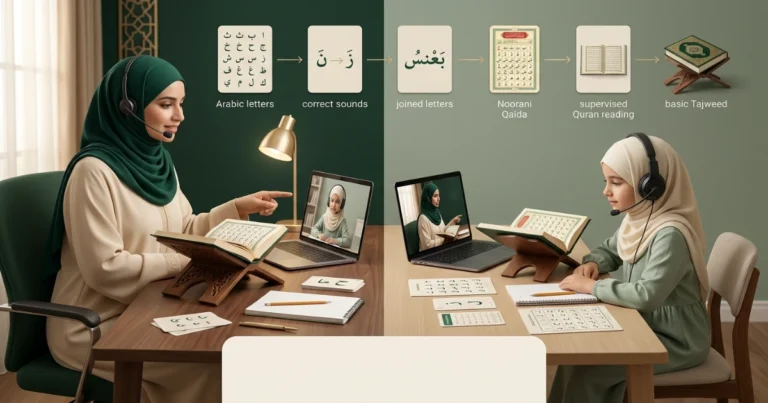
The required qualification depends on what the learner wants to study. A young beginner learning Arabic letters needs a teacher who can model foundational sounds, distinguish similar letters, and prevent guessing. A Quran reading student needs accurate fluency correction and stopping guidance. A Tajweed learner needs a teacher who understands the relevant rules and can hear whether the learner applies them. A Hifz student needs memorization supervision, revision planning, and retention checks. Ijazah or advanced study may require a teacher with a more specialized chain of study and course-specific authorization.
Parents and sisters can ask about Quran study, Tajweed training, memorization, teaching experience, languages, and the courses the teacher regularly handles. However, avoid treating certificates as the final decision. A document cannot show whether the teacher listens carefully, explains simply, notices patterns, manages lesson time, or creates a respectful learning environment. Qualifications should be supported by live evidence.
Modeling test
Can the teacher demonstrate the sound, rule, line, or passage accurately and at a pace the learner can imitate?
Listening test
Does she listen long enough to identify the real error pattern rather than interrupting randomly?
Explanation test
Can she turn technical knowledge into one practical instruction the learner understands?
Correction test
Does the learner produce a better attempt after the teacher’s guidance?
Placement test
Does the teacher assess current ability before selecting a book, page, pace, or course?
Progress test
Can she explain the current goal, revision task, and next milestone clearly?
What parents should check in a female Quran teacher for children
Children need more than simplified adult teaching. The teacher must understand attention, confidence, age, language, school routine, and the difference between normal resistance and genuine distress. A five-year-old beginner may need short imitation tasks and parent help with materials. A nine-year-old may need clearer independence and consistent revision. A twelve-year-old may respond better to respectful accountability and visible goals.
Brief and highly guided
Look for short instructions, sound imitation, visual pointing, gentle repetition, and comfort with a parent staying nearby.
Foundation with routine
The teacher should build Qaida or reading systematically while keeping tasks manageable and correction encouraging.
Growing responsibility
Look for clearer milestones, respectful accountability, independent attempts, and revision the child can understand.
Mature communication
Avoid childish language. Teen learners often need privacy, meaningful goals, honest feedback, and respect for school demands.
Parents should observe whether the teacher lets the child attempt before correcting, avoids comparison, explains errors without shame, and communicates concerns professionally. A child-friendly teacher is not a teacher who avoids correction. She corrects accurately while helping the learner remain willing to try again.
What sisters should check before choosing an online female Quran tutor
Adult sisters often begin with different backgrounds. Some are complete beginners who did not have consistent access earlier. Some can read but want to correct Tajweed. Others are restarting after a long gap, preparing for Ramadan, memorizing selected surahs, or seeking a structured Hifz plan. The teacher should respond without judgment and should not assume that age equals level.
Comfort matters, but the class should also have direction. Ask whether the teacher can explain in your preferred language, whether she teaches adults regularly, and whether lessons can accommodate work, children, study, health, or caregiving responsibilities. A good plan may use shorter frequent lessons, longer weekly sessions, or a customized mix of recitation and revision. The format should be sustainable rather than ideal only on paper.
Adult beginner
Check for respectful foundational teaching, clear letter recognition, pronunciation modeling, and no embarrassment about starting later.
Tajweed improvement
The teacher should hear specific articulation and rule-application issues, not only explain theory.
Hifz and revision
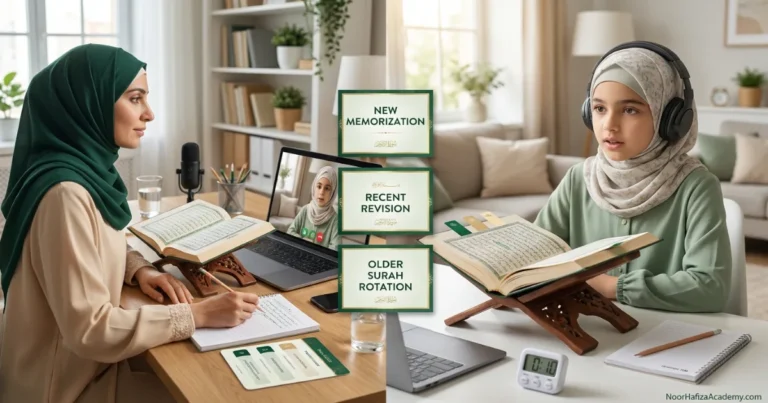
Look for a realistic balance of new memorization, recent revision, older revision, and retention checks.
Quran restart
A restarting learner may need assessment, confidence rebuilding, and correction of long-standing habits without rushing.
Islamic Studies
Confirm the curriculum, source approach, class format, discussion method, and whether the level matches your goals.
Private women-only space
Ask about platform privacy, recordings, camera expectations, communication channels, and female-only participation.

How to evaluate a female Quran teacher online during a trial class
A live trial is the strongest practical step in the selection process. It allows the teacher to hear the learner and gives the learner real evidence about recitation, explanation, correction, comfort, technology, and structure. The trial does not need to show perfect chemistry. It should show a professional process.
Confirm identity and course
Join through the official route, confirm the teacher’s name, and make sure she knows the learner’s requested course, age or adult status, and current level.
Allow an independent sample
The learner should read, identify, repeat, or recite without constant help so the teacher can assess genuine ability.
Listen to the teacher’s modeling
Her recitation should be clear, measured, and suitable for imitation. Technical explanations should support the sound rather than replace it.
Observe one correction cycle
Look for a clear sequence: hear the mistake, identify the issue, model the better form, allow repetition, and check again.
Assess emotional comfort
The learner should feel respected and able to ask questions or try again. Nervousness is normal; humiliation or pressure is not.
Request a starting recommendation
The teacher should explain the course, starting point, lesson length, weekly frequency, revision expectation, and first milestone.
Questions to ask after the trial
- What is the learner’s current level based on the live assessment?
- Which skill or mistake should be addressed first?
- Which course and starting material do you recommend?
- How will pronunciation and Tajweed be corrected?
- How do you teach children, adult beginners, or Hifz students differently?
- What lesson length and weekly frequency are realistic?
- What home revision will be expected?
- How will progress be recorded and communicated?
- Which platform and message channel will be used?
- What happens if the teacher or student misses a lesson?
What does effective Quran teaching and respectful correction look like?
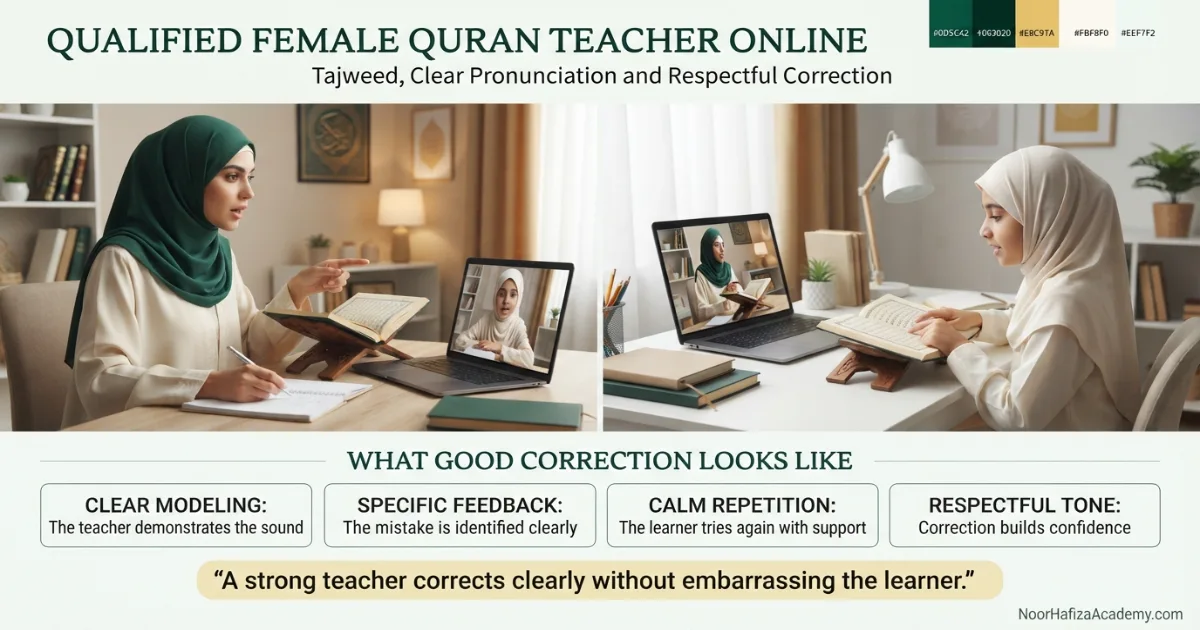
A useful lesson includes enough listening to understand the learner’s pattern, not random interruption after every sound. The teacher then prioritizes one or two important corrections, demonstrates them clearly, and gives the learner another attempt. She may repeat several times, but the goal is gradual independence rather than permanent imitation.
Listen first
The teacher hears enough of the word, phrase, or passage to identify the actual pattern.
Prioritize clearly
She chooses the correction that will make the greatest difference instead of overwhelming the learner.
Model accurately
The learner hears the improved sound or recitation at a pace that can be followed.
Invite another attempt
The teacher gives the learner space to repeat without finishing every word for them.
Check independence
She reduces help and checks whether the skill appears in another example.
Track the pattern
The same issue is reviewed later so that correction becomes lasting improvement.
How to check privacy and safety with a female Quran teacher online
A women-led class should still follow clear professional boundaries. Parents should know who teaches the child, which account and platform are used, when lessons occur, how scheduling messages are handled, and whom to contact at the academy. Adult sisters should know whether lessons are private or group-based, who can join, whether cameras are expected, and whether sessions are recorded.
Lesson links, schedule changes, attendance, homework, progress, and concerns should move through known channels. Children should not be asked to keep messages secret or move to an unapproved private account.
For parents of children
- Verify the teacher through the academy
- Keep the platform and schedule documented
- Remain nearby for young learners
- Keep messages parent-visible
- Ask about recordings and screenshots
- Know the complaint and teacher-change route
For adult sisters
- Confirm whether the class is private or group-based
- Ask who can access the lesson link
- Clarify camera and recording expectations
- Use a neutral background and protected device
- Keep personal information limited to learning needs
- Know how to pause or change the arrangement
Match the female teacher to the right Quran course
Not every capable teacher is equally suited to every course. Parents and sisters should ask about current teaching practice rather than only broad claims. A teacher who regularly teaches Noorani Qaida may be excellent with children but may not offer advanced Ijazah study. A Hifz teacher may be highly organized with revision but may not teach Islamic Studies. Correct matching prevents wasted time and unrealistic expectations.
| Course | What the teacher should demonstrate | Question to ask | Caution sign |
|---|---|---|---|
| Noorani Qaida | Clear letter and sound modeling with recognition checks | How do you prevent guessing and memorizing order? | Only page repetition without recognition |
| Quran Reading | Fluency, joining, vowels, stops, and recurring error correction | How do you track repeated reading mistakes? | Page completion without careful listening |
| Tajweed | Practical rule application and articulation correction | How will you help me hear and produce the difference? | Theory without applied recitation |
| Hifz | New lesson, recent revision, old revision, and retention planning | How do you balance memorization and revision? | New memorization without retention checks |
| Islamic Studies | Defined curriculum, age level, sources, and discussion method | Which topics and materials are included? | No clear syllabus or level |
| Advanced or Ijazah | Course-specific preparation and appropriate authorization | What is the pathway and assessment process? | Vague promises without a defined route |
Do schedule, language, and technology affect teacher suitability?
Yes. A teacher may be excellent but still be the wrong practical match when the class occurs during school preparation, late-night fatigue, work hours, or family responsibilities. Ask about the recurring time in your time zone, punctuality, holidays, rescheduling, and teacher absence. A sustainable plan is more valuable than an ambitious schedule that produces frequent missed lessons.
Language also matters. The teacher does not need to share every cultural background, but instructions and feedback must be understandable. A learner studying Arabic pronunciation may still need explanations in English, Urdu, or another preferred language. During the trial, notice whether questions are understood and whether the teacher can simplify an explanation when needed.
Technology should support recitation. Clear sound is more important than elaborate software. The teacher should use a stable device, suitable microphone placement, correct material, and a camera angle that supports communication. Repeated echo, background conversations, unstable links, or constant device handling can reduce learning time.
How should a female Quran teacher report learning progress?
Progress should be more specific than “good class” or “completed two pages.” Page movement can hide repeated mistakes. Useful feedback identifies the current skill, one improvement, one recurring difficulty, the exact revision task, and the next milestone. Adult sisters can receive this directly; parents should receive enough information to support the child without taking over the lesson.
Define the real level and first priority
The teacher explains what the learner can do independently, what requires support, and why the chosen starting point is appropriate.
Give a manageable revision target
Homework should be clear, realistic, and connected to the lesson rather than an unexplained page count.
Measure accuracy, confidence, and consistency
The teacher reviews whether corrections are retained, whether the pace remains suitable, and which milestone should come next.
How should you compare the cost of a female Quran teacher online?
Price should be compared with lesson frequency, duration, private or group format, teacher specialization, progress support, scheduling flexibility, materials, and policies. A lower monthly fee may include fewer minutes or shared teacher time. A higher fee may include longer private sessions, advanced instruction, or more support. Neither price proves quality by itself.
Ask for the normal recurring fee, not only a first-month promotion. Confirm the number of lessons, minutes per lesson, makeup policy, family discount, payment schedule, pause terms, and whether the quoted teacher is included. Then use the trial to decide whether the teaching evidence supports the cost.
Course fit, active reading time, teacher quality, privacy, communication, reliability, and progress support determine real value—not the headline monthly number alone.
Red flags when choosing an online female Quran teacher
One imperfect moment does not prove a teacher is unsuitable. Internet problems happen, learners can be nervous, and rapport can take time. Look for repeated patterns or serious boundary concerns.
Unclear identity or route
The teacher cannot be verified through the academy or asks the learner to bypass the official enrollment process.
Harsh or humiliating correction
The learner is mocked, threatened, compared, or made afraid to attempt recitation.
No meaningful correction
The teacher moves through pages without listening carefully or only says “again” without explaining the issue.
Unapproved private communication
A child is contacted secretly or asked to move to a private channel without parent awareness.
Pressure around recordings
The recording purpose, access, storage, use, and deletion are not explained clearly.
Repeated unreliability
Lessons regularly start late, change without notice, or are missed without a defined recovery process.
No course plan
The learner cannot identify the current goal, revision task, repeated challenge, or reason for moving forward.
Universal claims
The teacher promises unrealistic speed, guaranteed memorization, or the same method for every learner.
How to judge the teacher match after the first 30 days
A trial provides an initial signal, while several regular lessons show routine, correction, attendance, and progress more accurately. Unless there is a safety or serious teaching concern, review the arrangement after a reasonable period. The expected result is not instant fluency. It is a stable and understandable learning process.
Placement and comfort
The teacher confirms the level, materials, communication route, and predictable lesson structure.
Correction routine
The learner understands how to attempt, listen, repeat, and complete the assigned revision.
Retention and transfer
The teacher checks whether an earlier correction appears in another word, line, or memorized passage.
Review the match
Assess accuracy, comfort, privacy, attendance, communication, revision, and the next realistic goal.
The learner participates, understands correction, follows the routine, and shows observable improvement.
Adjust timing, lesson length, language, revision load, or parent support before changing teachers.
Change may be appropriate when safety, harshness, weak correction, poor privacy, or repeated unreliability remains unresolved.
Female Quran teachers at Noor Hafiza Academy
Noor Hafiza Academy is a women-led online Quran academy offering live learning for children, girls, women, sisters, and beginners with female Quran teachers. Families and adult learners can share age, current level, preferred course, language needs, time zone, schedule, and learning goal before a regular plan is confirmed.
A trial or level check helps the teacher identify the starting point and gives the learner a real lesson to evaluate. Course and teacher matching may consider Noorani Qaida, Quran reading, Tajweed, Hifz, Islamic Studies, revision, or an adult restart pathway. Current teacher availability, qualifications for a specific course, lesson frequency, fees, privacy practices, and enrollment terms should be confirmed directly.
Share the learner’s age or adult status, Quran level, course goal, country or time zone, preferred language, and suitable schedule.
Female Quran teacher online: final selection checklist
Quran knowledge
- Accurate recitation
- Relevant Tajweed knowledge
- Course-specific experience
- Clear modeling
Learner fit
- Child or adult experience
- Suitable explanation language
- Age-aware or adult-aware pacing
- Respectful encouragement
Correction
- Listens before correcting
- Identifies the exact issue
- Models the better version
- Checks independent application
Privacy and safety
- Verified official route
- Approved platform
- Clear recording policy
- Professional boundaries
Reliability
- Known recurring schedule
- Reasonable punctuality
- Clear absence policy
- Stable audio and preparation
Progress support
- Honest level assessment
- Specific revision task
- Useful feedback
- Defined next milestone
Parents can explore Quran classes for kids, review how to choose an online Quran teacher for a child, and use the online Quran safety checklist. Adult sisters can explore online Quran classes for women and online Tajweed classes.
FAQs about choosing a female Quran teacher online
What should I check before choosing a female Quran teacher online?
How can I verify an online female Quran teacher?
Is a female Quran teacher better for girls?
Can adult beginners learn with a female Quran teacher online?
What should happen during a free trial class?
How do I know whether a female Quran teacher is qualified for Tajweed?
Can a female Quran teacher contact my child privately?
Should online Quran lessons for women be recorded?
How long should I test a new female Quran teacher?
Can I request a female Quran teacher at Noor Hafiza Academy?
Meet a female Quran teacher through a live trial class
Share the learner’s age or adult status, current Quran level, preferred course, language needs, country or time zone, and suitable schedule. Noor Hafiza Academy can help arrange a trial so you can evaluate recitation, teaching style, privacy, comfort, and the recommended pathway.