
Meem Sakinah Rules: Ikhfa Shafawi, Idgham and Izhar

Meem Sakinah rules in Tajweed are easier to understand when beginners focus on one simple question: what letter comes immediately after مْ? If Meem Sakinah is followed by Bā’ (ب), the rule is Ikhfa Shafawi and a controlled Ghunnah is used. If it is followed by another Meem (م), the rule is Idgham Shafawi, where the two Meems merge and Ghunnah is heard. If Meem Sakinah is followed by any other Arabic letter, the rule is Izhar Shafawi, where Meem is pronounced clearly without the same extended concealment or merging. This guide explains the three rules, pronunciation, easy recognition, common mistakes, parent checks, and a practical learning plan.
What are the three Meem Sakinah rules?
Meem Sakinah has three main Tajweed rules based on the next letter. Ikhfa Shafawi occurs when مْ is followed by Bā’ (ب); the Meem is concealed with a clear Ghunnah, commonly held for about two counts. Idgham Shafawi occurs when مْ is followed by another Meem (م); the two Meems merge and are read with Ghunnah. Izhar Shafawi occurs when مْ is followed by any other Arabic letter; the Meem is pronounced clearly from the lips without the same held Ghunnah used in Ikhfa or Idgham. Beginners should learn to identify the next letter first, then apply the correct lip position, Ghunnah, and timing.
What is Meem Sakinah?
Meem Sakinah is a Meem (م) carrying Sukoon, written as مْ, meaning it has no short vowel of its own. The way it is pronounced in connected Quran recitation depends on the letter immediately after it. This is why the rule is not determined by the Meem alone.
The beginner should first be able to recognize Meem in isolated and joined forms, understand Sukoon, and know that Meem is articulated using the lips. Ghunnah is naturally related to Meem, but the amount and way it is heard changes according to the Tajweed rule.
Find مْ, look at the next letter, decide the rule, then read it with the correct lip action and Ghunnah.
Ikhfa Shafawi, Idgham Shafawi and Izhar Shafawi
Ikhfa Shafawi
Meem Sakinah before Bā’. The Meem is concealed while Ghunnah remains. Lip control is important because both letters involve the lips.
مْ + بIdgham Shafawi
Meem Sakinah before another Meem. The two Meems merge into a Mushaddad Meem with clear Ghunnah.
مْ + مIzhar Shafawi
Meem Sakinah before the remaining letters. Pronounce Meem clearly from the lips without concealment or merging.
مْ + other letters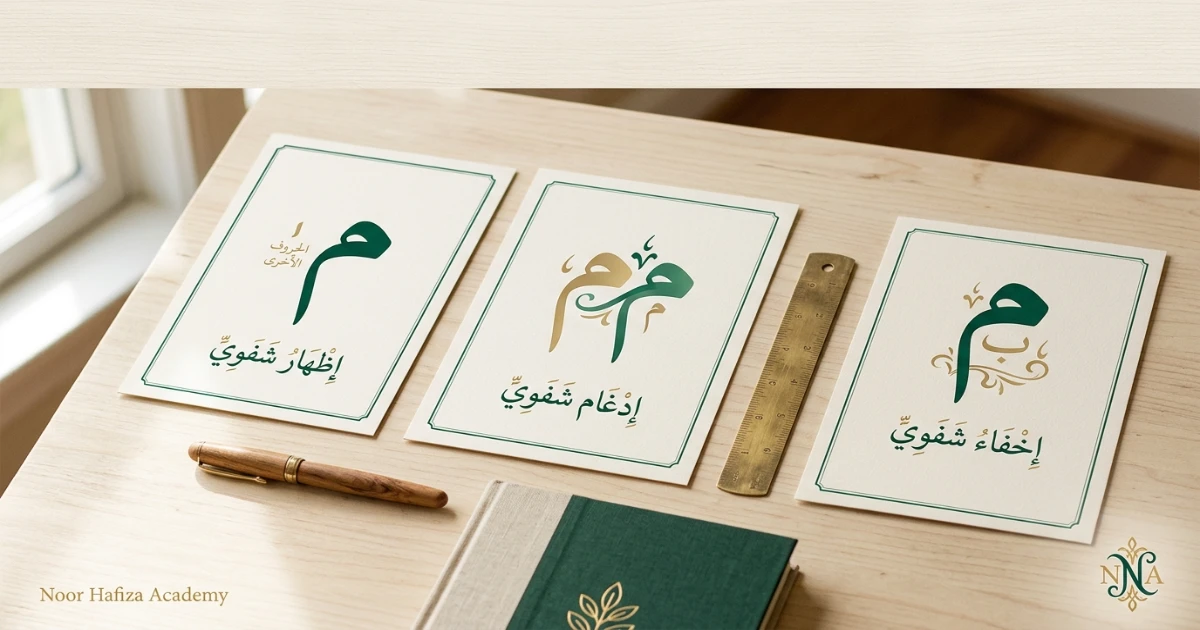
What is Ikhfa Shafawi?
Ikhfa Shafawi occurs when Meem Sakinah is followed by Bā’ (ب). The word “Shafawi” relates to the lips, which is appropriate because both Meem and Bā’ are articulated using the lips. The Meem is concealed rather than pronounced with the full clarity of Izhar, and a controlled Ghunnah is maintained.
In beginner Tajweed classes, the Ghunnah is commonly taught for about two counts. The key is not to convert the Meem into a completely separate syllable. The learner should move smoothly from the concealed Meem toward Bā’ while keeping the nasal resonance controlled.
See Meem Sakinah and immediately check whether the next letter is Bā’.
Keep a concealed Meem quality with Ghunnah before moving into Bā’.
Use an even teacher-guided Ghunnah rather than a long exaggerated hum.
One of the most common mistakes is closing the lips so heavily that the Meem becomes fully clear, making it sound closer to Izhar. Another mistake is leaving the lips too open and losing Meem identity. A qualified teacher helps the learner find the balanced lip position.

What is Idgham Shafawi?
Idgham Shafawi occurs when Meem Sakinah is followed by another Meem. The two Meems merge so that the result is read like a Meem with Shaddah. Because Meem Mushaddadah carries a clear Ghunnah, the nasal sound is commonly held for about two counts.
The beginner should not read the two Meems as two separate stops. The first Meem is absorbed into the second, producing one strengthened Meem sound. This creates smooth recitation and reflects the meaning of Idgham—merging or incorporation.
Two consecutive Meems with the first one sakin indicate Idgham Shafawi.
The two Meems merge into a strengthened Meem with Shaddah-like behavior.
Hold a clear, even nasal resonance without adding a new vowel.
A frequent beginner error is reading the first Meem separately and then restarting the second. Another is merging correctly but making the Ghunnah disappear. The teacher should model the difference between two separate Meems and one merged Mushaddad Meem.

What is Izhar Shafawi?
Izhar Shafawi occurs when Meem Sakinah is followed by any Arabic letter other than Bā’ or Meem. In this rule, the Meem is pronounced clearly from the lips. There is no concealment like Ikhfa and no merging like Idgham.
Beginners sometimes misunderstand “clear” to mean “loud.” Izhar means the Meem should be distinct and complete, not exaggerated. The lips close appropriately for Meem and then move naturally to the next letter.
Pronounce Meem distinctly before moving to Fā’.
Because Wāw also uses the lips, keep Meem clear and do not blur the transition.
All letters other than Bā’ and Meem fall under Izhar Shafawi.
Special care is often recommended before Fā’ (ف) and Wāw (و) because both involve the lips and can make the Meem less clear if the student rushes. The Meem should remain audible without adding a two-count concealment.

How to identify the Meem Sakinah rule in seconds
Look at only one thing: the next letter
Use Ikhfa Shafawi: conceal Meem with controlled Ghunnah.
Use Idgham Shafawi: merge the two Meems with Ghunnah.
Use Izhar Shafawi: pronounce Meem clearly.
This decision structure is ideal for beginners because it reduces memorization. Instead of learning 28 separate cases, the student learns two special letters and one default rule.
How does Ghunnah change across the three rules?
| Rule | Next letter | Meem treatment | Ghunnah |
|---|---|---|---|
| Ikhfa Shafawi | ب | Concealed | Clear, commonly about 2 counts |
| Idgham Shafawi | م | Merged into next Meem | Clear, commonly about 2 counts |
| Izhar Shafawi | All others | Clear | No added held Ghunnah like Ikhfa/Idgham |
Because Ghunnah is naturally associated with Meem, teachers may describe some underlying nasal quality even in clear Meem. The beginner distinction is practical: do not add the same two-count held Ghunnah to Izhar Shafawi that you use for Ikhfa or Idgham.
How should the lips work in Meem Sakinah rules?
Meem is a lip letter, so lip control is central. The lips come together for Meem, but the transition to the next letter changes according to the rule.
Ikhfa
Keep the Meem concealed and controlled before Bā’. Avoid an overly hard closure that turns it into full Izhar.
Idgham
The first Meem merges into the second, so the lips support one strengthened Meem rather than two separate stops.
Izhar
Close for Meem clearly, then move cleanly to the next letter without hiding or merging the sound.
Common Meem Sakinah mistakes beginners make
Using Ikhfa before every lip letter
Only Bā’ triggers Ikhfa Shafawi. Wāw and Fā’ still belong to Izhar Shafawi.
Making Ikhfa too clear
The Meem is fully pronounced as Izhar instead of being concealed before Bā’.
Making Ikhfa disappear
The learner rushes into Bā’ and loses the Meem/Ghunnah quality entirely.
Separating the two Meems
Idgham becomes two independent Meem sounds instead of one merged Mushaddad Meem.
Weak Ghunnah in Idgham
The merge occurs, but the nasal resonance is too short to hear clearly.
Adding two-count Ghunnah to Izhar
The student holds every Meem Sakinah instead of keeping Izhar clear and direct.
Blurring Meem before Wāw or Fā’
The next lip-related letter causes the Meem to lose clarity.
Memorizing examples only
The learner knows sample words but cannot determine the rule in an unfamiliar Quran passage.
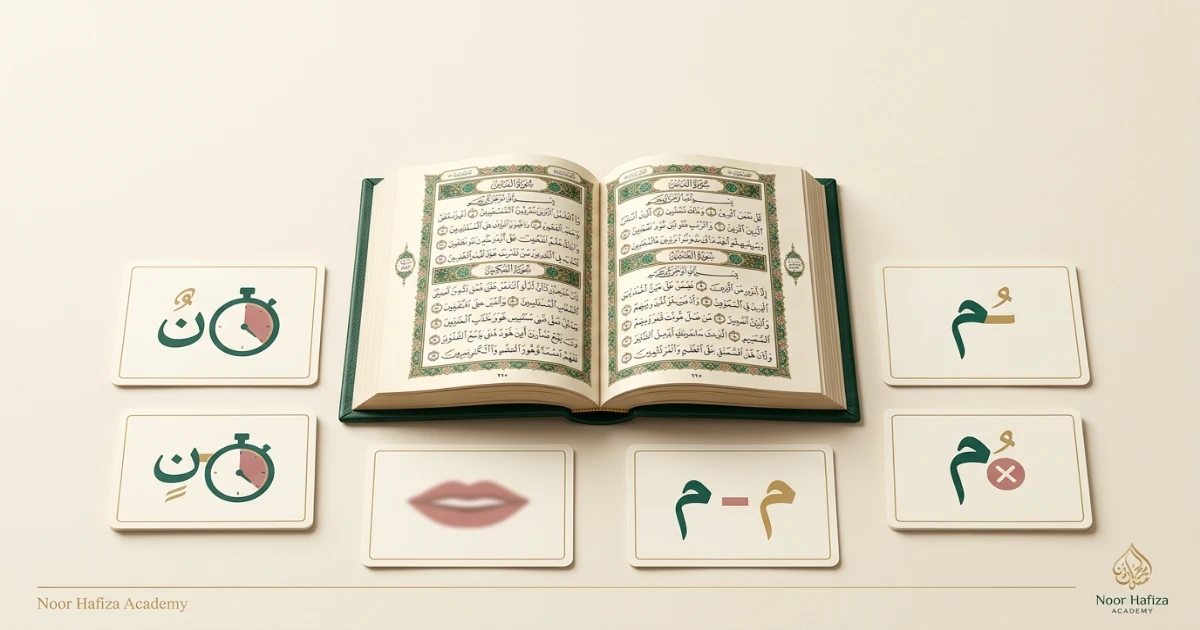
Easy Meem Sakinah practice tips for beginners
Find the Meem Sakinah
Scan the line for مْ before trying to name the rule.
Look at the next letter
Ask: Bā’, Meem, or something else?
Say the rule aloud
Name Ikhfa, Idgham, or Izhar before reciting so the logic becomes automatic.
Practise the lip movement
Use teacher feedback to prevent overclosure, underclosure, or blurred transitions.
Control the Ghunnah
Hold Ikhfa and Idgham evenly; do not give Izhar the same sustained hold.
Transfer to Quran reading
Find all three rules in unfamiliar passages without stopping before every example.

A simple 30-day Meem Sakinah learning plan
| Week | Main focus | Home practice | Teacher checkpoint |
|---|---|---|---|
| Week 1 | Rule recognition | Find مْ and classify Bā’, Meem, or other | Check fast identification |
| Week 2 | Ikhfa Shafawi | Short مْ + ب examples with controlled Ghunnah | Check lip balance and two-count timing |
| Week 3 | Idgham and Izhar | Compare merged Meem with clear Meem examples | Check merging, clarity, and Ghunnah contrast |
| Week 4 | Mixed Quran reading | Mark all three rules in a short passage and recite continuously | Check transfer and natural flow |
What parents should notice when a child learns Meem Sakinah
Simple parent checklist
- Can the child recognize Meem Sakinah?
- Does the child look at the next letter before choosing the rule?
- Can the child remember Bā’ for Ikhfa?
- Can the child remember Meem for Idgham?
- Is Ghunnah clearly heard in Ikhfa and Idgham?
- Is Izhar Meem clear without an unnecessary two-count hold?
- Does the child keep Meem clear before Wāw and Fā’?
- Can the child identify the rule in a fresh Quran example?
Questions to ask a Tajweed teacher about Meem Sakinah
Use these during a trial or Tajweed lesson
- How do you teach the difference between Ikhfa Shafawi, Idgham Shafawi, and Izhar Shafawi?
- How do you explain the lip position for Ikhfa Shafawi?
- How long do you teach the Ghunnah in Ikhfa and Idgham?
- How do you prevent students from overclosing the lips before Bā’?
- How do you teach the merge in Idgham Shafawi?
- How do you distinguish Idgham Shafawi from ordinary Meem with Shaddah?
- How do you teach clear Meem before Wāw and Fā’?
- Do you use unfamiliar Quran examples to test rule recognition?
- How do you correct overholding Ghunnah in Izhar?
- How much home practice should a beginner do?
- How do you track whether the learner can apply the rule without prompts?
- When do you introduce more advanced Noon and Meem rules?
Online Tajweed classes for Meem Sakinah rules
Noor Hafiza Academy offers live online Quran learning for girls, women, children, adults, new Muslims, complete beginners, and returning readers with female Quran teachers. A Tajweed assessment can review Arabic letters, Harkaat, Sukoon, Shaddah, Qalqalah, Ghunnah, Madd, Meem Sakinah, Noon Sakinah, Tanween, Makharij, stopping, and current Quran reading level.
A suitable beginner plan may include Noorani Qaida, Quran reading, Tajweed foundations, Meem Sakinah rules, Ghunnah timing, lip articulation, Noon and Tanween rules, and controlled fluency. Current teacher qualifications, availability, schedules, trial arrangements, fees, privacy practices, policies, and enrollment terms should be confirmed directly.
Share the learner’s age, current Quran level, Tajweed experience, time zone, schedule, and whether the main difficulty is Ikhfa Shafawi, Idgham Shafawi, Izhar Shafawi, Ghunnah, or lip control.
FAQs about Meem Sakinah rules
What are the three Meem Sakinah rules?
When does Ikhfa Shafawi occur?
When does Idgham Shafawi occur?
When does Izhar Shafawi occur?
How many letters trigger Ikhfa Shafawi?
How many letters trigger Idgham Shafawi?
How many letters trigger Izhar Shafawi?
Does Ikhfa Shafawi have Ghunnah?
Does Idgham Shafawi have Ghunnah?
Does Izhar Shafawi have two-count Ghunnah?
Why are Wāw and Fā’ important in Izhar Shafawi?
How should beginners practise Meem Sakinah rules?
Master Meem Sakinah with one simple decision rule and build clearer Tajweed
Share the learner’s age, current Quran level, Tajweed experience, time zone, schedule, and whether the main challenge is Ikhfa Shafawi, Idgham Shafawi, Izhar Shafawi, Ghunnah, or lip articulation.