
Noon and Meem Mushaddad Rules in Tajweed
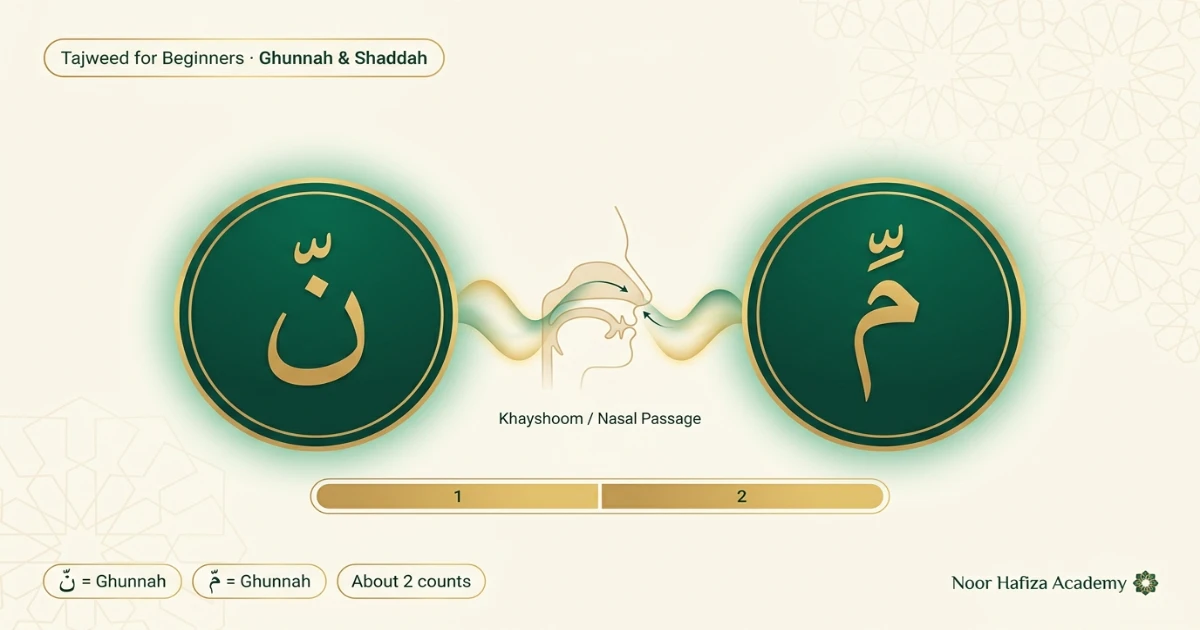
The Noon and Meem Mushaddad rules in Tajweed are among the easiest rules to identify visually and among the most important to pronounce correctly. When Noon (ن) or Meem (م) carries a Shaddah, written as نّ or مّ, the reader produces a clear Ghunnah—a nasal sound that resonates through the nasal passage. In common beginner teaching, this Ghunnah is held for about two counts. The sound should be present and controlled: not rushed until it disappears, and not stretched so long that it becomes exaggerated. The rule applies whenever the recited Noon or Meem is Mushaddad, whether the Shaddah is part of the word’s written form or arises through another Tajweed process. This guide explains the rule, the meaning of Ghunnah, how Shaddah works, Quran examples, timing, pronunciation, differences from Sakin Noon and Meem rules, and a practical method for building a reliable two-count habit.
What is the rule for Noon and Meem Mushaddad?
Whenever Noon or Meem has a Shaddah—نّ or مّ—pronounce the letter with a clear nasal Ghunnah. In common beginner Tajweed teaching, the Ghunnah is held for approximately two counts. Keep the letter’s normal articulation while allowing the nasal resonance to remain audible. Do not read the Shaddah as a single light consonant, and do not turn the Ghunnah into an excessively long hum. The rule is the same whether the Mushaddad Noon or Meem appears near the beginning, middle, or end of a word.
What does Shaddah mean on Noon or Meem?
A Shaddah indicates that a consonant is doubled. In simple beginner terms, a Mushaddad letter combines a first consonant that is Sakin with a second consonant that carries the visible vowel. That is why the letter has more weight and duration than a normal single consonant.
When the doubled letter is Noon or Meem, Tajweed adds an important sound quality: Ghunnah. The reader does not merely “hold the letter”; the hold has a clear nasal resonance.
The first visual habit for beginners is simple: whenever you spot نّ or مّ, prepare for a controlled nasal sound.
What is Ghunnah?
Ghunnah is the nasal sound associated especially with Noon and Meem. Traditional Tajweed teaching connects its resonance to the Khayshoom, the nasal passage.
You can notice this quality by gently closing the nose while sustaining a correctly produced Mushaddad Noon or Meem: the sound is affected because the nasal passage is an essential part of the resonance. This is a useful demonstration, but normal recitation should be relaxed and natural.
Noon Mushaddad
Pronounce the doubled Noon with a clear nasal Ghunnah, keeping the tongue placement for Noon accurate.
Meem Mushaddad
Pronounce the doubled Meem with Ghunnah while keeping the two lips properly closed for Meem.
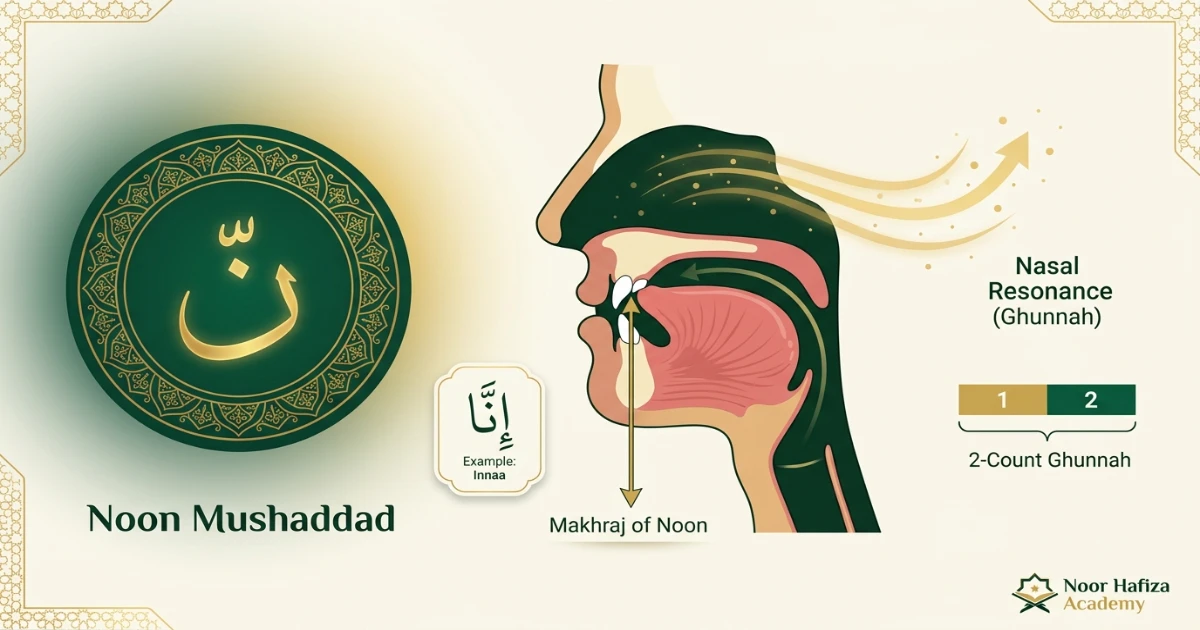
How do you pronounce Noon Mushaddad?
With Noon Mushaddad (نّ), keep the normal articulation of Noon while allowing the Ghunnah to remain clear for about two counts. The tongue contacts the area associated with Noon, while the nasal passage carries the characteristic resonance.
Do not turn Noon Mushaddad into a long vowel or a vague humming sound. The listener should still hear that the consonant is Noon.
Spot the doubled Noon before trying to read the word quickly.
Keep the tongue in the correct position for Noon.
Maintain the nasal sound for approximately two balanced counts.
How do you pronounce Meem Mushaddad?
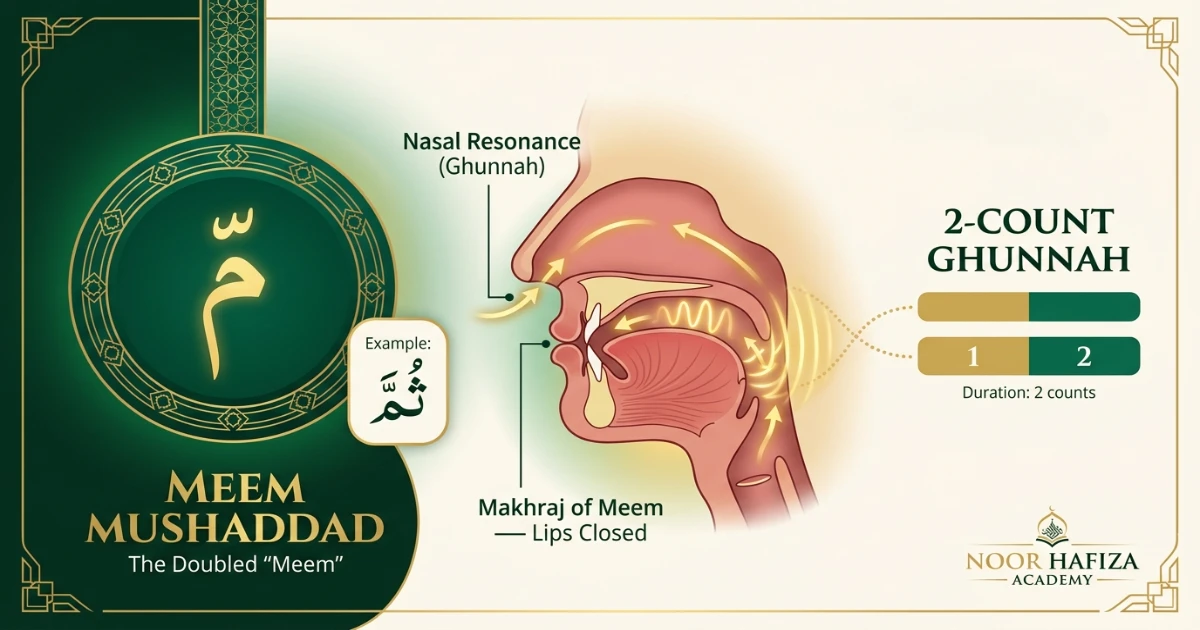
With Meem Mushaddad (مّ), the two lips close for Meem while the nasal Ghunnah is sustained. The Ghunnah again receives about two counts in common beginner teaching.
The lips should remain natural. Do not press them together so strongly that the sound becomes tense, and do not open them too early or the Meem will lose clarity.
Use the normal Meem articulation without excessive pressure.
Let the Ghunnah remain audible through the Khayshoom.
After the two-count hold, move smoothly into the vowel carried by the Mushaddad Meem.
How long should the Ghunnah be?
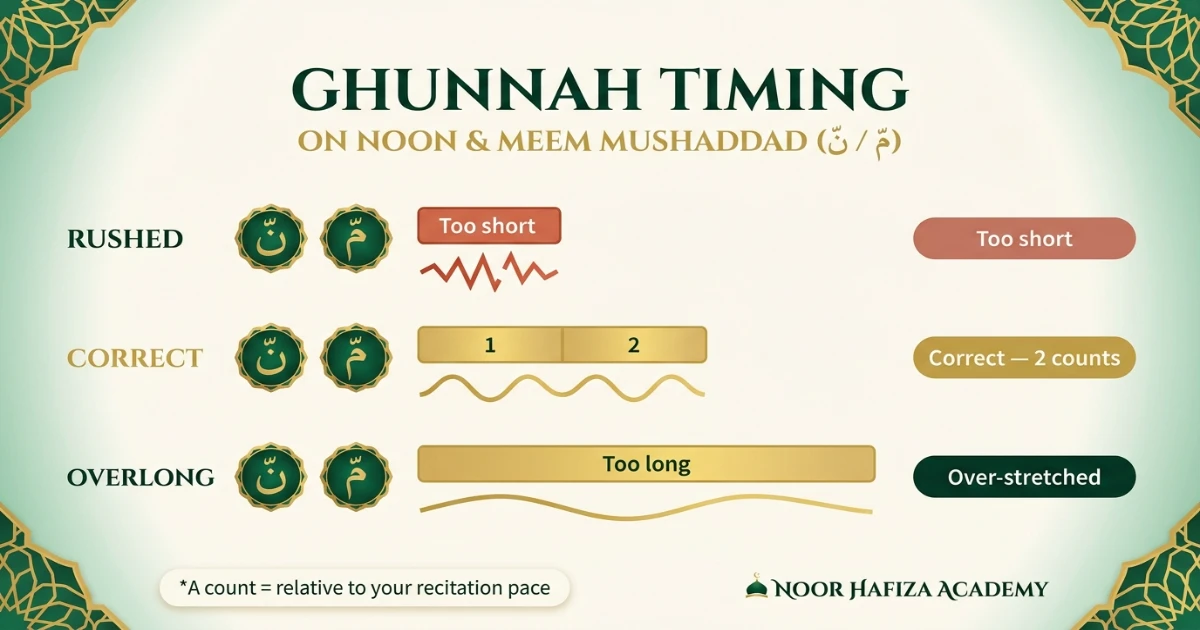
The Ghunnah of Noon and Meem Mushaddad is commonly taught as approximately two counts. A count is a relative recitation unit, not an exact number of clock seconds. The goal is consistency within the reader’s pace.
If your recitation is slow, the two counts will naturally take a little longer than in faster recitation. What matters is proportion. Do not make the Ghunnah so short that it disappears and do not make it so long that it sounds like an additional Madd.
First count
The Ghunnah is already present as the Mushaddad Noon or Meem is established.
Second count
Maintain the nasal resonance evenly, then move naturally into the next sound.
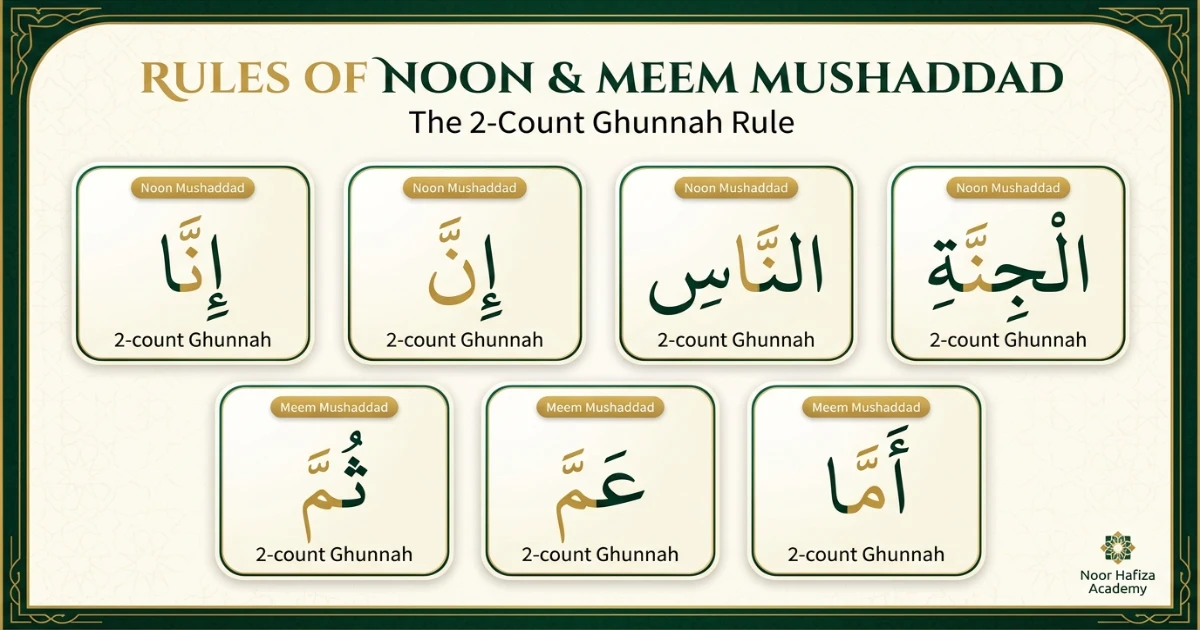
Quran examples of Noon and Meem Mushaddad
The rule becomes easy when students learn to spot the Shaddah first. The following examples are useful for practising the sound in familiar Quranic words and phrases.
| Example | Letter | Rule | Practice focus |
|---|---|---|---|
| إِنَّا | نّ | Noon Mushaddad | Clear two-count Ghunnah |
| إِنَّ | نّ | Noon Mushaddad | Do not rush the doubled Noon |
| النَّاسِ | نّ | Noon Mushaddad | Ghunnah remains after Lam assimilation |
| الْجِنَّةِ | نّ | Noon Mushaddad | Keep Noon clear and nasal |
| ثُمَّ | مّ | Meem Mushaddad | Closed lips plus Ghunnah |
| عَمَّ | مّ | Meem Mushaddad | Balanced two-count nasal hold |
| أَمَّا | مّ | Meem Mushaddad | Release smoothly into the following vowel |
Is the Ghunnah of Noon and Meem Mushaddad especially strong?
Many Tajweed curricula describe the Ghunnah of Mushaddad Noon and Meem as one of the strongest or most complete levels of Ghunnah because the nasal quality is fully present and clearly timed.
The exact terminology used for “levels of Ghunnah” can vary between teaching systems. For a beginner, the practical point is enough: نّ and مّ require an unmistakable Ghunnah. It should be more obvious than the natural nasal quality present in an ordinary Noon or Meem.
How is Mushaddad Noon/Meem different from Sakin Noon/Meem?
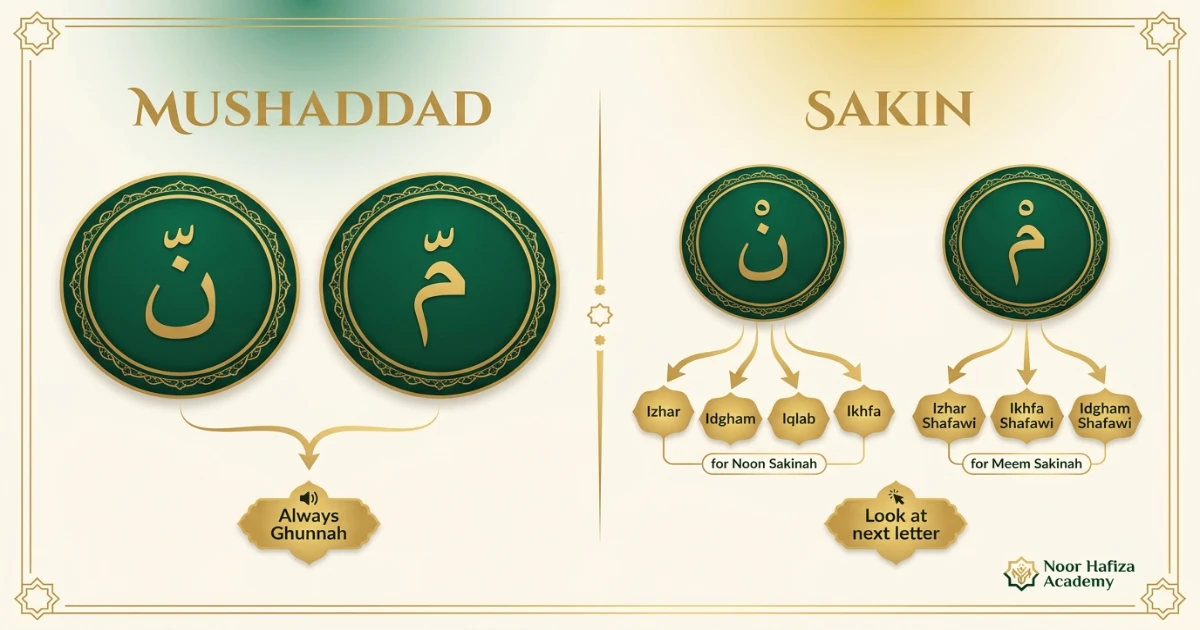
A Shaddah gives you a direct rule: if you see نّ or مّ, produce Ghunnah. Sakin Noon and Sakin Meem are different because their rule depends on what letter comes next.
| Form | What decides the rule? | Possible treatment | Beginner takeaway |
|---|---|---|---|
| نّ | Shaddah itself | Clear Ghunnah | Always hold the nasal sound |
| مّ | Shaddah itself | Clear Ghunnah | Always hold the nasal sound |
| نْ | Next letter | Izhar, Idgham, Iqlab, or Ikhfa | Look ahead |
| مْ | Next letter | Izhar Shafawi, Ikhfa Shafawi, or Idgham Shafawi | Look ahead |
Does the rule still apply if Shaddah appears because of Idgham?
Yes, whenever the recited result is a Mushaddad Noon or Meem, the Ghunnah of that doubled letter must be heard according to the applicable Tajweed rule. For example, some Idgham situations produce a doubled Noon or Meem sound, and the resulting Ghunnah is essential.
For beginners, this means you do not need to ask whether the Shaddah was “original” before deciding whether to make Ghunnah. First read the Mushaddad Noon or Meem correctly. Later, as you study Idgham in more detail, you can learn why the Shaddah appears.
What happens if you stop on Noon or Meem Mushaddad?
If a word is stopped upon while its final pronounced letter is a Mushaddad Noon or Meem, the Shaddah remains part of the consonant and the Ghunnah should not simply disappear. The ending vowel may be dropped because of Waqf, but the doubled character of the consonant remains.
Because stopping cases can vary with the exact word and recitation context, beginners should practise specific examples with a teacher rather than guessing from spelling alone.
Common Noon and Meem Mushaddad mistakes
Rushing the Ghunnah
The student sees Shaddah but moves on so quickly that the nasal sound becomes almost inaudible.
Holding too long
The two-count Ghunnah turns into an exaggerated hum that disrupts recitation rhythm.
Holding only the vowel
The student lengthens the Fathah, Kasrah, or Dammah after the letter instead of sustaining the consonantal Ghunnah.
Losing Noon articulation
The nasal sound is present, but the consonant stops sounding like a proper Noon.
Opening the lips during Meem
Meem Mushaddad loses clarity because the lips release too early.
Squeezing the nose
Ghunnah should resonate naturally; it should not be forced by facial tension.
Counting too mechanically
The reader pauses unnaturally to count instead of keeping the Ghunnah integrated into the word.
Missing Shaddah in fast reading
The learner reads the letter as single because visual recognition has not become automatic.
How to apply the rule in seconds
Find a doubled consonant in the word.
If it is نّ or مّ, prepare a Ghunnah.
Use the correct articulation for Noon or Meem.
Maintain Ghunnah for about two balanced counts.
Move into the vowel or next sound without a separate pause.
Match the two counts to the speed of your recitation.
A 10-minute practice routine for Noon and Meem Mushaddad
| Minutes | Activity | What to practise | Goal |
|---|---|---|---|
| 2 | Visual scan | Find every نّ and مّ in a short passage | Fast Shaddah recognition |
| 2 | Noon drill | Repeat إِنَّا, إِنَّ, النَّاس | Stable Noon Ghunnah |
| 2 | Meem drill | Repeat ثُمَّ, عَمَّ, أَمَّا | Stable lip closure + Ghunnah |
| 2 | Timing check | Compare rushed, correct, and overlong versions | Hear balanced two counts |
| 2 | Fresh recitation | Read a new passage without marking the rules first | Automatic application |
Why teacher feedback matters
A learner can often identify نّ and مّ correctly before they can hear whether their Ghunnah is balanced. The most common sound problems—too short, too long, too tense, or unclear in articulation—are easier for another trained listener to notice.
A teacher can also compare the two letters directly. Noon Mushaddad keeps Noon articulation while Meem Mushaddad requires closed lips, yet both share the nasal Ghunnah. Hearing and repeating that contrast is more useful than treating Ghunnah as a generic “nose sound.”
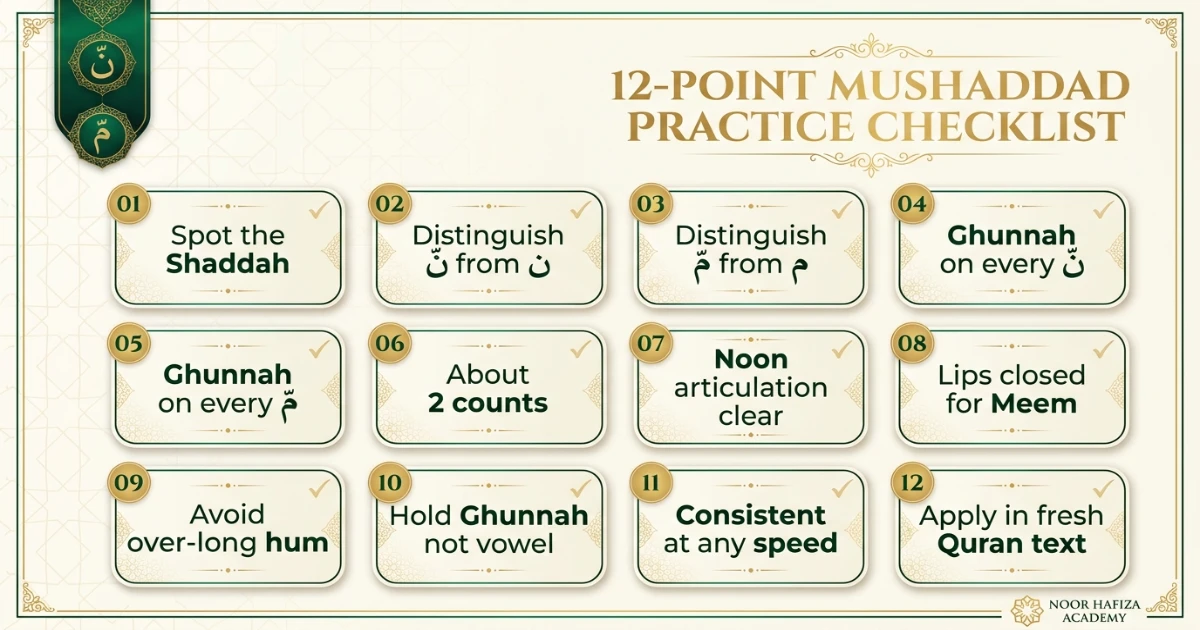
12-point Noon and Meem Mushaddad checklist
Use this while reading a fresh Quran passage
- Can I spot Shaddah quickly?
- Can I distinguish نّ from a normal ن?
- Can I distinguish مّ from a normal م?
- Am I producing clear Ghunnah on every Noon Mushaddad?
- Am I producing clear Ghunnah on every Meem Mushaddad?
- Is my Ghunnah approximately two balanced counts?
- Am I keeping Noon articulation clear during the nasal sound?
- Am I keeping my lips closed correctly for Meem?
- Am I avoiding an excessively long hum?
- Am I holding the consonantal Ghunnah rather than stretching the vowel?
- Can I keep the timing consistent at different recitation speeds?
- Can I apply the rule in fresh Quran text without stopping to name it?
Learn Noon and Meem Mushaddad in online Tajweed lessons
Noor Hafiza Academy offers live online Quran learning for children, girls, women, adults, beginners, returning readers, teenagers, siblings, and homeschool families with female Quran teachers. Learners can ask about Noorani Qaida, Quran reading, Tajweed, Makharij, Ghunnah, Hifz, and pronunciation correction according to their current level.
A beginner Tajweed plan may include Noon and Meem Mushaddad, Ghunnah, Noon Sakinah and Tanween, Meem Sakinah, Idgham, Ikhfa, Iqlab, Izhar, Qalqalah, Madd, Waqf, and guided recitation practice. Current teacher qualifications, female-teacher availability, class length, trial arrangements, fees, schedules, privacy practices, safeguarding policies, and enrollment terms should be confirmed directly.
Share the learner’s age, Quran level, Tajweed background, main pronunciation difficulty, preferred schedule, and whether a female teacher is requested.
FAQs about Noon and Meem Mushaddad rules
What is the rule of Noon Mushaddad?
What is the rule of Meem Mushaddad?
What does Mushaddad mean?
What is Ghunnah?
How long is the Ghunnah on Noon and Meem Mushaddad?
Is every Noon with Shaddah read with Ghunnah?
Is every Meem with Shaddah read with Ghunnah?
Is Mushaddad Ghunnah the same as Ikhfa?
Is Meem Mushaddad the same as Ikhfa Shafawi?
Where does the Ghunnah sound come from?
What is a common mistake with Mushaddad Ghunnah?
How should beginners practise Noon and Meem Mushaddad?
Master Noon and Meem Mushaddad by hearing a clear two-count Ghunnah and keeping the letter articulation accurate
Share the learner’s age, Quran level, Tajweed background, main pronunciation difficulty, and preferred class schedule.