Hafiza vs Qaria vs Tajweed Teacher: What Do the Titles Mean?
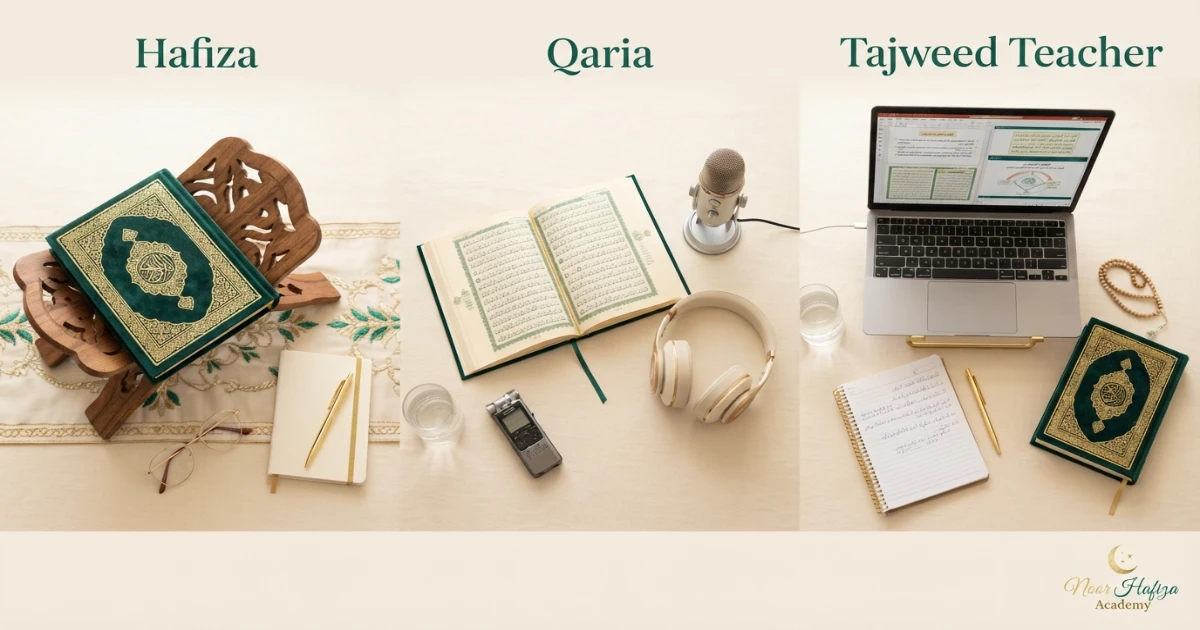
The titles Hafiza, Qaria, and Tajweed teacher are often used when families search for a female Quran teacher, but the words describe different strengths. A Hafiza is generally a woman who has memorized the entire Quran. A Qaria is the feminine form of Qari and usually refers to a woman known for Quran recitation or skilled reading. A Tajweed teacher is a functional teaching role: someone who teaches correct pronunciation, Makharij, Madd, Ghunnah, Qalqalah, Noon and Meem rules, Waqf, and other recitation principles according to the student’s level. One person may hold all three descriptions, but none automatically proves the others. A Hafiza may be an excellent memorizer without being an experienced Tajweed teacher; a Qaria may recite beautifully without being a Hifz instructor; and a Tajweed teacher may teach accurately without having memorized the entire Quran. Because these titles are not used identically in every country, institution, or community, families should ask about actual training, recitation accuracy, teaching experience, Ijazah where relevant, and suitability for the learner.
What is the difference between a Hafiza, Qaria, and Tajweed teacher?
A Hafiza generally means a woman who has memorized the entire Quran. A Qaria generally means a female Quran reciter or reader, often someone recognized for accurate or skilled recitation. A Tajweed teacher is a person who teaches how to recite correctly, including pronunciation and rules. These titles can overlap, but they are not interchangeable. A Hafiza is not automatically a Tajweed teacher, a Qaria is not automatically a Hafiza, and a Tajweed teacher does not necessarily have the entire Quran memorized. For choosing a teacher, ask about actual recitation level, Tajweed study, Ijazah if relevant, teaching experience, child or adult pedagogy, and the learner’s specific goal.
Hafiza, Qaria, and Tajweed teacher at a glance
Hafiza
Usually a woman who has memorized the complete Quran. The title speaks primarily to memorization, not automatically to teaching experience or advanced Tajweed credentials.
Qaria
A female Quran reciter or reader. In many communities the title suggests strong recitation ability, though the exact standard behind the title can vary.
Tajweed teacher
A teacher who instructs students in correct Quran recitation, pronunciation, Makharij, rules, practice, and error correction.
When hiring or enrolling, ask what the teacher can actually demonstrate and teach rather than relying on a title alone.
What is a Hafiza?
Hafiza is commonly used as the feminine form of Hafiz in Quran-learning contexts. It generally refers to a woman who has memorized the entire Quran. She may have completed Hifz as a child, teenager, or adult and may continue a regular revision system to keep memorization strong.
The title tells you something important: the woman has achieved a major memorization milestone. It does not, by itself, tell you how strong her current revision is, whether she has an Ijazah, whether her Tajweed is advanced, or whether she has experience teaching beginners, children, adults, or Hifz students.
The full Quran has generally been memorized.
She may understand Sabaq, Sabqi, Manzil, revision, and retention methods.
Memorization and recitation precision should be evaluated separately.
Knowing the Quran by heart and teaching a beginner are different competencies.
What is a Qaria?
Qaria is commonly used as the feminine form of Qari. At its basic linguistic level, it refers to a female reader or reciter. In Quran education, many people use the title for a woman who recites the Quran skillfully or has studied recitation seriously.
However, “Qaria” is not a single globally standardized certification. In one institution it may be used after formal recitation study; in another community it may simply be an honorific for a skilled reciter. That is why parents should ask what stands behind the title.
The person is known as a female reader or reciter.
Many Qarias have studied pronunciation and recitation rules in depth.
A Qaria may or may not have memorized the full Quran.
A skilled reciter still needs teaching skill to explain errors effectively.
What is a Tajweed teacher?
A Tajweed teacher teaches students how to recite the Quran correctly. Unlike Hafiza and Qaria, which are often used as titles, “Tajweed teacher” describes a role and function.
A strong Tajweed teacher should be able to hear errors, identify their cause, demonstrate a correction, explain the rule at the right level, and help the student transfer that correction into Quran reading.
Helps students distinguish sounds such as ق/ك, ص/س, ض/د, and ح/ه where needed.
Teaches Ghunnah, Qalqalah, Madd, Noon Sakinah, Meem Sakinah, and other rules.
Guides students on appropriate stopping, restarting, breath, and meaning.
Identifies repeated mistakes and gives practical drills instead of only naming rules.
A Tajweed teacher may also be a Hafiza, Qaria, and Ijazah holder—but those are additional qualities that should be confirmed rather than assumed.
Hafiza vs Qaria vs Tajweed Teacher: side-by-side comparison
| Title / role | Main meaning | Usually strong in | Does not automatically prove |
|---|---|---|---|
| Hafiza | Woman who has memorized the Quran | Hifz, recall, revision experience | Advanced Tajweed or teaching skill |
| Qaria | Female Quran reader / reciter | Recitation and often pronunciation | Complete Hifz or pedagogy |
| Tajweed teacher | Teaches correct Quran recitation | Rules, Makharij, correction | Complete Hifz or Ijazah |
| Ijazah holder | Has a recognized chain/authorization in a defined recitation scope | Verified transmission within that scope | Child pedagogy or suitability for every learner |
Can a Quran teacher be a Hafiza, Qaria, and Tajweed teacher at the same time?
Yes. A female Quran teacher may have memorized the entire Quran, studied recitation deeply, completed Tajweed training, received an Ijazah in a particular recitation path, and developed years of teaching experience. In that case, several titles can accurately describe different parts of her background.
But the overlap should not be assumed. Families should verify each relevant strength. If the goal is Hifz, ask how the teacher manages new memorization and revision. If the goal is Tajweed, listen to her recitation and ask about formal study. If the learner is a five-year-old beginner, ask about teaching children—not only recitation credentials.
Is an Ijazah the same as being a Hafiza or Qaria?
No. An Ijazah is a separate credential. In Quran recitation, it generally refers to authorization or attestation from a qualified teacher within a defined recitation or transmission scope, often connected through a chain of teachers.
A person may be a Hafiza without an Ijazah. A Qaria may or may not hold an Ijazah. A Tajweed teacher may teach accurately without holding one, depending on the institution, level taught, and her training. For advanced recitation study, an Ijazah can be a valuable indicator, but it is not the only thing parents should evaluate.
Ask what the Ijazah covers rather than treating the word as a universal teaching license for every level, age, or curriculum.

Which title matters most for your learning goal?
| Your goal | Look for | Why | Also verify |
|---|---|---|---|
| Complete beginner | Beginner Quran teacher | Needs patient letter and Qaida instruction | Clear pronunciation + pedagogy |
| Improve Tajweed | Strong Tajweed teacher / Qaria | Needs precise recitation correction | Training, Ijazah if relevant, teaching clarity |
| Memorize Quran | Experienced Hafiza / Hifz teacher | Understands memorization and revision structure | Tajweed and Hifz coaching skill |
| Teen / child learning | Age-appropriate Quran teacher | Pedagogy and motivation matter | Recitation accuracy and boundaries |
| Advanced recitation | Qualified recitation teacher | May require deeper transmission study | Specific Ijazah / Qira’at scope |
What should parents check beyond the teacher’s title?
Can the teacher model correct Quran reading consistently?
Can she explain and correct without overwhelming the learner?
Does she know how to teach young children, teens, adults, or new Muslims?
Does she track repeated errors, Hifz revision, and learning goals?
A teacher with impressive titles but poor communication may not be the best fit for a nervous beginner. A teacher with excellent pedagogy but weak recitation accuracy is also not the right choice. Families should look for the combination needed by the actual student.
Common mistakes when interpreting Quran teacher titles
Assuming every Hafiza teaches Hifz well
Personal memorization success does not automatically equal coaching skill.
Assuming every Qaria is a Hafiza
Strong recitation and complete memorization are separate achievements.
Assuming a Tajweed teacher has full Hifz
A teacher may specialize in recitation correction without having memorized the entire Quran.
Treating Ijazah as a universal certificate
Its scope matters, and teaching children requires additional skills.
Choosing by title alone
The student’s goal, level, age, and personality still matter.
Ignoring current recitation
A historic qualification should not replace listening to how the teacher actually reads now.
Ignoring teaching experience
Knowing a rule and explaining it to a beginner are different abilities.
Assuming titles mean the same everywhere
Usage can vary between countries, academies, and communities.
Questions to ask a female Quran teacher about qualifications
Ask these before enrolling
- Are you a Hafiza, and how do you maintain your Quran revision?
- What does the title Qaria mean in your training background?
- What Tajweed study have you completed?
- Do you hold an Ijazah? If yes, in what recitation or scope?
- How many years have you taught Quran?
- Do you teach complete beginners or mainly advanced readers?
- What age groups do you teach most often?
- How do you correct Makharij and repeated pronunciation errors?
- How do you structure Hifz revision for students?
- How do you track student progress?
- Can we hear a short recitation sample or use a trial class?
- What course would you recommend for this learner’s current level?
Choosing the right female Quran teacher at Noor Hafiza Academy
Noor Hafiza Academy offers live online Quran learning for girls, women, children, adults, new Muslims, teenagers, siblings, and homeschool families with female Quran teachers. Depending on the student’s needs, families may look for support with Noorani Qaida, Quran reading, Tajweed, Hifz, or Islamic Studies.
Rather than selecting a teacher by title alone, families should match the teacher’s strengths to the learner’s actual goal. Current teacher qualifications, Hifz background, Tajweed training, Ijazah details, teaching experience, age specialization, schedules, trials, fees, privacy practices, safeguarding policies, and enrollment terms should be confirmed directly.
Share the learner’s age, current Quran level, main goal, previous experience, preferred schedule, and whether the priority is Qaida, recitation, Tajweed, Hifz, or advanced study.
FAQs about Hafiza, Qaria, and Tajweed teacher titles
What does Hafiza mean?
What does Qaria mean?
What does a Tajweed teacher do?
Is every Hafiza also a Qaria?
Is every Qaria a Hafiza?
Does a Tajweed teacher have to be a Hafiza?
Can one woman be a Hafiza, Qaria, and Tajweed teacher?
Is Ijazah the same as being a Qaria?
Does an Ijazah automatically make someone a good teacher?
Which teacher is best for Hifz?
Which teacher is best for Tajweed?
Which title should parents prioritize?
Look beyond titles and choose a Quran teacher whose strengths match the learner’s real goal
Share the learner’s age, Quran level, learning goal, previous experience, preferred schedule, and whether the priority is Qaida, recitation, Tajweed, Hifz, or advanced study.