
How to Restart Quran Reading After Years Away

Restarting Quran reading after years away can feel harder emotionally than academically. Many returning learners still recognize letters, familiar Surahs, or common word patterns, but they may read slowly, confuse similar letters, forget Harkaat rules, hesitate at joined forms, or feel embarrassed about mistakes they did not make before. The best way back is usually not to force yourself through long pages or assume you must begin from zero. Start with a short assessment of what you still know. Strengthen the exact skills that have become weak, then build toward accurate Quran reading, better Makharij, basic Tajweed, smoother phrasing, and confidence. A ten- to fifteen-minute daily routine can be more effective than an occasional long session, especially when a qualified Quran teacher helps identify repeated errors early.
How do you start reading the Quran again after a long break?
Start by checking what you still remember instead of automatically beginning from the alphabet. Read a short unfamiliar passage slowly. Notice whether the problem is letter recognition, joined forms, Harkaat, Sukoon, Shaddah, pronunciation, Tajweed, or fluency. Review only the weak areas, then practise Quran reading for about 10–15 minutes on most days. Read slowly enough to be accurate, listen to a reliable recitation after your own attempt, and repeat difficult words. If you keep making the same errors or are unsure where to restart, use a teacher assessment. A returning learner often improves faster when the plan is targeted rather than starting every beginner lesson again.
Step 1: assess what you still remember
After a long gap, memory is often uneven. You may remember Al-Fatihah and short Surahs fluently because you recite them regularly, yet struggle with an unfamiliar Quran page. Familiar recitation can therefore make your reading ability look stronger than it really is.
Use a fresh passage as a diagnostic tool. Read only a few lines and resist the urge to listen first. If you can recognize letters but hesitate inside words, joining may be weak. If you can decode words but pronounce several letters inaccurately, your main need may be Makharij correction. If the words are accurate but the recitation is broken into tiny pieces, fluency may be the next priority.
Read an unfamiliar passage
Choose a short section you have not memorized and read it slowly without audio first.
Notice hesitation
Mark where you stop, guess, repeat, or confuse letters and vowel signs.
Listen afterward
Compare your attempt with a trusted recitation to identify obvious pronunciation differences.
Record the weak area
Decide whether the main issue is decoding, pronunciation, Tajweed, or fluency.

You may not need to relearn everything
Many returning readers assume that because they are slow, they should restart from the first Arabic letter. Sometimes that is appropriate, but often it wastes motivation and repeats material that is still secure. The goal is to find the earliest weak link and rebuild from there.
| If you can… | But struggle with… | Likely restart point | Main focus |
|---|---|---|---|
| Recognize most letters | Joined forms | Joined-letter review | Beginning, middle, final forms |
| Read simple words | Sukoon / Shaddah | Qaida rule review | Accurate blending |
| Read Quran text | Pronunciation | Makharij / Tajweed | Teacher correction |
| Read accurately | Slow pace | Fluency practice | Phrases and unfamiliar passages |
Step 2: refresh letters, Harkaat, and joining only where needed
If your foundation has become weak, spend a few days or weeks rebuilding the exact skills causing errors. Review Arabic letters in random order, then Harkaat, Tanween, Sukoon, Shaddah, and joined forms. Random order matters because some returning learners remember the alphabet sequence but hesitate when a letter appears alone in a Quran word.
Identify letters without depending on alphabet order or one memorized chart.
Restore quick recognition of short vowels, Sukoon, Shaddah, and Tanween.
Practise how letters change inside words so recognition becomes automatic again.
Do not spend months on Qaida if you can already read Quran text with only a few weaknesses. The purpose of foundation review is to remove bottlenecks, not delay real Quran reading indefinitely.

Step 3: build a simple 10–15 minute Quran routine
Long gaps are usually repaired through consistency, not intensity. A short routine on most days gives your brain repeated exposure to Arabic shapes, sounds, and Quranic word patterns. It also reduces the emotional weight of “starting again” because the daily task stays small.
Review one weak letter, sign, or Tajweed issue from the previous session.
Read a small unfamiliar passage slowly enough to maintain accuracy.
Compare with a reliable recitation, then retry difficult words or phrases.
If ten minutes feels easy after two weeks, add a little more. If fifteen minutes feels impossible because of work, children, or fatigue, start with five. The habit should be small enough to survive busy days.

Step 4: do not rush to sound fluent
Returning learners often remember what smooth recitation used to feel like and try to force that speed immediately. This can turn hesitation into guessing and make old pronunciation errors harder to notice.
A slow, accurate reader has a stronger foundation for future fluency than a fast reader who repeatedly substitutes letters, drops signs, or invents vowels.
For the first weeks, stop when necessary, repeat difficult words, and allow the eyes to decode each part. Once accuracy becomes more automatic, start grouping words into short phrases. Fluency should grow from reliable recognition rather than from pressure to finish pages quickly.
Step 5: rebuild pronunciation and Tajweed with feedback
Some errors are hard to hear in your own voice. A returning reader may confuse ق with ك, ص with س, ح with ه, or struggle with ع, غ, ض, and ط. A teacher can identify whether the issue is articulation, timing, breath, or rule application.
Makharij
Correct the place and quality of difficult letter sounds before increasing speed.
Ghunnah
Restore controlled nasalization without stretching every nasal sound.
Madd
Rebuild consistent relative timing instead of guessing long-vowel length.
Waqf
Learn where to stop and restart so breath and meaning remain more controlled.
Do not try to relearn every Tajweed term in one week. Choose the errors that most affect your reading and work on them until the correction begins to appear naturally in new passages.

Step 6: practise on Quran passages you have not memorized
Memorized Surahs are valuable, but they are a poor test of independent reading because memory can supply the next word before the eyes decode it. Add short unfamiliar passages to your routine. A useful pattern is to attempt two to five lines you do not know by heart, mark difficult words, listen afterward, then reread the same lines.
On the next day, try a new small section. This prevents you from becoming fluent only on one page. The ability you want is transfer: recognizing letters, rules, and word patterns wherever they appear.
What if you feel embarrassed about how much you have forgotten?
Embarrassment can become a practical barrier because it makes learners delay lessons, avoid reading aloud, or choose material that is too easy. Treat the gap as information. If you have forgotten something, it tells you what to review.
Do not compare your current reading with your strongest period years ago. Compare this month with last month. A returning learner who reduces hesitation, corrects two difficult letters, or reads a fresh passage with fewer prompts is making real progress.
It can also help to choose a teacher who regularly works with adult beginners and returning readers. A calm correction style matters because adults often carry more self-consciousness than young children, even when the learning problem itself is simple.
How to measure progress after a long gap
| Area | Track this | Good sign | Avoid measuring only |
|---|---|---|---|
| Accuracy | Repeated letter/sign mistakes | Fewer corrections | Pages read |
| Fluency | Unnatural pauses and restarting | Smoother short phrases | Speed |
| Pronunciation | Difficult letters | Cleaner Makharij | Confidence |
| Independence | Teacher/parent prompts | More self-correction | Familiar Surahs |
A simple monthly voice recording can be helpful. Read the same short passage or a passage of similar difficulty and compare hesitation, clarity, and corrections. Do not judge only by how pleasant the recording sounds; look for fewer repeated mistakes and stronger self-correction.

A simple 30-day restart plan
| Week | Focus | Daily task | End-of-week check |
|---|---|---|---|
| Week 1 | Baseline + foundations | Letters, signs, joined forms, short reading | Can you name the main weak area? |
| Week 2 | Accuracy | Fresh words and short passages | Are guessing and extra vowels decreasing? |
| Week 3 | Pronunciation + Tajweed | One correction target + teacher feedback | Does correction transfer into new text? |
| Week 4 | Fluency + confidence | Phrase reading, Waqf, self-correction | Can you read unfamiliar lines more independently? |
Thirty days is a structure for momentum, not a promise of full fluency. Some returning learners recover quickly; others need longer because the gap was longer, the original foundation was weaker, or pronunciation habits need direct correction.
How to restart Quran reading with work, children, and a busy schedule
A returning routine should fit real life. Parents may only have a quiet ten-minute window before children wake up, after Fajr, during lunch, or after bedtime. Choose a repeatable cue instead of waiting for a perfect hour.
Read a few lines after a consistent morning cue if the house is quiet.
A focused ten minutes can work better than postponing practice until a long evening session.
If energy is low, review one page section or one pronunciation target rather than skipping entirely.
Common mistakes when restarting Quran reading
Starting with long daily sessions
The routine feels ambitious for three days and then disappears.
Reading only memorized Surahs
Memory hides weak decoding and makes progress difficult to assess.
Chasing speed too early
Guessing and pronunciation errors increase because the learner wants to sound fluent.
Restarting from zero unnecessarily
Secure skills are repeated for too long and motivation drops.
Skipping pronunciation correction
Old errors return and become comfortable again.
Using too many teachers or videos
Different correction styles make the learner less consistent.
Not testing fresh text
The learner becomes good at one page but not independent Quran reading.
Waiting to feel confident first
Confidence is expected before practice, even though practice is what rebuilds it.
When should a returning learner work with a Quran teacher?
A teacher is especially useful if you are unsure where to restart, keep repeating the same pronunciation mistakes, cannot hear your own errors, or have been practising for several weeks without clear improvement. A short assessment can save months of unfocused review.
Ask these during a returning-reader assessment
- Do I need Qaida review or can I continue directly with Quran reading?
- Which two weaknesses are limiting my reading most?
- Are my main problems decoding, Makharij, Tajweed, or fluency?
- Which letters should I practise separately?
- How much should I read each day?
- Should I use transliteration at all?
- Which Tajweed rules should I focus on first?
- How should I practise unfamiliar passages?
- How can I record and compare my progress?
- When should I increase reading speed?
- How often should I take live lessons?
- What should I prepare before the next class?
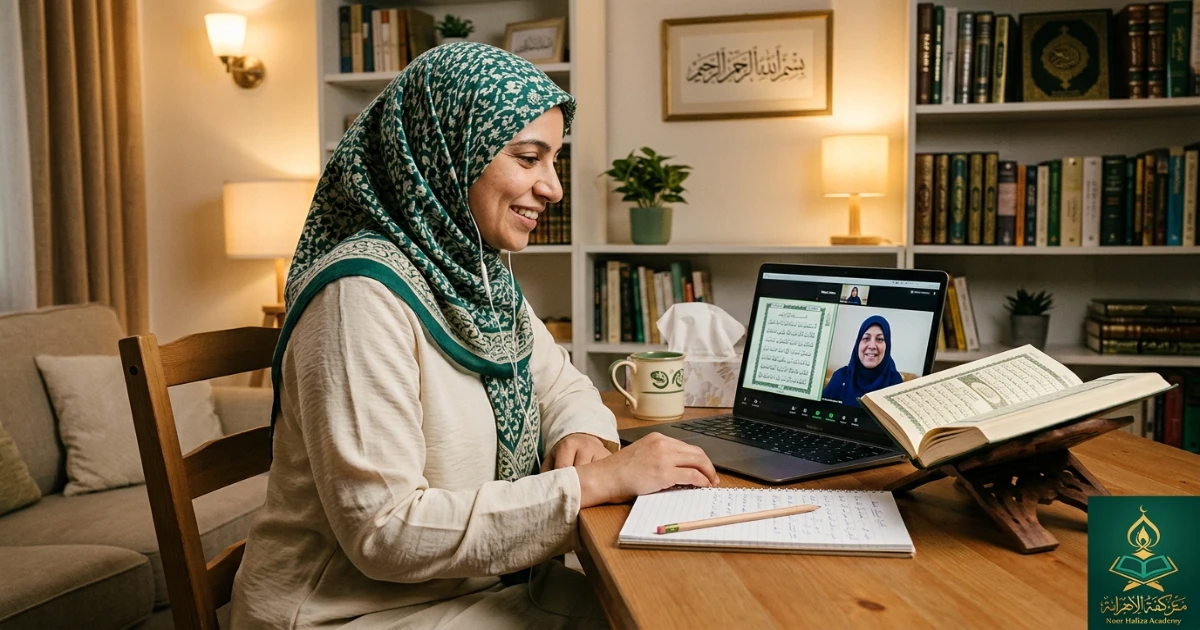
Online Quran classes for adults returning after a long gap
Noor Hafiza Academy offers live online Quran learning for women, girls, children, adults, new Muslims, complete beginners, and returning readers with female Quran teachers. A returning-reader assessment can check Arabic letter recognition, joined forms, Harkaat, Sukoon, Shaddah, fluency, Makharij, Tajweed readiness, and confidence with unfamiliar Quran passages.
A suitable plan may include targeted Qaida review, Quran reading, pronunciation correction, basic or intermediate Tajweed, short daily practice, and regular progress checks. Current teacher qualifications, availability, class length, trial arrangements, fees, schedules, privacy practices, policies, and enrollment terms should be confirmed directly.
Share how long you have been away, what you still remember, where you struggle, your preferred schedule, and whether the main goal is reading, Tajweed, fluency, or rebuilding consistency.
FAQs about restarting Quran reading after years away
Do I need to start Quran reading from the alphabet again?
How long does it take to relearn Quran reading?
How many minutes should I practise each day?
Should I read familiar Surahs first?
Should I use transliteration when restarting?
When should I start Tajweed again?
What if my Quran reading is much slower than before?
Can adults relearn Quran reading online?
What if I feel embarrassed reading in front of a teacher?
How can I tell if I am improving?
Should I listen to Quran recitation while relearning?
What should I send when asking for a returning-reader assessment?
Return to Quran reading with a plan built around your current level, not your past expectations
Share how long you have been away, what you still remember, where you struggle, your preferred schedule, and whether your main goal is reading, Tajweed, fluency, or consistency.