
Lam Shamsiyyah and Lam Qamariyyah Explained
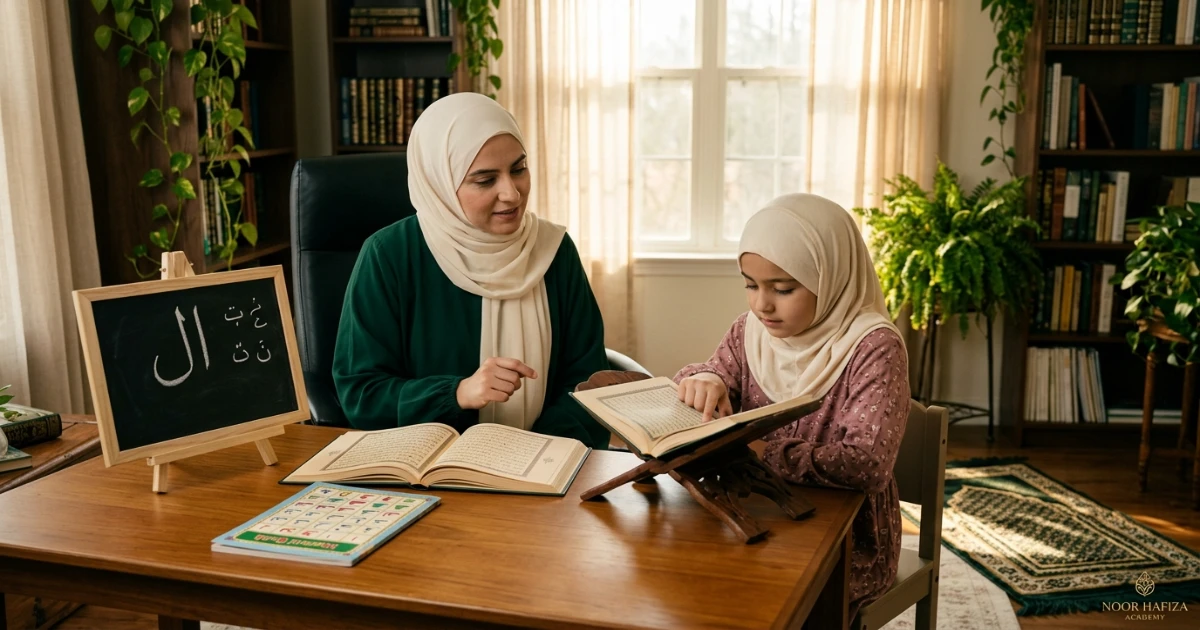
Lam Shamsiyyah and Lam Qamariyyah explain how the Lam in the Arabic definite article ال is pronounced. The Lam is always written, but it is not always heard in the same way. With Lam Shamsiyyah, the next letter is one of 14 sun letters, so the Lam is not pronounced and the following consonant is read with a Shaddah-like doubled sound. With Lam Qamariyyah, the next letter is one of 14 moon letters, so the Lam is pronounced clearly before moving to the next letter. Familiar examples are الشَّمْسُ (ash-shams) for Lam Shamsiyyah and الْقَمَرُ (al-qamar) for Lam Qamariyyah. Once beginners learn the two 14-letter groups and understand what the Shaddah or Sukoon is showing them, this rule becomes much easier to identify in Quran reading.
What is the difference between Lam Shamsiyyah and Lam Qamariyyah?
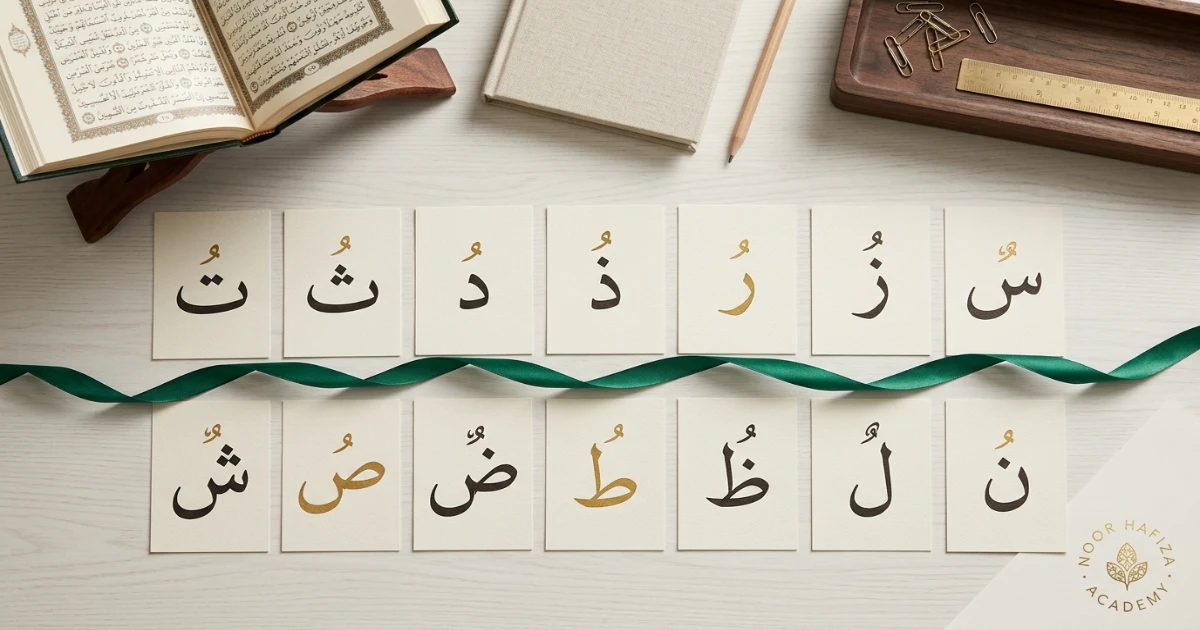
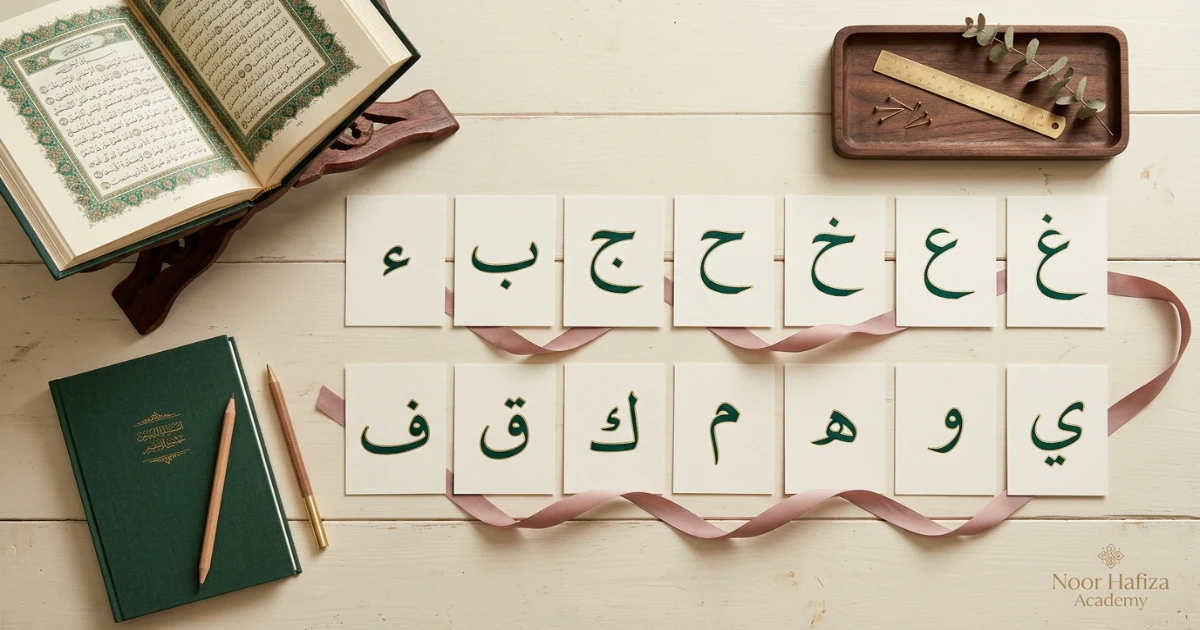
Lam Shamsiyyah occurs when the Arabic definite article ال comes before one of 14 sun letters: ت ث د ذ ر ز س ش ص ض ط ظ ل ن. The Lam is written but not pronounced; instead, the following sun letter is doubled in pronunciation. Lam Qamariyyah occurs before one of 14 moon letters: ء ب ج ح خ ع غ ف ق ك م ه و ي. Here, the Lam is pronounced clearly. The easiest visual clue is that sun-letter words normally show a Shaddah on the next letter, while moon-letter words commonly show Sukoon on the Lam in fully vowelled text.
What is the Lam in the Arabic definite article?
Arabic commonly uses ال to make a noun definite, roughly similar to “the” in English. The written form contains an Alif and a Lam. In fully vowelled Arabic and Quranic text, the way that Lam is read depends on the first letter of the noun that follows it.
The rule does not remove the Lam from spelling. In both Lam Shamsiyyah and Lam Qamariyyah, the Lam remains written. What changes is pronunciation.
The Lam is written in both patterns. In Shamsiyyah it assimilates into the next letter; in Qamariyyah it is pronounced clearly.
What is Lam Shamsiyyah?
Lam Shamsiyyah means the “solar Lam” or “sun Lam.” When ال is followed by a sun letter, the Lam is not pronounced as a separate l sound. Instead, the following sun letter is assimilated and pronounced as a doubled consonant.
The classic example is الشَّمْسُ. Although the word is written with Alif-Lam, it is pronounced approximately ash-shams, not “al-shams.” The Shaddah on ش shows that the Sheen is doubled.
Lam is not pronounced
The written Lam assimilates into the following sun letter.
The next letter is doubled
Pronounce the sun letter with the strength and timing of a Mushaddad consonant.
What are the 14 Lam Shamsiyyah letters?
These are called sun letters because of the teaching example الشمس—“the sun.” The name is simply a learning label. The practical rule is phonetic: the Lam assimilates before these letters.
What is Lam Qamariyyah?
Lam Qamariyyah means the “lunar Lam” or “moon Lam.” When ال is followed by a moon letter, the Lam is pronounced clearly before the next letter.
The classic example is الْقَمَرُ. It is pronounced approximately al-qamar. The Lam remains audible, and in fully vowelled text the Lam commonly carries Sukoon.
Lam is pronounced clearly
Complete the Lam sound before moving to the following moon letter.
No doubling of the moon letter
The next consonant begins normally rather than receiving Shamsiyyah assimilation.
What are the 14 Lam Qamariyyah letters?
The Hamzah may appear on an Alif carrier as أ or إ in actual words, but the relevant consonantal sound is Hamzah. These are called moon letters because of the example القمر—“the moon.”
Lam Shamsiyyah vs Lam Qamariyyah at a glance
| Feature | Lam Shamsiyyah | Lam Qamariyyah |
|---|---|---|
| Number of letters | 14 | 14 |
| Is Lam pronounced? | No | Yes |
| What happens next? | Next letter is doubled | Next letter starts normally |
| Common visual cue | Shaddah on next letter | Sukoon on Lam |
| Classic example | الشَّمْسُ | الْقَمَرُ |
| Approximate reading | ash-shams | al-qamar |
Simple Quran examples of Lam Shamsiyyah
The best practice is to spot the sun letter immediately after ال, then notice the Shaddah on that letter.
| Word | Sun letter | Approximate reading | What happens to Lam? |
|---|---|---|---|
| الشَّمْسِ | ش | ash-shams | Not pronounced |
| النَّاسِ | ن | an-naas | Not pronounced |
| الرَّحْمَٰنِ | ر | ar-Rahmaan | Not pronounced |
| الصِّرَاطَ | ص | as-siraat | Not pronounced |
| التِّينِ | ت | at-teen | Not pronounced |
| الضُّحَىٰ | ض | ad-duhaa | Not pronounced |
The transliterations are only pronunciation aids. The real learning goal is to read the Arabic text correctly and hear the doubled sun letter.

Simple Quran examples of Lam Qamariyyah
With moon letters, hear the Lam clearly before the next consonant. Do not skip the Lam and do not double the moon letter.
| Word | Moon letter | Approximate reading | What happens to Lam? |
|---|---|---|---|
| الْقَمَرِ | ق | al-qamar | Pronounced clearly |
| الْكِتَابُ | ك | al-kitaab | Pronounced clearly |
| الْحَمْدُ | ح | al-hamd | Pronounced clearly |
| الْفَلَقِ | ف | al-falaq | Pronounced clearly |
| الْجَنَّةِ | ج | al-jannah | Pronounced clearly |
| الْيَوْمِ | ي | al-yawm | Pronounced clearly |
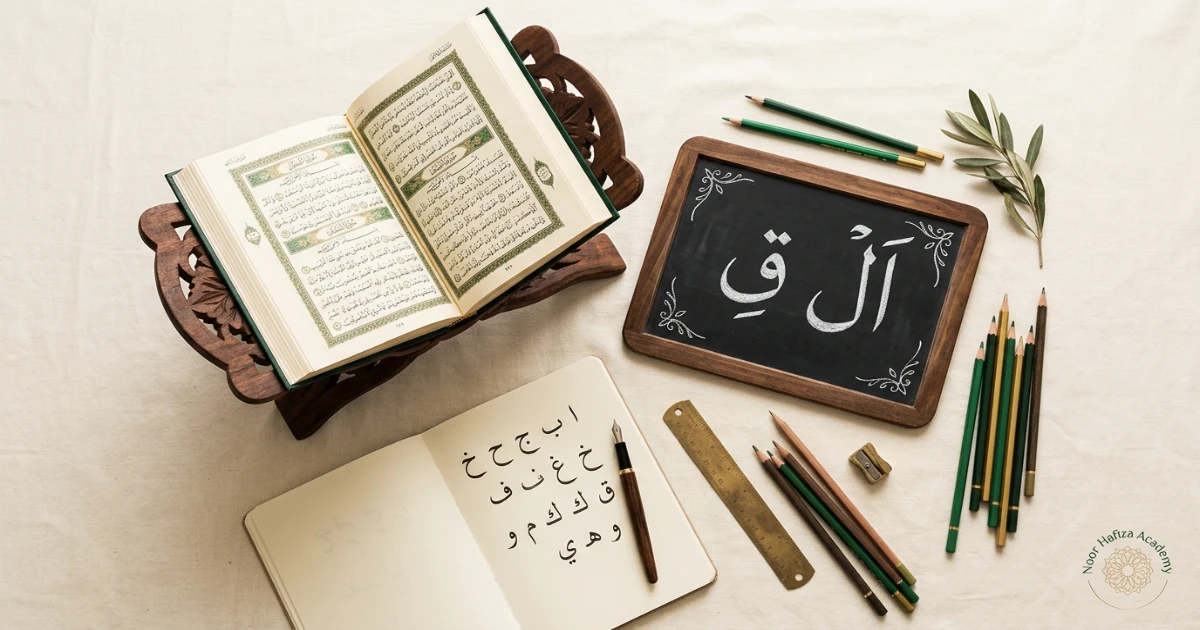
How do Shaddah and Sukoon help you identify the rule?
In a fully vowelled Mushaf, the signs themselves often guide the reader. With Shamsiyyah, the sun letter usually carries a Shaddah, showing that the sound is doubled. With Qamariyyah, the Lam commonly carries Sukoon, showing that the Lam is read as a consonant before the next letter.
The Lam is not pronounced separately; pronounce the following letter twice in the normal Mushaddad manner.
Complete the Lam sound clearly, then move into the moon letter.
Do not rely only on printed marks because learning the 14+14 groups makes reading faster and more transferable.
How should Lam Shamsiyyah and Lam Qamariyyah sound?
Shamsiyyah: move directly into the sun letter
Do not insert an audible “l.” Pronounce the next letter as a doubled consonant. For example, الشَّمْس begins ash-sh…, not al-sh….
Qamariyyah: complete the Lam first
Pronounce the Lam clearly from its proper articulation, then start the moon letter. القمر begins al-q…, not aq-q….
The difference should be audible but natural. Do not exaggerate the Lam in Qamariyyah, and do not over-stress the doubled sun letter in Shamsiyyah.

What happens to the Alif in ال when connecting words?
The Alif of the definite article is associated with Hamzat al-Wasl. When you begin directly with the word, you pronounce the starting vowel, producing the familiar al-, ash-, an-, and similar beginnings depending on the next letter.
When connecting from a previous word, the Hamzat al-Wasl is not pronounced as a new independent Hamzah. The recitation flows from the previous word into the Lam Qamariyyah or directly into the doubled sun letter for Lam Shamsiyyah.
This is a separate skill from identifying sun and moon letters, so beginners should first master the Lam rule, then practise connected reading with a teacher.
Why are they called sun letters and moon letters?
The labels come from two familiar Arabic words. الشمس begins with a sun letter, Sheen, so the Lam is assimilated: ash-shams. القمر begins with a moon letter, Qaf, so the Lam is clear: al-qamar.
The names are memory tools rather than a spiritual or astronomical rule. The actual distinction is pronunciation.
Common Lam Shamsiyyah and Lam Qamariyyah mistakes
Pronouncing Lam before a sun letter
Reading “al-shams” instead of assimilating the Lam makes the Shamsiyyah rule incorrect.
Skipping Lam before a moon letter
Reading القمر as though Qaf were doubled removes the clear Qamariyyah Lam.
Ignoring the Shaddah
In Shamsiyyah, the following sun letter must be pronounced as a doubled consonant.
Over-holding the Shaddah
Doubled does not mean stretching the consonant unnaturally.
Memorizing only a few examples
The learner recognizes الشمس and القمر but struggles when a different sun or moon letter appears.
Relying only on transliteration
English spellings are useful temporarily but do not replace reading the Arabic signs and letters.
Confusing Lam Shamsiyyah with Idgham rules
Both involve assimilation, but they belong to different Tajweed/Arabic-reading contexts and have different trigger systems.
Forgetting connected reading
The Hamzat al-Wasl behavior can change how the beginning sounds when a word is connected to what comes before it.
How to identify Shamsiyyah or Qamariyyah in seconds
Check whether the word begins with the Arabic definite article.
The letter after Lam decides the category.
If it is ت ث د ذ ر ز س ش ص ض ط ظ ل ن, use Shamsiyyah.
If it is ء ب ج ح خ ع غ ف ق ك م ه و ي, use Qamariyyah.
Shaddah supports Shamsiyyah; Sukoon on Lam supports Qamariyyah.
Assimilate or pronounce the Lam without stopping to name the rule aloud.
How should beginners practise Lam Shamsiyyah and Lam Qamariyyah?
A short daily routine works better than memorizing the 28 letters once and never using them. Divide practice into recognition, pronunciation, and fresh Quran reading.
| Minutes | Activity | What to do | Goal |
|---|---|---|---|
| 2 | Letter review | Recite the 14 sun letters and 14 moon letters | Fast recognition |
| 2 | Visual signs | Find Shaddah after ال and Sukoon on Lam | Use Mushaf cues |
| 2 | Contrast reading | Alternate الشمس / القمر and similar pairs | Hear the difference |
| 2 | Fresh text | Scan a short Surah for words beginning ال | Transfer the rule |
| 2 | Teacher/listening check | Compare pronunciation with a reliable recitation or teacher correction | Fix sound errors |
12-point Lam Shamsiyyah and Qamariyyah checklist
Use this while reading a fresh Quran passage
- Can I identify the definite article ال?
- Can I name all 14 sun letters?
- Can I name all 14 moon letters?
- Do I check the first letter after Lam before reading?
- With a sun letter, am I leaving the Lam unpronounced?
- Am I doubling the sun letter correctly?
- With a moon letter, am I pronouncing the Lam clearly?
- Am I avoiding an unnecessary Shaddah on moon letters?
- Can I use the Shaddah as a Shamsiyyah clue?
- Can I use the Sukoon on Lam as a Qamariyyah clue?
- Can I read the rule correctly without relying on transliteration?
- Can I apply both patterns in a new Quran passage without naming the rule first?

Learn Lam Shamsiyyah and Lam Qamariyyah in online Quran classes
Noor Hafiza Academy offers live online Quran learning for children, girls, women, adults, beginners, returning readers, teenagers, siblings, and homeschool families with female Quran teachers. Learners can ask about Arabic letters, Noorani Qaida, Quran reading, Tajweed, Makharij, Hifz, and pronunciation correction according to their current level.
A beginner Quran-reading plan may include Arabic letter recognition, joining letters, Harkaat, Tanween, Sukoon, Shaddah, Lam Shamsiyyah, Lam Qamariyyah, Madd, Qalqalah, Noon Sakinah and Tanween, and guided reading practice. Current teacher qualifications, female-teacher availability, class length, trial arrangements, fees, schedules, privacy practices, safeguarding policies, and enrollment terms should be confirmed directly.
Share the learner’s age, Quran reading level, current Qaida stage, pronunciation difficulty, preferred schedule, and whether a female teacher is requested.
FAQs about Lam Shamsiyyah and Lam Qamariyyah
What is Lam Shamsiyyah?
What is Lam Qamariyyah?
What are the 14 sun letters?
What are the 14 moon letters?
Why is the Lam not pronounced in Lam Shamsiyyah?
How do I recognize Lam Shamsiyyah in the Mushaf?
How do I recognize Lam Qamariyyah in the Mushaf?
Is the Lam removed from the spelling in Shamsiyyah?
What is the easiest example of Lam Shamsiyyah?
What is the easiest example of Lam Qamariyyah?
Does Hamzat al-Wasl affect these words?
How should beginners practise sun and moon letters?
Master the Arabic definite article by hearing when the Lam is assimilated and when it stays clear
Share the learner’s age, Quran reading level, Qaida stage, main pronunciation difficulty, and preferred class schedule.