Heavy Letters in Arabic: The 7 Letters Beginners Should Know

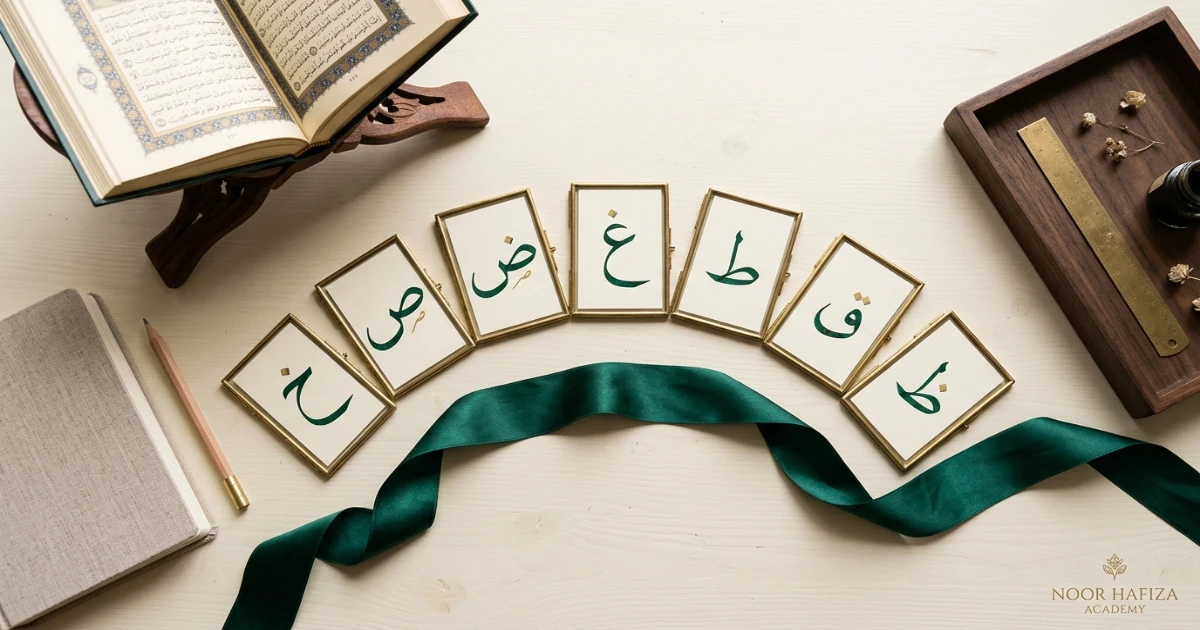
The heavy letters in Arabic that beginners meet in Tajweed are the seven letters of Isti’la: خ ص ض غ ط ق ظ. These letters are pronounced with Tafkheem, meaning the sound is full, broad, and heavy because the back of the tongue rises and the oral resonance becomes deeper. A useful mnemonic is خص ضغط قظ. The most important beginner point is that these seven letters remain heavy whether they carry Fathah, Dammah, Kasrah, or Sukoon. The degree of heaviness changes, but the letters do not become ordinary light letters. Four of the seven—ص ض ط ظ—also have the characteristic of Itbaq and are generally stronger in heaviness. This guide gives you the seven letters, pronunciation method, vowel levels, contrast pairs, common mistakes, and a simple practice system you can use while reading Quran.
What are the 7 heavy letters in Arabic?
In Tajweed, the seven always-heavy Isti’la letters are خ ص ض غ ط ق ظ. They are commonly memorized with the phrase خص ضغط قظ. Each is pronounced with Tafkheem, which gives the sound fuller resonance through elevation of the back of the tongue. These letters remain heavy with Fathah, Dammah, Kasrah, and Sukoon. A Kasrah reduces the degree of heaviness, but it does not turn an Isti’la letter into a light letter. The four letters ص ض ط ظ are especially strong because they also carry Itbaq.
The 7 heavy letters beginners should memorize first
If you remember only one list from this article, make it this one:
These are the seven letters described as having the characteristic of Isti’la. Isti’la means elevation because the back of the tongue rises during pronunciation. That tongue posture creates the heavier resonance Tajweed teachers call Tafkheem.
Kha
A heavy throat letter. Keep its deep upper-throat sound without turning it into a light breathy “kh.”
Sad
Always heavy. It also has Itbaq, so its heaviness is especially strong.
Dad
Always heavy. Correct side-of-tongue articulation is as important as the heaviness itself.
Ghayn
A heavy upper-throat letter with deep resonance.
Heavy Ta
Always heavy and one of the four Itbaq letters. Do not flatten it into ت.
Qaf
Always heavy with a deep articulation from the back of the tongue. Do not replace it with ك.
Heavy Za
Always heavy and part of the Itbaq group. Keep both tongue placement and fullness accurate.
Why do these seven Arabic letters sound heavy?
Tafkheem is not created by speaking louder or pushing harder. It comes mainly from the shape of the vocal tract. With Isti’la letters, the back of the tongue rises toward the upper palate. This changes the resonance and gives the sound a broader quality.
Create the fuller resonance associated with Isti’la without tightening the whole mouth.
Heaviness should never change Qaf into Kaf, Sad into Seen, or Ta into ت.
Tafkheem is resonance and tongue posture, not loudness.
This distinction matters because beginners often try to “sound heavy” by increasing volume. That creates tension without improving Tajweed. A correct heavy letter can be recited quietly and still sound full.

Which heavy letters are strongest?
Four of the seven Isti’la letters also have Itbaq:
These four generally sound stronger in heaviness than خ غ ق because they combine Isti’la with the additional quality of Itbaq. Itbaq involves greater contact or enclosure between the tongue and the upper mouth area, which intensifies the fullness of the sound.
For beginners, the practical lesson is simple: do not make all seven letters sound exactly identical in heaviness. Learn each Makhraj first, then allow the natural characteristics of the letter to shape the sound.
Do the heavy letters stay equally heavy with every vowel?
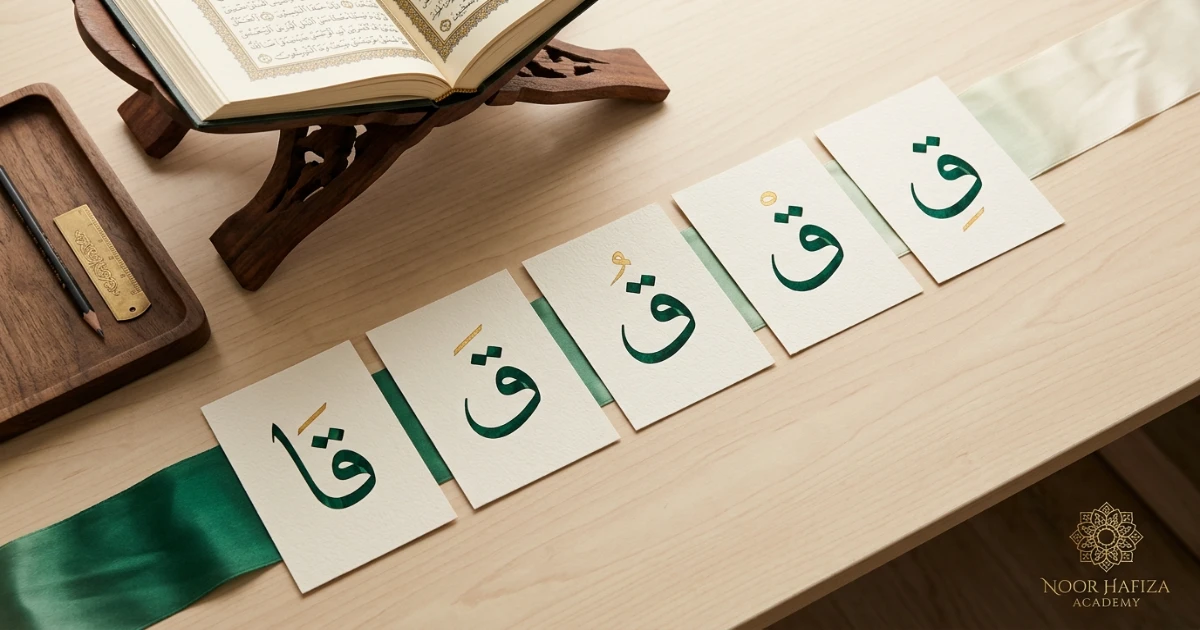
No. The seven letters always remain within Tafkheem, but the degree of heaviness changes. Many beginner curricula teach a five-level model.
| Level | Condition | Relative heaviness | Beginner note |
|---|---|---|---|
| 1 | Fathah followed by Alif | Strongest | Broadest heavy resonance |
| 2 | Fathah | Very strong | Clear Tafkheem |
| 3 | Dammah | Strong | Heavy with rounded vowel |
| 4 | Sukoon | Context-sensitive level | Still heavy; surrounding vowel influences color |
| 5 | Kasrah | Lightest Tafkheem | Still not Tarqeeq |
Some Tajweed teachers organize the middle levels slightly differently, particularly the place of Sukoon. That difference in presentation does not change the beginner principle: خ ص ض غ ط ق ظ never become ordinary light letters.
How are heavy letters different from light letters?
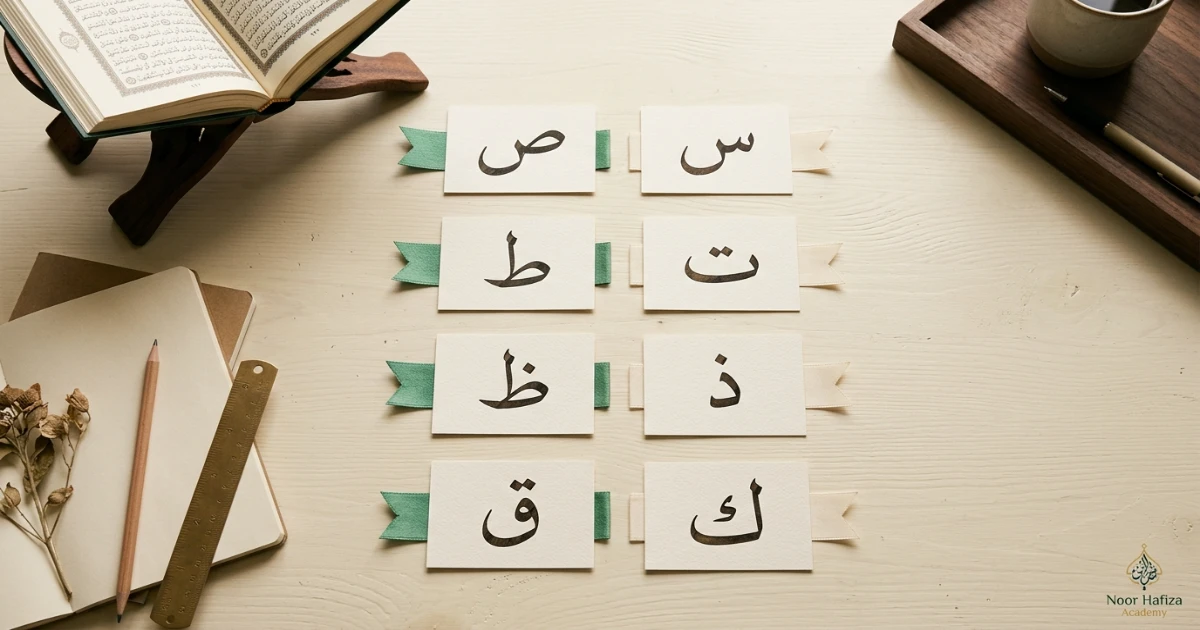
Most Arabic letters are normally read with Tarqeeq, meaning a lighter and thinner resonance. The difference becomes easier to hear when you compare letters with similar articulation areas.
| Heavy letter | Light comparison | Common beginner error | Practice goal |
|---|---|---|---|
| ص | س | Sad becomes flat like Seen | Keep Sad full without changing its Makhraj |
| ط | ت | Heavy Ta becomes ordinary Ta | Hear and feel tongue elevation |
| ظ | ذ | Za loses its heavy quality | Keep correct tongue contact plus Tafkheem |
| ق | ك | Qaf sounds like Kaf | Keep Qaf deep and distinct |
Do heavy letters become light with Kasrah?
No. This is one of the most important corrections for beginners. Kasrah reduces the degree of Tafkheem, but the letter remains heavy.
The tongue still carries the Isti’la quality, but the heaviness is less strong than with Fathah or Dammah.
This removes the defining heavy quality and can make the letter sound like a different consonant.
For example, a Kasrah on Qaf does not turn Qaf into Kaf, and a Kasrah on Sad does not turn Sad into Seen. The vowel affects the level of heaviness; it does not erase Isti’la.
How do you stop a heavy letter from making nearby letters heavy?
A heavy letter can influence a beginner’s mouth position so strongly that the following or preceding light letters accidentally become heavy too. Tajweed requires each letter to keep its own quality.
Do not raise the back of the tongue too early and darken a light letter before the heavy consonant.
Let the Isti’la letter sound complete without forcing it.
Return to the correct posture for the next light letter instead of carrying heavy resonance forward.
Are Ra, Lam, and Alif part of the seven heavy letters?
No. This distinction prevents a lot of confusion. The seven Isti’la letters are always-heavy letters. Ra, the Lam in the name Allah, and Alif can participate in heavy pronunciation, but they are not part of the seven-letter Isti’la group.
| Letter / group | Always heavy? | Main rule | Where to learn more |
|---|---|---|---|
| خ ص ض غ ط ق ظ | Yes | Always Tafkheem; degree changes | This guide |
| Ra (ر) | No | Heavy or light by vowel/context | Rules of Ra |
| Lam in Allah | No | Heavy after Fathah/Dammah, light after Kasrah | Tafkheem & Tarqeeq |
| Alif | No | Follows the letter before it | Tafkheem & Tarqeeq |
What should beginners notice in each heavy letter?
The seven letters share Isti’la, but each one still needs its own Makhraj and Sifat. Heavy pronunciation should never make them sound interchangeable.
Keep the throat articulation clear while maintaining heavy resonance.
Both are heavy; Dad also needs its distinctive side-of-tongue articulation.
Do not reduce them to their lighter comparison letters ت and ذ.
The back-of-tongue articulation must remain distinct from Kaf.
Common mistakes with heavy Arabic letters
Memorizing the list but not the sound
The learner can name all seven letters but still reads them without correct Tafkheem.
Turning heaviness into loudness
Shouting does not create Tafkheem and often adds unnecessary tension.
Making Kasrah letters fully light
The seven letters remain heavy even in their lightest degree.
Spreading heaviness
Light letters around an Isti’la letter accidentally become dark and heavy.
Confusing Qaf and Kaf
The student loses the deeper Qaf articulation.
Confusing Sad and Seen
Sad loses both its heavy quality and correct tongue posture.
Flattening heavy Ta
ط begins to sound like ت when the back of the tongue does not rise.
Ignoring Makhraj while chasing heaviness
Tafkheem cannot compensate for a letter produced from the wrong articulation point.
How to recognize heavy letters in seconds
Use the mnemonic until the seven letters are automatic.
When you see خ ص ض غ ط ق ظ, prepare for Tafkheem.
The vowel helps determine the strength of heaviness, not whether heaviness exists.
Produce the letter from its correct articulation point.
Release the heavy mouth posture after the letter.
Use a teacher or accurate recitation model to correct the sound.
A simple 10-minute practice routine for heavy letters
A short focused routine is usually better than reading many pages without listening to sound quality. Use one or two letters per session until the contrast becomes stable.
| Minutes | Task | Example focus | Goal |
|---|---|---|---|
| 2 | Letter recognition | Say خ ص ض غ ط ق ظ from memory | Instant identification |
| 2 | Vowel drill | One heavy letter with Fathah, Dammah, Kasrah | Keep Tafkheem across vowels |
| 2 | Contrast pair | ص/س or ق/ك | Hear heavy vs light |
| 2 | Quran words | Find 3–5 examples containing the target letter | Transfer skill to recitation |
| 2 | Record and compare | Listen back or recite to a teacher | Catch flattening or over-heaviness |
12-point heavy letters checklist
Use this while reading a fresh Quran passage
- Can I name all seven Isti’la letters from memory?
- Can I recognize them quickly inside Quran words?
- Am I raising the back of the tongue instead of increasing volume?
- Am I preserving the correct Makhraj of each letter?
- Do I keep Tafkheem when a heavy letter has Kasrah?
- Can I hear that Fathah + Alif gives stronger heaviness than Kasrah?
- Am I giving ص ض ط ظ their naturally stronger quality?
- Can I distinguish ص from س?
- Can I distinguish ط from ت?
- Can I distinguish ظ from ذ?
- Can I distinguish ق from ك?
- Am I preventing the heavy sound from spreading into nearby light letters?

Learn heavy letters with live Tajweed correction
Noor Hafiza Academy offers live online Quran learning for children, girls, women, adults, beginners, returning readers, teenagers, siblings, and homeschool families with female Quran teachers. Learners can ask about Noorani Qaida, Quran reading, Tajweed, Makharij, Hifz, and pronunciation correction according to their current level.
A beginner Tajweed plan may include the seven heavy letters, Tafkheem and Tarqeeq, rules of Ra, Makharij, Noon Sakinah and Tanween, Meem Sakinah, Qalqalah, Ghunnah, Madd, Waqf, and guided recitation practice. Current teacher qualifications, female-teacher availability, class length, trial arrangements, fees, schedules, privacy practices, safeguarding policies, and enrollment terms should be confirmed directly.
Share the learner’s age, Quran level, Tajweed background, pronunciation difficulty, preferred schedule, and whether a female teacher is requested.
FAQs about heavy letters in Arabic Tajweed
What are the 7 heavy letters in Arabic?
What is the mnemonic for the heavy letters?
What does Isti’la mean?
Are the seven heavy letters always heavy?
Do heavy letters become light with Kasrah?
Which heavy letters are strongest?
Is Ra one of the seven heavy letters?
Is the Lam in Allah one of the seven heavy letters?
Is Alif a heavy letter?
Is Tafkheem the same as speaking loudly?
What are the most useful heavy/light pairs to practise?
How should a beginner practise the heavy letters?
Master the seven heavy letters by hearing correct Tafkheem and applying it without changing each letter’s Makhraj
Share the learner’s age, Quran level, Tajweed background, main pronunciation difficulty, and preferred class schedule.