
Tafkheem and Tarqeeq: Heavy and Light Letters in Tajweed

Tafkheem and Tarqeeq describe two important sound qualities in Tajweed. Tafkheem means heaviness or fullness, while Tarqeeq means lightness or thinness. The seven letters of Isti’la—خ ص ض غ ط ق ظ—are pronounced with heaviness. Most other Arabic letters are generally light. However, beginners must also learn three special areas: Ra (ر) can be heavy or light depending on its vowel and context; the Lam in the name Allah (اللّٰه) can be heavy or light depending on the vowel before it; and Alif (ا) follows the heaviness or lightness of the letter before it. This guide explains the heavy letters, light letters, degrees of Tafkheem, context-dependent letters, common mistakes, and a practical method for training your ear and tongue.
What are Tafkheem and Tarqeeq in Tajweed?
Tafkheem is a heavy, full pronunciation produced with greater elevation of the back of the tongue and fuller oral resonance. The seven Isti’la letters خ ص ض غ ط ق ظ are always heavy, although their degree of heaviness changes with the vowel. Tarqeeq is a light, thin pronunciation. Most Arabic letters are normally light. Three areas need special attention: Ra may be heavy or light, the Lam in Allah is heavy after Fathah or Dammah and light after Kasrah, and Alif follows the letter before it.
What do Tafkheem and Tarqeeq mean?
Tafkheem means heaviness or fullness. The back of the tongue rises and the resonance of the sound fills more of the mouth. Tarqeeq means lightness or thinness. The back of the tongue does not rise in the same way, so the sound remains thinner and lighter.
Neither quality should be exaggerated. A heavy letter should not be shouted, and a light letter should not become weak or unclear. The letter keeps its correct Makhraj and other Sifat.
A heavy Qaf must still be Qaf, and a light Kaf must still be Kaf. Tafkheem should never distort the basic identity of a letter.
What are the seven heavy letters in Tajweed?
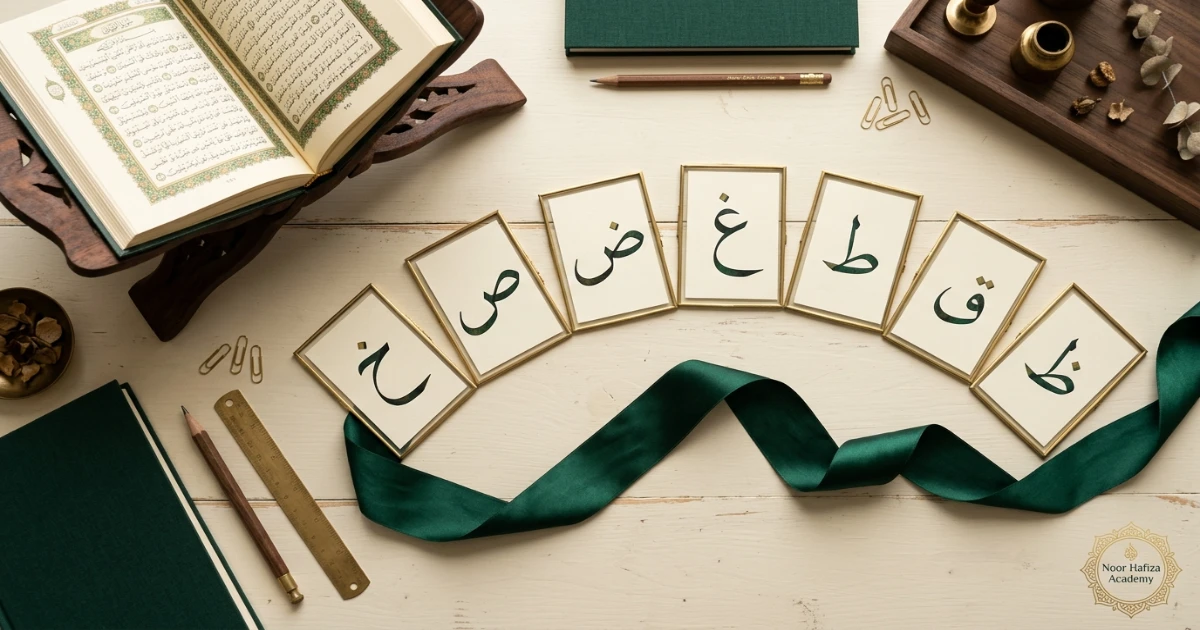
The seven letters of Isti’la are always pronounced with Tafkheem:
A common mnemonic is خص ضغط قظ. Isti’la means elevation, referring to the elevation of the back of the tongue during pronunciation.
Kha
Always heavy. Keep its upper-throat sound full.
Sad
Always heavy and also one of the stronger Itbaq letters.
Dad
Always heavy; correct side-of-tongue articulation remains essential.
Ghayn
Always heavy with fuller upper-throat resonance.
Ta
Always heavy and especially strong because it also has Itbaq.
Qaf
Always heavy; avoid turning it into a light Kaf-like sound.
Za
Always heavy and part of the strong Itbaq group.
Why are ص ض ط ظ stronger in heaviness?
Among the seven Isti’la letters, four also have the characteristic of Itbaq: ص ض ط ظ. Itbaq adds greater enclosure and fullness to the sound, so these letters are generally stronger in heaviness than خ غ ق under comparable vowel conditions.
For beginners, this does not mean forcing the mouth or throat. The extra heaviness should come from correct tongue position and resonance. If you create heaviness by squeezing, the Makhraj often becomes distorted.
Do heavy letters have different levels of heaviness?
Yes. The seven Isti’la letters remain heavy with every vowel, but the degree of Tafkheem changes. A common five-level teaching system ranks Fathah followed by Alif as strongest, then Fathah, Dammah, Sukoon, and Kasrah as the lightest degree of heaviness.
| Level | Condition | Relative heaviness | Beginner note |
|---|---|---|---|
| 1 | Fathah + Alif | Strongest | Fullest resonance |
| 2 | Fathah | Very strong | Clearly heavy |
| 3 | Dammah | Strong | Heavy with rounded vowel |
| 4 | Sukoon | Context-sensitive level | Still heavy |
| 5 | Kasrah | Lightest Tafkheem | Still not Tarqeeq |
Some Tajweed curricula arrange the middle levels differently, especially the position of a Sakin heavy letter. The key beginner principle is stable: Kasrah reduces the degree of heaviness but does not turn an Isti’la letter into a light letter.

Which letters are light in Tajweed?
Most Arabic letters are normally pronounced with Tarqeeq. Instead of memorizing a long second list, beginners can memorize the seven always-heavy letters and then learn the few context-dependent areas separately.
These seven always use Tafkheem.
Use Tarqeeq unless a specific rule tells you otherwise.
Light pronunciation does not mean weak articulation. A light letter can still have strong characteristics such as Shiddah, Jahr, or Qalqalah. Tarqeeq only describes the thinness of the sound.
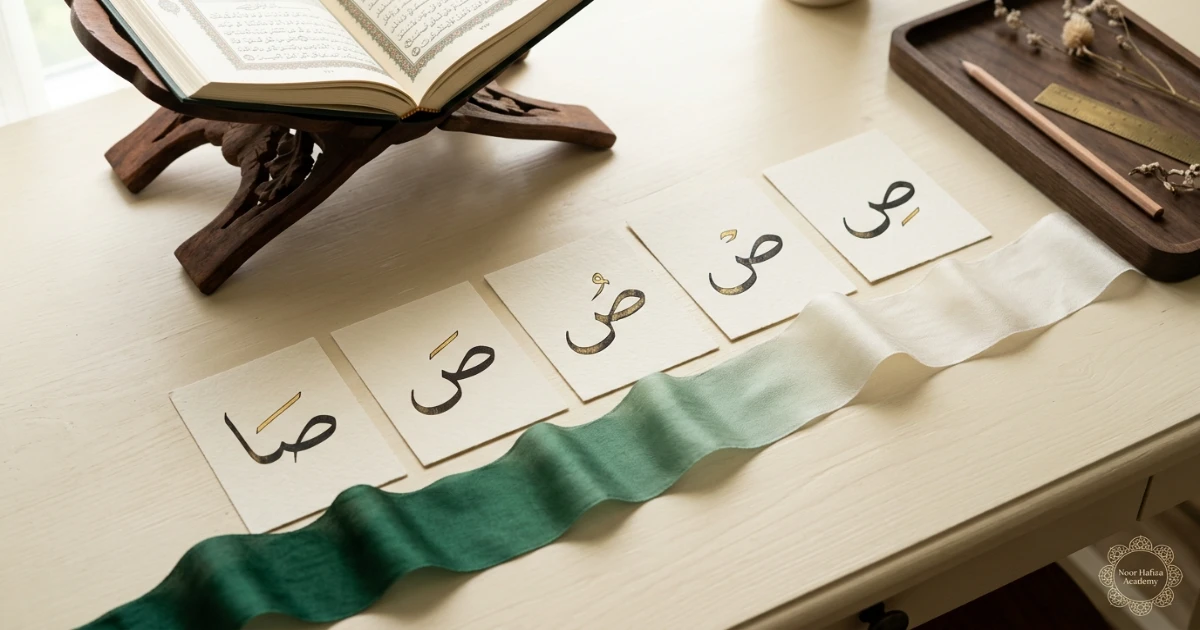
Why can Ra be heavy or light?
Ra (ر) is not one of the seven always-heavy letters, yet Tajweed gives it both Tafkheem and Tarqeeq depending on context.
Ra is heavy.
Ra is light.
Check the vowel before it and then the relevant exceptions.
Ra has a detailed chapter because Waqf, temporary Kasrah, and Isti’la-letter exceptions can change the result. Use the dedicated Rules of Ra in Tajweed guide for the full decision process.
When is the Lam in Allah heavy or light?
The Lam in the divine name Allah (اللّٰه) has a special rule based on the vowel immediately before it.
| Before Allah | Lam reading | Pattern | Result |
|---|---|---|---|
| Fathah | Heavy | …َ الله | Tafkheem |
| Dammah | Heavy | …ُ الله | Tafkheem |
| Kasrah | Light | …ِ الله | Tarqeeq |
This special heavy/light behavior belongs to the Lam in Allah. Ordinary Lam is generally light.
Is Alif heavy or light?
Alif does not independently choose Tafkheem or Tarqeeq. It follows the quality of the consonant before it. After a heavy consonant, the Alif sounds heavy; after a light consonant, it sounds light.
The long vowel carries the heavy resonance of the preceding letter.
The long vowel remains light with the preceding consonant.
This is why learners should not pronounce every long Alif with one fixed mouth shape. The preceding letter controls its quality.

How do you pronounce heavy letters correctly?
Correct Tafkheem comes from tongue posture and resonance, not volume. The back of the tongue rises, narrowing the oral space and creating a fuller sound. The exact Makhraj of the consonant must remain stable.
Create the fuller resonance associated with Isti’la.
Do not let heaviness turn Qaf into Kaf or distort Dad.
Tafkheem is resonance, not loudness.
How do you pronounce light letters correctly?
Tarqeeq keeps the back of the tongue lower and the sound thinner. The letter should still be clear enough to preserve its articulation and other characteristics.
A common mistake is making light letters weak or breathy. A light letter can be firm, strong, or qalqalah-producing while still remaining thin in resonance.
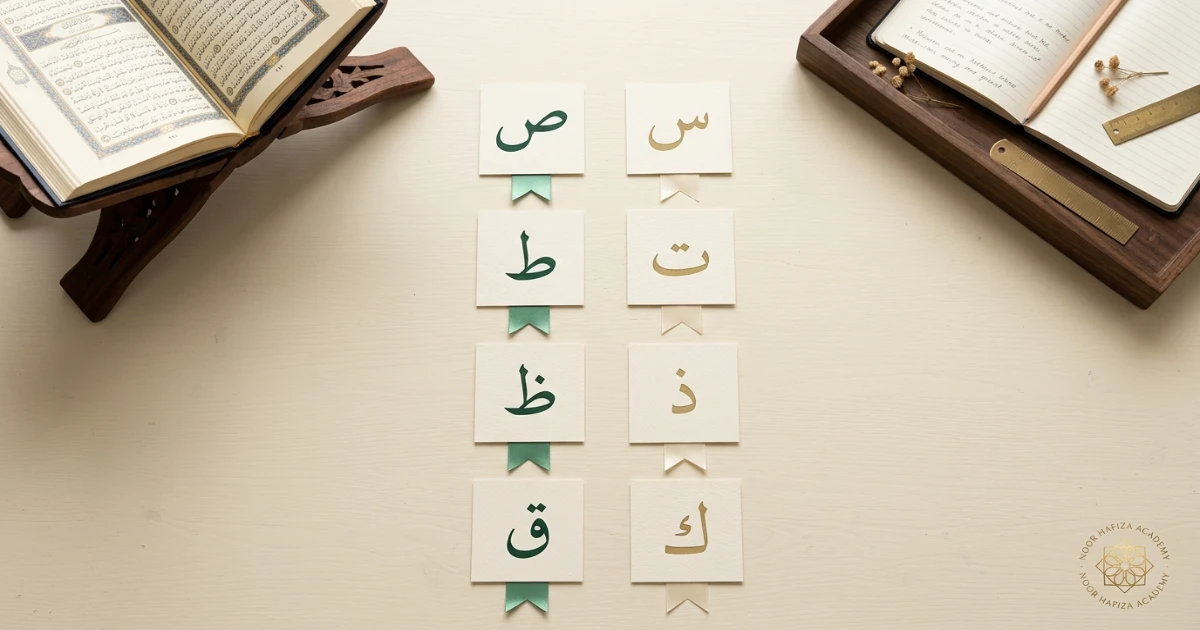
Why practise heavy and light letter pairs?
Learners often confuse letters whose articulation areas are related. Contrast practice helps the ear and tongue distinguish heaviness without changing the actual letter.
| Heavy letter | Light comparison | Main risk | Practice goal |
|---|---|---|---|
| ص | س | Flattening Sad into Seen | Keep Sad full |
| ط | ت | Losing Tafkheem | Hear heavy/light contrast |
| ظ | ذ | Replacing Za with Dhal | Maintain heaviness and tongue placement |
| ق | ك | Making Qaf sound like Kaf | Keep Qaf’s deeper articulation |
Can Tafkheem affect nearby light letters?
A heavy letter can influence the learner’s mouth posture so strongly that nearby light letters accidentally become heavy. This is a pronunciation mistake, not a Tajweed rule. After a heavy letter, the tongue must return to the correct position for the next light consonant.
The reverse can also happen: a strong Kasrah or nearby light letter may tempt the learner to flatten a heavy Isti’la letter. The heavy letter must preserve its identity even when surrounded by light sounds.
Common Tafkheem and Tarqeeq mistakes
Making every letter heavy
Neighboring light letters become darkened because the tongue stays raised too long.
Flattening heavy letters
Qaf, Sad, Ta, and other Isti’la letters lose their correct Quranic sound.
Thinking Kasrah removes Tafkheem
The seven Isti’la letters stay heavy even with Kasrah; the degree simply becomes lighter.
Making every Lam heavy
The special context rule is for the Lam in Allah; ordinary Lam is generally light.
Making Alif independently heavy
Alif follows the preceding consonant’s quality.
Using one rule for every Ra
Ra is context-dependent and needs its own Tafkheem/Tarqeeq rules.
Confusing heaviness with loudness
Tafkheem comes from articulation and resonance, not extra volume.
Over-spreading heaviness
A heavy consonant should not automatically make the letters around it heavy.
How to decide heavy or light in six steps
If yes, pronounce it heavy.
Check the separate Ra rules.
Check the vowel immediately before the divine name.
Follow the quality of the letter before it.
Use the normal light Tarqeeq pronunciation.
Make sure heavy resonance has not spread into adjacent light letters.
How to practise Tafkheem and Tarqeeq at home
Start by isolating the seven heavy letters. Read each with Fathah, Dammah, Kasrah, and Sukoon. Then compare heavy/light pairs. After that, study Ra, Lam in Allah, and Alif as three separate mini-lessons. Finish by reading fresh Quran lines where the rules are not marked for you.
| Stage | Focus | Exercise | Goal |
|---|---|---|---|
| 1 | Seven heavy letters | Read خ ص ض غ ط ق ظ with different vowels | Stable Tafkheem |
| 2 | Heavy/light pairs | ص/س, ط/ت, ظ/ذ, ق/ك | Hear contrast |
| 3 | Levels of heaviness | Compare Fathah+Alif, Fathah, Dammah, Kasrah | Control degree |
| 4 | Ra | Heavy vs light Ra examples | Context awareness |
| 5 | Lam & Alif | Allah after different vowels; Alif after heavy/light letters | Avoid overgeneralizing |
12-point Tafkheem and Tarqeeq checklist
Use this while reading a fresh Quran passage
- Can I identify all seven Isti’la letters?
- Am I keeping those seven letters heavy even with Kasrah?
- Can I hear the stronger heaviness of ص ض ط ظ?
- Am I keeping most other letters light?
- Am I preventing heaviness from spreading into nearby light letters?
- If the letter is Ra, have I checked its own heavy/light rule?
- If I see Allah, have I checked the vowel before the Lam?
- If I see Alif, am I following the quality of the preceding letter?
- Am I using resonance rather than loudness for Tafkheem?
- Am I keeping each letter’s Makhraj accurate?
- Can I compare a heavy/light pair without confusing the two letters?
- Can I apply the rules in a fresh Quran line without labeling every letter aloud?

Learn Tafkheem and Tarqeeq in online Tajweed lessons
Noor Hafiza Academy offers live online Quran learning for children, girls, women, adults, beginners, returning readers, teenagers, siblings, and homeschool families with female Quran teachers. Learners can ask about Noorani Qaida, Quran reading, Tajweed, Makharij, Hifz, and pronunciation correction according to their current level.
A Tajweed plan may include Tafkheem and Tarqeeq, rules of Ra, Lam in Allah, heavy-letter levels, Noon Sakinah and Tanween, Meem Sakinah, Qalqalah, Ghunnah, Madd, Waqf, and guided recitation. Current teacher qualifications, female-teacher availability, class length, trial arrangements, fees, schedules, privacy practices, safeguarding policies, and enrollment terms should be confirmed directly.
Share the learner’s age, Quran level, Tajweed background, pronunciation difficulty, preferred schedule, and whether a female teacher is requested.
FAQs about Tafkheem and Tarqeeq
What is Tafkheem in Tajweed?
What is Tarqeeq in Tajweed?
What are the seven heavy letters in Tajweed?
Are the seven heavy letters always heavy?
Which heavy letters are strongest?
Are all other Arabic letters light?
Can Ra be heavy and light?
When is the Lam in Allah heavy?
Is Alif heavy or light?
Do heavy letters become light with Kasrah?
Is Tafkheem the same as speaking loudly?
How should beginners practise heavy and light letters?
Master Quran pronunciation by hearing the contrast between Tafkheem and Tarqeeq and applying it in real recitation
Share the learner’s age, Quran level, Tajweed background, main pronunciation difficulty, and preferred class schedule.