
Rules of Ra in Tajweed: When Ra Is Heavy or Light

The rules of Ra in Tajweed explain when the Arabic letter ر is pronounced with Tafkheem—a fuller, heavier sound—and when it is pronounced with Tarqeeq—a thinner, lighter sound. For beginners, the easiest starting rule is: Ra with Fathah or Dammah is heavy, while Ra with Kasrah is light. When Ra is Sakin, the vowel before it usually decides. Important advanced details include temporary Kasrah, Isti’la letters, stopping on Ra, and a small number of words where more than one transmitted treatment is taught. This page follows the common rules of Hafs ‘an ‘Asim. Learners studying another Qira’ah or Riwayah should follow their teacher because some Ra details differ between readings.
When is Ra heavy or light in Tajweed?
In common Hafs ‘an ‘Asim teaching, a Ra carrying Fathah (رَ) or Dammah (رُ) is heavy, while a Ra carrying Kasrah (رِ) is light. If Ra is Sakin (رْ), look at the vowel immediately before it: Fathah or Dammah usually makes Ra heavy, while an original Kasrah usually makes it light. There are exceptions, especially when the Kasrah is temporary or when an Isti’la letter follows the Sakin Ra in the same word. When stopping on final Ra, the final vowel falls away, so the reader checks what remains before the Ra.
What do Tafkheem and Tarqeeq mean for Ra?
Tafkheem means heaviness or fullness of sound. When Ra is heavy, the sound feels broader and fuller in the mouth, with more back-of-mouth resonance. Tarqeeq means lightness or thinness. When Ra is light, the sound is thinner and the back of the tongue is not raised in the same way.
Neither pronunciation should be exaggerated. A heavy Ra is not a completely different letter, and a light Ra is not a flat English-style “r.” The Arabic articulation of Ra remains while its resonance changes.
Ra has a natural tendency toward repeated tongue-tip movement, called Takreer, but Tajweed training controls that tendency. Heavy does not mean “roll more.”
When is Ra heavy in Tajweed?
Ra with Fathah
When Ra carries Fathah, pronounce it with Tafkheem.
Ra with Dammah
When Ra carries Dammah, it is also heavy.
Sakin after Fathah
A Sakin Ra is normally heavy when the previous letter has Fathah.
Sakin after Dammah
A Sakin Ra is normally heavy when the previous letter has Dammah.
Ra with Shaddah
A Mushaddad Ra follows its own vowel: Fathah or Dammah gives heaviness.
Heavy at a Stop
A final Ra made Sakin at Waqf may be heavy depending on the vowel or long-vowel letter before it.
The basic logic is that when Ra has its own Fathah or Dammah, you do not need to look backward. Its own vowel already tells you to use Tafkheem.

When is Ra light in Tajweed?
The clearest light-Ra case is when Ra itself carries Kasrah. This is a direct Tarqeeq rule.
When Ra carries Kasrah, pronounce it thin and light.
When Ra is Sakin after an original Kasrah, Tarqeeq is normally used unless an exception applies.
At a stop, a Sakin Ya immediately before the final Ra also leads to a light Ra. This is why common examples ending in a long “ee” sound before Ra are taught with Tarqeeq when stopped upon.
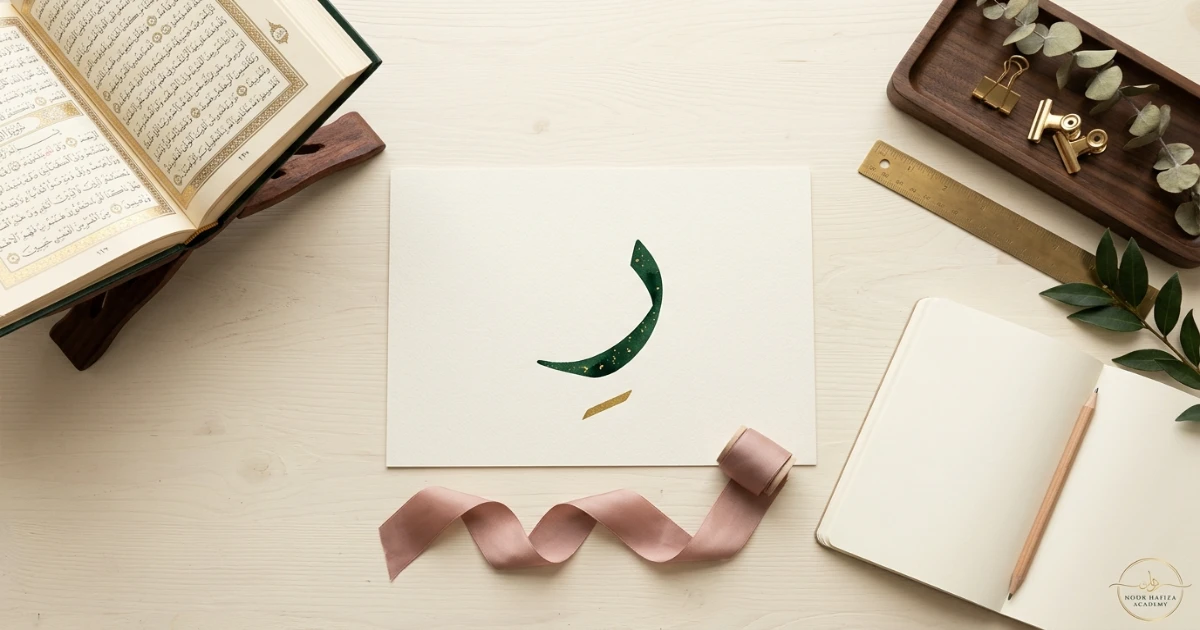
How do you decide whether a Sakin Ra is heavy or light?
A Ra with Sukoon has no vowel of its own, so the learner usually looks at the vowel before it. This rule solves most beginner examples.
| Ra condition | Before Ra | Usual reading | Action |
|---|---|---|---|
| رْ | Fathah | Heavy | Tafkheem |
| رْ | Dammah | Heavy | Tafkheem |
| رْ | Original Kasrah | Light | Tarqeeq unless exception |
| Final رْ at Waqf | Sakin Ya | Light | Tarqeeq |
| Final رْ at Waqf | Alif / Sakin Waw | Heavy | Tafkheem |
The advanced part begins when the preceding Kasrah is not original or when a heavy Isti’la letter follows the Ra in the same word.
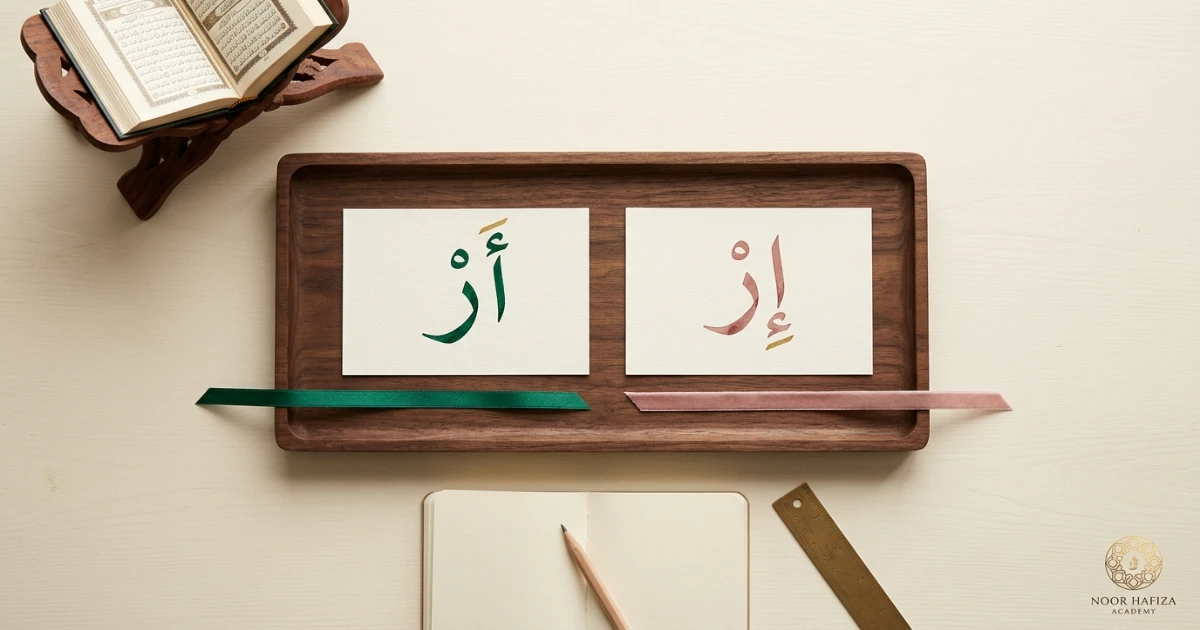
Why an original Kasrah matters
The shortcut “Sakin Ra after Kasrah is light” is only reliable when the Kasrah is original. A temporary Kasrah used to begin on Hamzat al-Wasl does not automatically lighten the following Sakin Ra.
A Kasrah that belongs to the previous word also should not be treated as though it were an original Kasrah within the same word governing the Ra. This is why advanced Ra study asks not only “Is there Kasrah?” but also “Where did that Kasrah come from?”
That one distinction prevents many beginner mistakes.
When can Sakin Ra remain heavy after Kasrah?
In common Hafs teaching, a Sakin Ra after an original Kasrah can still be heavy when an Isti’la letter follows in the same word under the relevant condition. The seven Isti’la letters are:
Common teaching examples include forms such as قِرْطَاس, مِرْصَاد, and إِرْصَادًا. The following heavy letter influences the treatment of the Sakin Ra.
A well-known advanced case is فِرْقٍ in Surah Ash-Shu’ara 26:63, where both heavy and light treatment are taught in Hafs. Beginners should take such limited cases from a qualified teacher rather than trying to build a new general rule from one exception.

Is a Ra with Shaddah always heavy?
No. Shaddah does not decide heaviness by itself. The vowel on the Mushaddad Ra decides the pronunciation.
Heavy.
Heavy.
Light.
This matters because learners sometimes look at the vowel before a Mushaddad Ra even though the Ra already carries its own vowel. If Ra has a clear vowel, start with that vowel.
What happens to Ra when you stop on a word?
Stopping usually removes the final short vowel, making the final Ra effectively Sakin. You then apply a backward-looking rule to what remains.
| Before final Ra at Waqf | Usual result | Pattern | Why |
|---|---|---|---|
| Fathah | Heavy | ـَـرْ | Nearest vowel is Fathah |
| Dammah | Heavy | ـُـرْ | Nearest vowel is Dammah |
| Kasrah | Light | ـِـرْ | Nearest vowel is Kasrah |
| Alif | Heavy | ـارْ | Alif follows Fathah quality |
| Sakin Waw | Heavy | ـورْ | Waw follows Dammah quality |
| Sakin Ya | Light | ـيرْ | Ya follows Kasrah quality |
If another Sakin consonant stands between the final Ra and the nearest vowel, look past that Sakin consonant. Common teaching reads stopping on الْفَجْر with a heavy Ra because the earlier vowel is Fathah, while stopping on الْحِجْر gives a light Ra because the earlier vowel is Kasrah.

Are there cases where both heavy and light Ra are taught?
Yes. A small number of advanced Hafs cases are taught with more than one transmitted treatment. Teachers often discuss words such as مِصْر and الْقِطْر when stopping, as well as the connected-reading case فِرْقٍ.
These are exception-level details. A beginner should first make the ordinary rules automatic, then learn the small special list from a teacher and stay consistent with the transmitted reading being taught.
How do you avoid over-rolling Ra?
Ra has the characteristic of Takreer, meaning the tongue tip has a tendency to repeat or flutter. Tajweed does not require a long trill. The reciter restrains unnecessary repetition while still allowing a correct Arabic Ra.
Use Tafkheem without turning the sound into “rrrr.”
Use Tarqeeq without flattening Ra into a foreign sound.
How to decide Ra in six steps
Fathah/Dammah = heavy; Kasrah = light.
If yes, look at the vowel before it.
Read heavy.
Read light unless an advanced exception applies.
Re-check the letters and vowel that remain before final Ra.
Follow your teacher rather than guessing.
Common Ra mistakes beginners make
Reading every Ra heavy
Kasrah and many Sakin-after-Kasrah cases require Tarqeeq.
Reading every Ra light
Fathah and Dammah normally require Tafkheem.
Looking backward when Ra has its own vowel
The Ra’s own vowel normally decides first.
Treating every Kasrah as original
Temporary Kasrah does not always lighten a Sakin Ra.
Ignoring Isti’la exceptions
Some same-word contexts keep Ra heavy after Kasrah.
Forgetting Waqf changes the rule
A final vowel disappears at a stop, so the Ra must be reassessed.
Over-rolling the Ra
Heavy sound does not mean repeated tongue taps.
Learning exceptions before basics
Master the normal rules first, then add the limited special cases.
How to practise heavy and light Ra
Practice in layers. First train the ear on vowelled Ra. Next add Ra Sakin. Then practise Waqf. Only after these are stable should you focus on advanced exception words.
| Stage | Focus | Compare | Goal |
|---|---|---|---|
| 1 | Ra with vowels | رَ / رُ vs رِ | Hear heavy vs light |
| 2 | Ra Sakin | Fathah/Dammah vs Kasrah before | Use context rule |
| 3 | Shaddah | رَّ / رُّ vs رِّ | Follow Ra’s own vowel |
| 4 | Waqf | Alif/Waw/Ya before final Ra | Recalculate at stops |
| 5 | Advanced exceptions | Temporary Kasrah / Isti’la cases | Avoid overgeneralizing |
12-point Ra Tajweed checklist
Use this while reading a fresh Quran passage
- Does the Ra carry Fathah, Dammah, Kasrah, or Sukoon?
- If Ra has Fathah, am I reading it heavy?
- If Ra has Dammah, am I reading it heavy?
- If Ra has Kasrah, am I reading it light?
- If Ra is Sakin, what vowel comes immediately before it?
- If the previous vowel is Kasrah, is that Kasrah original?
- Is there an Isti’la letter after the Sakin Ra in the same word?
- Am I reading an exception that needs teacher guidance?
- If I stop, does the final Ra become Sakin?
- At Waqf, is there an Alif, Sakin Waw, or Sakin Ya before Ra?
- Am I controlling Takreer instead of over-rolling Ra?
- Can I explain why each Ra is heavy or light before reciting it?

Learn the rules of Ra in online Tajweed lessons
Noor Hafiza Academy offers live online Quran learning for children, girls, women, adults, beginners, returning readers, teenagers, siblings, and homeschool families with female Quran teachers. Learners can ask about Noorani Qaida, Quran reading, Tajweed, Makharij, Hifz, and pronunciation correction according to their current level.
A Tajweed plan may include Tafkheem and Tarqeeq of Ra, Noon Sakinah and Tanween, Meem Sakinah, Qalqalah, Ghunnah, Madd, Waqf, Makharij, and guided recitation. Current teacher qualifications, female-teacher availability, class length, trial arrangements, fees, schedules, privacy practices, safeguarding policies, and enrollment terms should be confirmed directly.
Share the learner’s age, Quran level, Tajweed background, pronunciation difficulty, preferred schedule, and whether a female teacher is requested.
FAQs about the rules of Ra in Tajweed
When is Ra heavy in Tajweed?
When is Ra light in Tajweed?
What is Tafkheem of Ra?
What is Tarqeeq of Ra?
How do I read a Sakin Ra?
Is Ra with Shaddah always heavy?
Why can a Sakin Ra be heavy after Kasrah?
What happens to Ra when stopping?
Is Ra light after a Sakin Ya when stopping?
Are there words where both heavy and light Ra are taught?
Is a heavy Ra the same as a rolled Ra?
Do Ra rules change in other Qira’at?
Master Ra by hearing the difference between Tafkheem and Tarqeeq and applying the rules in real Quran recitation
Share the learner’s age, Quran level, Tajweed background, main pronunciation difficulty, and preferred class schedule.