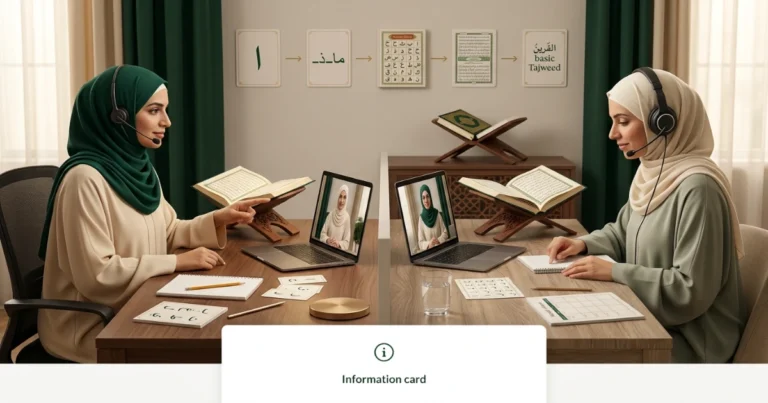
Central Time Online Quran Classes: After-School and Weekend Options

Central Time online Quran classes can fit Muslim family routines well when lesson times are chosen around the learner’s real week rather than an ideal calendar. Families in cities such as Chicago, Dallas, Houston, Minneapolis, St. Louis, Kansas City, Memphis, Nashville, Birmingham, and New Orleans often plan around Central Time (CT), which changes between CST and CDT through the year. This guide explains practical after-school and weekend planning windows for children, teenagers, adults, and siblings, along with daylight-saving guidance and a simple way to request a current Noor Hafiza Academy slot without treating example times as guaranteed availability.
What are good Central Time online Quran class options after school and on weekends?
For many school-age children, a useful planning window is roughly 4:00 PM to 8:00 PM Central Time after school. Younger children often focus better between about 4:00 and 6:00 PM after a snack and short break, while older children and teens may prefer later evening times. Weekend morning and early-afternoon lessons can be easier for families with heavy homework or sports schedules. Early-morning classes can also work for some adults, teens, homeschoolers, or families with later school starts. These are planning examples only; current Noor Hafiza Academy teacher availability should be confirmed directly.
What does Central Time mean for online Quran scheduling?
Central Time is commonly abbreviated as CT because the actual offset changes seasonally in most places. Central Standard Time is UTC−6, while Central Daylight Time is UTC−5. Families do not need to manually calculate that difference every week; the simplest approach is to plan lessons in local CT and follow the time shown on the family’s own device or booking confirmation.
This matters when the teacher is abroad. A lesson that remains 5:30 PM for a family in Dallas may correspond to a different teacher-local hour after daylight-saving changes. Reconfirming around seasonal clock changes prevents confusion.
Do not memorize one overseas conversion and assume it stays correct all year. Let the family’s current Central Time clock remain the anchor.

Which U.S. cities commonly use Central Time?
Examples include Chicago, Dallas, Houston, Minneapolis, St. Louis, Kansas City, New Orleans, Memphis, Nashville, Birmingham, Milwaukee, Oklahoma City, and many other communities across the central United States. Large parts of Texas, Illinois, Wisconsin, Minnesota, Missouri, Louisiana, Arkansas, Mississippi, Alabama, Oklahoma, and nearby states use Central Time.
Some states cross time-zone boundaries, so families near a boundary should confirm the local clock for their city rather than relying on the state name alone.
After-school online Quran class timings in Central Time
Early after-school
Often suitable for younger children who arrive home early and can take a short break first.
Core family window
Can work well between school recovery and the busiest dinner or homework period.
Later evening
May suit older children and teens, provided homework, Salah, dinner, and bedtime remain manageable.
A child who is exhausted at 7:30 PM will not benefit simply because that slot looks convenient on paper. The best time is the earliest sustainable slot that fits the household.

Fit Quran class around the family’s real evening routine
- Allow a snack and short break after school for younger learners.
- Avoid the exact time dinner is normally served.
- Protect the family’s local Salah routine.
- Do not push homework so late that bedtime becomes the cost of the lesson.
- Keep sports and tutoring days in mind before choosing fixed weekdays.
- Use the same lesson time each week where possible.
Weekend Quran class options for Central Time families
| Planning window | May suit | Check first |
|---|---|---|
| 8:00–10:00 AM CT | Early-rising families and young children | Sleep, breakfast, sports |
| 10:00 AM–12:00 PM CT | School-age children | Weekend activities and errands |
| 12:00–2:00 PM CT | Older students and adults | Dhuhr and lunch |
| Late afternoon / evening | Families busy in the morning | Sports, visitors, dinner, Salah |
Weekend teacher availability can change, so these windows are meant to help families decide what they prefer before contacting the academy.
Best timing approach for younger children
Young children usually learn best before fatigue becomes the main issue. An early after-school slot after a snack, or a weekend morning lesson, is often easier than a late-evening class. Shorter sessions may also work better for beginners who are learning Arabic letters, Noorani Qaida, or early Quran reading.
If a child becomes restless after fifteen or twenty focused minutes, a shorter lesson with consistent home practice may be more productive than extending the session only because an hour is available.
Central Time options for teenagers and adults
Later afternoon or early evening
Can fit after school activities, but exam weeks and sports should be planned in advance.
Morning, evening, or weekend
Work schedules vary, so adults often benefit from choosing the most repeatable weekly slot rather than the most convenient one-time opening.
How to plan lessons for siblings in Central Time
Families with two or more children often prefer one Quran-learning block. Back-to-back lessons can keep devices, materials, and parental supervision organized. Parallel lessons with different teachers may also work if the family has enough devices and quiet space.

CST vs CDT: what families need to know
Most Central Time communities change clocks seasonally. During standard time the zone is CST, and during daylight saving time it is CDT. Because many online teachers live in other countries, the teacher’s local time may shift relative to the family’s lesson.
Around clock-change periods, check the next lesson confirmation or ask the academy to reconfirm the time. This is safer than manually converting from an old screenshot or message.
Choose timing according to the Quran course
Use a high-attention slot
Beginners need careful sound recognition and letter correction, so avoid the child’s most tired hour.
Protect consistency
A stable weekly time helps reading fluency and correction build gradually.
Leave room for home revision
The live lesson should not consume the only available Quran-learning time in the week.
Weekend can suit discussion
Longer discussion-based lessons may work better when the child is not rushing from homework.
How long should a Central Time online Quran lesson be?
| Length | Often suitable for | Scheduling benefit |
|---|---|---|
| 20–30 minutes | Young children, beginners, focused revision | Easy to fit before dinner or homework |
| 30–45 minutes | School-age readers, Tajweed, Hifz | Balanced teaching and correction time |
| 45–60 minutes | Older students or mixed goals | More depth but requires stronger attention |
What to do when school exams disrupt the normal Quran lesson
A busy school period does not always require stopping Quran learning completely. Families can ask whether a shorter lesson, revision-only lesson, temporary day change, or weekend option is possible. The key is to communicate before the schedule becomes unmanageable.
For Hifz students, protecting revision may be more important than adding new memorization during an exam week.
Example Central Time family planning windows
| Family profile | Possible planning window | Why it may work |
|---|---|---|
| Young child, home by 3:30 PM | 4:30–5:30 PM CT | Snack and short break first |
| Two siblings | Back-to-back 5:00–6:00 PM CT | One family Quran block |
| Teen with sports | 7:00–8:00 PM CT on non-sport days | Allows activities to finish first |
| Busy school week | Weekend morning | Less homework pressure |
| Adult professional | Early morning or evening | Avoids core work hours |

What to send when asking for a Central Time Quran class
- City and state.
- Confirm that your local schedule uses Central Time.
- Learner age and current Quran level.
- Course required.
- Preferred lesson days.
- Two or three acceptable CT windows.
- Whether siblings need consecutive or parallel lessons.
- School, sports, work, or exam constraints.

Online Quran classes for Central Time Muslim families
Noor Hafiza Academy provides online Quran learning for children, girls, women, adults, beginners, and returning learners with female Quran teachers. Families can ask about Noorani Qaida, Quran reading, Tajweed, Hifz, Islamic Studies, short Surah memorization, and related Quran-learning goals.
Because teacher schedules change, this page does not present any example time as guaranteed live availability. Current class timings, lesson duration, teacher availability, trial arrangements, fees, safeguarding practices, privacy policies, and enrollment terms should be confirmed directly.
Send your city/state, learner age, course, preferred days, and two or three CT windows so the academy can check current teacher availability.
FAQs about Central Time online Quran classes
What time zone should Central U.S. families use for online Quran classes?
What are good after-school Quran class times in Central Time?
Are weekend Quran classes easier for Central Time families?
Can siblings take lessons back to back?
How does daylight saving time affect Central Time Quran lessons?
Which cities commonly use Central Time?
What is the best class time for young children?
What time works well for teenagers?
Can adults take Quran classes before work?
Should Quran lesson length change by age?
What if school exams make the normal lesson time difficult?
How do I ask Noor Hafiza Academy for a Central Time class slot?
Choose a Central Time lesson your family can sustain every week
Use CT as the anchor, protect school and bedtime, offer several acceptable windows, and confirm the current teacher schedule directly rather than relying on an unverified example time.