
Quran Waqf Signs: Where to Stop and Start While Reciting

Quran Waqf signs are symbols printed in the Mushaf to guide readers about where stopping, continuing, or restarting is appropriate. They help protect meaning, support natural breathing, and prevent a beginner from breaking a phrase in an awkward place. Common signs include م for a strong stop, لا where stopping is generally avoided, ج where stopping or continuing are both acceptable, and قلى or صلى where one choice is generally preferred. Some Mushafs also use paired symbols that allow stopping at one of two places but not both. Exact notation can vary by Mushaf printing tradition, so learners should use the conventions of the Mushaf they recite from and ask a qualified teacher when meaning or restart points are unclear.
What do Quran Waqf signs tell a reader?
Quran Waqf signs help a reader decide where to stop, continue, or restart while reciting. A common beginner guide is: م indicates a strong stopping point; لا indicates that stopping should generally be avoided; ج means stopping or continuing are both acceptable; قلى generally indicates that stopping is preferable; صلى generally indicates that continuing is preferable; and paired stop signs—often shown as three dots in two nearby places—mean the reader may stop at either marked location but should not stop at both. Because sign systems can vary slightly between Mushaf editions, learners should follow the notation of their Mushaf and teacher.
What are Waqf and Ibtida?
Waqf means stopping during recitation, usually to take a breath and then continue. Ibtida means beginning or restarting recitation from a suitable place. The two skills belong together. A reader may stop correctly but then restart from a phrase that is incomplete or confusing.
Good Waqf considers the end of a phrase, the printed sign, grammar, meaning, and the reader’s breath. Good Ibtida considers where the meaning can resume clearly. Beginners do not need advanced Arabic grammar before learning useful stopping habits, but they should understand that not every space between words is an equally good place to stop.
Do not wait until your breath is completely gone. Look ahead for a safe stopping point and plan your recitation.
The most common Quran Waqf signs beginners should know
Waqf Lazim
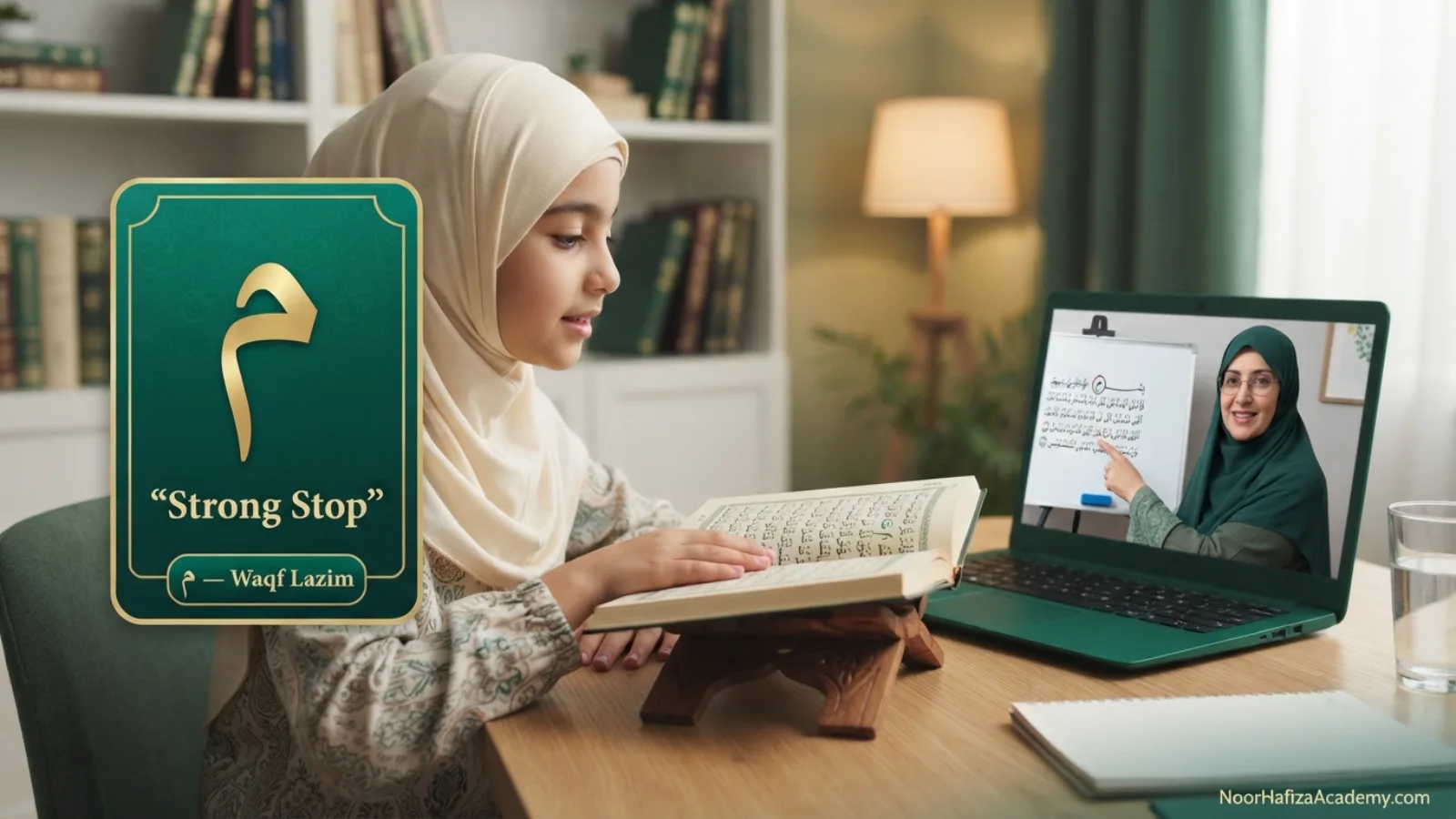
A strong stopping point. In common teaching, the reader should stop because continuing may connect meanings in an undesirable way.
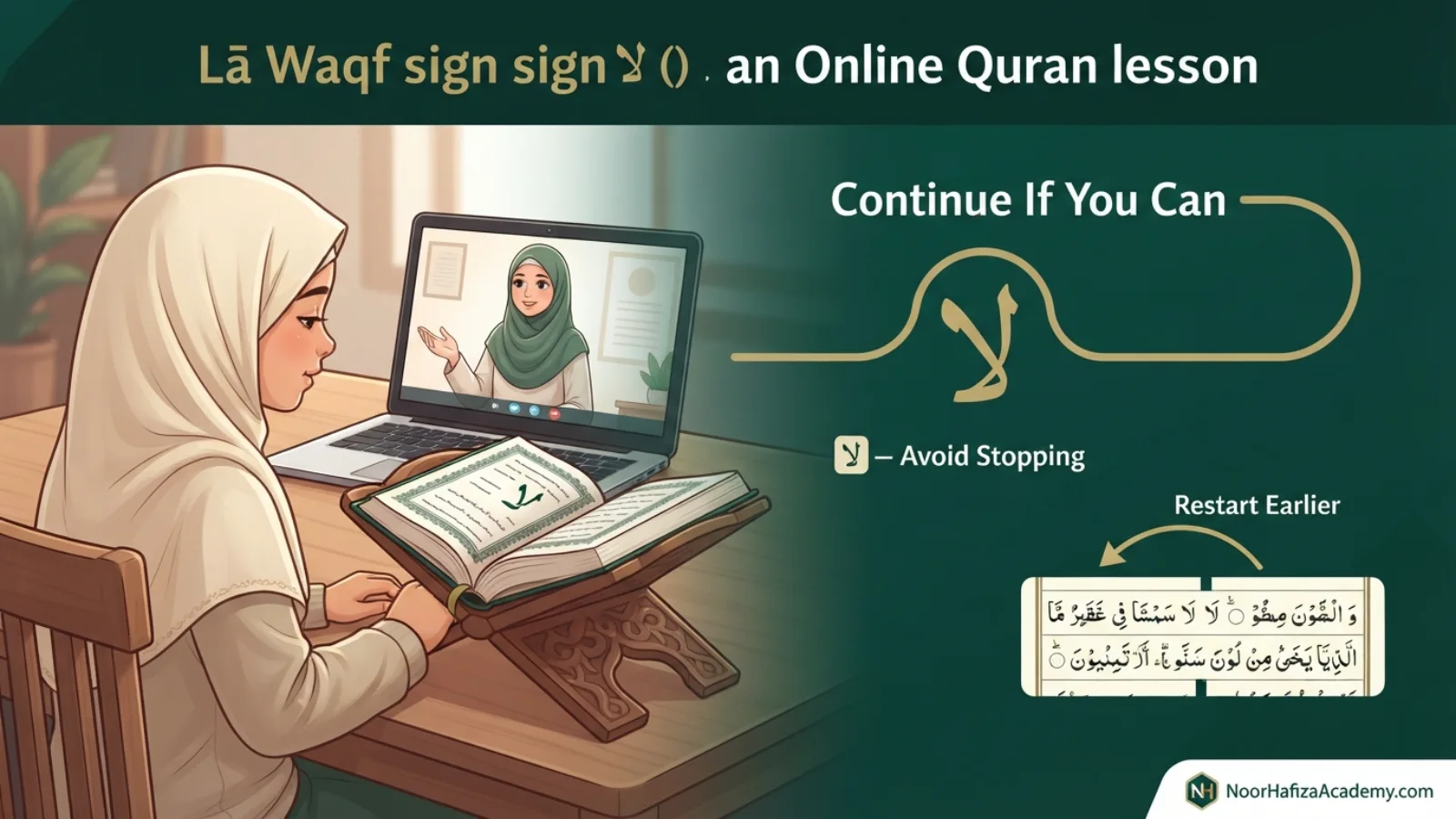
Beginner cue: Stop here.Lā — Avoid Stopping
Stopping is generally avoided when continuation is possible because the phrase remains strongly connected to what follows.
Beginner cue: Continue if you can.Waqf Jaiz
Stopping and continuing are both generally permissible, so breath and recitation flow can guide the choice.
Beginner cue: Either is acceptable.Stopping Preferred
Stopping is commonly considered preferable, although continuing can still be allowed.
Beginner cue: Better to stop.Continuing Preferred
Continuing is commonly considered preferable, though stopping may still be permitted depending on the notation system.
Beginner cue: Better to continue.Paired Stop
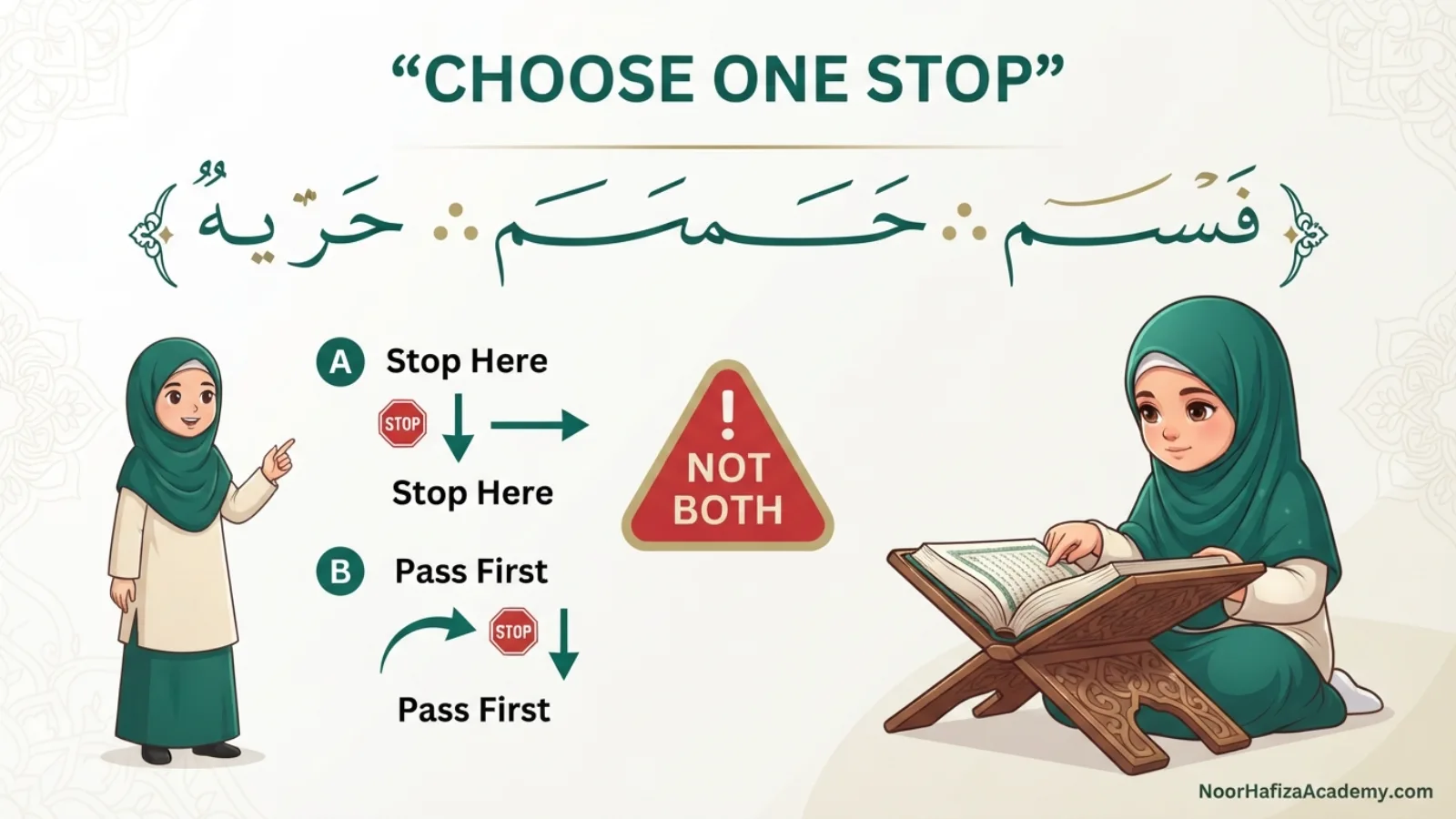
Two nearby paired marks indicate two alternative stopping places. The reader chooses one of them, not both.
Beginner cue: Choose one stop.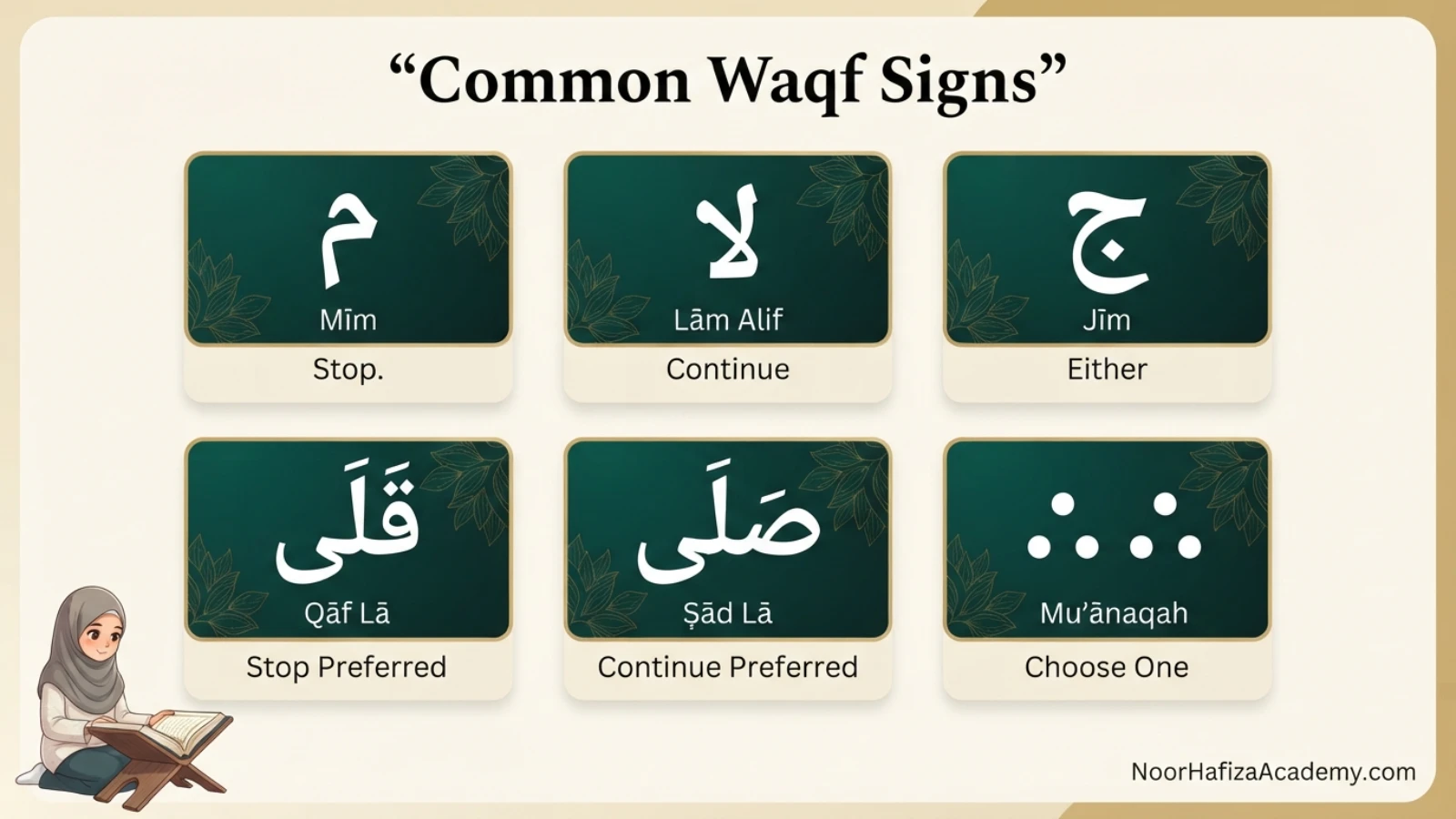
What does the Meem (م) Waqf sign mean?
The Meem sign is commonly called Waqf Lazim and marks a strong stopping point. It tells the reader that the phrase should be separated from what follows. For a beginner, treating م as “stop here” is a useful practical rule.
The reader should not rush the preceding words simply to reach the sign. Instead, prepare the breath, finish the word correctly, stop calmly, and then restart from the next appropriate phrase. A teacher can explain whether the next printed phrase is a suitable Ibtida point or whether a little context should be repeated.
What does the Lā (لا) Waqf sign mean?
Lā generally means that the reader should not intentionally stop at that point when continuing is possible. The words before and after the sign are closely connected in meaning or structure.
If breath genuinely runs out, stopping is safer than straining the voice, speeding up, or damaging pronunciation. The critical part then becomes Ibtida. Do not automatically restart from the exact word where the breath failed. Go back to an earlier phrase that makes sense and restart from there.
What do ج, قلى and صلى mean?
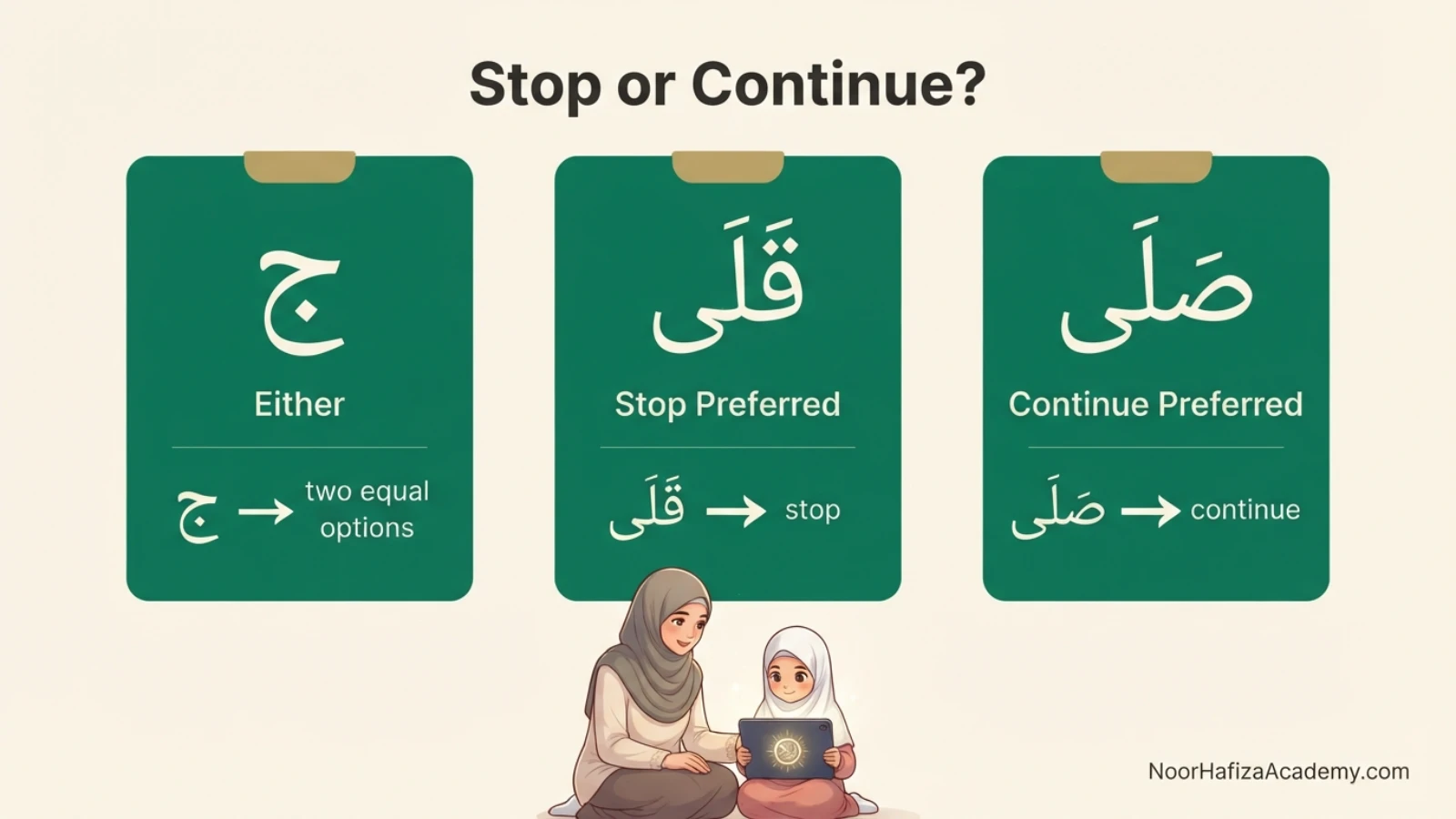
| Sign | Common meaning | Beginner action | Breath use |
|---|---|---|---|
| ج | Stop or continue | Either is generally acceptable | Useful optional breathing point |
| قلى | Stopping preferred | Prefer the stop when practical | Good planned phrase ending |
| صلى | Continuing preferred | Continue if breath allows | Avoid planning a stop unless needed |
These signs are especially helpful because they teach beginners that Waqf is not always “stop” versus “do not stop.” Sometimes both are valid but one better supports flow or meaning. A learner should become comfortable making a calm choice rather than hesitating whenever the sign is not absolute.
How do paired Waqf signs work?
Paired stop marks, often displayed as two groups of three dots, are commonly called Mu‘anaqah or embracing stops. They mark two alternative stopping places. If you stop at the first, you continue through the second. If you pass the first, you may stop at the second.
Paired-stop decision
Then continue through the second mark.
You may stop at the second mark.
The two marks are alternatives, not two consecutive stops.
How can stopping change the final sound?
Stopping can change the pronunciation of the final part of a word. A final short vowel may no longer be read the same way it is during connected recitation. Tanween, Taa Marbutah, Madd, Qalqalah, and other endings can behave differently at Waqf.
This connects Waqf to other Tajweed topics. For example, stopping can create temporary Sukoon that produces Madd ‘Arid Lissukun. Stopping on a final Qalqalah letter can also make the Qalqalah stronger because the final letter becomes sakin.
Madd can change
Stopping may create Madd ‘Arid Lissukun and introduce 2, 4, or 6-count options in the recognized rule.
Qalqalah can appear
A final Qalqalah letter may become sakin when stopping and produce a clearer rebound.
Where should you restart after stopping?
Ibtida should begin from a place that allows the meaning to develop clearly. A beginner should avoid restarting from a pronoun, conjunction, descriptive fragment, exception, or dependent phrase when that would disconnect it from the words that explain it.
If the stop was planned at a normal Waqf sign, the next phrase may be a natural restart. If the stop was forced because breath ended in an unsuitable place, go back to an earlier meaningful point. The exact restart may depend on grammar and meaning, so advanced cases belong with a qualified teacher.
Safer restart habits
- Restart from a phrase that carries a clear meaning.
- Do not restart from a word that obviously depends on what came before.
- After a forced stop at لا, review the phrase before restarting.
- Use teacher-marked restart points during practice.
- Do not assume every internal word is a safe Ibtida point.
What if your breath ends before the next Waqf sign?
Do not strain, speed up, or sacrifice Tajweed simply to reach a sign. Stop at the best available point and then restart from an earlier meaningful phrase. Breath management should support recitation, not control it.
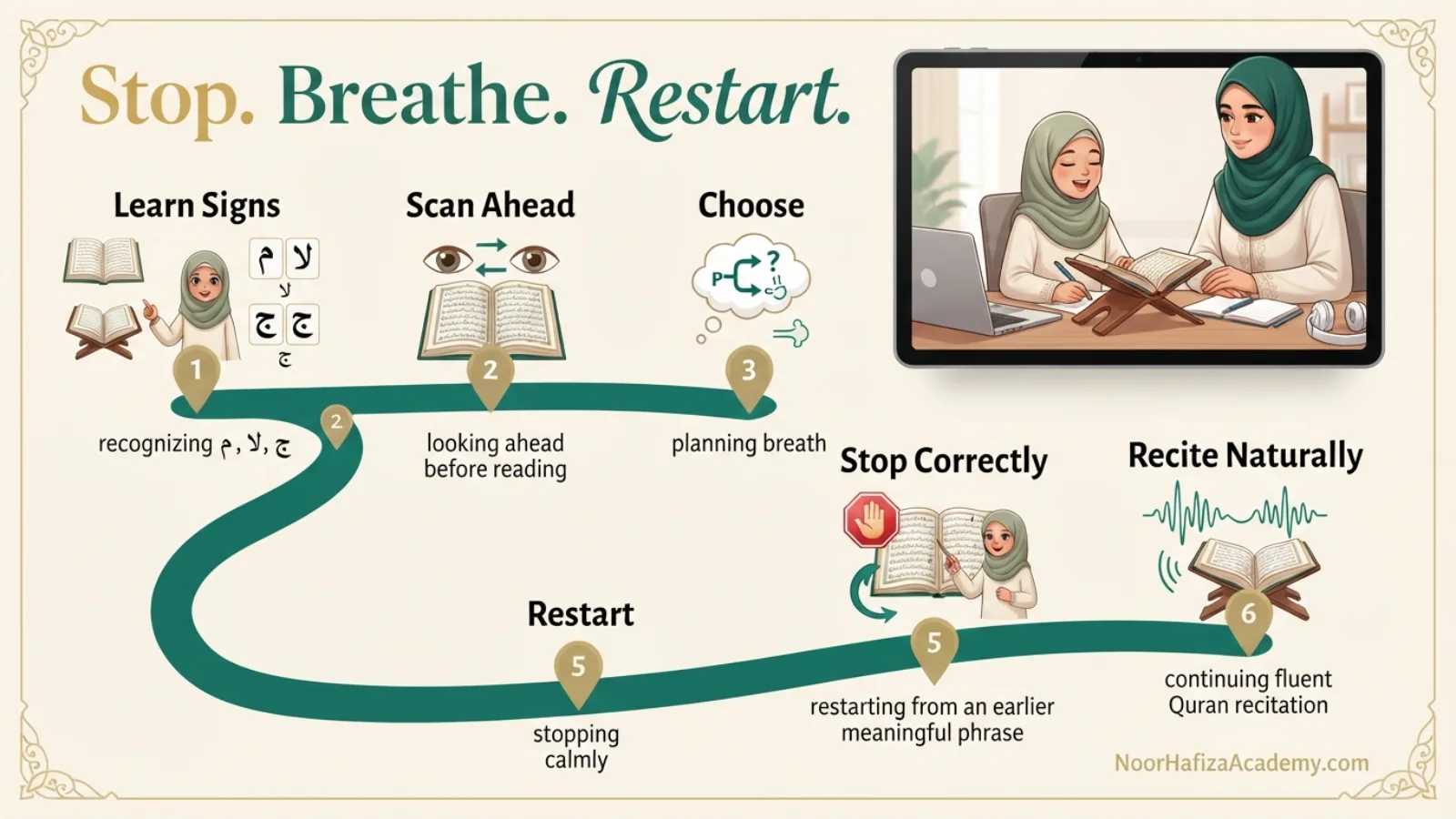
Three-step breath plan
Scan ahead and notice one or two possible stopping points.
Keep normal pace and pronunciation instead of rushing.
Stop safely and restart from a meaningful point.
Common Waqf and Ibtida mistakes beginners make
Stopping only when breath is gone
The reader ignores signs and meaning until an emergency stop becomes unavoidable.
Stopping intentionally at لا
The phrase is broken where continuation is generally preferred.
Ignoring م
A strong stopping point is passed without understanding its function.
Treating ج as “must stop”
Jim generally allows either stopping or continuing.
Stopping at both paired signs
The reader misses the fact that they are alternative stopping places.
Restarting from the breath-break word
The new phrase may be grammatically or meaningfully incomplete.
Ignoring stopping pronunciation
The reader keeps connected-reading endings even after stopping.
Assuming every Mushaf is identical
Some printed symbols and preferences differ across Mushaf editions.
Easy Waqf and Ibtida practice tips
Learn six common signs
Start with م, لا, ج, قلى, صلى and paired stops.
Scan before reciting
Look ahead for safe stopping points before your breath gets short.
Name the choice
During drills, say “stop,” “continue,” or “either” before reciting.
Practise the final word
Learn how the ending changes when you stop.
Practise Ibtida
Ask where to restart after planned and forced stops.
Read naturally
Apply the signs without pausing to analyze every symbol aloud.
A simple 30-day Quran Waqf signs practice plan
| Week | Main focus | Home practice | Teacher checkpoint |
|---|---|---|---|
| Week 1 | Common signs | Find and classify م, لا, ج, قلى, صلى and paired marks | Check symbol recognition |
| Week 2 | Stopping endings | Practise final vowels, Tanween, Madd and Qalqalah at stops | Check end-of-word pronunciation |
| Week 3 | Ibtida | Choose safe restart points after planned and forced stops | Check meaning and grammar |
| Week 4 | Natural recitation | Recite short passages with planned breath and Waqf choices | Check fluency, signs and restart quality |
What parents should notice when a child learns Waqf signs
Simple parent checklist
- Can the child recognize the common Waqf signs?
- Does the child plan a stop before breath is completely gone?
- Does the child avoid intentional stops at لا?
- Does the child know that ج allows either choice?
- Can the child choose one of a paired set of stops?
- Does the final word change correctly when stopping?
- Can the child restart from a meaningful place after a forced stop?
- Does Waqf become more natural in fresh Quran reading?
Questions to ask a Quran teacher about Waqf and Ibtida
Use these during a Tajweed lesson
- Which Waqf sign system does this Mushaf use?
- How do you explain م, لا, ج, قلى and صلى to beginners?
- How do you teach paired stop signs?
- What should a student do when breath ends before a safe stop?
- How do you teach restart points after an unplanned stop?
- How does stopping change final vowels and Tanween?
- How does stopping affect Madd ‘Arid Lissukun?
- How does stopping affect Qalqalah?
- How do you teach meaning-aware stopping without overwhelming beginners?
- Do you mark safe breath points during lessons?
- How do you test Waqf and Ibtida in unfamiliar passages?
- When is a learner ready for more advanced Waqf study?
Online Tajweed classes for Quran Waqf and Ibtida
Noor Hafiza Academy offers live online Quran learning for girls, women, children, adults, new Muslims, complete beginners, and returning readers with female Quran teachers. A Tajweed assessment can review Arabic reading, Makharij, Harkaat, Sukoon, Shaddah, Qalqalah, Ghunnah, Madd, Noon and Meem rules, Waqf, Ibtida, and current recitation fluency.
A suitable plan may include Noorani Qaida, Quran reading, Tajweed foundations, stopping signs, end-of-word rules, breath planning, and meaningful restart points. Current teacher qualifications, availability, schedules, trial arrangements, fees, privacy practices, policies, and enrollment terms should be confirmed directly.
Share the learner’s age, current Quran level, Tajweed experience, time zone, schedule, and whether the main challenge is stop signs, breath planning, end-of-word pronunciation, or restarting.
FAQs about Quran Waqf signs
What are Waqf signs in the Quran?
What does م mean in Quran recitation?
What does لا mean in the Quran?
What does ج mean in Waqf signs?
What does قلى mean?
What does صلى mean?
What are paired Waqf signs?
What should I do if I run out of breath at لا?
Does stopping change pronunciation?
What is Ibtida?
Do all Mushafs use exactly the same Waqf signs?
How should beginners practise Waqf signs?
Learn where to stop, where to continue, and how to restart with clearer Quran recitation
Share the learner’s age, current Quran level, Tajweed experience, time zone, schedule, and whether the main difficulty is Waqf signs, breath planning, stopping endings, or Ibtida.