What Qualifications Should an Online Quran Teacher Have?
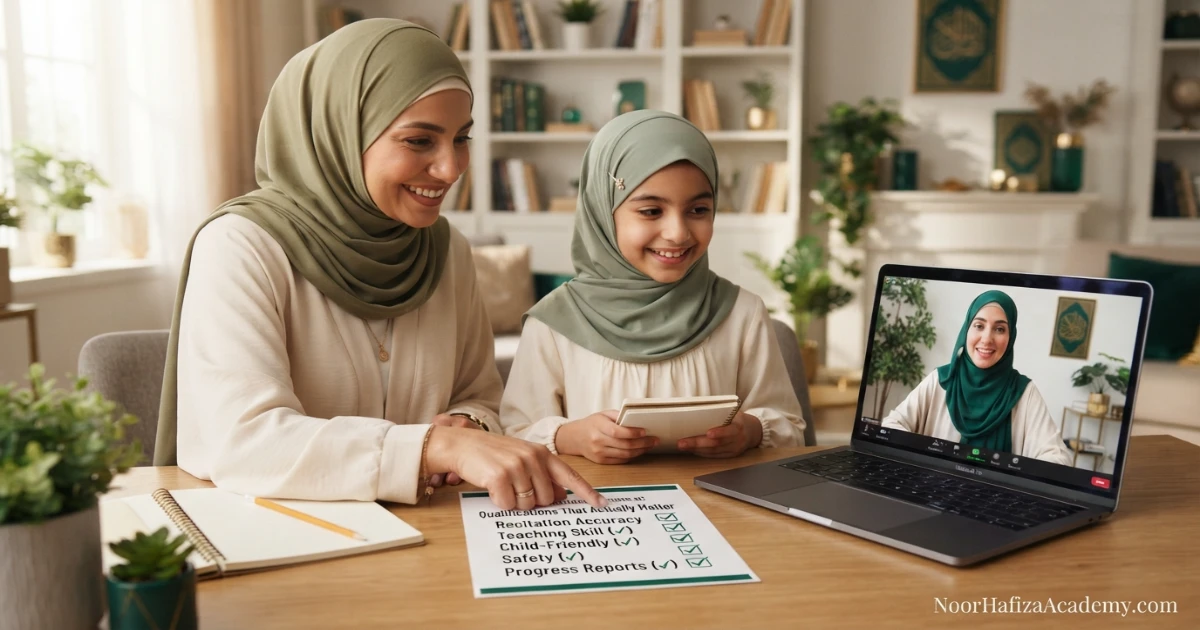
A qualified online Quran teacher needs more than a pleasant voice or a certificate displayed on a profile. The teacher should recite accurately, understand the Tajweed and reading foundations relevant to the course, diagnose learner mistakes, explain corrections clearly, adapt to age and level, communicate respectfully, manage online lessons professionally, protect child safety and privacy, and provide measurable progress feedback. Additional qualifications—such as formal Islamic studies, memorization, specialized Tajweed study, teacher training, or an ijazah—may be valuable depending on the course, but parents should never treat one credential as a substitute for teaching skill, reliability, child fit, and evidence from a live trial.
What qualifications should an online Quran teacher have?
An online Quran teacher should have accurate Quran recitation, sound knowledge of the reading and Tajweed skills required for the course, relevant teaching experience, clear communication, patience, diagnostic listening, and the ability to structure online lessons around independent learner practice. For children, the teacher should also understand age-appropriate teaching, safeguarding, parent-visible communication, and attention needs. Hifz teachers should know how to manage new memorization, recent revision, older revision, prompting, and retention. Advanced Tajweed or Quranic studies teachers may need stronger formal study or recognized authorization relevant to what they teach. Parents should verify qualifications through a live trial, recitation sample, clear explanations, references or academy oversight, and evidence of progress—not credentials alone.
What does “qualified Quran teacher” actually mean?
The word qualified can refer to several different things. A teacher may have strong recitation, formal study, memorization, an ijazah, years of teaching, a child-development background, academy training, or experience with a specific curriculum. These are useful signals, but they do not all measure the same ability.
For parents, a practical definition is more helpful: a qualified Quran teacher has enough knowledge and skill to teach the stated course accurately, safely, clearly, and consistently to the learner in front of her. This means the teacher’s qualifications should match the task. A Noorani Qaida teacher needs strong letter and reading foundations, accurate pronunciation, patience, and beginner teaching skill. A Tajweed teacher needs deeper diagnostic listening and rule application. A Hifz teacher needs a reliable revision system and strong recitation. An Islamic Studies teacher needs appropriate subject knowledge and age-sensitive explanation.
Ask what she is qualified to teach, which age and level she regularly teaches, how the academy verifies her work, and whether a live trial shows that her knowledge becomes clear learner progress.
Parents should distinguish subject expertise from teaching expertise. A person may recite beautifully yet struggle to explain why a child’s sound is wrong. Another may know many rule names but interrupt every word without prioritizing the learner’s main need. Qualifications become meaningful when they support accurate, effective instruction.
Core qualifications every online Quran teacher should have
Accurate Quran recitation
The teacher should model letters, vowels, shaddah, sukoon, madd, stopping, and connected recitation clearly enough for the course.
Sound Tajweed application
She should apply the rules she teaches and distinguish major reading problems from finer recitation improvements.
Diagnostic listening
The teacher should identify whether a mistake comes from recognition, articulation, timing, blending, memory, breath, or prompts.
Clear correction
She should explain what changed, model the correct sound, allow a full retry, and test a fresh example.
Relevant experience
Experience should match the learner’s age, level, language, confidence, course, and online learning needs.
Lesson planning
The teacher should set realistic targets, organize practice, assign manageable work, and review progress.
Respectful communication
She should maintain standards without shame, comparison, sarcasm, fear, or confusing instructions.
Reliability
Punctuality, preparation, consistent attendance, and timely parent communication are part of qualification.
Online teaching skill
She should use audio, video, shared text, listening time, and screen tools without making the lesson passive.

How accurate should the teacher’s own recitation be?
The teacher should model the content she teaches accurately and consistently. A beginner Qaida teacher should not confuse letters, shorten long vowels, add sounds after sakin letters, lose shaddah, or teach unstable stopping habits. A Tajweed teacher should demonstrate rules clearly inside connected recitation. A Hifz teacher should recognize memorization errors, joins, prompts, and recitation weaknesses.
Parents do not need to become Tajweed examiners. A trial should show whether the teacher’s model is clear, measured, and consistent. The academy should explain how teacher recitation is reviewed and which teachers are assigned to beginner, Tajweed, or Hifz programs.
A beautiful voice is not the same as reliable instruction. Melody can be pleasant, but the child needs a model that can be understood and copied at an appropriate speed.
Signs of reliable recitation instruction
- The teacher can read slowly without distorting words.
- She can isolate a difficult sound and return it to the whole word.
- She distinguishes short and long vowels clearly.
- She can explain why two similar letters are different.
- She corrects major errors without exaggerating minor details.
- Her demonstration remains consistent across repeated examples.
What level of Tajweed qualification should a teacher have?
The required depth depends on the course. Every Quran reading teacher should understand the Tajweed and pronunciation foundations needed to prevent inaccurate reading habits. A specialized Tajweed teacher should have deeper knowledge of Makharij, Sifat, vowel timing, noon and meem rules, ghunnah, qalqalah, heaviness and lightness, stopping, restarting, and how those skills appear in real recitation.
Parents should evaluate application, not only terminology. A teacher who can define a rule but cannot hear the child’s error or explain how to correct it may not be ready to teach that level independently.
| Teaching role | Expected knowledge | Trial evidence | Parent question |
|---|---|---|---|
| Qaida teacher | Letters, Makharij foundation, vowels, sukoon, shaddah, madd basics, blending | Accurate modeling and beginner-friendly correction | How do you prevent incorrect habits? |
| Quran reading teacher | Connected recitation, stopping, common Tajweed, fluency and accuracy | Diagnoses repeated reading patterns | How will you measure fluency? |
| Tajweed teacher | Deeper rule application, Makharij, Sifat, timing, nasalization and stopping | Explains and tests a correction | What formal Tajweed study have you completed? |
| Hifz teacher | Accurate recitation plus new lesson, recent revision, older revision and retention | Tests beyond the newest portion | How do you balance sabaq, sabqi, and manzil? |
| Advanced teacher | Course-specific advanced study and clear authorization | Precise diagnosis and documented scope | Which level are you authorized to teach? |
Why teaching skill matters as much as subject knowledge
Teaching is the ability to move a learner from the current level to the next level. A qualified teacher must gather evidence, choose a priority, explain it, create practice, observe a retry, and decide what comes next. This is different from simply knowing the answer.
Find the actual starting point
The teacher hears independent reading rather than relying only on the last completed page.
Choose the highest-value correction
She fixes letter identity, missing foundations, or unstable recall before minor refinements.
Use language the learner understands
Children need short concrete explanations; older learners may benefit from more detail.
Give independent attempts
The learner should read, recall, and transfer instead of only repeating.
Return to previous skills
Progress should be retained and tested, not declared because one page was completed.
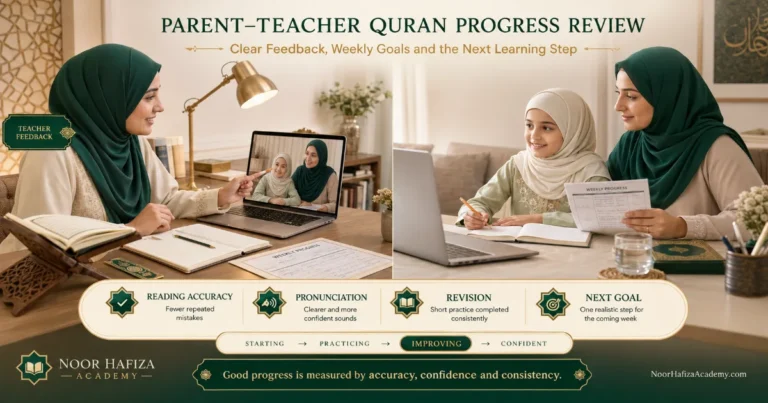
Give specific parent feedback
Parents should know what improved, what remains weak, and what to practise.
What qualifications matter when teaching children online?
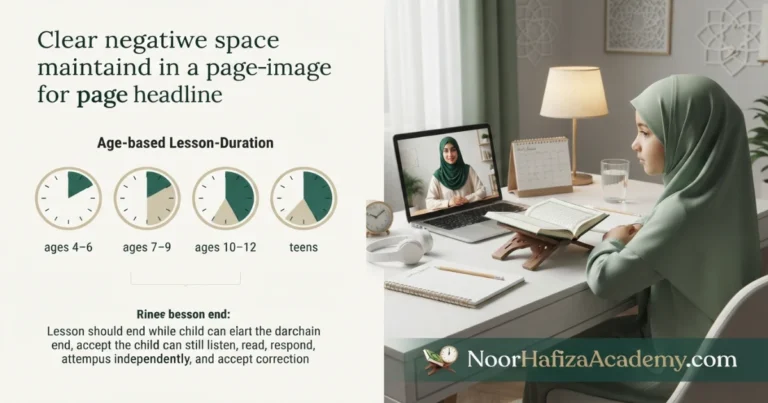
Children require more than simplified adult instruction. The teacher should understand attention, transitions, emotional safety, age-appropriate language, task length, motivation, and the parent’s role. Experience with children should be visible in the lesson rather than stated only in a profile.
Age-appropriate pacing
The teacher divides the lesson into manageable parts and notices when attention falls.
Calm redirection
She redirects respectfully without shouting, shaming, threatening, or losing structure.
Clear child language
Instructions are short and understandable, with examples suited to age and language.
Balanced encouragement
The teacher recognizes real effort without avoiding necessary correction.
Parent communication
She explains the child’s needs and assignment clearly and respectfully.
Safeguarding awareness
She follows parent-visible communication, privacy, and supervision procedures.

Qualifications should match the course being taught
One teacher may be excellent for beginners and not the right choice for advanced Tajweed. Another may be strong in Hifz revision but less experienced with young Qaida learners. Parents should ask which courses the teacher regularly teaches and what training or experience supports that role.
| Course | Teacher should be strong in | Useful additional qualification | Trial evidence |
|---|---|---|---|
| Noorani Qaida | Letters, joined forms, vowels, sukoon, shaddah, blending and early pronunciation | Experience with beginners and young children | Identifies the exact missing foundation |
| Quran reading | Accuracy, fluency, stopping, common Tajweed and unfamiliar text | Experience correcting without over-interrupting | Uses familiar and unfamiliar passages |
| Tajweed | Makharij, Sifat, timing, ghunnah, qalqalah, connected rules and stopping | Formal Tajweed study or relevant authorization | Explains and tests a correction |
| Hifz | New memorization, recent revision, older revision, prompts, joins and retention | Personal memorization and structured Hifz experience | Tests more than the newest lesson |
| Islamic Studies | Age-appropriate knowledge, explanation, discussion and application | Relevant Islamic studies education | Answers carefully and stays within knowledge |
| Adult beginners | Respectful correction, flexible pacing and confidence building | Experience with adult or returning learners | Assesses without embarrassment |
Does every online Quran teacher need an ijazah?
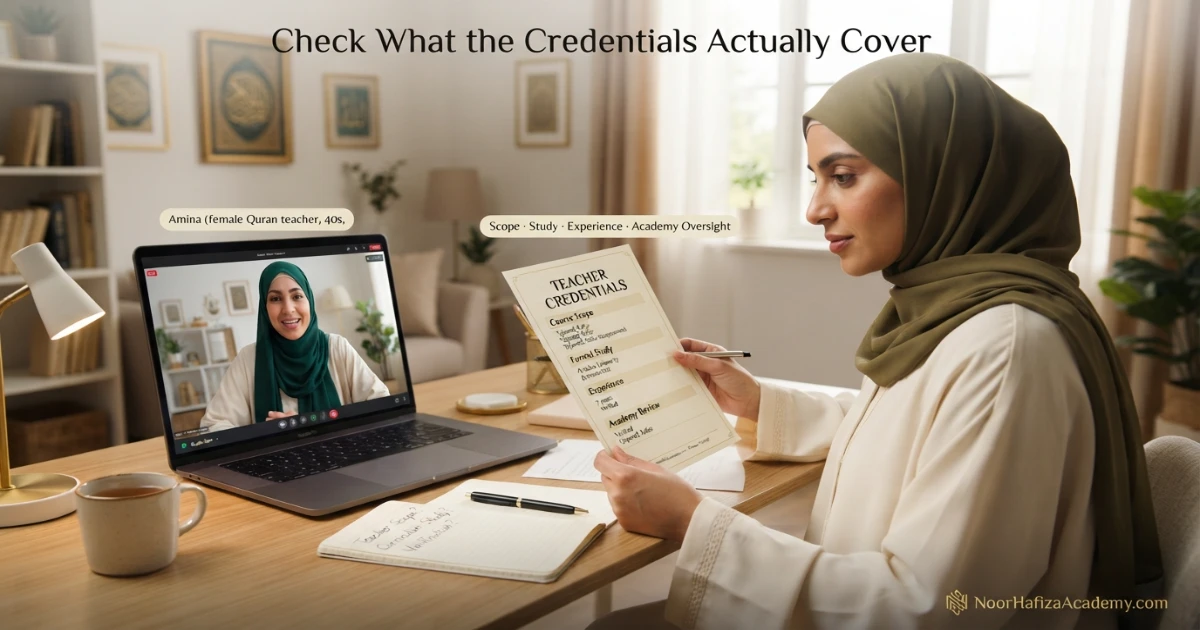
An ijazah can be a valuable form of authorization connected to a specific recitation, text, or chain of study. Parents should still understand its scope. Different credentials may relate to different levels, readings, books, or teaching permissions.
Not every beginner-learning role is evaluated in the same way. A strong Qaida teacher may have excellent supervised training and years of successful beginner teaching. An advanced Tajweed or recitation teacher may need stronger formal authorization relevant to the exact level being offered. The academy should accurately describe each teacher’s qualifications rather than using one title vaguely across all programs.
What was studied? Who assessed it? What does it qualify the teacher to teach? Parents should then use a trial to evaluate whether the knowledge can be applied effectively.
How important are language skills and communication?
The learner must understand instructions, corrections, and assignments. The teacher does not need perfect fluency in every family language, but the child should not depend on the parent to translate every step.
- The teacher gives one clear instruction at a time.
- She checks understanding instead of assuming silence means agreement.
- She can explain a difficult sound in more than one way.
- She uses terminology only when it helps application.
- She speaks respectfully about weaknesses.
- She gives home assignments parents can understand.
What online teaching skills should a Quran teacher have?
Online teaching is not simply an in-person lesson moved onto a video call. The teacher should preserve listening, correction, independence, focus, and privacy through technology.
Clear audio judgment
She notices echo, delay, low volume, or distortion and does not pretend to assess Tajweed through unusable sound.
Stable turn-taking
The teacher avoids speaking over the learner and gives complete independent attempts.
Useful visual tools
Shared pages, highlighting, or pointing support reading without making the child passive.
Attention management
The lesson changes activity when needed while keeping the Quran target clear.
Technical backup
The academy has a process for reconnecting, rescheduling, or continuing after failure.
Privacy discipline
Class links, recordings, contact, and parent communication follow clear rules.
What safety, privacy, and professionalism standards matter?
Parents should evaluate the teacher and academy system together. A skilled teacher still needs clear safeguarding, communication, supervision, and complaint procedures.
Professional standards checklist
- The teacher’s identity and role are confirmed by the academy.
- Parents know whether the same teacher continues after the trial.
- Scheduling and feedback use parent-visible channels for children.
- Camera, microphone, messaging, and recording policies are clear.
- The academy explains how teachers are reviewed and supported.
- Parents can report concerns or request a teacher change.
- Attendance, lateness, absence, and makeup policies are clear.
- The teacher maintains respectful professional boundaries.

Why punctuality and consistency are part of qualification
A knowledgeable teacher who cancels frequently or arrives unprepared can damage progress. Quran learning depends on regular listening, correction, and revision. Reliability is therefore part of educational quality.
Parents should review punctuality, lesson preparation, assignment continuity, attendance records, makeup policy, and whether previous correction priorities are remembered. A professional teacher should not restart the plan every week because notes were not maintained.
| Area | Good evidence | Concern | Parent action |
|---|---|---|---|
| Punctuality | Lessons start and finish consistently | Repeated late starts | Ask about attendance and makeup policy |
| Preparation | Teacher knows the page and previous correction | Class time is spent locating material | Request a lesson record |
| Continuity | Old skills are reviewed before targets increase | Pages advance but weaknesses remain | Ask how progress is measured |
| Communication | Changes and concerns are reported | Parents learn about issues late | Confirm review frequency |
| Records | Attendance, assignments, errors, and milestones are tracked | No consistent progress evidence | Ask for a progress report system |
How parents can verify an online Quran teacher’s qualifications
Ask for the exact teaching scope
Confirm which courses, levels, age groups, and learner types the teacher regularly teaches.
Request clear credential information
Ask what was studied, where, with whom, and what the qualification prepares the teacher to teach.
Use a live trial
Observe recitation accuracy, assessment, correction, communication, learner response, and the proposed plan.
Ask how the academy reviews teachers
Look for observation, curriculum guidance, progress records, safeguarding, and a replacement process.
Review relevant experience
Years alone are not enough. Match experience to the learner’s age, level, course, and needs.
Set an early progress review
After enrollment, compare the promised plan with attendance, accuracy, independence, retention, and comfort.
Questions parents should ask before choosing a Quran teacher
Use these questions during a trial or enrollment discussion
- Which Quran courses and levels do you regularly teach?
- What formal Quran, Tajweed, Hifz, or Islamic studies training have you completed?
- What does your ijazah or certificate specifically cover, where applicable?
- How much experience do you have with this age and level?
- How do you assess a new learner?
- How do you correct a child who becomes nervous or discouraged?
- How do you balance accuracy, fluency, and confidence?
- How do you track reading, Tajweed, or Hifz progress?
- What home practice will be expected?
- How often will parents receive feedback?
- What safety, privacy, and communication rules apply?
- What happens if the teacher and learner are not a suitable match?
Warning signs that a teacher may not be suitably qualified
Credentials are vague
The teacher uses impressive titles but cannot explain what was studied or what she is qualified to teach.
No independent assessment
The child is placed into a course without being heard or tested.
Correction is only imitation
The teacher says “listen and copy” but cannot identify the reading problem.
Every mistake is equal
The teacher interrupts constantly without prioritizing foundations.
Unrealistic promises
Fluency, Tajweed mastery, or Hifz completion is promised before assessment.
Harsh communication
The learner is compared, shamed, threatened, or made afraid to attempt.
Weak privacy information
The family cannot confirm identity, communication, recording, or complaint procedures.
No progress evidence
The teacher reports only page completion or broad praise.
What to evaluate in a trial class with the teacher
The trial should show qualifications in action. Parents should see enough to evaluate method, fit, accuracy, professionalism, and the proposed learning route.
| Area | Strong evidence | Weak evidence | Decision question |
|---|---|---|---|
| Recitation | Clear, accurate, measured modeling | Inconsistent or overly melodic model | Can the learner copy this accurately? |
| Assessment | Independent sample and diagnosis | Placement based on description | Does the starting point make sense? |
| Correction | Explains, models, retries, and transfers | Says only “wrong” | Can the teacher create independence? |
| Child fit | Clear tone, suitable pace, respectful redirection | Child remains confused or fearful | Can this relationship support learning? |
| Plan | Level, priority, course, schedule, and review are clear | Generic recommendation | Is there a realistic path forward? |

Qualified female Quran teachers for online learning
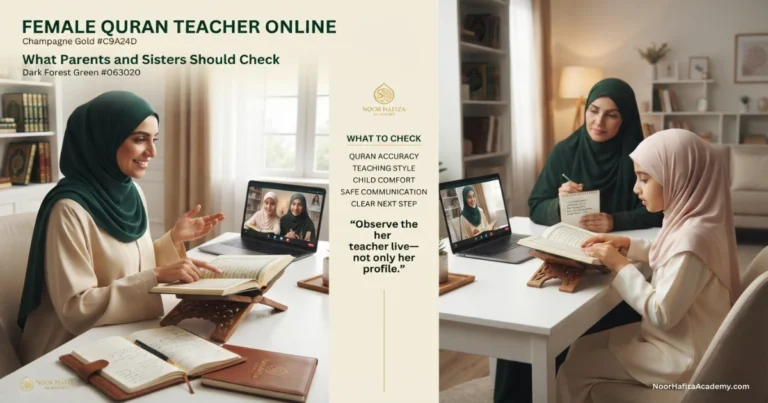
Noor Hafiza Academy offers live online Quran classes for children, girls, women, sisters, adults, beginners, Quran readers, Tajweed students, and Hifz learners with female Quran teachers. Teacher placement should consider age, current level, course, language needs, time zone, schedule, attention, previous experience, and the learner’s main goal.
Families can discuss the teacher’s relevant course experience, teaching approach, trial arrangement, lesson length, feedback process, and current availability. A live level assessment can help determine whether the learner needs Noorani Qaida, Quran reading, Tajweed, Hifz, revision, Islamic Studies, or a combined route. Current teacher qualifications, availability, schedules, fees, privacy practices, policies, and enrollment terms should be confirmed directly.
Share age, current level, course goal, previous experience, time zone, schedule, and any attention or communication needs.
FAQs about online Quran teacher qualifications
What qualifications should an online Quran teacher have?
Does every Quran teacher need an ijazah?
Is memorizing the Quran enough to become a Hifz teacher?
How can parents verify a Quran teacher’s qualifications?
What makes a Quran teacher qualified to teach children?
What qualifications should a Tajweed teacher have?
Should a Quran teacher have an Islamic studies degree?
How important is teaching experience?
Can a fluent Quran reader be a good teacher without certificates?
What online skills should a Quran teacher have?
What are red flags when choosing a Quran teacher?
Should parents choose the most qualified teacher on paper?
Choose an online Quran teacher with the knowledge, method, and reliability your learner can grow with
Share the learner’s age, current Quran level, course goal, previous experience, preferred female teacher, city and time zone, available days, and any attention or communication needs.