How Do Online Quran Classes Work? A Parent’s Step-by-Step Guide

Online Quran classes connect your child with a live Quran teacher through a secure video lesson. This guide explains what happens after you contact an academy, how the starting level is chosen, what a well-structured lesson includes, what parents should do at home, and how to recognize meaningful progress.
How do online Quran classes work?
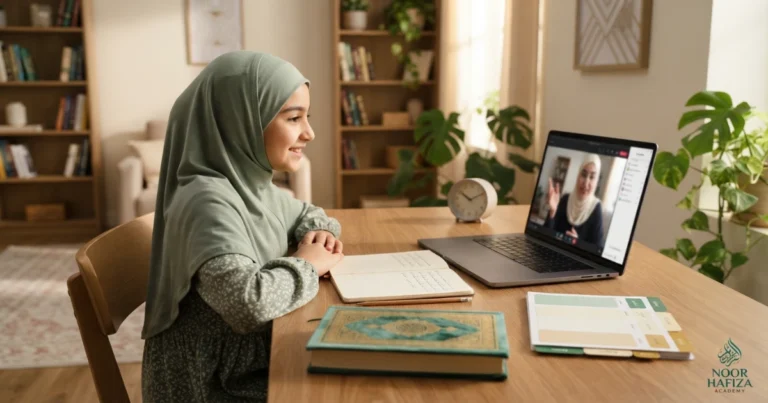
Online Quran classes begin with a short discussion about the learner’s age, current ability, time zone, and goal. The student then joins a live trial or level assessment. A teacher listens carefully and recommends the right starting course—such as Noorani Qaida, Quran reading, Tajweed, Hifz, Islamic Studies, or revision. After the family confirms a suitable teacher and recurring schedule, the learner attends live video lessons that include review, focused instruction, supervised reading or memorization, immediate correction, and a clear home-practice target. Parents support the process by protecting class time, preparing a calm learning space, and helping the child complete short, consistent revision between lessons.
Online Quran classes work in seven practical steps
For a parent, the biggest question is rarely whether a video call is possible. The real question is whether an online class can feel organized, personal, safe, and educational. It can—when the academy follows a clear process. The seven steps below show what a family should expect.
Share the learner’s age, level, and goal
Before a teacher is assigned, the academy should understand who the student is. Useful details include age, whether the learner recognizes Arabic letters, whether they can join letters, whether they already read from the Mushaf, any previous Tajweed or Hifz experience, the family’s time zone, preferred days, and the main goal. A six-year-old beginning Qaida needs a different pace from a twelve-year-old improving fluency or an adult woman returning to Quran reading after a long break.
Attend a live trial and level assessment
The trial class is not an exam that a child should fear. It is a gentle starting-point check. A teacher may ask a beginner to identify letters and vowels, ask a reader to recite several lines, or ask a Hifz student to read recent and older memorization. The purpose is to prevent two common problems: starting too far behind and becoming bored, or starting too far ahead and building new learning on weak foundations.
Choose the correct Quran learning pathway
After listening to the student, the teacher recommends a course and first milestone. A true beginner may begin with Noorani Qaida. A hesitant reader may need Quran fluency practice. A fluent reader with pronunciation weaknesses may enter Tajweed. A student ready to memorize needs a Hifz plan with revision. Children may also combine Quran lessons with age-appropriate Islamic Studies. The correct pathway is based on demonstrated ability, not only age or the last book the student completed.
Match the learner with a suitable teacher and schedule
Teacher matching matters because Quran learning is relational. Children often progress better with a teacher who is patient, expressive, and comfortable giving short instructions. Teenagers may prefer calm, respectful accountability. Adult women may need privacy, encouragement, and a teacher who understands how to restart without embarrassment. At Noor Hafiza Academy, families learn with female Quran teachers and can discuss the student’s comfort, level, availability, and program before regular classes begin.
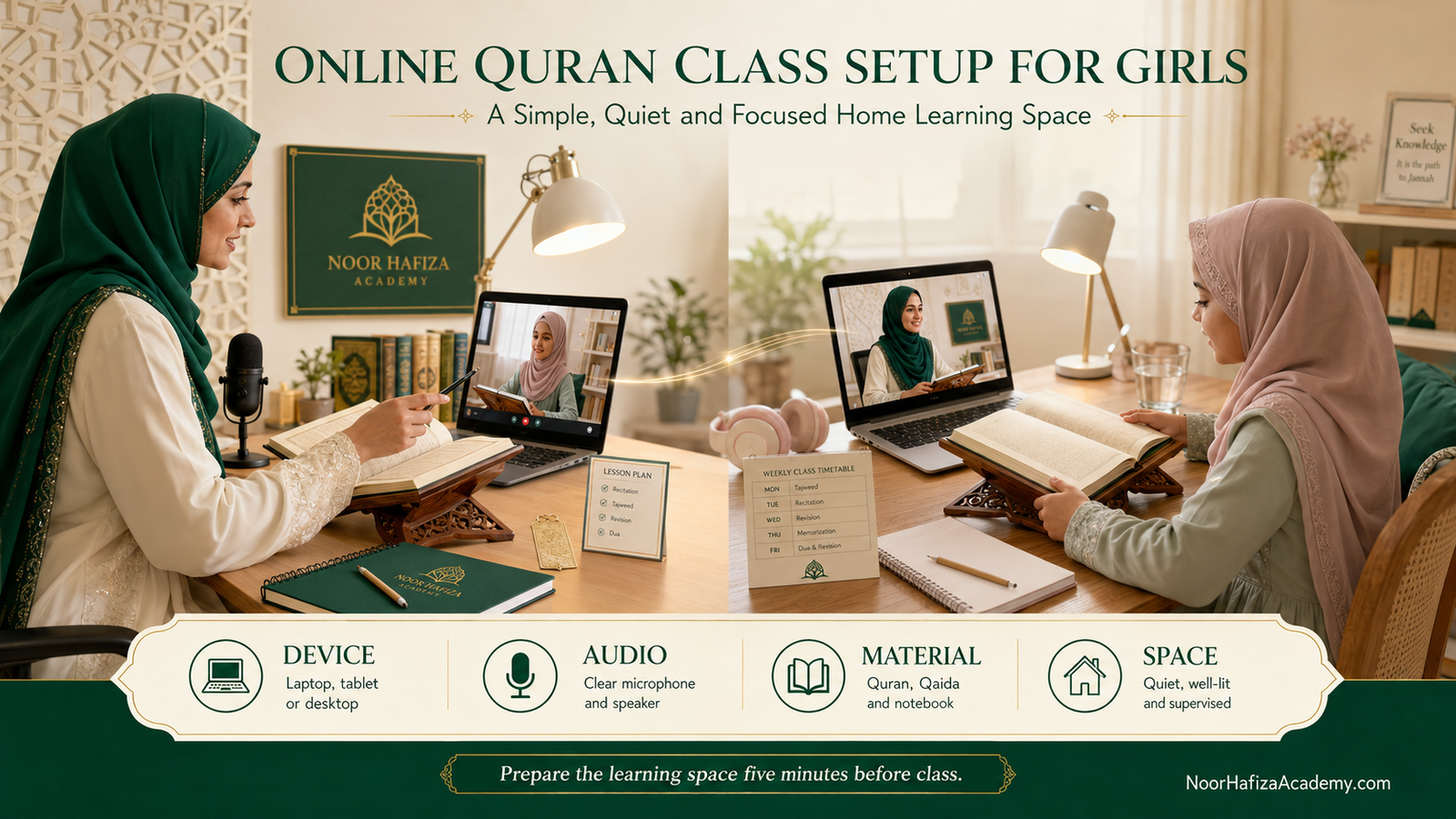
Prepare a simple home learning setup
A successful online Quran class does not require expensive equipment. The student needs a reliable device, clear audio, stable internet, the correct book or Quran, and a quiet place. Younger children should sit where a parent can support them without answering every question. The camera should show the student clearly enough for communication, while the Quran or Qaida should be easy to hold and follow. Removing toys, background television, and unnecessary browser tabs improves attention immediately.
Join regular live lessons with a repeatable structure
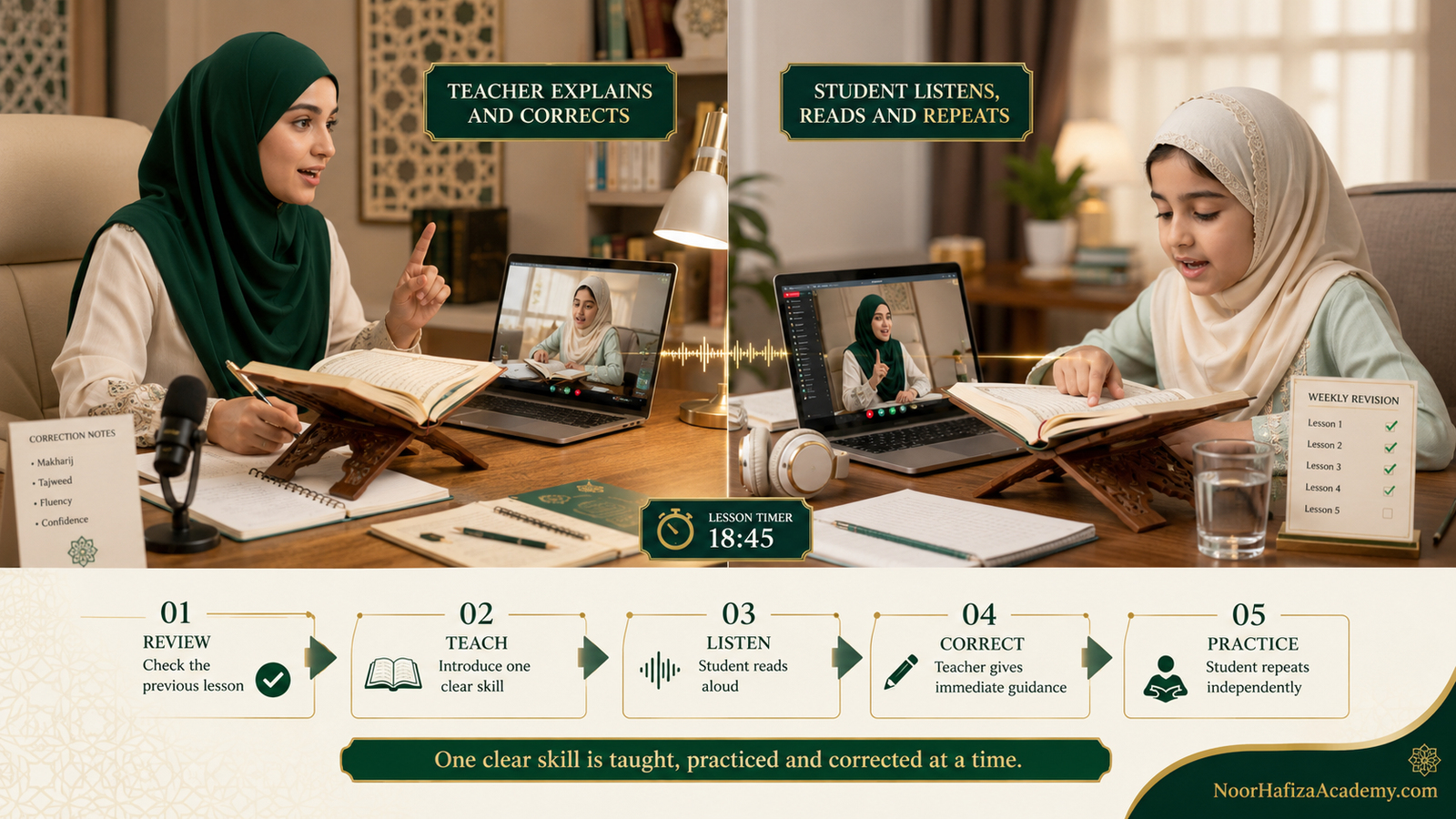
Good lessons are not random recitation sessions. They follow a pattern: greeting and settling, review of the previous target, focused instruction, student practice, immediate correction, repetition, and a clear task for home. The exact balance changes by program. Qaida lessons emphasize recognition and sound formation; Tajweed lessons emphasize rule application; Hifz lessons balance new memorization with revision; Islamic Studies lessons use explanation, questions, stories, and practical application.
Track progress and adjust the plan
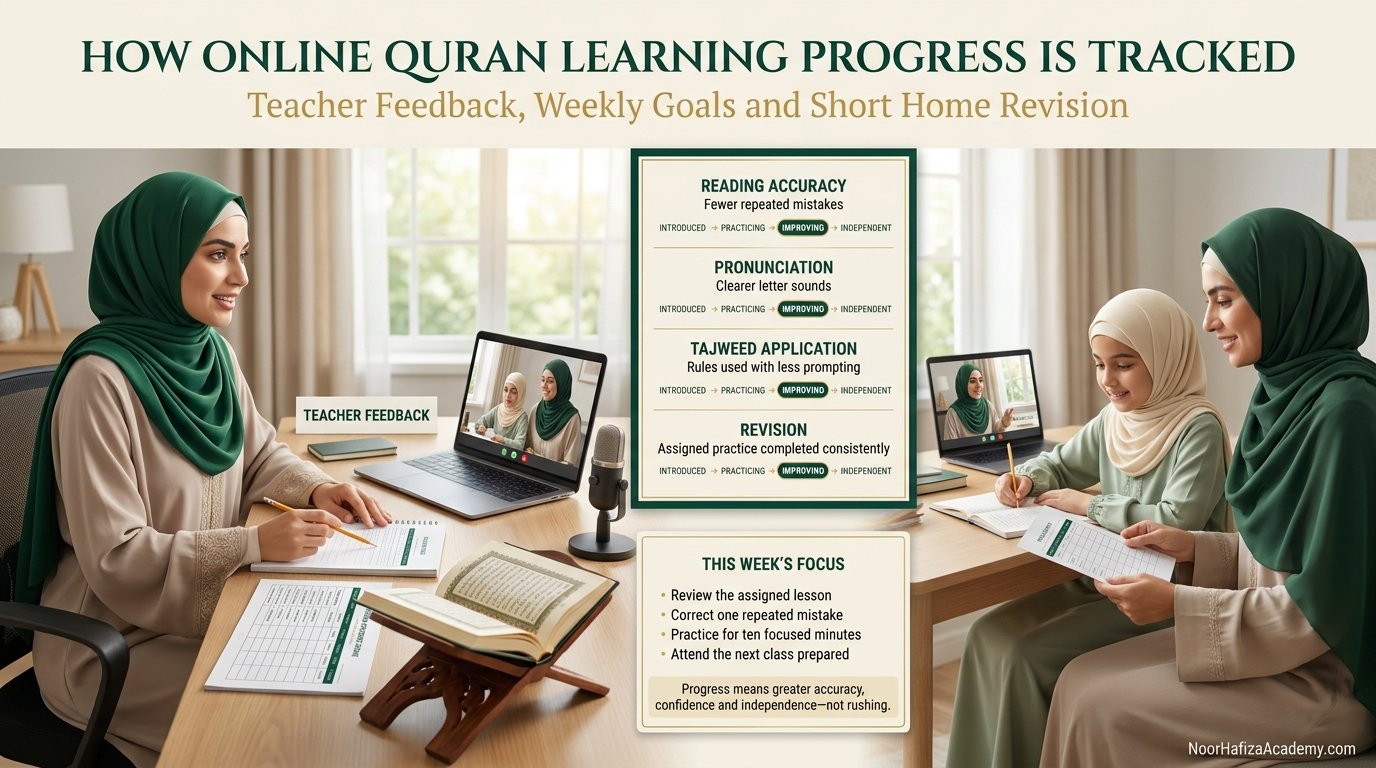
Progress should be visible in more than completed pages. Parents and teachers should look for fewer repeated mistakes, clearer pronunciation, better confidence, stronger retention, improved focus, and the ability to apply a correction without repeated prompting. When the learner is ready, the teacher increases difficulty. When a foundation remains weak, the plan slows down and strengthens it. Quality progress is responsive rather than rushed.
What happens during the free trial and level assessment?
The first lesson gives both the family and the teacher useful information. Parents see how the teacher communicates, how patiently mistakes are corrected, whether the child feels comfortable, and whether the technology works. The teacher sees the student’s real reading behavior rather than relying only on a description such as “he finished Qaida” or “she knows Tajweed.”
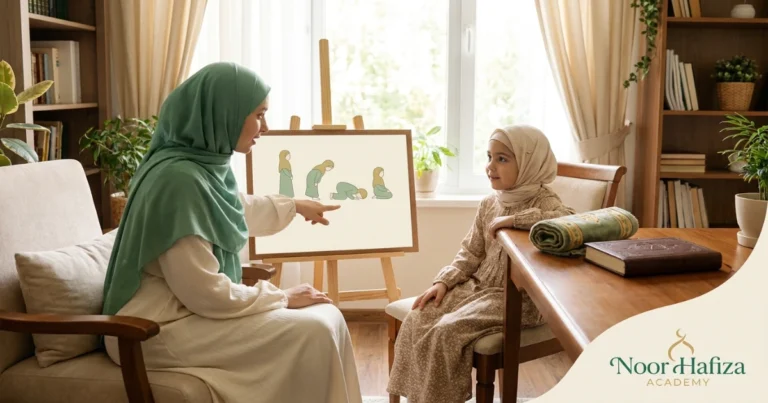
For an early beginner, the teacher may check whether the child recognizes isolated Arabic letters, distinguishes similar shapes, understands basic vowel marks, and can produce sounds without relying entirely on memorized order. For a Quran reader, the teacher may listen for fluency, stopping, joining, vowel accuracy, letter articulation, elongation, and recurring pronunciation patterns. For a Hifz learner, the teacher may compare new memorization with recent and older revision to understand retention.
Do not rehearse answers for your child or whisper corrections throughout the assessment. The teacher needs to see the learner’s independent starting point. A lower starting point is not a failure; it protects the child from future frustration and allows progress to be measured honestly.
What happens inside a live online Quran lesson?
The details change by age and course, but a well-organized lesson has a clear beginning, middle, and end. Parents should be able to describe what the teacher worked on—not simply say that the child “read Quran for thirty minutes.”
1. Review
The teacher checks the previous lesson, listens to assigned revision, and notices whether corrections were retained. This prevents the student from moving forward while old mistakes remain active.
2. Focused Teaching
One manageable concept is taught: a letter sound, joining pattern, Tajweed rule, fluency technique, memorization section, dua, or Islamic Studies objective.
3. Guided Practice
The learner applies the skill while the teacher listens. Corrections are immediate, specific, and repeated until the student can produce a better version.
4. Independent Attempt
The teacher reduces prompts and asks the student to read, recite, or explain independently. This shows whether the learning has begun to transfer.
5. Home Revision
The student receives a small, clear task. Effective revision is specific: repeat these lines, review these sounds, revise this portion, or practice this rule.
6. Next-Step Note
The teacher records what improved, what remains weak, and what should happen next. Parents can then support practice without guessing.
What equipment and internet setup does your child need?
Families sometimes delay online Quran learning because they imagine a complicated digital classroom. In most cases, the setup is simple. A laptop or desktop offers the largest screen, but a well-positioned tablet can also work. A phone is possible when necessary, although the smaller display may be less comfortable for young readers following a page. The best device is the one that gives stable sound, a clear view, and minimal distractions.
Essential items
- Phone, tablet, laptop, or desktop computer
- Stable internet connection
- Working microphone and speaker
- Camera for natural communication when required
- Printed or digital Noorani Qaida, Quran, or lesson material
- Quiet desk or reading area with suitable lighting
Helpful but optional
- Headphones for an older independent student
- Device stand so the screen remains stable
- Bookmark, pencil, and small revision notebook
- Backup mobile data for occasional internet problems
- Parent calendar reminder before each class
- Separate child profile with distracting apps closed
Before the first class, test the call link, audio, camera permissions, and charging cable. Place the device where the child can look toward the teacher without bending over. Keep the Quran at a comfortable reading distance. A prepared setup saves lesson time and helps the learner enter class calmly.
What should parents expect during the first week of online Quran classes?
The first week should feel calm and informative rather than intense. Its purpose is to confirm the learner’s real starting point, make the technology comfortable, establish a repeatable routine, and give the teacher enough time to observe how the student responds to correction. Parents should not expect a dramatic transformation after one or two lessons. A successful first week creates clarity and consistency.
Meet and assess
The teacher builds rapport, listens to the learner, checks foundational skills, and identifies strengths and recurring gaps. The parent observes communication, patience, and comfort.
Confirm the pathway
The family receives a recommended course, suitable lesson length, proposed frequency, and a realistic first milestone. Questions about timing, materials, and expectations should be clarified here.
Establish the routine
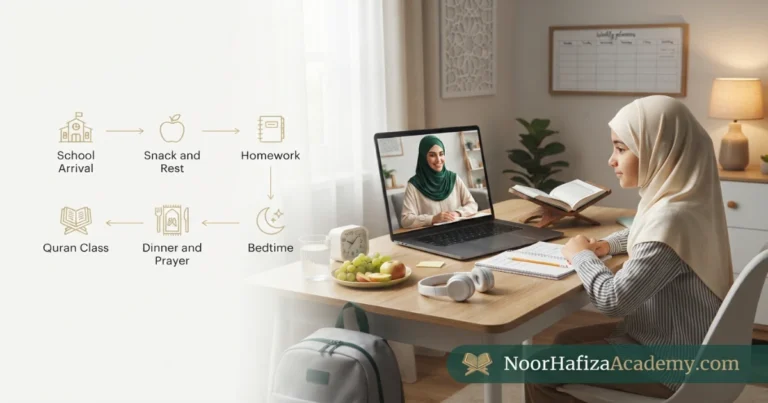
The learner begins a normal lesson with review, one focused skill, guided practice, correction, and a manageable home target. The goal is a repeatable process—not maximum page completion.
Review what worked
Parents check whether the schedule was practical, the child understood the revision task, the setup remained distraction-free, and the teacher match felt suitable. Small adjustments can then be made early.
By the end of the week, you should know the child’s starting level, primary learning goal, regular class time, learning material, home-practice target, and the clearest skill the teacher is currently strengthening. That clarity is more valuable than rushing through several new pages.
Which online Quran course should your child start?
The correct course depends on current ability and the next useful outcome. Many students need a blended plan, but each plan should still have one primary focus.
Noorani Qaida
Best for beginners learning Arabic letters, vowel signs, joined forms, basic pronunciation, and gradual word reading. Explore Noorani Qaida online.
Quran Reading
Best for students who know the basics but need smoother reading, fewer pauses, stronger recognition, and regular supervised recitation. See online Quran reading classes.
Tajweed
Best for readers who want more accurate articulation, elongation, nasalization, stopping, joining, and application of recitation rules. Visit online Tajweed classes.
Hifz Quran
Best for students ready to memorize with structured new lesson, recent revision, older revision, listening, and retention checks. Learn about Hifz Quran online.
Islamic Studies
Best for children building practical knowledge of salah, duas, manners, beliefs, Seerah, and everyday Muslim character. Explore Islamic Studies online.
Restart and Revision
Best for learners who studied before but lost fluency, confidence, or consistency. A gentle assessment identifies gaps without forcing a complete restart. See Quran restart and revision.
What is the parent’s role before, during, and after class?
Online learning gives parents more visibility than many traditional drop-off classes, but visibility should not become constant interference. The parent’s role is to create consistency, safety, and encouragement while allowing the teacher to teach.
Protect the routine
Confirm the device, open the lesson link, keep the book ready, offer water, and help the child arrive a few minutes early. Avoid starting class immediately after an overstimulating activity when possible.
Support without taking over
Stay nearby for a young child, help only with technical problems, and allow the teacher to hear genuine mistakes. Repeated parental prompting can hide the child’s true level and reduce independence.
Make revision achievable
Ask what was practiced, praise effort, and complete a short revision task. Ten focused minutes on several days is often more useful than one long, stressful session before the next class.
For very young children, the parent may need to help the student point to the correct line, keep the book steady, and return attention gently. As the learner matures, the parent should gradually step back. The long-term goal is a child who attends responsibly, listens to correction, and revises with growing independence.
How often should online Quran classes be, and how long should they last?
There is no single perfect timetable for every learner. Frequency should reflect age, goal, attention span, school commitments, and the amount of home revision a family can realistically maintain. Consistency matters more than choosing an impressive schedule that collapses after two weeks.
| Learner or goal | Useful starting pattern | Why it may work | Parent note |
|---|---|---|---|
| Young Qaida beginner | Short, frequent sessions | Supports attention, repetition, and sound recognition without overload. | Repeat a few letters or lines between lessons. |
| School-age Quran reader | Two to four lessons weekly | Creates enough teacher contact to build fluency while leaving room for home practice. | Protect the same recurring times each week. |
| Tajweed learner | Regular lessons plus recorded or live practice | Rules improve through repeated application and immediate correction, not theory alone. | Focus on one or two recurring mistakes at a time. |
| Hifz student | Frequent listening and structured revision | Memorization weakens when new portions grow faster than revision capacity. | Do not measure success only by new lines memorized. |
| Adult beginner or returnee | Consistent private lessons at a manageable pace | Builds confidence and removes group pressure. | Choose a time that is sustainable, not merely available once. |
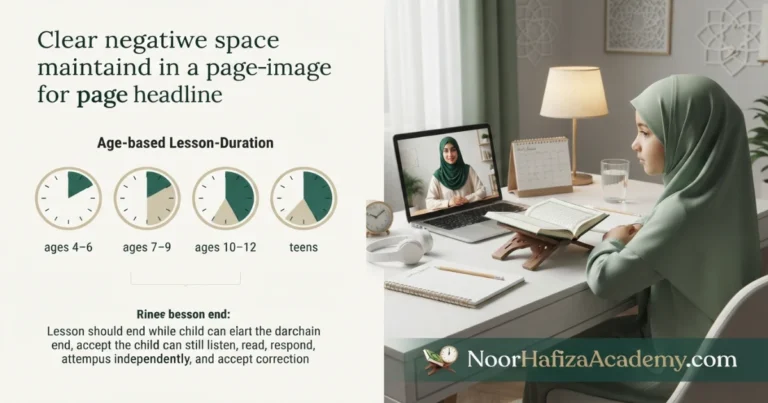
Younger learners often need shorter lessons because attention and sitting stamina are still developing. Older students may manage longer sessions, but only when the lesson remains interactive and purposeful. A class that is technically long but mentally unfocused is not automatically better.
How do teachers and parents track Quran learning progress?
Page completion is easy to count, but meaningful Quran progress includes accuracy, confidence, retention, and independence. A child can move through many pages while repeating the same pronunciation mistake. Another child may stay on a small section longer but build a foundation that makes later reading much easier.
Useful progress indicators
- Recognizes letters and words with less prompting
- Makes fewer repeated vowel and joining errors
- Applies a Tajweed correction in new verses
- Reads longer phrases with smoother pacing
- Retains memorization across recent and older revision
- Begins class prepared and responds to feedback calmly
- Can explain the week’s learning target in simple words
Questions parents can ask
- Which skill improved this week?
- Which mistake is still recurring?
- What exact portion should be revised?
- Is the current pace suitable?
- Does my child need more practice or a different explanation?
- When will the next level or milestone be reviewed?
- How can I support without confusing the teacher’s method?
Are online Quran classes safe for children?
Online classes can be a safe and comfortable option when parents and the academy use sensible safeguards. Parents should know the teacher’s identity, the lesson schedule, the communication channel, and how to contact the academy. Young children should take classes in a shared or supervised area rather than behind a locked bedroom door. The student should use a parent-approved device and should not move private conversations to unapproved apps.
Parents should know who teaches the child, when the lesson occurs, what the current target is, and how to raise concerns. A clear communication route is an important part of online learning safety.
A professional academy should keep communication focused on lessons, scheduling, revision, and educational progress. Parents should be included when appropriate, especially for young learners. Families can also protect privacy by using a neutral background, closing personal tabs, removing visible documents, and joining with the correct display name.
Know who is teaching, supervise younger students, use the agreed lesson platform, keep communication transparent, protect personal information, and contact the academy promptly if any interaction feels unclear or inconsistent with the educational purpose.
How do online Quran classes compare with mosque or center classes?
Both formats can serve families well. The better choice depends on teacher quality, class size, travel, schedule, the child’s personality, and the family’s access to suitable local instruction. Online learning is especially useful when a family wants one-to-one attention, a female Quran teacher, flexible timing, or access from an area with limited local options.
| Feature | Online one-to-one class | Typical local group class |
|---|---|---|
| Teacher attention | Individual listening and correction | Attention is shared among several learners. |
| Learning pace | Adjusted to the student’s level | Often follows the group’s average pace. |
| Travel | No commute required | Driving, parking, and weather may affect attendance. |
| Social environment | Private and focused. | May offer in-person peer interaction. |
| Schedule | More flexible recurring options | Usually fixed center hours. |
| Parent visibility | Easy to observe the learning routine | Parents may receive less direct visibility during class. |
| Technology | Requires stable audio and internet | No internet needed during instruction. |
The strongest option is not automatically “online” or “local.” It is the option that gives the learner qualified teaching, accurate correction, emotional comfort, a sustainable schedule, and enough consistency to make progress.
Seven mistakes that make online Quran learning less effective
1. Choosing by price alone
Low cost cannot compensate for weak correction, poor communication, an unsuitable teacher, or an unstructured curriculum. Compare the actual learning experience.
2. Skipping the level assessment
Starting from the wrong point creates boredom or frustration. A short assessment protects the learner’s confidence and time.
3. Treating attendance as progress
A child can attend every class but improve slowly without focused revision. Attendance creates opportunity; practice turns opportunity into skill.
4. Correcting over the teacher
When a parent supplies every answer, the teacher cannot assess independence. Support the environment, then let the teacher guide the lesson.
5. Changing teachers too quickly
A new teacher and student may need several lessons to understand each other. Change when there is a genuine mismatch, not after one ordinary adjustment period.
6. Using vague revision instructions
“Practice Quran” is difficult for a child to act on. “Read these six lines twice and repeat these three sounds” is clear and achievable.
7. Moving forward with weak revision
This is especially damaging in Hifz. New memorization should not grow faster than the learner’s ability to retain and revise earlier portions.
A better approach
Choose a realistic timetable, keep one primary goal, protect home revision, ask for specific feedback, and review progress after a meaningful period rather than judging every individual lesson.
What should parents check before enrolling in an online Quran academy?
A polished website does not tell you how a teacher will interact with your child. Use the trial lesson and your direct communication to test the experience. Ask whether classes are live, whether the learner receives individual correction, how teachers are selected, how missed classes are handled, how progress is communicated, which curriculum is used, and whether the academy can adjust the teacher or timing when a genuine problem appears.
Teacher suitability
The teacher should have Quran knowledge, clear pronunciation, patient communication, and an approach suited to the learner’s age and goal.
Transparent process
You should understand the trial, placement, timetable, lesson format, communication method, revision plan, and current fees before committing.
Evidence of progress
The academy should be able to explain what the student is learning, what remains difficult, and what the next realistic milestone will be.
Noor Hafiza Academy offers live online Quran learning for children, women, girls, and beginners across the United States. Families can explore all Quran programs, read about Quran classes for kids, review Quran classes for women, or begin with a free trial to understand the student’s current level.
FAQs about how online Quran classes work
How do online Quran classes work for children?
What equipment is needed for an online Quran class?
How long is an online Quran lesson?
Can a complete beginner learn Quran online?
Do parents need to sit in every class?
How is progress measured?
Are online Quran classes suitable for Hifz?
What happens during a free trial Quran class?
Can we request a female Quran teacher?
See how a live Quran class works with a free trial lesson
Share the student’s age, current level, learning goal, time zone, and preferred schedule. Noor Hafiza Academy will help you understand the best starting pathway and arrange a trial with a suitable female Quran teacher.