
Sabaq, Sabqi and Manzil Explained for Quran Memorization

Sabaq, Sabqi and Manzil are three connected responsibilities used in many Quran memorization programs. Sabaq is the new lesson, Sabqi is recently memorized Quran that still needs close repetition, and Manzil is older memorization revised through a planned cycle. The system prevents a common Hifz problem: adding new verses while earlier portions quietly become weak.
What are Sabaq, Sabqi and Manzil?
Sabaq is the new Quran portion being memorized today. Sabqi is the recently memorized portion—often the latest lessons or pages—that requires frequent repetition until it becomes stable. Manzil is older memorization revised on a rotating schedule so it remains available over weeks, months, and years. A healthy Hifz plan uses all three. Sabaq without Sabqi creates fragile new learning; Sabaq and Sabqi without Manzil allow older Surahs to fade; Manzil without carefully controlled new learning can preserve the past but stop progress. The teacher adjusts the amount of each according to level, age, accuracy, time, and retention.
Why Hifz needs three separate revision layers
Quran memorization passes through different levels of strength. A verse recited correctly immediately after repetition is not yet secure. The learner may remember it because the page is open in memory, the teacher has just modeled it, and the surrounding verses are familiar. After several hours or a night of sleep, recall becomes harder. After several days, weak joins, similar endings, and missed words become more visible. After weeks or months, a portion survives only when it has entered a dependable older-revision cycle.
The Sabaq, Sabqi and Manzil system responds to those stages. It does not treat all memorized Quran as equally strong. New Sabaq receives concentrated attention. Recent Sabqi receives repeated testing while memory is still developing. Older Manzil is reviewed often enough to remain accessible. This structure converts temporary familiarity into durable recall.
The exact terms and divisions vary among teachers, countries, madrasah traditions, and individual programs. Some use Sabqi for the most recent pages, while others use it for the current Juz or a larger recent block. Manzil may mean one Juz per day for an advanced Hafizah, a few pages for a developing learner, or selected Surahs for a child. The terminology matters less than the principle: new, recent, and older memorization need different review frequencies.
Do not increase new Sabaq merely because the learner can repeat it today. Increase only when the daily Sabqi and Manzil remain accurate, manageable, and consistently tested.
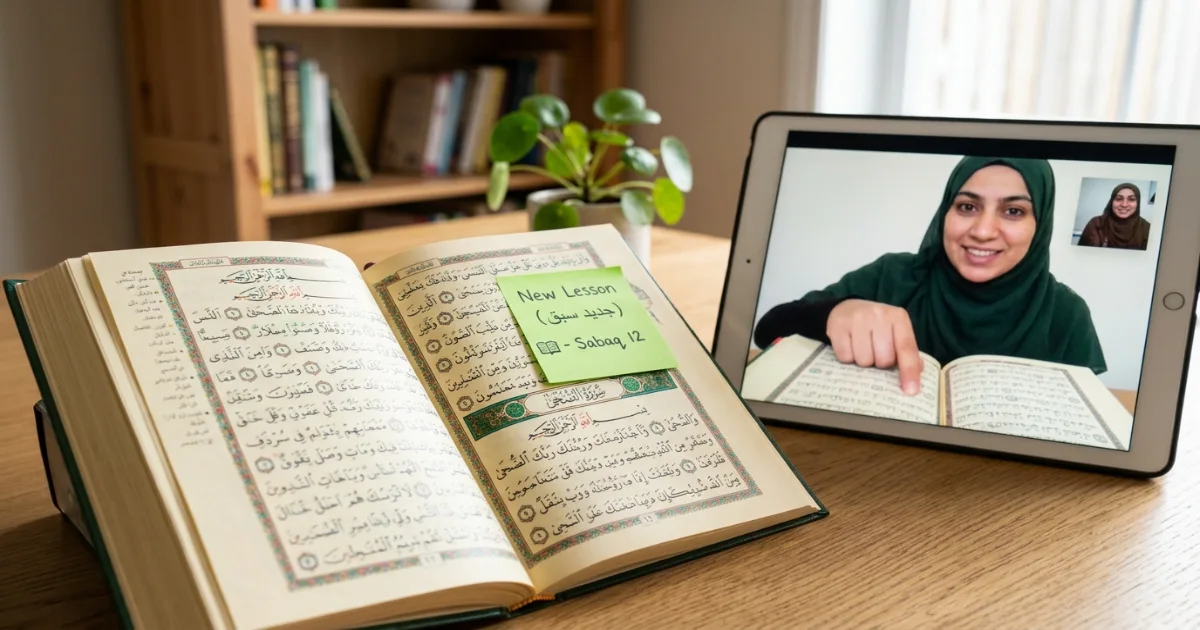
What is Sabaq in Quran memorization?
Sabaq is the new portion assigned for memorization. It may be several words, one verse, a group of verses, a few lines, half a page, or a full page depending on the learner. A responsible Sabaq target is not chosen by ambition alone. It is based on reading accuracy, Tajweed, concentration, available time, previous retention, and the amount of revision already due.
Before memorizing, the learner should read the portion accurately with the teacher or from a reliable recitation. Unknown words, difficult joins, stopping points, similar phrases, and pronunciation risks should be identified first. Memorizing an inaccurate version creates two tasks: learning the verse and later unlearning the mistake. Accuracy at the beginning is usually more efficient than repair after repetition.
A practical Sabaq process
Read accurately
Read the new passage from the Mushaf with correct letters, vowels, Tajweed, and stopping before attempting memorization.
Listen and mark risks
Notice unfamiliar pronunciation, repeated phrases, similar verse endings, and places where breath may affect the stop.
Divide into small phrases
Memorize meaningful sections rather than forcing an entire page into one continuous repetition cycle.
Recall without looking
Close or cover the text and retrieve each phrase. Looking repeatedly can create recognition without true recall.
Join the passage
Connect the phrases, test verse transitions, and begin from more than one point.
Present to the teacher
Recite without coaching whenever possible, receive specific correction, and repeat the corrected line accurately.
The learner should not confuse quantity with quality. One-quarter page retained well may be stronger progress than one full page that requires repeated prompts. A teacher may temporarily reduce Sabaq when school exams, illness, travel, sleep disruption, pronunciation repair, or weak Manzil makes the existing load difficult.

What is Sabqi and why is recent revision so important?
Sabqi is recent memorization that has moved beyond today’s Sabaq but is not yet strong enough to enter a wider older-revision cycle. It may include yesterday’s lesson, the latest several lessons, the current page group, or the current Juz. The teacher defines the boundary according to the program.
Recent memory is vulnerable. A learner can recite a new page confidently at the end of one session and struggle the next morning. This does not always mean the method failed. It means the memory requires spaced retrieval. Sabqi creates that spacing. The learner returns to the passage after time has passed, retrieves it again, repairs weak links, and repeats the process over several days.
Sabqi should not be a quick read-through from the Mushaf. It should include recitation from memory, teacher testing, starts from the middle, verse-ending checks, and attention to recurring Tajweed errors. When a passage can be recited only from the first verse, the sequence may be memorized as a chain without flexible access. Testing from varied points reveals the true strength.
Immediate recent review
Repeat the new portion later the same day to confirm it survives beyond the original memorization session.
Next-day retrieval
Recite before relearning. The first independent attempt shows which joins and words were truly retained.
Mixed recent testing
Combine several recent lessons and begin from different places to prevent dependence on one fixed sequence.
When Sabqi is too weak
Reduce new Sabaq rather than hiding the weakness under more pages. Identify the exact failure: forgotten words, confused endings, unstable verse order, pronunciation drift, weak starting cues, or inability to continue after a correction. Rebuild the passage in small units and retest it on another day.
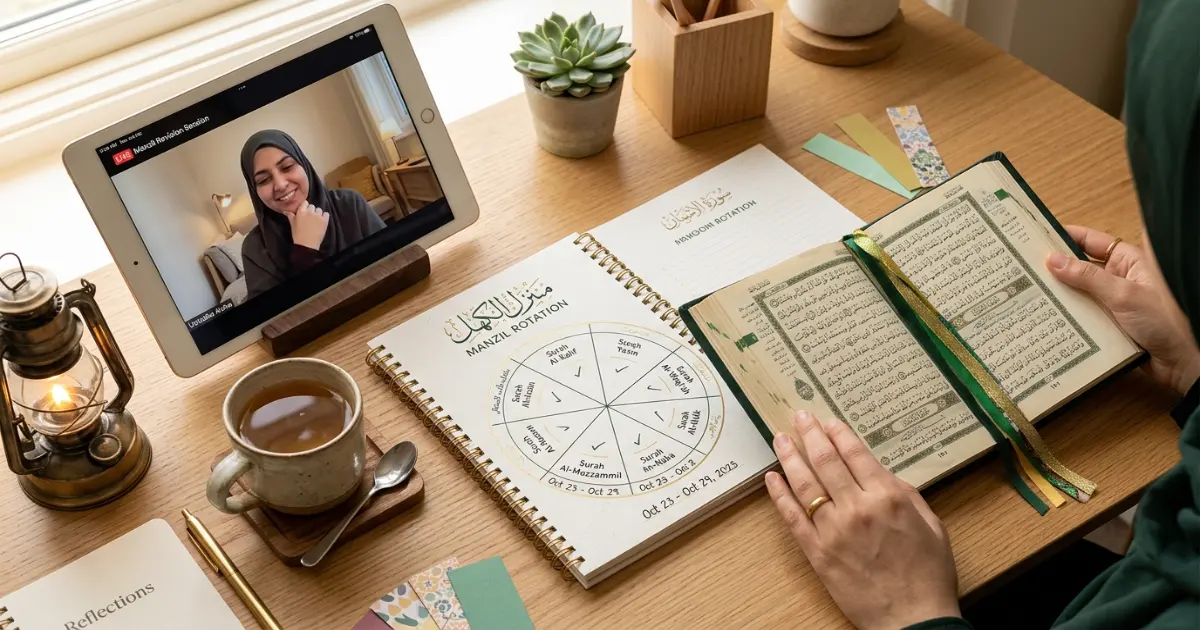
What is Manzil in Hifz revision?
Manzil is the older memorized Quran assigned for regular revision. Once a passage is no longer part of the recent Sabqi block, it still needs scheduled retrieval. Without Manzil, earlier Surahs may remain familiar when seen on the page but become difficult to recite independently.
The Manzil cycle should cover all older memorization within a realistic period. An advanced Hafizah may revise a Juz or more daily. A learner with five Juz may divide them across a week or several days. A child with selected short Surahs may rotate a manageable set each day. The correct cycle is one the learner can complete with accuracy, not a theoretical schedule that is repeatedly missed.
Older memorization also has different strength levels. Some Surahs may be very strong, others moderately stable, and others weak. A teacher may use a normal rotation for strong portions and a repair track for weak portions. This prevents one difficult section from consuming the entire daily schedule while still ensuring it receives extra attention.
| Memory layer | Purpose | Typical frequency | Testing method |
|---|---|---|---|
| Sabaq | Build new memorization accurately | Daily or on assigned lesson days | Full presentation with correction and repeated joins |
| Sabqi | Stabilize recent lessons | Daily or very frequently | Recall after delay, mixed starts, transition checks |
| Manzil | Preserve older memorization | Rotating daily schedule | Continuous recitation, random starts, weak-area repair |
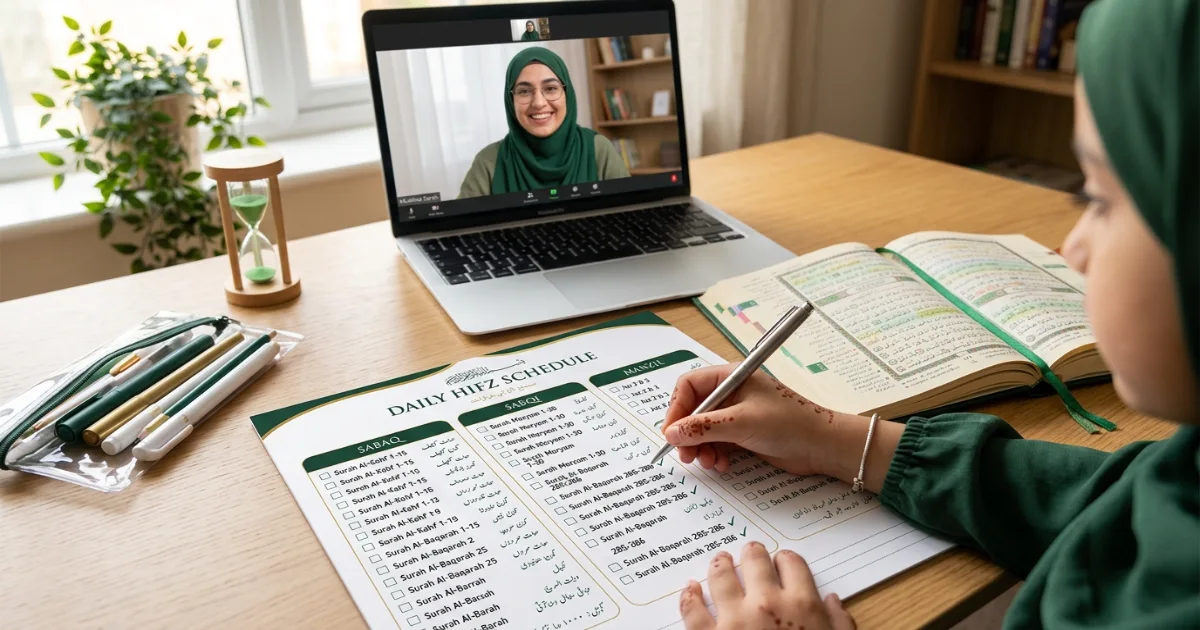
How much Sabaq, Sabqi and Manzil should be done daily?
There is no universal ratio. The balance depends on the total amount memorized, current accuracy, learning speed, age, school or work schedule, and teacher expectations. However, revision normally grows as memorization grows. A beginner with ten short Surahs has a small Manzil responsibility. A learner with ten Juz has a much larger one. The new Sabaq amount should therefore remain flexible.
| Learner profile | Possible Sabaq | Possible Sabqi | Possible Manzil |
|---|---|---|---|
| Young beginner | 1–3 lines or a short verse group | Latest 2–5 lessons | A few established Surahs |
| Developing child | 3–7 lines | Recent pages or current section | Several pages in rotation |
| Adult beginner | 2–6 lines | Recent 3–7 lessons | Previously completed Surahs |
| Advanced learner | Half to one page where sustainable | Current Juz or larger recent block | One or more older sections daily |
These are planning examples, not fixed prescriptions. A learner who makes many errors may need a smaller new lesson. A learner with strong retention may carry a larger portion. The teacher should review not only how much was recited but how much prompting, correction, relearning, and preparation were required.
When Sabqi or Manzil repeatedly fails, reduce Sabaq first. When revision becomes stable over several days, increase new memorization gradually rather than immediately doubling it.
Which should come first: Sabaq, Sabqi or Manzil?
The best order is the one that protects accuracy and fits the learner’s strongest concentration period. Some teachers prefer Manzil first because older revision requires fresh attention and can be neglected after a demanding new lesson. Others begin with Sabaq because the learner’s best mental energy is needed for new memorization. A third approach divides the work across the day.
Revision-first route
Complete Manzil and Sabqi early, then memorize a smaller Sabaq. Useful when revision is frequently skipped or older portions are weak.
New-lesson-first route
Learn Sabaq during the freshest period, then review recent and older work. Useful when new memorization requires maximum concentration.
Split-day route
Use morning for Sabaq, afternoon for Sabqi, and evening for Manzil, or another sustainable division around school and work.
Avoid constantly changing the order because a stable routine reduces decision fatigue. However, the plan should remain flexible during exams, illness, Ramadan routines, family travel, or periods of weak retention.

How teachers should test Sabaq, Sabqi and Manzil
A Hifz test should reveal independent recall. Constantly providing the first word, completing phrases, or allowing the learner to follow the teacher can make a weak portion appear stronger than it is. Support is sometimes necessary, especially for young or anxious learners, but prompts should be recorded and gradually reduced.
Test from varied starting points
Begin from the middle of a page, after a familiar verse, or from a teacher-selected phrase. This tests flexible access rather than one memorized chain.
Check verse endings and joins
Many learners know individual verses but lose the transition. Mark where the next verse begins and compare similar endings carefully.
Count prompts and self-corrections
A self-correction after a brief pause is different from an error corrected only after the teacher supplies words. Tracking both shows progress.
Include Tajweed and pronunciation
Hifz is not only word order. Repeated letter, vowel, madd, ghunnah, stopping, and articulation errors should be repaired.
A six-step weak-passage repair method
Locate the exact failure
Mark the missing word, confused ending, similar verse, pronunciation error, or transition rather than labeling the whole page weak.
Read the correct version
Return briefly to the Mushaf and a reliable teacher model so the repair begins from accurate text and sound.
Repeat a small unit
Practise the difficult phrase and its neighboring words, not only the isolated mistake.
Reconnect the transition
Recite the verse before, the corrected phrase, and the verse after until the join becomes stable.
Test after a delay
Return later the same day and again the next day. Immediate repetition alone cannot prove repair.
Track recurring mistakes
Keep a small error list for similar verses, endings, and pronunciation patterns that need repeated review.
How the system changes for kids and adults
Children may have strong imitation and memory but limited attention, school pressure, and dependence on adult routines. Their sessions should be shorter, visually clear, and emotionally safe. A child should know exactly what counts as Sabaq, Sabqi, and Manzil that day. Parents can protect the time, manage technology, and listen, but should avoid supplying every missing word.
Adults may understand the system quickly and practise independently, but work, family care, inconsistent sleep, and fear of making mistakes can interrupt progress. Smaller daily portions with reliable revision often work better than weekend-only intensity. Adult learners should not feel embarrassed to reduce Sabaq when Manzil needs rebuilding.
| Learner | Main priority | Useful adjustment | Common risk |
|---|---|---|---|
| Young child | Routine and positive correction | Small Sabaq, brief repeated Sabqi, limited Manzil | Fatigue and parent prompting |
| School-age child | Balance with school and sleep | Split sessions before and after school | Revision skipped during busy weeks |
| Adult beginner | Consistency around responsibilities | Small daily lesson and fixed weekly rotation | Long gaps followed by overload |
| Returning learner | Assess and repair older Hifz | Pause large Sabaq until Manzil stabilizes | Assuming familiar Surahs are still strong |
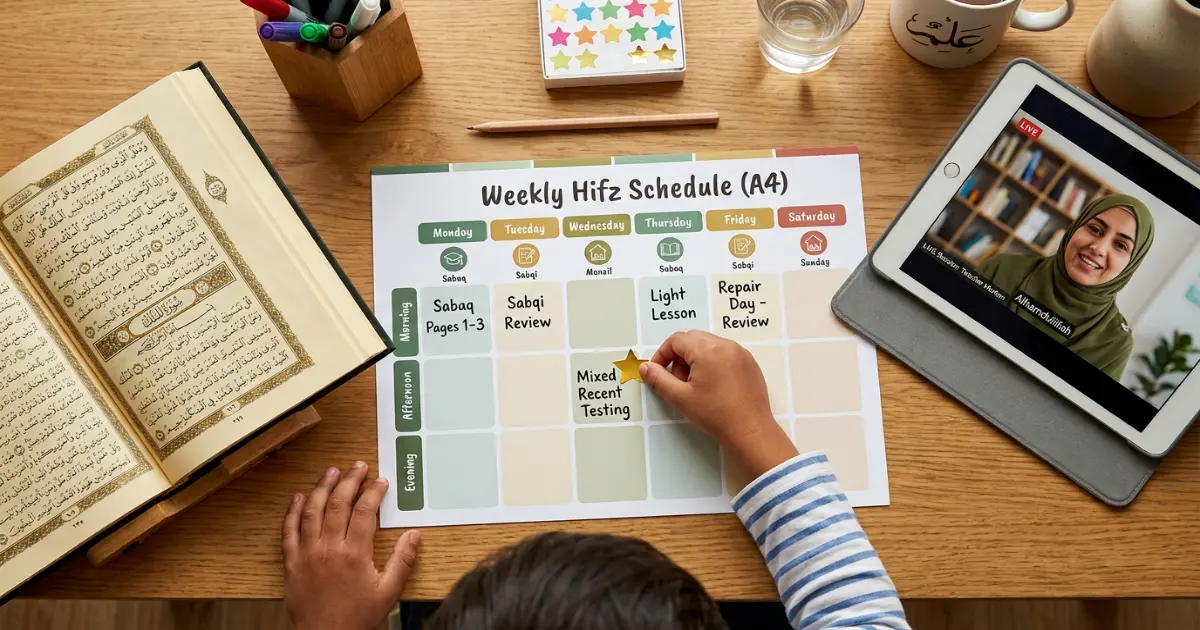
Sample weekly Sabaq, Sabqi and Manzil schedule
The following plan shows the structure rather than prescribing exact page amounts. The teacher should insert the learner’s real portions. Every day includes revision, while one day can be used for consolidation and testing instead of new memorization.
New lesson and baseline revision
Learn Sabaq, revise the recent block, and begin the week’s Manzil rotation with a strong older portion.
Retrieve yesterday’s Sabaq
Move Monday’s lesson into Sabqi, add the next small Sabaq if accurate, and continue Manzil.
Mixed recent testing
Test several recent lessons from varied starting points and repair verse joins before adding volume.
Continue with controlled growth
Add new memorization only when recent work remains stable and the older rotation is on schedule.
Light lesson or consolidation
Use a smaller Sabaq or no new lesson, depending on fatigue, school, family routine, and revision quality.
Longer Manzil and weak-area repair
Use available time for older portions, difficult Surahs, similar verses, and pronunciation correction.
Weekly assessment
Test the week’s Sabaq, review Sabqi strength, confirm Manzil coverage, and set the next realistic target.
Record evidence
Note errors, prompts, missed portions, strong sections, and the exact material due in the next session.
Mistakes that weaken the Sabaq Sabqi Manzil system
Making Sabaq the only priority
New pages increase while recent and older portions quietly become difficult.
Reading revision instead of recalling
Following the Mushaf creates familiarity but may not build independent retrieval.
Using the same starting point every time
The learner remembers a chain but cannot begin from a teacher-selected verse.
Ignoring recurring pronunciation errors
The wording may remain, but repeated inaccurate sounds become deeply memorized.
Setting an unrealistic Manzil cycle
A large schedule repeatedly missed provides less protection than a smaller completed cycle.
Continuing new lessons during collapse
Weak Sabqi and Manzil require repair before the burden becomes larger.
How to know the three-part system is working
New Sabaq survives overnight
The learner retrieves the lesson the next day without complete relearning.
Recent lessons connect smoothly
Sabqi can be recited as a larger block with fewer lost transitions.
Older portions remain accessible
Manzil does not require several minutes of re-reading before recall begins.
Random starts improve
The learner can begin from teacher-selected verses and continue accurately.
Errors become specific and fewer
Mistakes are limited to identifiable joins or similar verses rather than complete collapse.
The schedule is sustainable
All three responsibilities fit the learner’s real week without repeated overload.
How Noor Hafiza Academy can structure a balanced Hifz plan
Noor Hafiza Academy offers live online Quran memorization support with female Quran teachers for children, girls, women, sisters, beginners, and returning learners. A suitable Hifz plan begins with an assessment of current reading, pronunciation, memorized portions, retention strength, school or work routine, and available revision time.
The teacher can define the learner’s Sabaq, Sabqi, and Manzil boundaries, set an achievable daily amount, test from varied points, record recurring errors, and adjust new memorization when revision becomes weak. Parents can receive clear guidance about what to supervise at home without replacing the learner’s independent recall.
Share the learner’s age, current memorization, strongest and weakest Surahs, daily availability, school or work commitments, time zone, and preference for a female Quran teacher.
FAQs about Sabaq, Sabqi and Manzil
What do Sabaq, Sabqi and Manzil mean in Hifz?
Is Sabaq the same as the daily new lesson?
How much Sabqi should be revised each day?
What is Manzil in Quran memorization?
Should I do Manzil before learning new Sabaq?
What happens when a learner does too much Sabaq and too little revision?
Can children use the Sabaq Sabqi Manzil system?
Can adult beginners use this Hifz system?
How do I know whether Sabqi is ready to move into Manzil?
Should Tajweed mistakes count during Hifz testing?
What should I do when Manzil becomes very weak?
How long should a daily Sabaq Sabqi Manzil routine take?
Grow new Hifz while keeping earlier Quran strong and accessible
A balanced Sabaq, Sabqi and Manzil plan protects the learner from rushing forward and repeatedly rebuilding forgotten portions.