
Idgham Rules in Tajweed: A Simple Guide for Beginners

Idgham is one of the main Tajweed rules beginners learn for Noon Sakinah (نْ) and Tanween (ً ٍ ٌ). The word Idgham means merging or inserting one sound into another. In this rule, the Noon Sakinah or Tanween sound is not read as a separate clear “n” when the next word begins with one of six letters: ي ر م ل و ن. Instead, the sound merges into the next letter. Four of those letters—ي ن م و—are read with Ghunnah, while ل and ر are read without Ghunnah. Beginners also need one important boundary rule: this common Idgham rule normally happens across two words. When Noon Sakinah is followed by Ya or Waw inside the same word in certain Quranic words, it is read clearly rather than merged. This guide keeps the rule practical so you can identify Idgham, pronounce it correctly, and avoid the most common mistakes.
What are the Idgham rules in Tajweed?
For Noon Sakinah and Tanween, Idgham happens when the next word begins with one of six letters: ي ر م ل و ن. These are often remembered with the word يرملون (Yarmaloon). Idgham is divided into two main types. Idgham with Ghunnah uses the letters ي ن م و, where the sound is merged with a nasal Ghunnah. Idgham without Ghunnah uses ل and ر, where the Noon/Tanween merges directly into the next letter without holding a nasal sound. Beginners should also remember that this rule normally applies when the Noon Sakinah or Tanween is at the end of one word and the Idgham letter starts the next word.
What does Idgham mean in Tajweed?
Idgham means to merge or insert. In Tajweed, it describes a situation where one sound enters into the letter that follows it so the two are read as a connected pronunciation rather than as two completely separate sounds. For beginners, the most important Idgham rule is the one connected to Noon Sakinah and Tanween.
When the conditions are present, you do not stop and pronounce a full, separate Noon sound. You move smoothly into the next letter. The way that merge sounds depends on whether the next letter belongs to the Ghunnah group or the no-Ghunnah group.
The Noon/Tanween is not simply ignored. Its effect changes into the sound of the next letter, with or without Ghunnah depending on which Idgham letter follows.
What are the six Idgham letters?
The six Idgham letters for Noon Sakinah and Tanween are:
They are often grouped in the Arabic mnemonic يرملون, commonly transliterated as Yarmaloon. The mnemonic is useful because it gives beginners one memorable word, but you should still split the six letters into the two pronunciation groups.
Ya
Idgham with Ghunnah.
Noon
Idgham with Ghunnah.
Meem
Idgham with Ghunnah.
Waw
Idgham with Ghunnah.
Lam
Idgham without Ghunnah.
Ra
Idgham without Ghunnah.
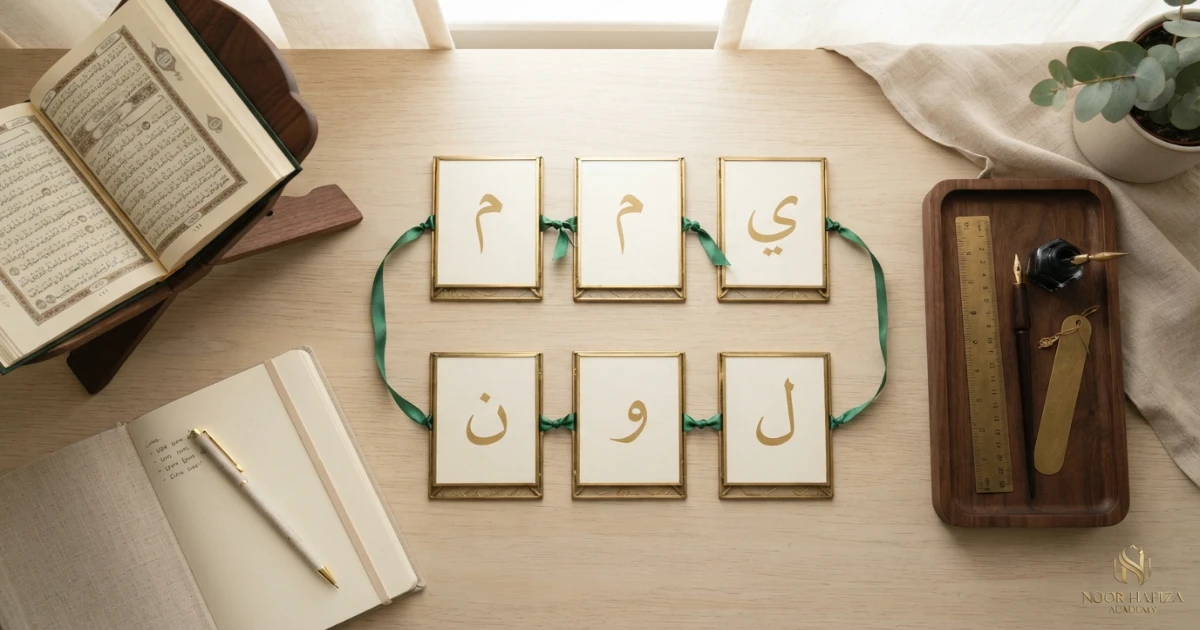
Idgham with Ghunnah: ي ن م و
Idgham with Ghunnah, also called Idgham bi Ghunnah, happens when Noon Sakinah or Tanween is followed by one of these four letters:
These four letters are often remembered with the word ينمو (Yanmu). The Noon/Tanween merges into the next letter while a nasal Ghunnah is heard. In common beginner teaching, the Ghunnah is held for about two counts.
Do not stop to pronounce a separate Noon. Let the sound flow into Ya, Noon, Meem, or Waw.
The nasal sound remains for the appropriate brief count while the merge happens.
A common beginner problem is making the Ghunnah too long or turning it into an exaggerated humming sound. Another problem is rushing it so quickly that the nasal quality disappears. A teacher can help you hear the middle ground.
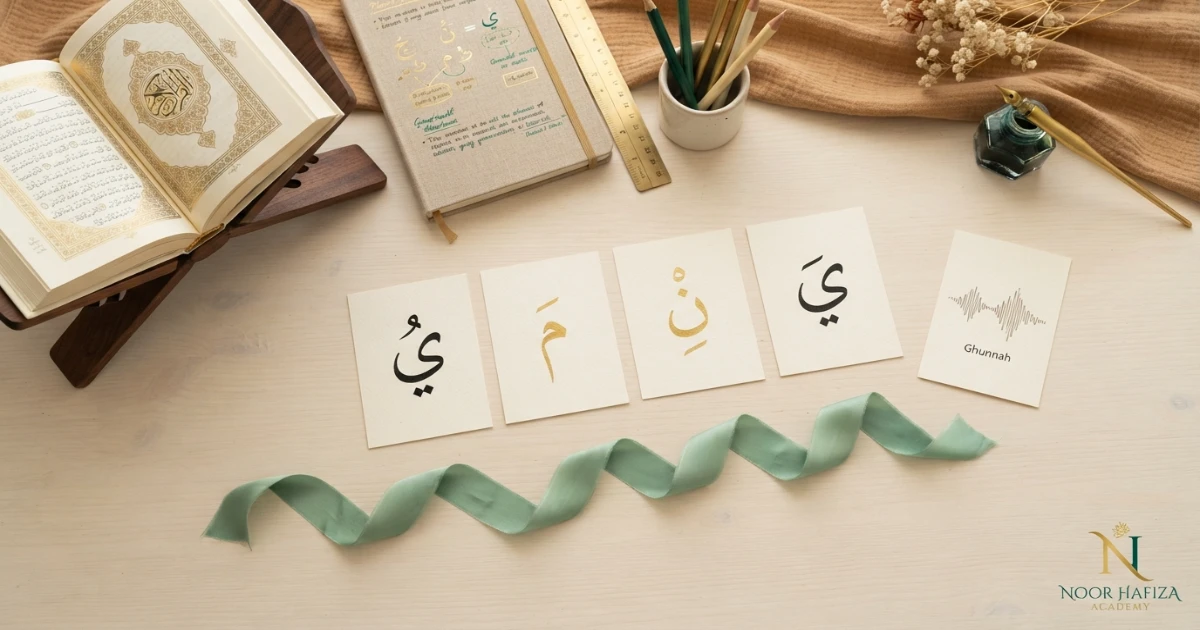
Idgham without Ghunnah: ل and ر
Idgham without Ghunnah, also called Idgham bila Ghunnah, happens when Noon Sakinah or Tanween is followed by Lam (ل) or Ra (ر).
Here, the Noon/Tanween merges directly into the next letter without holding a nasal Ghunnah. The learner should hear the Lam or Ra clearly rather than a lingering “n” sound. It should also not be treated as a pause between the two words.
All six letters belong to Idgham, but only four use Ghunnah.
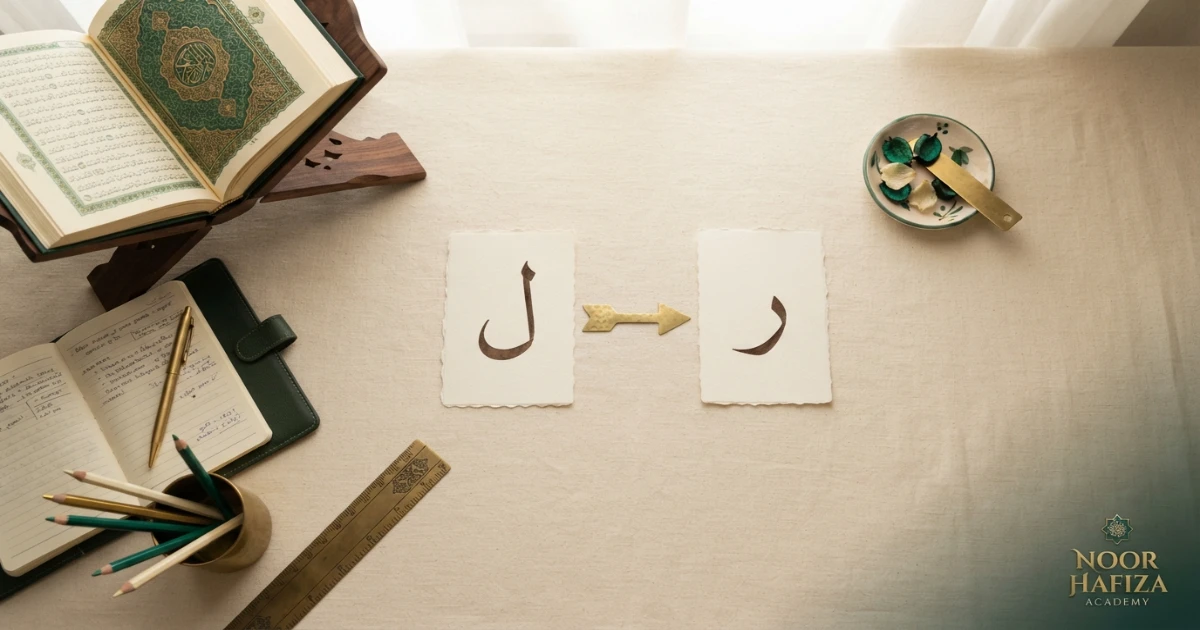
When does the Idgham rule apply?
For this beginner rule, check four things in order. First, find Noon Sakinah or Tanween. Second, look at the first letter of the next word. Third, decide whether that letter belongs to the six Idgham letters. Fourth, choose whether the merge uses Ghunnah or not.
Look for نْ or one of the Tanween signs ً ٍ ٌ.
The next word should begin with one of the six Idgham letters.
If the next letter is ي ن م و, use Ghunnah. If it is ل or ر, merge without Ghunnah.
Do not pronounce a separate complete Noon before the next letter.
The same decision process works whether the first word ends with Noon Sakinah or Tanween. The written sign changes, but the reading question is the same: what comes next?

Why word boundaries matter in Idgham
The common Noon Sakinah/Tanween Idgham rule normally happens when the Noon Sakinah or Tanween is at the end of one word and the Idgham letter begins the next word.
This matters because Noon Sakinah followed by Ya or Waw inside the same word is not treated with the same Idgham rule in certain Quranic words. Instead, the Noon is read clearly. This is commonly called Izhar Mutlaq or absolute clarity.
Do not merge automatically inside one word
Seeing Noon Sakinah before Ya or Waw is not enough by itself. Check whether the letters are in the same word.
Learn the well-known exception words
Commonly taught examples include الدنيا, بنيان, صنوان, and قنوان.
These same-word examples are important because they show why Tajweed cannot be learned by letter matching alone. You must notice structure and word boundaries.

What should correct Idgham sound like?
A correct Idgham should sound connected. The learner should not hear a full separate Noon, followed by a pause, followed by the next letter. Instead, the transition should feel like one smooth movement. With ي ن م و, that movement carries Ghunnah. With ل and ر, it does not.
| Type | Letters | Sound feature | Main beginner risk |
|---|---|---|---|
| With Ghunnah | ي ن م و | Merged + nasal Ghunnah | Too much or too little Ghunnah |
| Without Ghunnah | ل ر | Direct merge | Keeping an “n” sound |
| Same-word exception | Ya/Waw after Noon Sakinah | Clear Noon in taught exception words | Over-applying Idgham |
How to practise Idgham step by step
Find the trigger
Circle or point to the Noon Sakinah or Tanween.
Look ahead
Identify the first letter of the next word.
Name the type
Say “with Ghunnah” or “without Ghunnah.”
Recite naturally
Merge slowly first, then repeat at a normal reading speed.
Once identification becomes automatic, stop naming the rule aloud. The final goal is fluent application during Quran recitation, not constant verbal analysis.
How long is the Ghunnah in Idgham with Ghunnah?
In common beginner Tajweed teaching, the Ghunnah in Idgham with Ghunnah is held for about two counts. Counts are relative timing units rather than fixed seconds measured by a clock.
The important skill is consistency. The learner should not rush one Ghunnah and dramatically extend another. Listening to a qualified teacher and repeating short examples is usually more useful than trying to estimate timing from written descriptions alone.
Common Idgham mistakes beginners make
Pronouncing a full Noon first
The learner reads a clear “n” and then starts the next letter instead of merging.
Using Ghunnah with Lam or Ra
The learner treats all six letters as though they use the same nasal sound.
Skipping Ghunnah with ي ن م و
The merge becomes too dry and loses the nasal quality.
Stretching Ghunnah too long
The sound becomes exaggerated and breaks natural recitation flow.
Ignoring word boundaries
The learner applies Idgham inside a word where Noon should remain clear.
Looking only at the Noon
Idgham cannot be identified without checking the next letter.
Memorizing letters without hearing them
The student knows the rule but cannot recognize or produce it in recitation.
Practising only memorized examples
The learner performs one phrase correctly but struggles in fresh Quran text.
How is Idgham different from Izhar, Iqlab, and Ikhfa?
Noon Sakinah and Tanween are commonly taught through four major rule groups. Understanding the contrast makes identification faster.
| Rule | Basic idea | What happens | Beginner cue |
|---|---|---|---|
| Izhar | Clarity | Noon/Tanween is pronounced clearly | Do not merge |
| Idgham | Merging | Sound merges into next letter | Check يرملون |
| Iqlab | Conversion | Noon/Tanween changes toward a hidden Meem sound before ب | Only before ب |
| Ikhfa | Concealment | Sound is hidden between clarity and full merging | Remaining Ikhfa letters |
Are there other Idgham rules in Tajweed?
Yes. The word Idgham appears in other Tajweed topics. One beginner example is Idgham Shafawi, where Meem Sakinah is followed by another Meem. More advanced curricula may also discuss merging identical, similar, or closely articulated letters.
Do not mix these categories too early. If you are currently studying Noon Sakinah and Tanween, master the six Yarmaloon letters first. Then learn Meem Sakinah and advanced letter relationships as separate topics.
That is why the full name of the rule matters.
Why teacher feedback matters for Idgham
Idgham looks simple on paper, but small pronunciation details are difficult to judge alone. A learner may know all six letters yet still pronounce a separate Noon, hold too much Ghunnah, or fail to merge naturally into Lam or Ra.
A teacher can listen to fresh examples, compare them with your normal recitation, and tell you whether the rule is being applied consistently rather than only in memorized exercises. The teacher can also separate an Idgham problem from a Makharij problem when the next letter itself is not being pronounced correctly.
12-point Idgham practice checklist
Use this when checking a Quran passage
- Can I identify Noon Sakinah correctly?
- Can I identify all three Tanween signs?
- What is the first letter of the next word?
- Is it one of the six letters ي ر م ل و ن?
- If yes, is it a Ghunnah letter or a no-Ghunnah letter?
- Am I avoiding a full separate Noon sound?
- With ي ن م و, is the Ghunnah controlled rather than exaggerated?
- With ل or ر, am I avoiding an unnecessary nasal hold?
- Have I checked whether the letters are across two words?
- Could this be one of the same-word clarity exceptions?
- Can I read the example correctly without first naming the rule?
- Can I apply the same rule in a fresh Quran passage?

Learn Idgham and beginner Tajweed online
Noor Hafiza Academy offers live online Quran learning for children, girls, women, adults, beginners, returning readers, teenagers, siblings, and homeschool families with female Quran teachers. Learners can ask about Quran reading, Noorani Qaida, Tajweed, Makharij, Hifz, and pronunciation correction according to their current level.
A beginner Tajweed plan may include Noon Sakinah and Tanween rules, Meem Sakinah, Qalqalah, Ghunnah, Madd, Waqf, Makharij, and guided recitation practice. Current teacher qualifications, female-teacher availability, class length, trial arrangements, fees, schedules, privacy practices, safeguarding policies, and enrollment terms should be confirmed directly.
Share the learner’s age, Quran reading level, Tajweed background, main pronunciation difficulty, preferred schedule, and whether a female teacher is requested.
FAQs about Idgham rules in Tajweed
What is Idgham in Tajweed?
What are the six Idgham letters?
Which Idgham letters use Ghunnah?
Which Idgham letters do not use Ghunnah?
How long is the Ghunnah in Idgham with Ghunnah?
Does Idgham happen with both Noon Sakinah and Tanween?
Does Idgham usually happen inside the same word?
What are the common same-word Idgham exception words?
What is the easiest way to remember Idgham letters?
What is the difference between Idgham and Ikhfa?
Is Idgham Shafawi the same rule?
How should beginners practise Idgham?
Master Idgham by learning the six letters, controlling Ghunnah, and applying the rule in real Quran recitation
Share the learner’s age, Quran level, Tajweed background, main pronunciation difficulty, and preferred class schedule.