
Izhar Rules in Tajweed: Letters and Quran Examples

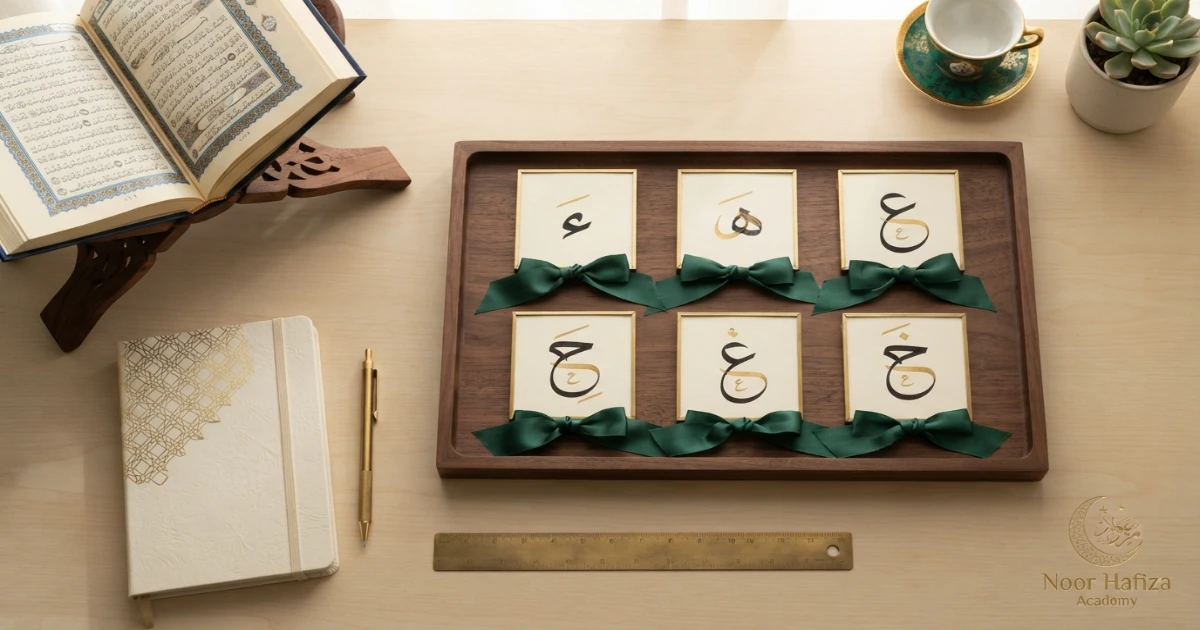
Izhar rules in Tajweed are among the first Noon Sakinah and Tanween rules beginners learn because the basic instruction is simple: pronounce the Noon sound clearly. The specific rule is called Izhar Halqi, meaning clear pronunciation connected with the throat letters. It happens when Noon Sakinah (نْ) or Tanween (ً ٍ ٌ) is followed by one of six letters: ء ه ع ح غ خ. The Noon or Tanween should remain distinct; it is not merged as in Idgham, hidden as in Ikhfa, or converted toward Meem as in Iqlab. The learner should also avoid adding an exaggerated held Ghunnah. Noon naturally has a nasal quality, but Izhar is read with clarity rather than an extra extended nasal hold. This guide explains the six letters, Quran examples, pronunciation, common mistakes, and a step-by-step practice method.
What are the Izhar rules in Tajweed?
Izhar Halqi occurs when Noon Sakinah or Tanween is followed by one of six throat letters: ء ه ع ح غ خ. The Noon or Tanween is pronounced clearly and separately from the next letter. Do not merge it into the following letter, do not hide it, and do not convert it to Meem. Also avoid adding an extended Ghunnah. A beginner can remember the process like this: find Noon Sakinah or Tanween, look at the next letter, and if that letter is one of the six throat letters, pronounce the Noon/Tanween clearly before moving to the next letter.
What does Izhar mean in Tajweed?
Izhar means clarity or making something clear. In the Noon Sakinah and Tanween chapter, it means the Noon sound is pronounced distinctly when one of the six throat letters follows.
The more complete beginner label is Izhar Halqi. “Halqi” refers to the throat because all six trigger letters come from throat articulation areas. This helps beginners connect the rule with Makharij instead of memorizing an isolated list.
The Noon/Tanween remains audible as itself before the throat letter. It is not hidden, merged, or converted.
What are the six Izhar letters?
The six letters of Izhar Halqi are:
Traditional Tajweed teaching groups these six letters into three throat regions, with two letters associated with each region. Remembering them by articulation area can be easier than memorizing six unrelated symbols.
Deepest throat
Hamzah and Ha are commonly taught from the deepest throat area.
Middle throat
Ayn and Ha are commonly taught from the middle throat.
Upper throat
Ghayn and Kha are commonly taught from the upper throat area nearer the mouth.
When does Izhar apply?
Identify the rule by looking at the letter immediately after Noon Sakinah or after Tanween. If the next letter is one of the six Izhar letters, the Noon/Tanween is read clearly.
Look for نْ or one of the three Tanween signs.
Look for ء ه ع ح غ خ.
Keep the Noon/Tanween distinct before moving to the throat letter.
Unlike the common Idgham rule, Noon Sakinah Izhar can occur within one word or across two words. Tanween appears at the end of a word, so its Izhar trigger is at the beginning of the next word.
Izhar Quran examples with Noon Sakinah
These short Quran examples show Noon Sakinah followed by throat letters. Read the Noon distinctly, then move to the next letter without forcing a pause.
| Letter | Quran example | Trigger | Reading action |
|---|---|---|---|
| ء | مَنْ آمَنَ | Noon Sakinah → Hamzah | Clear Noon |
| ه | مِنْ هَادٍ | Noon Sakinah → Ha | Keep Noon distinct |
| ع | مِنْ عِلْمٍ | Noon Sakinah → Ayn | No hiding or merging |
| ح | مِنْ حَكِيمٍ | Noon Sakinah → Ha | Clear Noon then Ha |
| غ | مِنْ غِلٍّ | Noon Sakinah → Ghayn | Keep sounds separate |
| خ | مِنْ خَيْرٍ | Noon Sakinah → Kha | Clear Noon before Kha |
The goal is clarity, not slowness for its own sake. Once the sound is correct, practise the same phrases at a natural recitation pace.

Izhar Quran examples with Tanween
Tanween carries an “n” quality at the end of a word. When the next word begins with one of the six throat letters, that final “n” remains clear.
| Letter | Quran example | Trigger | Reading action |
|---|---|---|---|
| ء | عَذَابٌ أَلِيمٌ | Tanween → Hamzah | Clear “n” sound |
| ه | سَلَامٌ هِيَ | Tanween → Ha | Keep Tanween clear |
| ع | سَمِيعٌ عَلِيمٌ | Tanween → Ayn | Clear then Ayn |
| ح | غَفُورٌ حَلِيمٌ | Tanween → Ha | Do not hide Tanween |
| غ | قَوْلًا غَيْرَ | Tanween → Ghayn | Keep final “n” clear |
| خ | عَلِيمٌ خَبِيرٌ | Tanween → Kha | Clear before Kha |
How do you pronounce Izhar correctly?
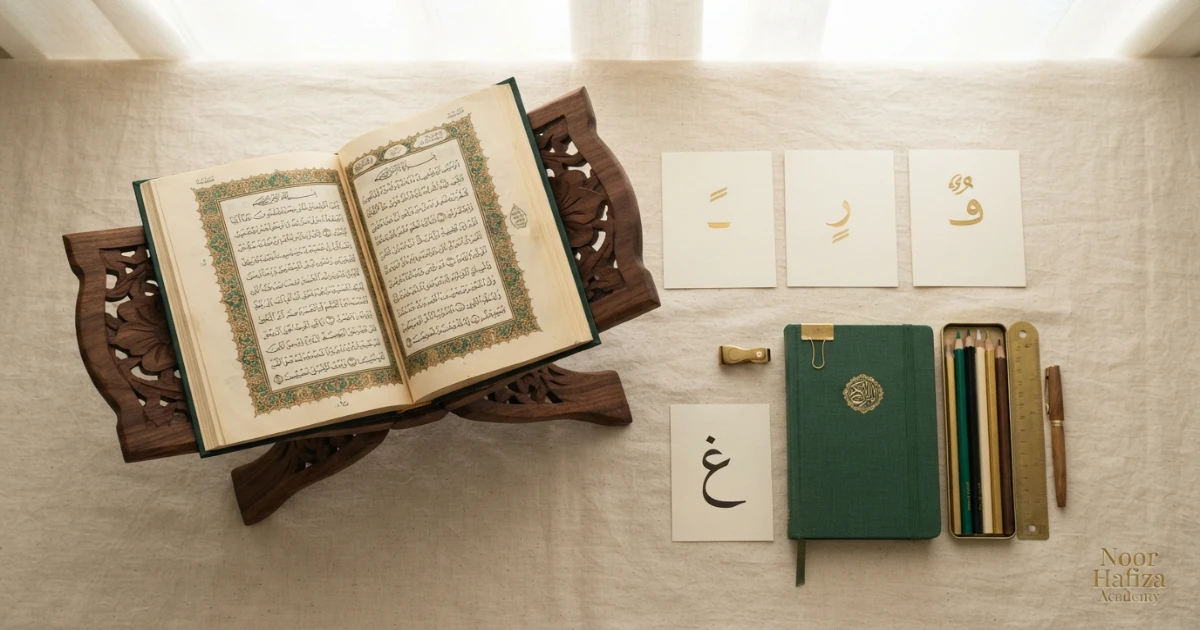
Pronounce the Noon clearly from its normal articulation, then move into the throat letter. The two sounds should remain distinct without becoming disconnected.
Do not conceal or merge the Noon into the throat letter.
Noon naturally has nasal resonance, but Izhar does not use the extended Ghunnah associated with Ikhfa or Idgham with Ghunnah.
Move into the throat letter without adding an extra vowel or artificial pause.
A common beginner mistake is making the Noon so strong that it becomes unnaturally long. Another is weakening it until it sounds hidden. Correct Izhar is clear, brief, and natural.

Why are the Izhar letters throat letters?
Traditional Tajweed explains that these six letters come from throat articulation areas that are separate from the articulation of Noon. This separation supports clear pronunciation instead of merging or concealment.
You do not need advanced phonetic terminology to apply the rule, but learning the three throat regions helps connect Tajweed rules with Makharij and improves recognition.
Can Izhar happen inside one word?
Yes. Noon Sakinah Izhar can occur within one word or across two words when one of the six throat letters follows. Tanween, however, appears at a word ending, so its trigger letter is found in the next word.
Do not borrow the Idgham boundary rule
Izhar is not restricted to two words. Noon Sakinah may be followed by a throat letter within the same word.
Read continuously
Clear pronunciation does not mean inserting an unnecessary stop between Noon and the throat letter.
Izhar vs Idgham, Iqlab, and Ikhfa
The four Noon Sakinah and Tanween rules are easiest to remember by asking what happens to the Noon sound.
| Rule | Core idea | Trigger | What happens |
|---|---|---|---|
| Izhar | Clarity | ء ه ع ح غ خ | Noon/Tanween stays clear |
| Idgham | Merging | يرملون | Noon/Tanween merges |
| Iqlab | Conversion | ب | Changes toward hidden Meem with Ghunnah |
| Ikhfa | Concealment | 15 letters | Noon/Tanween is hidden with Ghunnah |

Common Izhar mistakes beginners make
Hiding the Noon
The learner weakens the Noon until Izhar begins to sound like Ikhfa.
Merging into the next letter
The Noon loses its independence and begins to sound like Idgham.
Adding extended Ghunnah
The reader holds a nasal sound longer than clear Izhar requires.
Pausing between sounds
Clarity does not require an artificial break between Noon and the throat letter.
Confusing ه and ح
The rule may be identified, but the following throat letter is pronounced incorrectly.
Confusing ء and ع
These are different letters with different articulation points despite both being throat letters.
Ignoring Tanween
The learner recognizes Noon Sakinah examples but forgets the same rule for Tanween.
Only memorizing the list
The student knows six letters but cannot recognize Izhar quickly in fresh Quran text.
How to practise Izhar step by step
Find the trigger
Identify Noon Sakinah or Tanween.
Look ahead
Check the next letter for ء ه ع ح غ خ.
Say Noon clearly
Keep the Noon/Tanween distinct rather than hidden.
Move to throat letter
Pronounce the next letter from its correct Makhraj.
Avoid extra length
Do not turn clarity into a long nasal hold.
Use fresh text
Practise unfamiliar Quran lines until the rule becomes automatic.
A beginner Izhar drill for all six letters
Start by pairing Noon Sakinah with each throat letter. Listen for one clear Noon followed by one clear throat letter:
Then practise the Tanween equivalent across two words. Finally, move to Quran passages where you have not marked the rules in advance. This tests recognition rather than memory of an exercise.
Is Izhar Halqi the only Izhar rule in Tajweed?
No. Tajweed also uses the word Izhar in other contexts because the general meaning is clarity. Izhar Shafawi is a Meem Sakinah rule, while Izhar Mutlaq is commonly discussed for certain Noon Sakinah words where Idgham is not applied.
This page focuses on Izhar Halqi for Noon Sakinah and Tanween. Keep the categories separate while learning because the trigger letters and contexts are different.
The general idea is clarity, but the detailed rule depends on whether you are studying Noon Sakinah, Tanween, Meem Sakinah, or another topic.
Why teacher correction matters for Izhar
Izhar is simple to identify but still needs sound correction. A student may hide the Noon slightly, hold too much nasal resonance, or mispronounce the throat letter. This is especially common with Ayn, Ha, Ghayn, and Kha for learners whose first language does not use these sounds.
A teacher can check whether the Noon is clear without being exaggerated and whether the following throat letter is produced from the correct articulation point.
12-point Izhar practice checklist
Use this while reading fresh Quran text
- Can I identify Noon Sakinah?
- Can I identify all three Tanween signs?
- What is the next letter?
- Is it one of ء ه ع ح غ خ?
- Am I pronouncing the Noon/Tanween clearly?
- Am I avoiding full merging?
- Am I avoiding Ikhfa-style hiding?
- Am I avoiding an extra held Ghunnah?
- Can I pronounce the throat letter from its correct Makhraj?
- Can I recognize Izhar inside one word with Noon Sakinah?
- Can I recognize Tanween Izhar across two words?
- Can I apply the rule in an unfamiliar Quran line without stopping to name it?

Learn Izhar and beginner Tajweed online
Noor Hafiza Academy offers live online Quran learning for children, girls, women, adults, beginners, returning readers, teenagers, siblings, and homeschool families with female Quran teachers. Learners can ask about Noorani Qaida, Quran reading, Tajweed, Makharij, Hifz, and pronunciation correction according to their current level.
A beginner Tajweed plan may include Izhar, Idgham, Iqlab, Ikhfa, Meem Sakinah, Ghunnah, Qalqalah, Madd, Waqf, Makharij, and guided recitation practice. Current teacher qualifications, female-teacher availability, class length, trial arrangements, fees, schedules, privacy practices, safeguarding policies, and enrollment terms should be confirmed directly.
Share the learner’s age, Quran reading level, Tajweed background, main pronunciation difficulty, preferred schedule, and whether a female teacher is requested.
FAQs about Izhar rules in Tajweed
What is Izhar in Tajweed?
What are the six Izhar letters?
Why is it called Izhar Halqi?
Does Izhar apply to both Noon Sakinah and Tanween?
Does Izhar use Ghunnah?
Can Izhar happen inside one word?
Can Tanween Izhar happen inside one word?
What is the difference between Izhar and Ikhfa?
What is the difference between Izhar and Idgham?
What is the difference between Izhar Halqi and Izhar Shafawi?
What is a common Izhar mistake?
How should beginners practise Izhar?
Master Izhar by learning the six throat letters, keeping Noon clear, and applying the rule in real Quran recitation
Share the learner’s age, Quran level, Tajweed background, main pronunciation difficulty, and preferred class schedule.