
Why Do Students Forget Memorized Quran and How Can They Retain It?

Students often forget memorized Quran not because they are incapable of Hifz, but because memorization and revision are treated as separate stages. A verse may feel “finished” after many immediate repetitions, yet still be fragile the next day. Older Surahs may disappear when new Hifz grows faster than the review system. Similar verses can become mixed, pronunciation mistakes may interrupt recall, and school or work pressure can make revision irregular. The solution is a retention system: memorize smaller portions accurately, test without looking, review soon after learning, keep recent Hifz under frequent review, rotate older Surahs every week, repair exact weak points, and reduce new memorization whenever revision begins to collapse.
Why do students forget memorized Quran?
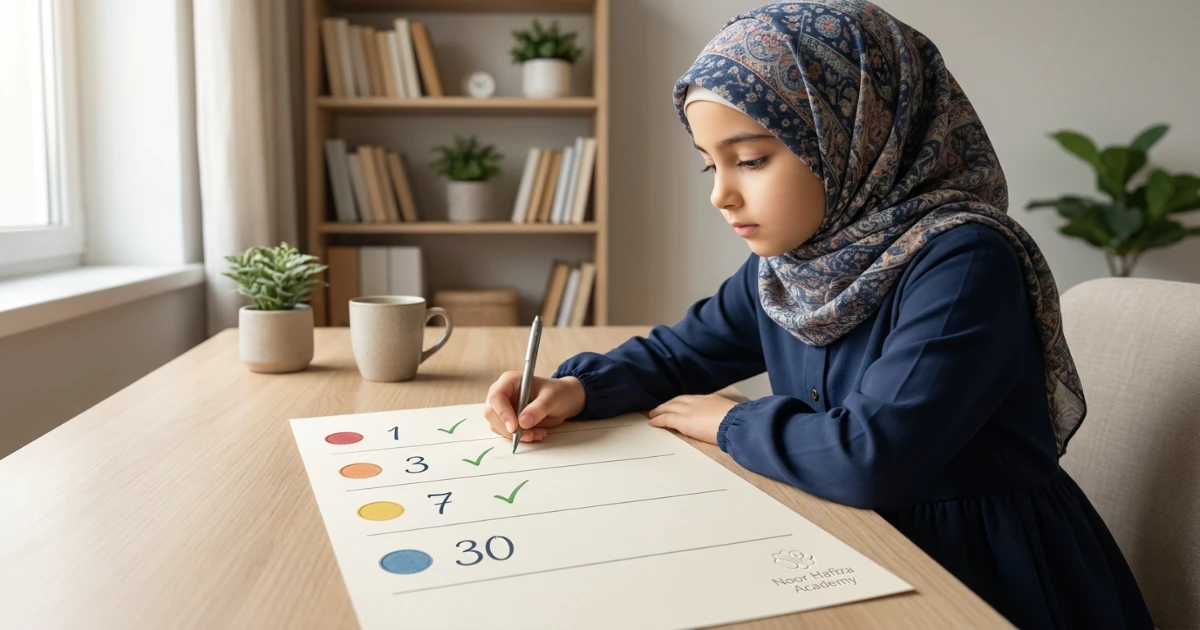
The most common reason is that the memorized portion was not reviewed often enough after it was first learned. Immediate repetition can create short-term fluency, but long-term retention needs recall after a gap. Students also forget when they keep adding new Hifz while recent and older Surahs are becoming unstable, when they only recite with audio instead of testing without prompts, when similar verses are not compared carefully, or when pronunciation and verse transitions were weak from the beginning. A practical retention plan is to review yesterday before learning today, use a 1–3–7 early review rhythm, keep recent memorization in frequent rotation, divide older Hifz across the week, and pause new material whenever recall starts to require repeated prompts.
Forgetting memorized Quran does not always mean the memory is weak
A student may recite a page, Surah, or passage perfectly immediately after repeating it many times and then struggle the next morning. This is common in learning. The first successful recitation shows that the sequence can be produced under fresh practice conditions; it does not yet prove that the passage can be retrieved reliably after time has passed.
This distinction matters because it changes the response. If parents or students interpret every forgotten verse as a personal failure, they may increase pressure, repeat the entire passage excessively, or add more memorization to “catch up.” A stronger response is to identify where recall breaks, test the passage after gaps, and strengthen the review schedule.
Job 1 is learning the passage accurately. Job 2 is proving that it can still be recalled tomorrow, three days later, next week, and while other Surahs are being memorized.
The first memorization was too weak or too rushed
Some forgetting begins during the original memorization session. The student may repeat quickly, follow a recording without truly recalling, overlook pronunciation errors, or move to the next line as soon as one successful repetition occurs. The passage feels familiar, but familiarity is not the same as independent retrieval.
Recitation works only with audio
The student can follow the reciter but loses the verse when the recording stops.
The first word always needs prompting
The verse is partly memorized but the starting cue has not become independently retrievable.
Transitions break repeatedly
Individual verses sound correct, but the student cannot move naturally from one verse to the next.
Strengthen first learning by using smaller units, reading or listening accurately, recalling without looking, and joining the end of one verse to the beginning of the next before moving forward.

Too much new Hifz is added before old Hifz becomes stable
A student can look productive while memorizing something new every day, yet slowly lose the Surahs learned last month. This happens when the new-memorization target grows faster than the revision system. The problem is not necessarily the daily amount by itself; it is the ratio between new Hifz and the time available to maintain what has already been learned.
If yesterday’s passage needs several prompts, recent Surahs are being mixed, or older memorization is disappearing, do not solve the problem by adding more new material. Reduce or pause new Hifz and repair the revision layers first.
Review happens only immediately after memorization
Repeating a verse twenty times in one sitting may make it feel smooth, but the student still needs to retrieve it later. That later retrieval is what reveals whether the passage is becoming durable. A simple spaced pattern can help families and students remember to test recall at increasing intervals.
Simple early review rhythm
Later the same dayNext dayAfter 3 daysAfter 7 daysWeekly rotation after thatThe exact numbers can change. The important principle is to test recall after a gap instead of keeping all repetitions inside one session.
Review is passive instead of active
Listening to Quran, following the Mushaf, or repeating immediately after a teacher can all support learning. But retention is tested when the student has to produce the passage from memory. If the student always hears the answer first, the review may feel easier than the true recall level.
- Ask for the Surah before playing the recording.
- Let the student pause and search memory before giving the first word.
- Test random Surahs, not only the newest one.
- Ask for a verse from the middle if the teacher considers that appropriate.
- After a mistake, repair the exact phrase and then restart from a few words earlier.
Similar verses and repeated endings become mixed
Short Surahs and longer passages can contain similar words, recurring patterns, or repeated endings. Students sometimes know each verse separately but choose the wrong next verse because the transition cue is weak.
Mark the exact confusion point
Do not repeat the whole Surah if only two similar transitions are causing the problem.
Compare the two places
Notice which words are the same and which word changes the direction of the passage.
Practise the transition
Repeat the end of the previous verse together with the correct beginning of the next verse.
Test again later
Return after a gap so the student proves that the distinction remains available from memory.

Pronunciation errors interrupt memory
Memorization and recitation are connected. If a student is uncertain whether a letter is correct, whether a Madd should be held, or whether a Shaddah was missed, the hesitation can interrupt the sequence. Repeating an incorrect pronunciation many times can also make the wrong version feel familiar.
Teacher correction should therefore happen before errors become deeply repeated. When a pronunciation problem appears, isolate the word, practise it slowly, place it back inside the phrase, and then recite the surrounding verses again.
Revision is irregular because school, work, or family life becomes busy
Students rarely forget in a perfectly predictable environment. School exams, travel, illness, work deadlines, family commitments, and tiredness can reduce the time available for revision. The mistake is often trying to keep the same new-Hifz target while the available review time has already fallen.
During busy periods, protect a smaller maintenance routine. Five or ten minutes of recent and older revision may be more useful than forcing a large new portion and then losing several older Surahs.
Use new Hifz, recent revision, and older revision separately
New Hifz
The passage currently being memorized. This receives detailed repetition, reading checks, teacher correction, and same-day recall.
Recent revision
Surahs or pages learned recently. These should be recited frequently until they remain stable after several days.
Older revision
Memorization considered strong. Divide it across the week so no section disappears from active use for too long.
The exact size of each layer depends on how much Quran the student has memorized. A child with five short Surahs may revise all of them easily. A student with a much larger Hifz amount needs a structured rotation.

Example weekly Quran revision plan
| Day | New Hifz | Recent revision | Older revision |
|---|---|---|---|
| Monday | Small new portion | Yesterday + latest Surah | Older group A |
| Tuesday | Continue if Monday is stable | Recent group | Older group B |
| Wednesday | Reduce if needed | Recent group | Older group C |
| Thursday | Small new portion | Latest material | Older group D |
| Friday | Optional / light | Full recent review | Selected Salah Surahs |
| Saturday | Teacher-guided if stable | Repair weak sections | Random recall |
| Sunday | Review only if needed | Full check | Weekly consolidation |
A practical retention schedule after memorizing a new passage
For families who want a simple rule, use increasing review gaps. This does not have to be followed like a strict formula; it is a reminder not to let new Hifz disappear from attention after one successful day.
| Review point | What to test | If it is weak |
|---|---|---|
| Day 1 | Recite later the same day without immediate audio prompts. | Repair the exact phrase and repeat again. |
| Day 3 | Recite the passage in sequence after a gap. | Reduce new Hifz and strengthen transitions. |
| Day 7 | Recite as part of a longer recent-review session. | Move it back into frequent revision. |
| Day 30 | Test it among older memorized Surahs, not only by itself. | Return it to recent revision until stable again. |
How to repair mistakes without making revision exhausting
When a student makes one mistake in a Surah, repeating the entire Surah ten times is not always the best correction. Use targeted repair.
- Identify the exact word, ending, or transition.
- Listen to or read the correct version once or twice.
- Repeat the difficult phrase accurately.
- Add the few words before it so the cue becomes natural.
- Add the few words after it so the transition becomes stable.
- Test the full passage again after a short gap.
Targeted repair keeps revision efficient and helps the student understand where memory is actually failing.
How parents can help children retain memorized Quran
- Keep one predictable daily review time.
- Ask for old Hifz before playing the recitation model.
- Use short sessions when the child is tired after school.
- Keep a visible list of new, recent, and strong Surahs.
- Do not compare siblings or classmates.
- Tell the teacher which Surahs are slipping at home.
- During exam weeks, reduce new Hifz before removing revision.
- Celebrate a week of strong review, not only a new Surah completed.

How adult learners can retain memorized Quran with limited time
Adults often have less uninterrupted time than children, but they can use consistency and self-monitoring to their advantage. A short daily revision window is usually more useful than one long weekend session. Keep a small recent-review list, rotate older Surahs across the week, and use Salah to reinforce stable memorization while still keeping separate deliberate revision.
Adults can also maintain an error log. If one transition, letter, or verse repeatedly fails, write it down and target it in the next session rather than relying on general repetition.
Can understanding the meaning help Quran memorization retention?
Meaning can support memory by giving the verses a clearer structure. A student who understands the general flow of a Surah may find it easier to remember which idea comes next. This is especially useful when similar-sounding verses create confusion.
Meaning should support accurate Arabic memorization, not replace it. Keep the Hifz target clear: understand the passage at an age-appropriate level and also reproduce the Quranic text accurately as taught.
Use stable memorized Surahs in Salah—but do not make Salah the only review
Reciting memorized Surahs in Salah is valuable retrieval practice and keeps Quran connected to worship. However, students often repeat the same favorite Surahs. That can strengthen a few passages while older memorization remains untouched.
Rotate stable Surahs in Salah when appropriate, and keep a separate revision plan that includes passages the student does not naturally choose during prayer.
Signs the student should stop adding new memorization temporarily
Recent Hifz needs constant prompts
Yesterday’s or last week’s material is not stable enough to support another new layer.
Older Surahs are disappearing
The revision rotation is too small for the amount already memorized.
Similar verses are being mixed repeatedly
The student needs targeted comparison before adding more similar material.
Pronunciation declines under recall
Memory pressure is causing the student to lose recitation accuracy.
Revision sessions are becoming very long
The new-Hifz pace may be creating more maintenance than the schedule can support.
School or work pressure has changed
Keep connection through revision and restart new material when the routine becomes sustainable again.
How a Quran teacher can improve retention
A teacher can distinguish different kinds of forgetting. One student may have weak first memorization. Another may know the Surah but confuse transitions. A third may have strong sequence but repeated Makharij errors. Another may simply need a better old-revision rotation.
Teacher feedback can therefore change the plan instead of simply asking for more repetition. A useful Hifz check can review new material, a recent Surah, and an older random Surah so the teacher sees whether the problem is local or system-wide.
Share the learner’s age, Surahs or Juz already memorized, what is being forgotten, current revision routine, reading level, time zone, and available lesson schedule.
A simple two-week plan when memorized Quran is slipping
| Days | Main action | New Hifz | Revision focus |
|---|---|---|---|
| 1–3 | Audit weak Surahs | Pause or reduce | Find exact weak transitions and errors |
| 4–7 | Repair recent Hifz | Very small if stable | Daily recent review + one old group |
| 8–10 | Reintroduce spaced testing | Small | Test without audio or immediate prompts |
| 11–14 | Check transfer | Increase only if stable | Random older Surahs + full recent review |
After two weeks, the goal is not necessarily to memorize a large new amount. The goal is to restore a system in which recent and older Quran can be recalled without constant rescue.
FAQs about forgetting memorized Quran
Why do I forget Quran after memorizing it?
Is forgetting memorized Quran normal?
How often should memorized Quran be revised?
What is the 1–3–7 Quran revision method?
Should I stop new Hifz if old Surahs are weak?
Does listening to Quran count as revision?
How do I fix similar verses that keep getting mixed?
Can Salah help retain memorized Surahs?
How can parents help a child retain Hifz?
What if a student forgets after a school exam period?
Is more repetition always the solution?
How do I know a Surah is truly retained?
Strong Hifz is built by what happens after memorization
Memorize smaller portions accurately, retrieve them without prompts, review them after increasing gaps, and keep recent plus older Quran in rotation before adding more new material.