Madd Muttasil and Madd Munfasil Explained
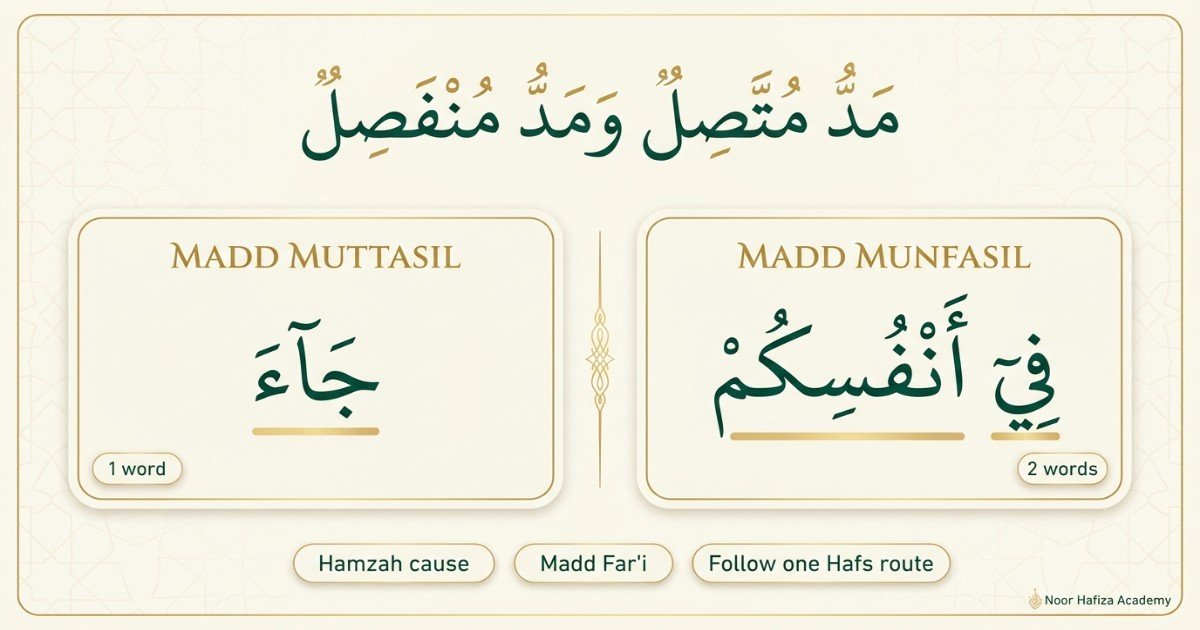
Madd Muttasil and Madd Munfasil are two important types of Madd Far’i caused by Hamzah. The main difference is where the Hamzah appears. In Madd Muttasil, the Madd letter and Hamzah occur in the same word. In Madd Munfasil, the Madd letter ends one word and the Hamzah begins the next word. In common Hafs ‘an ‘Asim classroom teaching, both are often taught with an extended count such as four or five beats, but exact permitted timing depends on the Tariq being followed, especially for Munfasil. The practical beginner rule is to follow one qualified teacher and one consistent transmission method rather than mixing different valid lengths.
What is the difference between Madd Muttasil and Madd Munfasil?
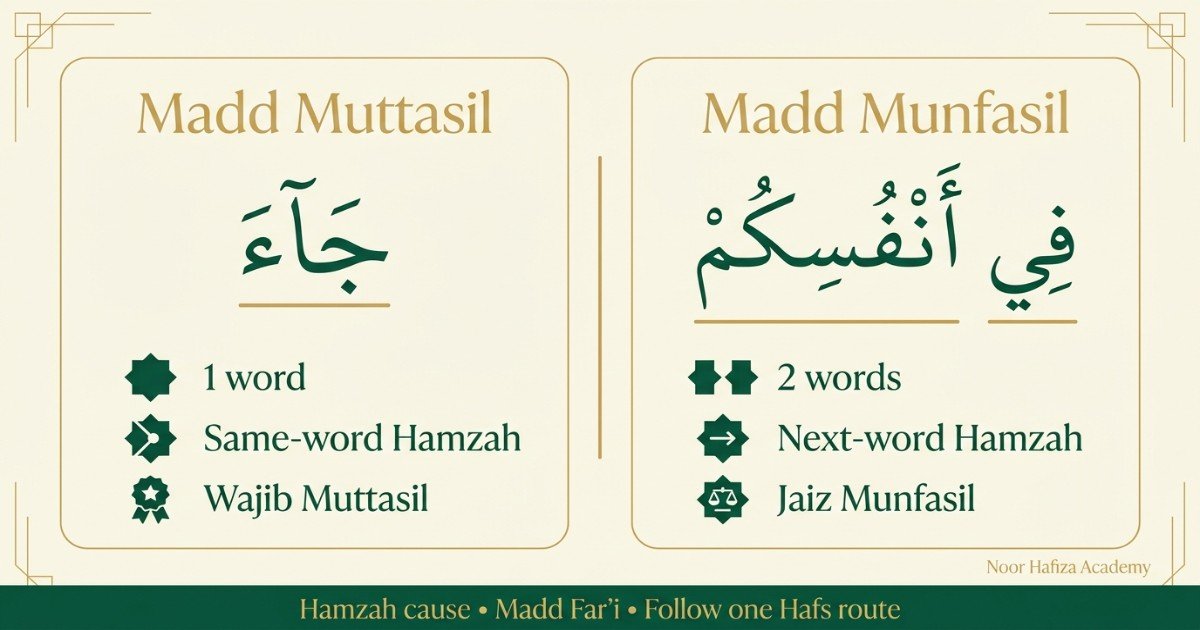
Madd Muttasil occurs when a Madd letter is followed by Hamzah in the same word. Madd Munfasil occurs when one word ends with a Madd letter and the next word begins with a pronounced Hamzah. Both are Hamzah-based Madd Far’i rules. The fastest memory rule is: Muttasil = connected inside one word; Munfasil = separated across two words.
What do Muttasil and Munfasil have in common?
Both rules begin with a valid Madd letter: Alif after Fathah, a Sakin Waw after Dammah, or a Sakin Ya after Kasrah. Both then involve Hamzah as the additional cause that moves the elongation beyond ordinary Madd Asli into a secondary Madd rule.
The student therefore asks two questions. First, is there a genuine Madd letter? Second, where is the Hamzah in relation to it? If the Hamzah remains in the same word, the rule is Muttasil. If it begins the next word, the rule is Munfasil when the words are connected.
This distinction should be mastered before worrying about the exact count.
What is Madd Muttasil?
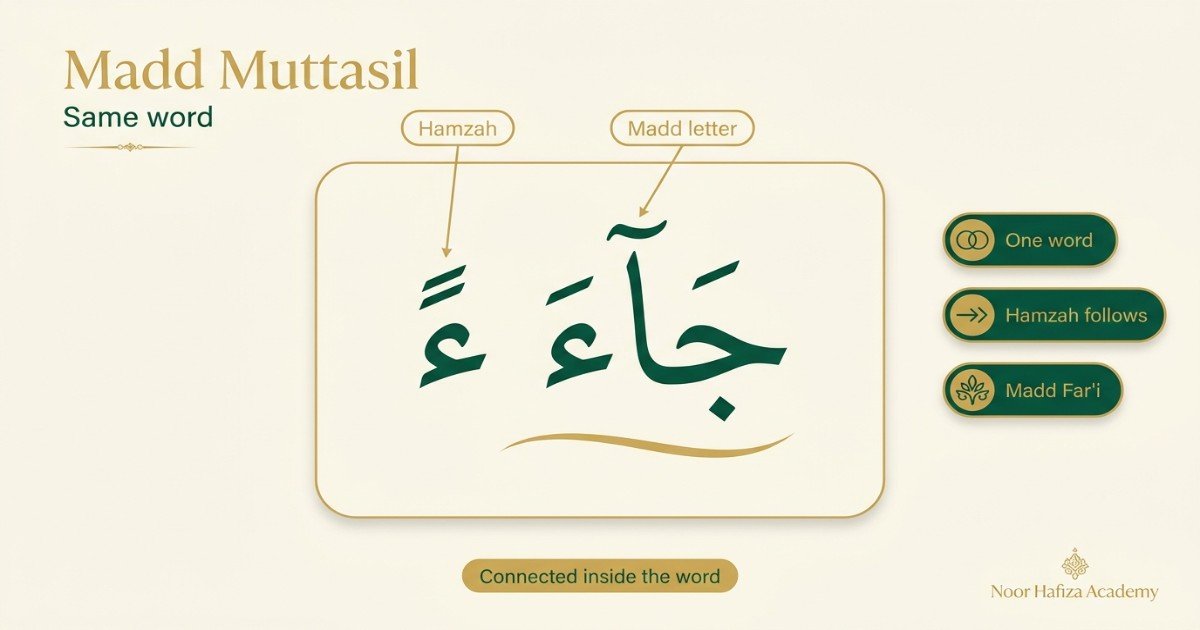
Madd Muttasil, often called Madd Wajib Muttasil, occurs when a Madd letter is followed by Hamzah within the same word. The Arabic label “Muttasil” means connected, describing the fact that the Madd and Hamzah are structurally connected inside one word.
Because both elements belong to the same word, the relationship is built into the word itself. It is not created merely by joining two separate words in recitation.
Madd + Hamzah in one word
The long vowel is followed by Hamzah inside the same written word.
Secondary elongation
The Hamzah creates a Far’i rule and the Madd is lengthened according to the Hafs route being studied.
What is Madd Munfasil?
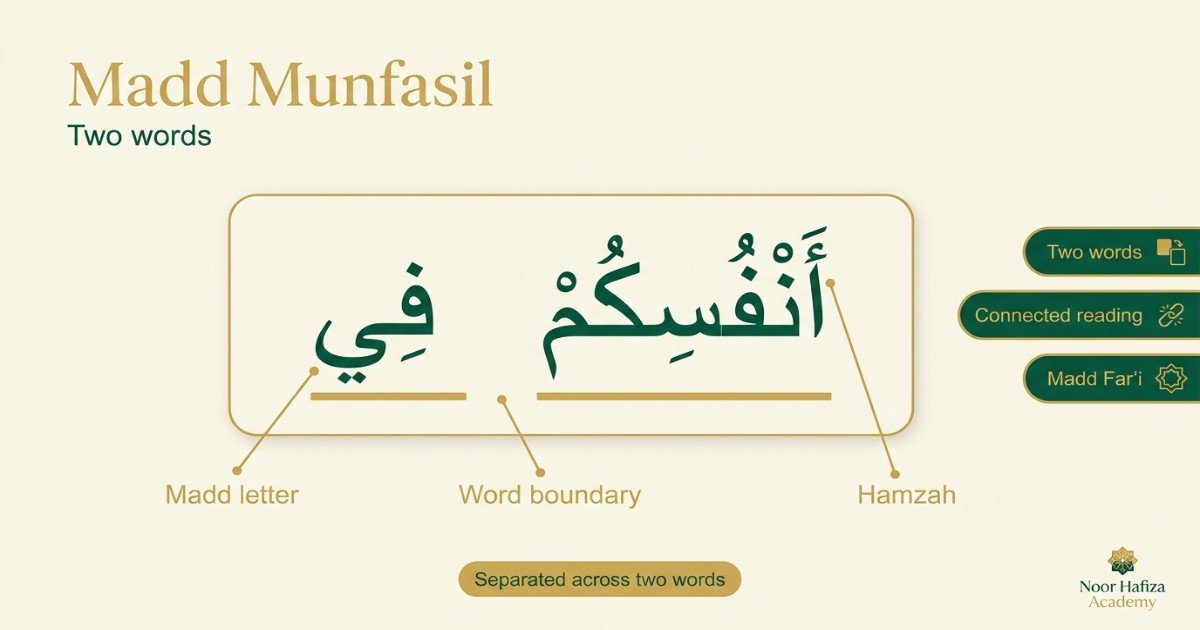
Madd Munfasil, often called Madd Jaiz Munfasil, occurs when the first word ends with a Madd sound and the next word begins with Hamzah. The word “Munfasil” means separated because the Madd and Hamzah belong to two separate words.
This rule depends on connection. When the two words are read together, the Madd at the end of the first word is followed immediately by the pronounced Hamzah of the second word. If the reader stops before the second word, the cross-word Munfasil relationship is not being read at that point.
Madd at word end + Hamzah next word
The Madd belongs to word one and Hamzah belongs to word two.
Cross-word Madd
The special Munfasil relationship appears in connected recitation.
Madd Muttasil vs Madd Munfasil at a glance
| Feature | Madd Muttasil | Madd Munfasil |
|---|---|---|
| Hamzah position | Same word | Beginning of next word |
| Number of words | One | Two |
| Shared cause | Hamzah | Hamzah |
| Broad class | Madd Far’i | Madd Far’i |
| Traditional label | Wajib Muttasil | Jaiz Munfasil |
| If you stop before next word | Same-word relationship remains | Cross-word relationship ends |
Common Quran examples of Madd Muttasil
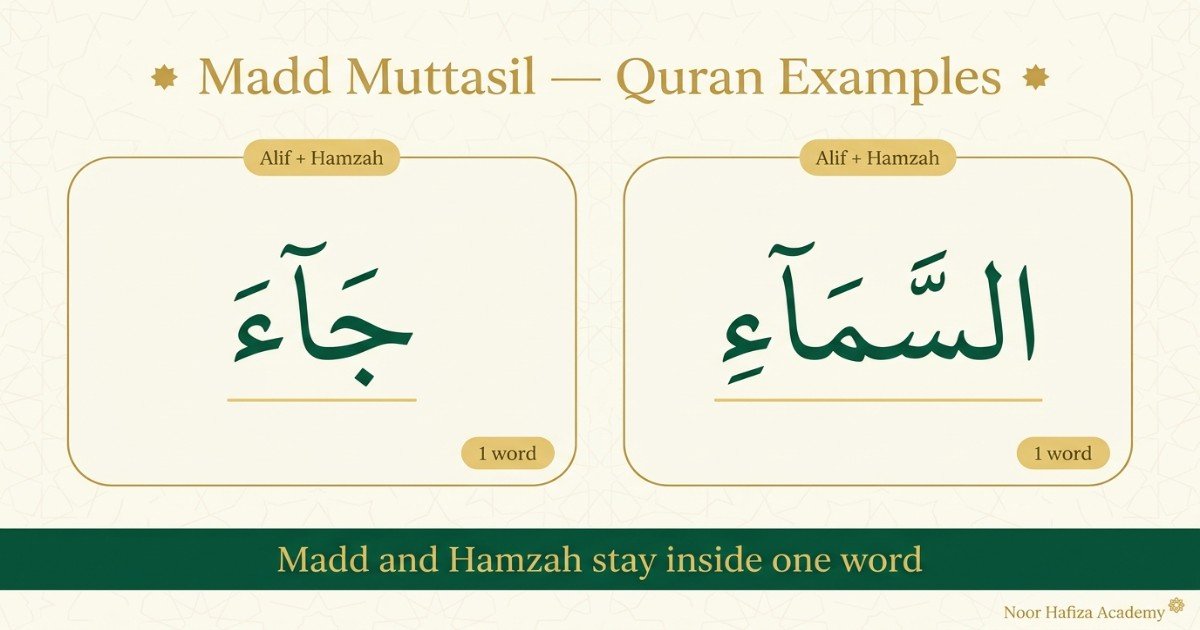
Commonly taught examples include words such as جَاءَ and السَّمَاءِ, where the Madd sound and Hamzah are contained within one word. The student should notice the word boundary before thinking about count.
The exact visual position of Hamzah can look different depending on the word and Mushaf orthography, so pattern recognition should combine the written form with listening. If the Madd and Hamzah remain part of the same word, the rule stays Muttasil.
Confirm that the long vowel is a real Madd letter in the proper condition.
The Hamzah must follow the Madd in the word.
If both remain inside one word, classify it as Muttasil.
Common Quran examples of Madd Munfasil
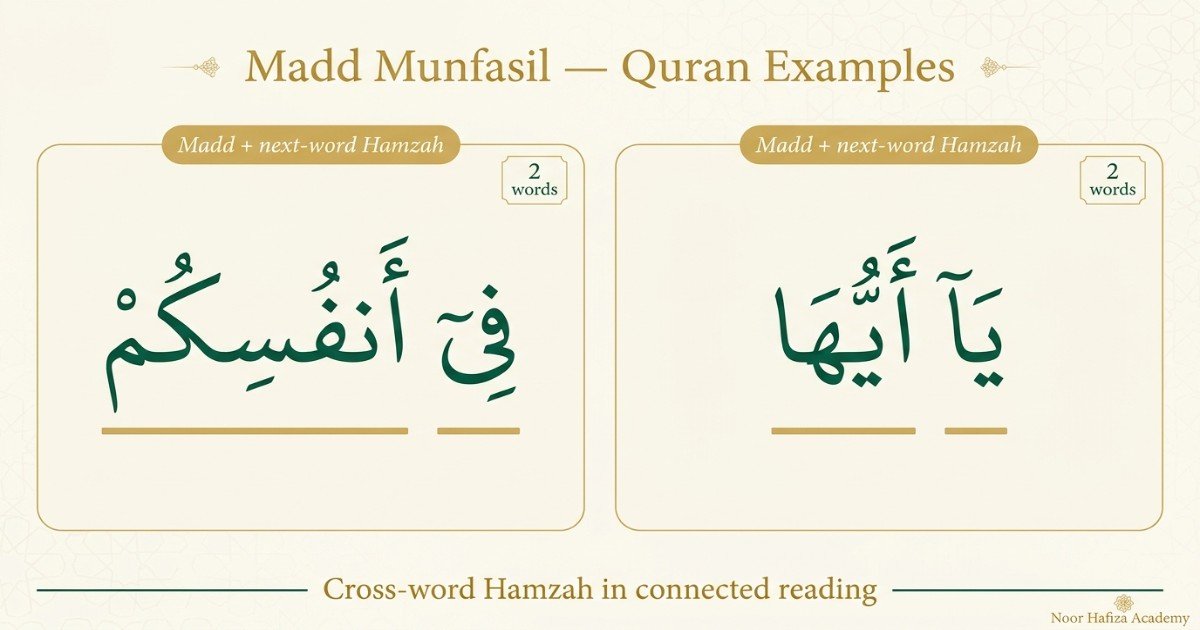
A typical Munfasil pattern is seen in phrases such as فِي أَنْفُسِكُمْ, where the first word ends with a Madd Ya and the next word begins with a pronounced Hamzah. The two words remain separate in writing even though they are joined in recitation.
The student should not simply look for an Alif at the beginning of the next word. The next word must begin with a Hamzah that is pronounced in connection. This is why understanding Hamzatul Qat and Hamzatul Wasl is useful.
The long vowel belongs to the first word.
The Hamzah belongs to the second word and remains audible in connection.
The Munfasil relationship appears when the phrase is connected.
How many counts are Muttasil and Munfasil in Hafs?
In many beginner Hafs classrooms, both are taught with a longer value such as four or five counts. However, the exact transmission details are more nuanced. The permitted length depends on the Tariq, and Munfasil has especially well-known route-based variation.
Muttasil is traditionally called Wajib because the Madd is lengthened beyond ordinary natural Madd in the transmitted reading. Munfasil is called Jaiz because valid transmitted routes include variation in its length.
The student should not mix one teacher’s four-count method with another recording’s shorter Munfasil and then alternate randomly. Valid variation is learned as a coherent recitation route, not as personal choice from word to word.
Why are they called Wajib Muttasil and Jaiz Munfasil?
The terms are traditional Tajweed labels. Wajib Muttasil points to the strong transmitted requirement of extending this same-word Madd beyond its natural baseline. Jaiz Munfasil reflects the presence of transmitted variation in how the separated Madd can be read across different valid routes.
These labels should not be turned into an oversimplified legal discussion. For a beginner, they are best treated as names that help organize the recitation rules.
What happens if you stop?
Stopping shows the structural difference very clearly. In Munfasil, if you stop at the end of the first word, you are no longer connecting into the Hamzah of the next word. Therefore the cross-word Munfasil relationship is not present at that stop.
Muttasil is different because the Hamzah is already inside the same word as the Madd. The same-word relationship does not depend on joining two words together.
Same-word relationship
The Madd and Hamzah remain structurally connected in the word.
Cross-word relationship
If you stop before the second word, you do not read the Munfasil connection there.
Why Hamzatul Qat matters for Munfasil
For Munfasil, the Hamzah at the beginning of the second word must remain pronounced in connected reading. A visual Alif alone is not enough. Hamzatul Wasl drops in connection, so it does not behave like the pronounced Hamzah required for the standard Munfasil pattern.
This is one reason the topic connects naturally with Hamzatul Wasl vs Hamzatul Qat. The better the student understands connected Hamzah behavior, the easier Munfasil becomes to identify.
How are Muttasil and Munfasil different from Madd Asli?
Madd Asli is the natural two-count Madd without an additional Hamzah or Sukoon cause. Muttasil and Munfasil are both Madd Far’i because Hamzah adds a new condition that changes the rule.
| Rule | Extra cause? | Hamzah position | Core idea |
|---|---|---|---|
| Madd Asli | No | No Hamzah creating Far’i | Natural 2-count Madd |
| Madd Muttasil | Yes | Same word | Hamzah-based Far’i |
| Madd Munfasil | Yes | Next word | Cross-word Hamzah-based Far’i |
Common Muttasil and Munfasil mistakes
Looking only for Hamzah
The position of Hamzah decides whether the rule is Muttasil or Munfasil.
Ignoring the word boundary
One rule stays in one word; the other crosses two words.
Treating every initial Alif as Qat
Hamzatul Wasl can drop in connection, so visual Alif alone is not enough.
Using random counts
Follow one valid Hafs route instead of mixing lengths from different recordings.
Keeping Munfasil after a stop
If you stop before the next word, the cross-word Munfasil relationship is not being read.
Reducing Muttasil to natural Madd
Muttasil is a Far’i rule, not ordinary Madd Asli.
Mechanical counting
Counts are rhythmic units that should fit the recitation speed.
Memorizing labels without sound
Recognition must be followed by real recitation practice.
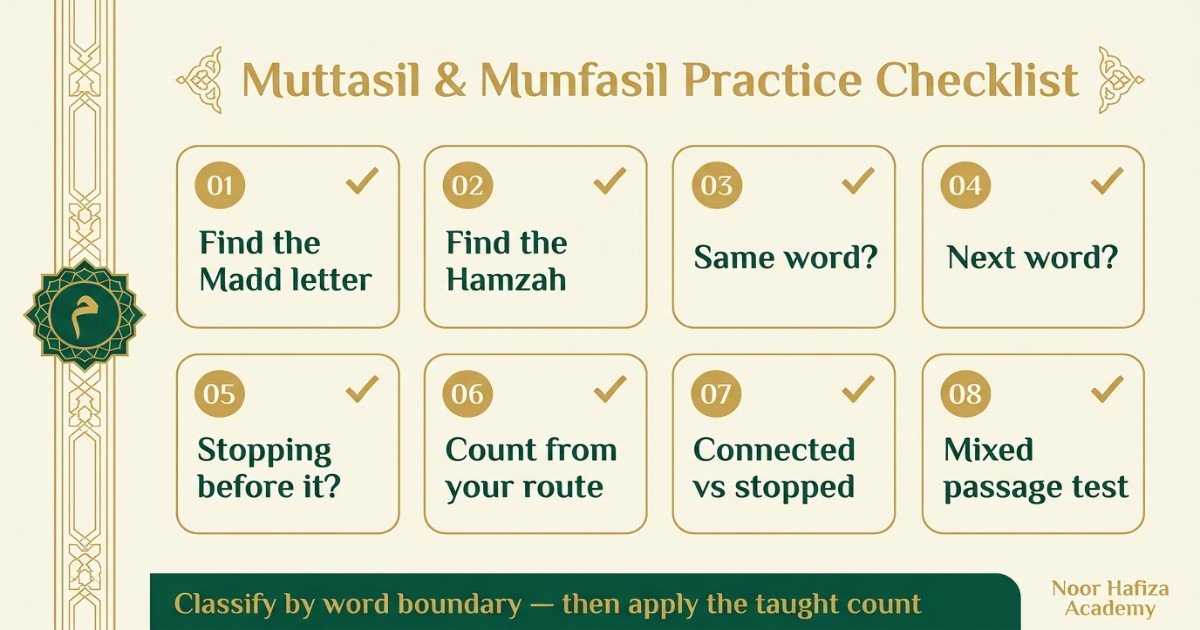
How to identify Muttasil or Munfasil in six steps
Confirm Alif, Waw, or Ya is acting as a Madd letter.
Check whether a pronounced Hamzah follows.
If yes, classify it as Muttasil.
If yes, classify it as Munfasil when connected.
If you stop before the next word, do not keep the connected Munfasil relationship.
Use the count of your teacher’s Hafs route.
How should beginners practise Muttasil and Munfasil?
Begin with classification rather than counting. Take a short list of examples and mark each as one word or two words. Once this becomes automatic, add the count taught by your teacher.
Then practise contrast: one Madd Asli example, one Muttasil example, and one Munfasil example. This trains the ear to hear that all three contain elongation but differ in cause and structure.
Finally, practise Munfasil twice: once connecting into the Hamzah and once stopping at the end of the first word. The difference between those two readings makes the rule much easier to understand.
| Stage | Focus | Exercise | Goal |
|---|---|---|---|
| 1 | Word boundary | Mark one-word vs two-word examples | Correct classification |
| 2 | Muttasil | Repeat same-word Hamzah examples | Stable timing |
| 3 | Munfasil | Read connected two-word examples | Hear cross-word relation |
| 4 | Stop vs connect | Read Munfasil both ways | Understand connection |
| 5 | Mixed passage | Label Asli, Muttasil, Munfasil | Automatic application |
Why teacher feedback matters for Madd counts
A learner may classify the rule correctly but still produce unstable timing. Teacher correction helps keep each count even and makes sure the reciter is following one coherent Hafs route.
Teacher guidance is especially useful for Munfasil because valid transmission routes can differ in length. The goal is not to collect every possible number, but to recite consistently according to the method being studied.
12-point Muttasil and Munfasil checklist
Use this while reading a fresh Quran passage
- Can I identify the Madd letter correctly?
- Is a pronounced Hamzah involved?
- Is the Hamzah in the same word?
- If yes, have I identified Madd Muttasil?
- Is the Hamzah at the beginning of the next word?
- If yes, am I connecting the two words for Madd Munfasil?
- Could the next-word Alif be Hamzatul Wasl rather than a pronounced Hamzah?
- If I stop on the first word, am I avoiding a false Munfasil reading?
- Am I using the count taught for my Hafs route?
- Am I keeping my count units even?
- Can I distinguish Muttasil, Munfasil, and Madd Asli in a mixed passage?
- Can I explain the word-boundary reason before I recite?
Learn Madd Muttasil and Madd Munfasil in online Tajweed lessons
Noor Hafiza Academy offers live online Quran learning for children, girls, women, adults, beginners, returning readers, teenagers, siblings, and homeschool families with female Quran teachers. Learners can ask about Noorani Qaida, Quran reading, Tajweed, Makharij, Sifaat, Madd, Hifz, and pronunciation correction according to their current level.
A Tajweed plan may include Madd Asli, Madd Muttasil, Madd Munfasil, Madd Badal, Madd Lazim, Madd ‘Arid lis-Sukoon, Waqf, Qalqalah, Ghunnah, Noon Sakinah and Tanween, Meem Sakinah, and guided recitation. Current teacher qualifications, female-teacher availability, class length, trial arrangements, fees, schedules, privacy practices, safeguarding policies, and enrollment terms should be confirmed directly.
Share the learner’s age, Quran level, Tajweed background, Madd difficulties, preferred schedule, and whether a female teacher is requested.
FAQs about Madd Muttasil and Madd Munfasil
What is Madd Muttasil?
What is Madd Munfasil?
What is the easiest difference between Muttasil and Munfasil?
Are both types of Madd Far’i?
Why is Muttasil called Wajib?
Why is Munfasil called Jaiz?
How many counts is Madd Muttasil in Hafs?
How many counts is Madd Munfasil in Hafs?
Does Munfasil apply if I stop at the end of the first word?
Does Muttasil disappear if I stop on the word?
Can Hamzatul Wasl create Madd Munfasil?
How should beginners practise Muttasil and Munfasil?
Master Hamzah-based Madd by checking whether the Hamzah is inside the same word or at the start of the next
Share the learner’s age, Quran level, Tajweed background, Madd difficulties, and preferred class schedule.