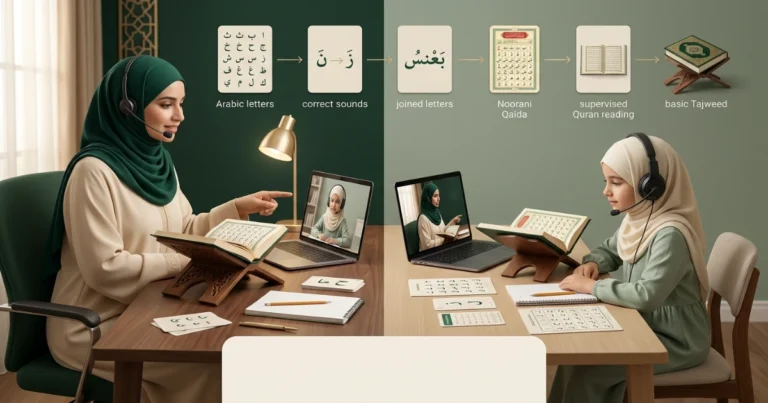
Arabic Alphabet for Quran Beginners: Letters, Shapes and Sounds
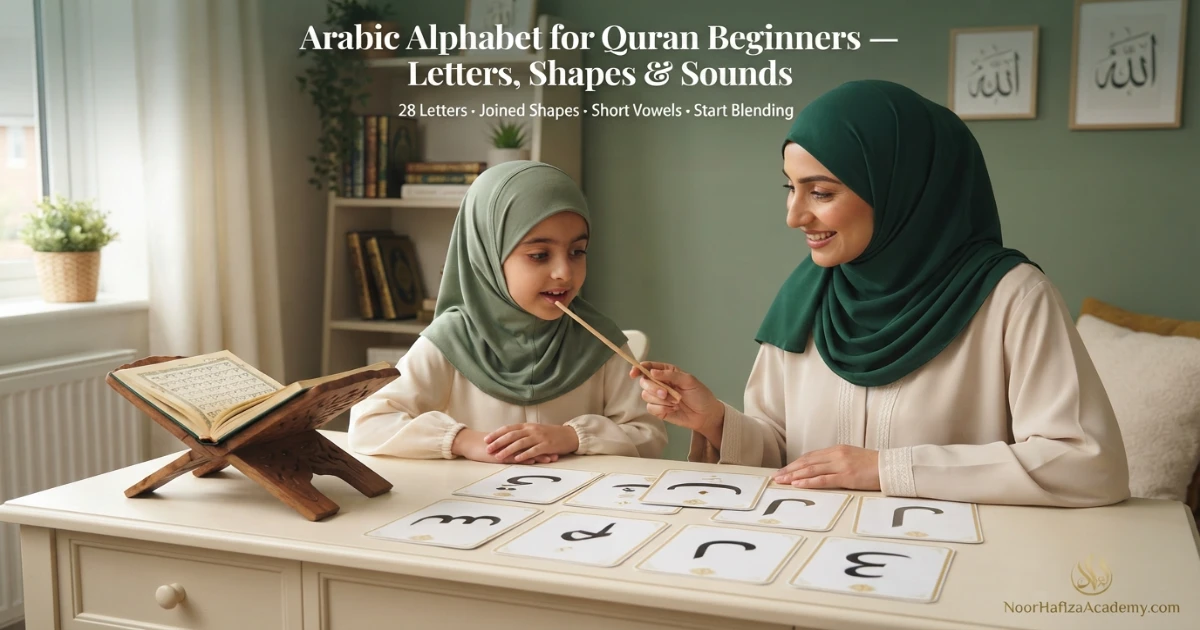
The Arabic alphabet for Quran beginners has 28 core letters, but learning their names in a chart is only the first step. To read Quran, a beginner must recognize letters when they appear alone and when their shapes change inside words, understand which letters connect and which do not connect to the next letter, produce the sounds as accurately as possible, and combine those letters with vowel marks. Several Arabic sounds do not have a close English equivalent, so written sound descriptions should be treated as rough memory aids rather than replacements for listening to a qualified teacher. This guide gives beginners a practical roadmap from letter recognition to early Quran decoding.
How should a Quran beginner learn the Arabic alphabet?
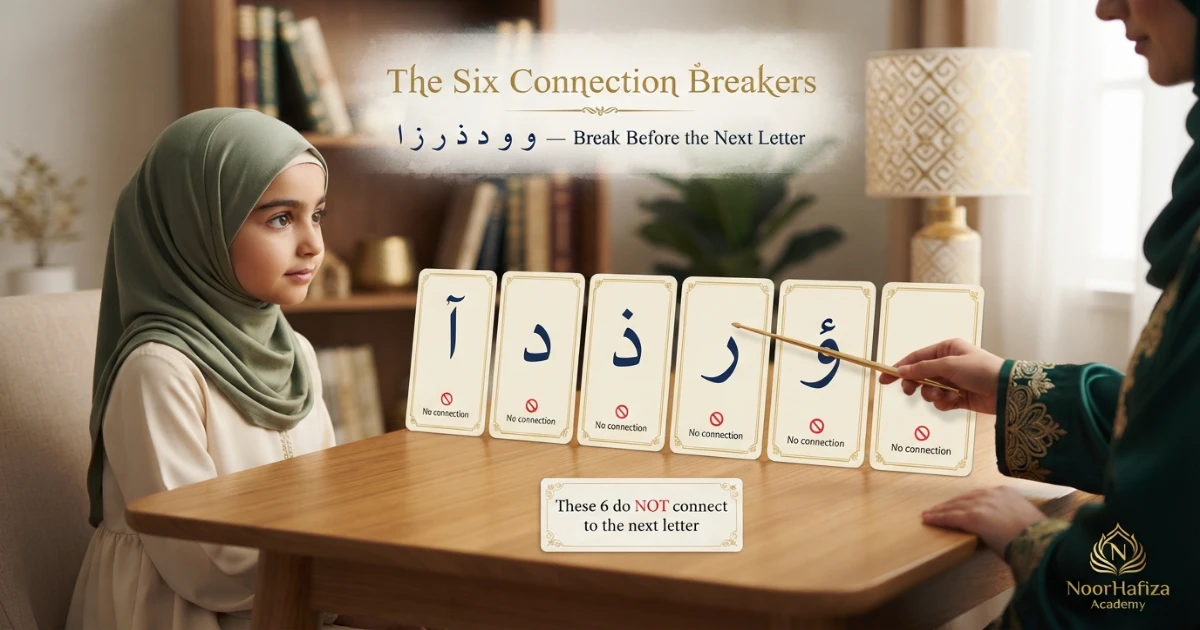
A Quran beginner should learn the Arabic alphabet in stages. First, recognize the 28 letters in isolated form and associate each with its correct sound. Second, learn how letters change when they appear at the beginning, middle, or end of a word. Third, memorize the six letters that do not connect to the following letter: ا, د, ذ, ر, ز, and و. Fourth, add the short vowels—fathah, kasrah, and dammah—then practise sukoon, shaddah, and basic long-vowel patterns. Finally, combine the letters into short unfamiliar words so the learner is decoding rather than memorizing a page. Because sounds such as ح, خ, ع, غ, ص, ض, ط, ظ, and ق cannot be represented accurately by English spelling alone, live listening and correction from a qualified teacher are especially valuable.
The 28 Arabic letters used in Quran reading
Arabic is written from right to left. The letters below are presented in standard alphabetic order. The English sound cues are deliberately simple: they can help a beginner remember a letter, but they cannot reproduce precise Quran pronunciation.
Often carries or supports a vowel sound; its exact reading depends on the marks and word.
Similar to English b in “book.”
Similar to a clear English t.
Similar to th in “think.”
Commonly taught with a j-like sound in Quran recitation.
A breathy throat sound; English has no exact equivalent.
A rough throat sound, often written kh.
Similar to English d.
Similar to th in “this.”
A tapped or rolled r-type sound; details vary by context.
Similar to English z.
Similar to a light English s.
Similar to sh in “ship.”
A heavier, fuller s-type sound.
A heavy emphatic sound with no exact English equivalent.
A heavy, emphatic t-type sound.
A heavy emphatic sound with no exact English equivalent.
A deep throat sound with no exact English equivalent.
A voiced throat sound often written gh.
Similar to English f.
A deep q-type sound produced farther back than kāf.
Similar to English k.
Similar to l; its quality can change in certain Quran contexts.
Similar to English m.
Similar to English n, with additional Quran rules in some contexts.
A light h-type sound.
Can represent a w-type consonant or support a long vowel depending on context.
Can represent a y-type consonant or support a long vowel depending on context.
Beginners often confuse letters that share a basic shape. For example, ب ت ث differ mainly by dots; ج ح خ share a body shape; د ذ are related; ر ز are related; س ش are related; ص ض are related; ط ظ are related; ع غ are related; and ف ق may look similar in some scripts. Learning these visual families can reduce overload because the learner sees relationships instead of 28 unrelated symbols.
Why Arabic letters have isolated, initial, medial, and final shapes
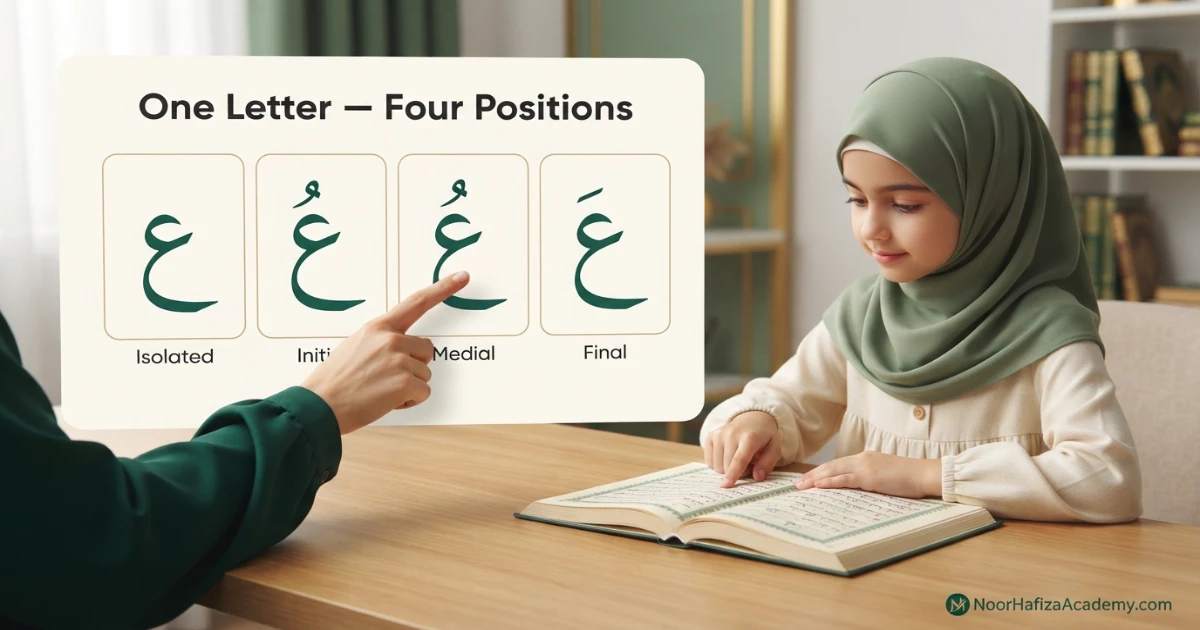
Most Arabic letters join to neighboring letters. Their core identity remains the same, but the visible shape may change slightly depending on where the letter sits in the word. A beginner who learns only isolated alphabet-chart forms may recognize letters during flashcard practice but become lost as soon as the same letters appear in connected Quran words.
Isolated form
The letter stands alone and is not joined to another letter. Beginners usually meet this form first.
Initial form
The letter appears at the beginning of a connected group and joins forward when connection is allowed.
Medial form
The letter appears inside a connected group and may connect on both sides.
Final form
The letter appears at the end of a connected group and may join to the letter before it.
Shape family
Dots, loops, teeth, and curves help preserve identity even when joining strokes change.
Recognition goal
The learner should identify letters inside unfamiliar combinations, not only on one memorized Qaida page.
Which Arabic letters do not connect to the next letter?
Six commonly taught letters connect to a preceding letter when possible but do not connect forward to the letter that follows them: ا د ذ ر ز و. This creates a visible break inside a word even though the word itself continues. Memorizing this rule early helps beginners understand why some Quran words look like two or more visual groups.
| Letter | Name | Connection rule | Beginner reminder |
|---|---|---|---|
| ا | Alif | Does not connect forward | The next letter begins a new shape group |
| د | Dāl | Does not connect forward | Do not add a joining stroke after it |
| ذ | Dhāl | Does not connect forward | Same connection behavior as dāl |
| ر | Rā’ | Does not connect forward | The following letter starts separately |
| ز | Zāy | Does not connect forward | Same connection behavior as rā’ |
| و | Wāw | Does not connect forward | Expect a visual break after it |
Why Arabic letter sounds need listening, not transliteration alone
English spellings such as “kh,” “gh,” “th,” or “q” are useful labels, but they cannot reproduce Arabic articulation. Several Quran letters come from places in the throat or mouth that English speakers may not normally use in the same way. The best beginner process is to hear the sound, attempt it, receive correction, and then place it inside simple words.
Letters such as ب, ت, ف, ك, م, and ن have broad similarities to English sounds, though Quran pronunciation should still be checked.
Beginners need to hear contrasts such as س/ص, د/ض, ت/ط, and similar light–heavy relationships.
ح, خ, ع, and غ often require live modeling because English descriptions are especially limited.
Qāf and kāf are distinct; a teacher helps the learner hear and produce the difference.
The goal is not to make a beginner anxious about every technical Makharij term in the first week. The early goal is to keep clearly different letters distinct and then improve precision gradually.

Fathah, kasrah, and dammah for Quran beginners
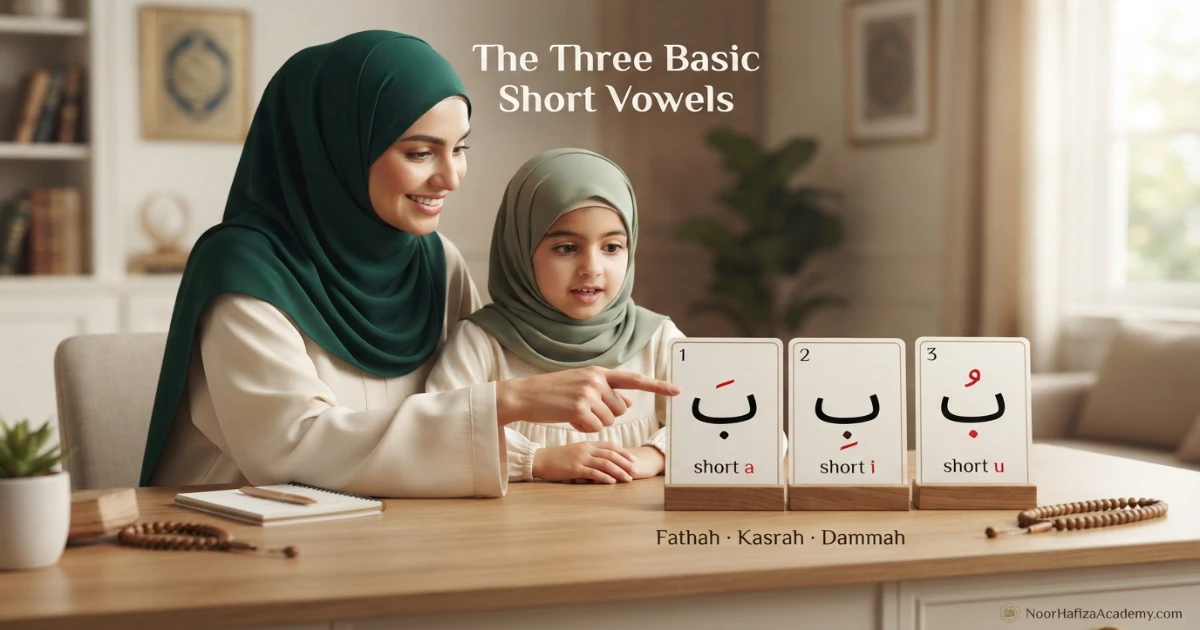
After recognizing letters, beginners learn how small marks change the sound. The three basic short vowels are foundational because they turn a consonant into a readable syllable. The learner should keep these sounds short unless another sign creates lengthening.
| Example | Name | Approximate cue | Key rule |
|---|---|---|---|
| بَ | Fathah | Short “a”-type sound | Keep it short unless a lengthening pattern is present |
| بِ | Kasrah | Short “i”-type sound | Do not automatically stretch it |
| بُ | Dammah | Short “u”-type sound | Keep the sound short and clean |
Sukoon, shaddah, tanween, long vowels, and blending
Once short vowels are stable, a structured beginner course usually introduces other symbols and patterns gradually. The order can vary slightly by Qaida method, but the learning logic is similar: recognize the sign, hear its effect, practise it in controlled examples, then transfer it into unfamiliar Quran words.
Sukoon
Shows a consonant without its own short vowel. Beginners often need practice avoiding an added vowel after it.
Shaddah
Marks a doubled consonant action and should not be read like an ordinary single letter.
Tanween
Double-vowel endings are introduced after the learner is comfortable with single short vowels.
Long vowels
Patterns involving alif, wāw, or yā’ create longer vowel sounds under specific conditions.
Joined words
The learner combines symbols without stopping after every letter.
Quran application
Skills transfer from controlled Qaida exercises into real Quran words and short passages.
Learn Arabic letters in visual shape families
Alphabet order is important, but visual families help beginners recognize letters more quickly. The following groups share a similar body and differ through dots or small details.
| Family | Letters | Main difference | Practice idea |
|---|---|---|---|
| Bā’ family | ب ت ث | Dot number and position | Mix all three randomly |
| Jīm family | ج ح خ | Dot below, no dot, dot above | Recognize isolated and joined forms |
| Dāl family | د ذ | Dot on dhāl | Remember both break forward connection |
| Rā’ family | ر ز | Dot on zāy | Practise before different following letters |
| Sīn family | س ش | Three dots on shīn | Contrast shape and sound |
| Ṣād family | ص ض | Dot on ḍād | Pair visual recognition with heavy sound |
| Ṭā’ family | ط ظ | Dot on ẓā’ | Avoid substituting lighter letters |
| ‘Ayn family | ع غ | Dot on ghayn | Use teacher audio because sounds differ strongly |
A five-step Arabic alphabet practice method
See the letter
Name it and identify its dot pattern, basic body, and visual family.
Hear the sound
Listen to a qualified teacher rather than depending only on English transliteration.
Say the sound
Repeat briefly, then allow correction before repeating a mistake many times.
Find it in a joined form
Recognize the same letter in initial, medial, or final position.
Add a vowel and blend
Read simple unfamiliar combinations instead of memorizing the page order.

Common Arabic alphabet mistakes Quran beginners make
Memorizing only alphabet order
The learner can recite letter names but cannot recognize them randomly.
Learning isolated forms only
The learner knows the chart but becomes lost when shapes connect inside words.
Ignoring dot position
Letters from the same family are confused because dots are not checked carefully.
Using transliteration as pronunciation
Letters with no English equivalent are replaced by familiar sounds and the habit becomes harder to repair.
Forgetting connection rules
The learner expects every word to look like one continuous joined shape.
Stretching short vowels
Fathah, kasrah, and dammah are made longer than the pattern requires.
Repeating after the teacher every time
The learner sounds correct by imitation but cannot decode independently.
Advancing too early
Pages progress while letter confusion remains, making later Quran reading harder.
A simple 30-day Arabic alphabet plan for Quran beginners
| Week | Main goal | Home practice | Teacher checkpoint |
|---|---|---|---|
| Week 1 | Recognize core letter families | 5–10 letters at a time in random order | Check sound identity and visual confusion |
| Week 2 | Complete all 28 letters and joined forms | Match isolated letters to initial, medial, and final forms | Test unfamiliar joined combinations |
| Week 3 | Short vowels and non-connecting letters | Mixed fathah, kasrah, dammah plus connection breaks | Check short-vowel timing and visual grouping |
| Week 4 | Early blending and symbol review | Simple words with sukoon, shaddah, and controlled blending where appropriate | Confirm readiness for the next Qaida or Quran-reading stage |

How do you know a learner is ready to move beyond the alphabet?
Finishing an alphabet chart is not the same as being ready for full Quran reading. The learner should show enough independent recognition that later lessons are not built on guessing.
Useful readiness indicators
- Recognizes all 28 letters in mixed order.
- Identifies common letters in isolated and joined forms.
- Understands the six non-connecting letters.
- Reads basic fathah, kasrah, and dammah combinations accurately.
- Does not consistently confuse major shape families.
- Can attempt unfamiliar combinations before hearing the teacher.
- Responds to pronunciation correction and improves the sound.
- Begins blending short combinations without stopping after every letter.
Questions parents and adult beginners should ask a Quran teacher
Use these questions during a trial or beginner assessment
- Do you teach all 28 letters through both shape and sound?
- How do you teach initial, medial, and final forms?
- How do you test letter recognition in unfamiliar order?
- When do you introduce the six non-connecting letters?
- How do you correct letters such as ح, ع, غ, ق, ص, and ض?
- Do students practise independently before repeating after you?
- When do you introduce fathah, kasrah, and dammah?
- How do you prevent short vowels from becoming stretched?
- Do you use Noorani Qaida or another structured beginner method?
- How will you decide when the learner is ready for Quran reading?
- How much home practice should a beginner do?
- How do you report letter, pronunciation, and blending progress?
Online Arabic alphabet and Noorani Qaida classes for Quran beginners
Noor Hafiza Academy offers live online Quran learning for girls, women, children, adults, new Muslims, complete beginners, and returning readers with female Quran teachers. Beginners can start with an assessment of letter recognition, joined forms, vowels, pronunciation, blending, and previous Quran learning.
A suitable beginner plan may include Arabic alphabet recognition, Noorani Qaida, Makharij foundations, short vowels, sukoon, shaddah, blending, Quran reading, or a targeted restart. Current female-teacher qualifications, availability, schedules, trial arrangements, fees, privacy practices, policies, and enrollment terms should be confirmed directly.
Share the learner’s age, current letter recognition, previous Qaida experience, time zone, schedule, and whether the main difficulty is shapes, sounds, vowels, or blending.
FAQs about the Arabic alphabet for Quran beginners
How many letters are in the Arabic alphabet for Quran beginners?
Why do Arabic letters change shape inside words?
Which Arabic letters do not connect to the next letter?
Should a beginner learn letter names or sounds first?
Can English transliteration teach Arabic pronunciation accurately?
What are fathah, kasrah, and dammah?
What should a beginner learn after the alphabet?
Is Noorani Qaida useful for learning the Arabic alphabet?
How long does it take to learn the Arabic alphabet for Quran?
Which Arabic letters are hardest for English-speaking beginners?
How should children practise Arabic letters at home?
How do I know when a learner is ready to read Quran words?
Learn Arabic letters as real shapes and sounds, then build toward confident Quran reading
Share the learner’s age, current alphabet knowledge, previous Qaida experience, city and time zone, available days, and whether the main challenge is letter recognition, pronunciation, joined forms, vowels, or blending.