
Harkaat, Tanween, Sukoon and Shaddah Explained for Beginners
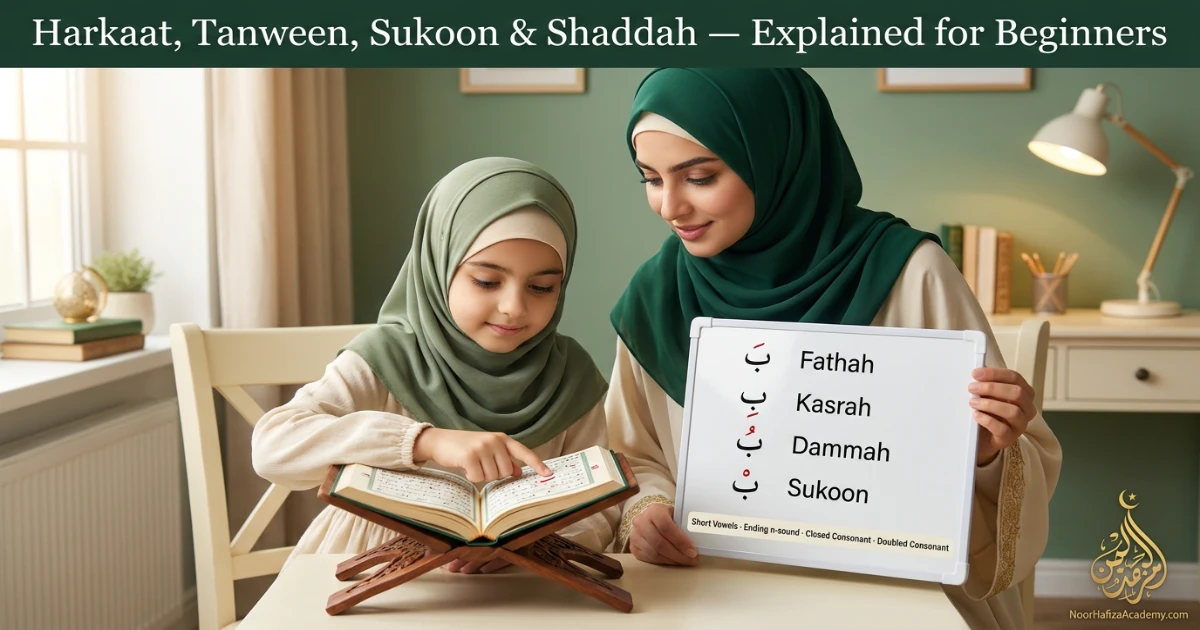
For a Quran beginner, Arabic letters are only the first layer of reading. Small marks placed above or below the letters tell the reader how those letters should sound. Harkaat—usually Fathah, Kasrah, and Dammah—add short vowel sounds. Tanween uses doubled vowel marks and normally adds an ending n-sound. Sukoon shows that a consonant has no short vowel of its own. Shaddah tells the reader that a consonant is doubled or strengthened. These signs appear constantly in beginner Qaida lessons and Quran reading, so understanding them early prevents guessing and builds accurate blending.
What are Harkaat, Tanween, Sukoon and Shaddah?
Harkaat are the short vowel marks used with Arabic letters: Fathah gives a short a-type sound, Kasrah a short i-type sound, and Dammah a short u-type sound. Tanween uses doubled vowel marks and usually adds an n-sound at the end: -an, -in, or -un in simple beginner transliteration. Sukoon shows that the consonant carries no short vowel, so it joins directly to the sound before it. Shaddah marks a doubled consonant: the first part behaves like a consonant with Sukoon and the second part carries the visible vowel. Beginners should learn these symbols by hearing and reading them in simple combinations rather than memorizing names only.
What are Harkaat in Quran reading?
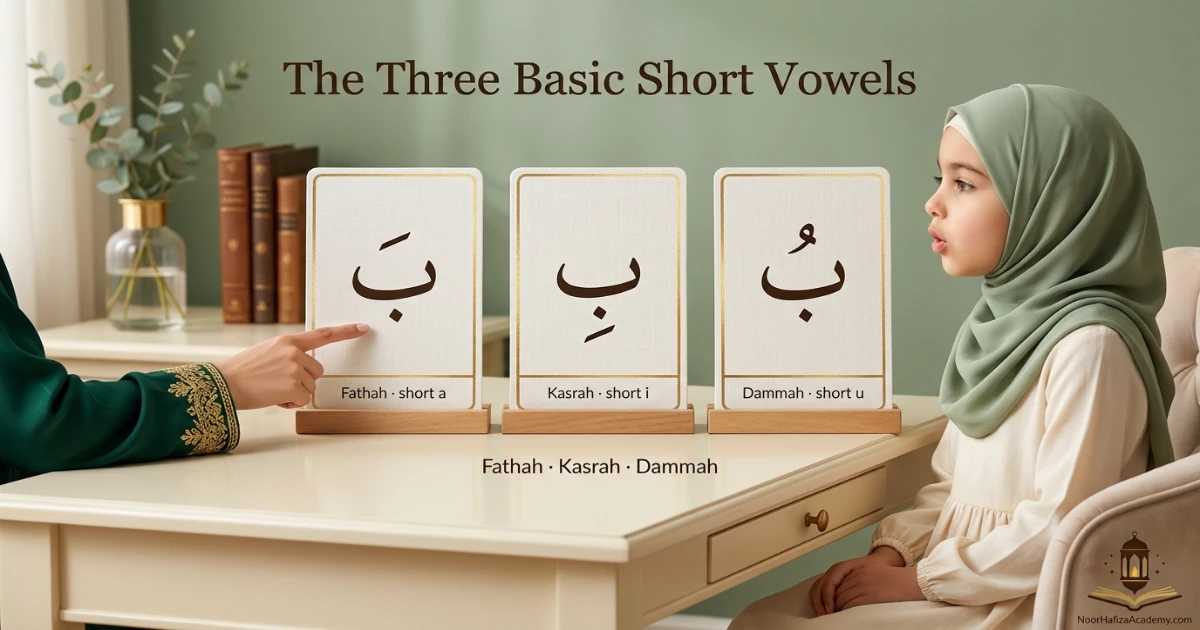
The word Harkaat is commonly used in beginner Quran learning for the vowel marks that move a consonant into a readable sound. The three basic short vowel marks are Fathah, Kasrah, and Dammah. These marks are not separate letters. They tell the reader how to pronounce the consonant they accompany.
A small mark above the letter. Beginners often hear it as a short a-type sound: ba.
A small mark below the letter. Beginners often hear it as a short i-type sound: bi.
A small curl-like mark above the letter. Beginners often hear it as a short u-type sound: bu.
No short vowel is added. The consonant closes into or joins with the surrounding sound.
The English cues “a,” “i,” and “u” are only approximations. They help beginners remember the pattern, but the exact sound should be learned by listening. The most important beginner habit is to keep the vowel short unless a separate long-vowel pattern is present.
How does Fathah work?
Fathah is written above a letter. For a beginner, it is usually introduced as a short a-type sound. When placed on ب, the beginner reads بَ as “ba.” When placed on ت, تَ is read with the same short-vowel pattern applied to the letter tā’.
A common beginner mistake is turning every Fathah into a long “aa.” This makes the vowel longer than the written sign indicates. The teacher may ask the student to contrast a short Fathah with a true long-vowel pattern so the ear learns the difference.
Do not pause between the consonant and Fathah, and do not add another hidden vowel after it.
How does Kasrah work?
Kasrah is written below a letter and produces a short i-type sound. For example, بِ is read with a brief “bi” pattern. Beginners should notice that Kasrah belongs to the consonant above it even though the mark itself sits below the writing line.
The main difficulty is often stretching Kasrah into an “ee” sound. A qualified teacher helps the learner hear the short-versus-long contrast and maintain the correct duration in joined reading.
How does Dammah work?
Dammah appears above the letter and produces a short u-type sound. بُ can be approximated as “bu” for a beginner. The mouth shape is different from Fathah and Kasrah, and beginners benefit from hearing a teacher demonstrate the same consonant with all three Harkaat.
Dammah is sometimes confused visually with Wāw by very early learners. The teacher should explain that Dammah is a vowel mark attached to another letter, while و is a full Arabic letter.
What is Tanween and how is it read?
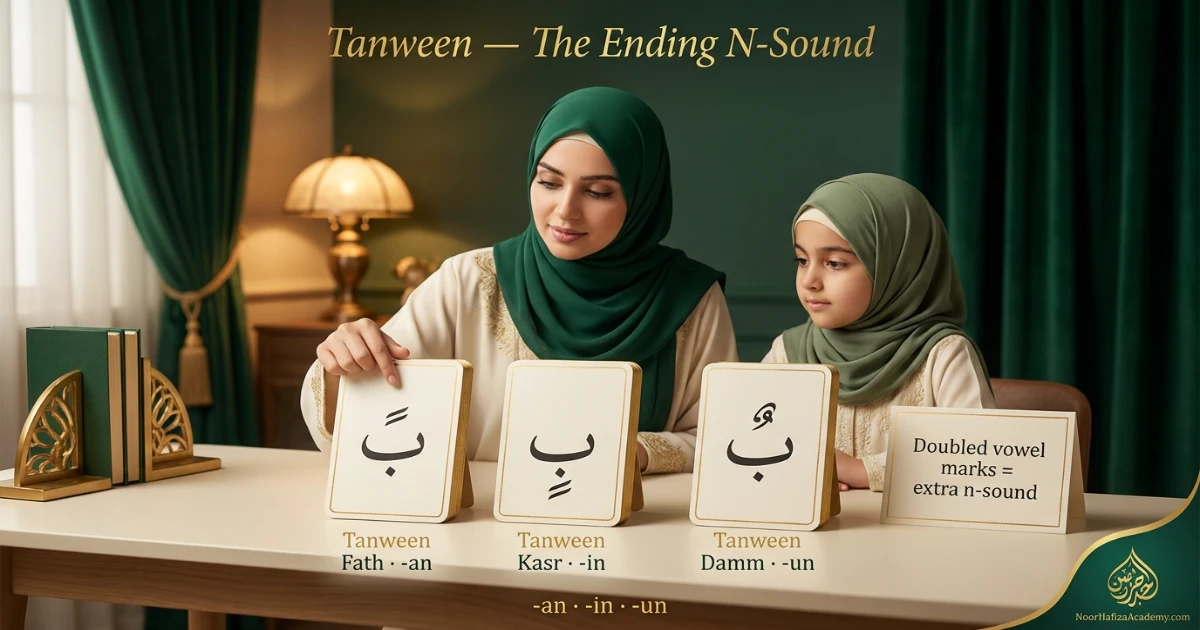
Tanween is shown by doubled vowel marks and is usually taught to beginners as adding an ending n-sound. The three common forms are Tanween Fath, Tanween Kasr, and Tanween Damm. In simple beginner transliteration they are often represented as -an, -in, and -un.
Double Fathah. In simple beginner practice, the ending is approximated as -an.
Double Kasrah. In simple beginner practice, the ending is approximated as -in.
Double Dammah. In simple beginner practice, the ending is approximated as -un.
Two matching vowel marks usually signal Tanween rather than an ordinary single short vowel.
The precise behavior of Tanween can change in connected Quran recitation because of later Tajweed rules such as Izhar, Idgham, Iqlab, and Ikhfa. A complete beginner does not need to master those advanced details before recognizing Tanween itself. First learn to see the doubled mark and hear the basic ending sound.
What does Sukoon mean in Quran reading?
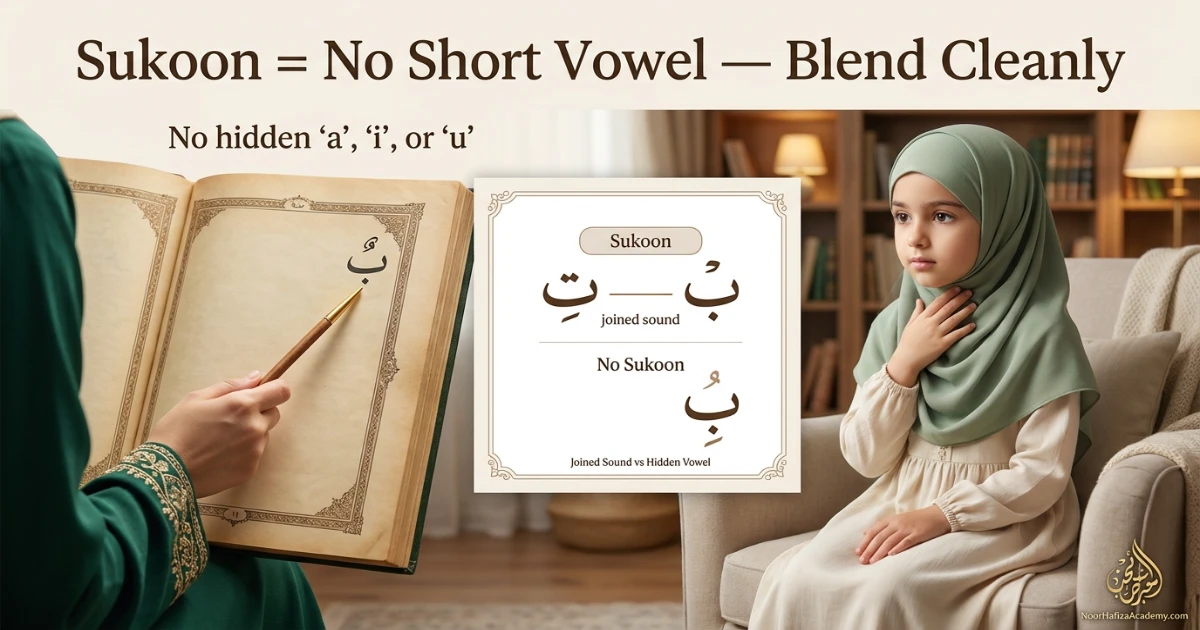
Sukoon shows that the consonant has no short vowel of its own. Instead of reading a separate “ba,” “bi,” or “bu,” the consonant closes into the sound before it. This is one of the most important steps in moving from isolated syllables to real word blending.
For example, a beginner may first learn بَ as one consonant with Fathah. When Sukoon appears on a later consonant, the learner must connect that consonant directly without inserting an extra vowel. This is where many beginners accidentally add a small “a,” “i,” or “u” that is not written.
No hidden vowel
A consonant with Sukoon should not receive an extra short vowel simply to make it easier to say.
Join from the previous sound
The Sukoon letter depends on the sound before it and is read as part of the same connected unit.
Keep the letter clear
Removing the vowel does not mean swallowing the consonant. The letter still needs its proper identity and articulation.
What does Shaddah mean and why is it doubled?
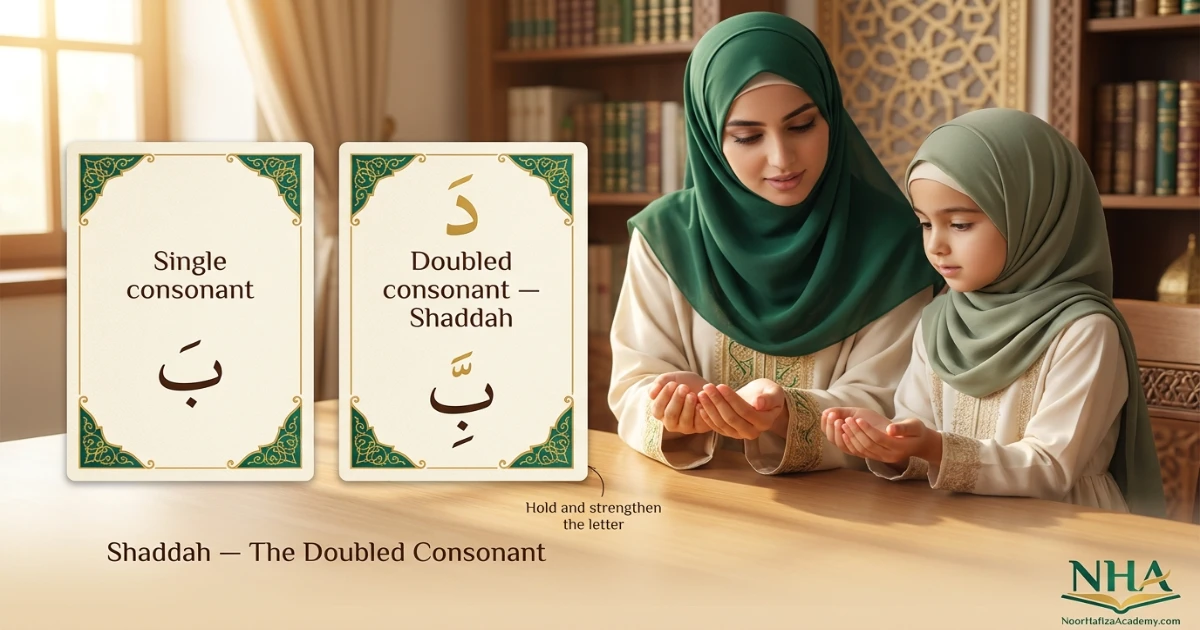
Shaddah marks a doubled consonant. A useful beginner explanation is that the first half of the doubled consonant behaves like a consonant with Sukoon, while the second half carries the visible vowel or other mark. The reader should therefore give the consonant more weight than a normal single letter.
The doubled consonant ends with a short a-type vowel on the second part.
The doubled consonant ends with a short i-type vowel on the second part.
The doubled consonant ends with a short u-type vowel on the second part.
Do not read Shaddah as an ordinary single consonant. It represents a doubled consonant action.
Beginners often either ignore the Shaddah or over-hold it dramatically. The teacher should model the difference between a single consonant and a doubled consonant so the student learns the correct weight rather than relying on visual guessing.
Harkaat vs Tanween vs Sukoon vs Shaddah
| Sign | What it does | Beginner sound idea | Common mistake |
|---|---|---|---|
| Fathah / Kasrah / Dammah | Adds one short vowel | a / i / u | Stretching it like a long vowel |
| Tanween | Adds doubled vowel mark and ending n-sound | an / in / un | Reading it as an ordinary single Harkah |
| Sukoon | Removes the consonant’s short vowel | Closed consonant | Adding a hidden vowel |
| Shaddah | Doubles the consonant | Held/strengthened consonant | Reading it as a single consonant |
In what order should beginners learn these signs?
Single Harkaat
Learn Fathah, Kasrah, and Dammah on familiar letters and keep the sounds short.
Mixed Harkaat
Read unfamiliar combinations so the learner responds to the mark rather than memorized order.
Tanween
Recognize doubled marks and hear the ending n-sound before advanced Tajweed rules are added.
Sukoon
Practise closing the consonant cleanly without adding an unwritten vowel.
Shaddah
Learn the doubled consonant action and compare it directly with the same letter without Shaddah.
Mixed blending
Combine Harkaat, Tanween, Sukoon, and Shaddah in short unfamiliar examples before Quran passages.
How Noorani Qaida teaches Harkaat, Tanween, Sukoon and Shaddah
A structured Qaida usually introduces these symbols in a controlled sequence. The learner first sees clear repeated patterns, then gradually mixes letters and signs. The purpose is not only to finish pages but to build automatic recognition.
Name the mark and find which letter it belongs to.
Notice how the same consonant changes with Fathah, Kasrah, Dammah, Sukoon, or Shaddah.
Read before the teacher models so actual decoding ability becomes visible.
Apply the same rule in an unfamiliar word or new Qaida line.

Common beginner mistakes with these Quran reading signs
Stretching every Harkah
Short vowels become long because the learner holds them too much.
Confusing Dammah with Wāw
The learner treats the vowel mark as a full Arabic letter.
Ignoring the second Tanween mark
The learner reads Tanween like an ordinary single vowel.
Adding a vowel after Sukoon
An unwritten “a,” “i,” or “u” is inserted to make the consonant easier.
Ignoring Shaddah
The doubled consonant becomes a normal single consonant and changes the reading pattern.
Overholding Shaddah
The consonant is exaggerated far beyond the amount needed.
Memorizing the Qaida page
The learner appears fluent on familiar examples but struggles with the same sign elsewhere.
Moving to Quran too early
The learner begins full Quran reading before the core symbol patterns are stable.
A simple 30-day practice plan for Harkaat, Tanween, Sukoon and Shaddah
| Week | Main focus | Home practice | Teacher checkpoint |
|---|---|---|---|
| Week 1 | Fathah, Kasrah, Dammah | Mixed letters with one short vowel at a time | Check vowel length and sound clarity |
| Week 2 | Tanween | Compare single vs doubled vowel marks | Check -an, -in, -un recognition |
| Week 3 | Sukoon | Short connected pairs without added vowels | Check clean consonant closure and blending |
| Week 4 | Shaddah and mixed reading | Single vs doubled consonants plus mixed signs | Confirm readiness for more advanced Qaida or Quran reading |

How do you know a beginner is ready to move on?
A learner does not need perfection before moving to the next lesson, but the core sign should be recognizable without constant prompting. The following indicators are useful:
Readiness checklist
- Reads Fathah, Kasrah, and Dammah without mixing them.
- Keeps short vowels short.
- Recognizes Tanween as a doubled vowel mark.
- Produces the basic ending n-sound in beginner practice.
- Reads Sukoon without inserting an extra vowel.
- Recognizes Shaddah as a doubled consonant.
- Can compare a normal consonant with the same consonant carrying Shaddah.
- Applies the signs in unfamiliar combinations, not only memorized examples.
Questions parents and adult beginners should ask a Quran teacher
Use these questions during a trial or Qaida assessment
- How do you teach the difference between short and long vowels?
- How do you explain Fathah, Kasrah, and Dammah to complete beginners?
- When do you introduce Tanween?
- Do you teach the advanced Tajweed rules of Tanween immediately or later?
- How do you stop learners from adding vowels after Sukoon?
- How do you explain the doubled action of Shaddah?
- Do students read unfamiliar examples before hearing your model?
- How do you check whether a Qaida page is memorized rather than understood?
- How much home practice should a beginner do?
- How do you decide when the learner is ready for full Quran reading?
- How do you correct pronunciation without overwhelming the learner?
- How is progress reported to parents or adult students?
Online Noorani Qaida and Quran reading classes for beginners
Noor Hafiza Academy offers live online Quran learning for girls, women, children, adults, new Muslims, complete beginners, and returning readers with female Quran teachers. Beginners can start with an assessment of Arabic letters, joined forms, Harkaat, Tanween, Sukoon, Shaddah, blending, pronunciation, and current Qaida level.
A suitable plan may include Noorani Qaida, Arabic alphabet review, Harkaat, Tanween, Sukoon, Shaddah, Makharij foundations, Quran reading, or targeted restart lessons. Current female-teacher qualifications, availability, schedules, trial arrangements, fees, privacy practices, policies, and enrollment terms should be confirmed directly.
Share the learner’s age, current Qaida page, letter recognition, main reading difficulty, time zone, schedule, and whether the challenge is Harkaat, Tanween, Sukoon, Shaddah, or blending.
FAQs about Harkaat, Tanween, Sukoon and Shaddah
What are the three basic Harkaat?
What is Tanween?
What does Sukoon mean?
What does Shaddah mean?
What is the difference between Harkaat and Tanween?
Why do beginners add a vowel after Sukoon?
Why is Shaddah important?
Should beginners learn advanced Tanween Tajweed rules immediately?
How long should a beginner practise these signs daily?
Can children learn Sukoon and Shaddah online?
How do I know if a child memorized the Qaida page?
What should a beginner learn after Shaddah?
Master the small Quran reading signs that turn Arabic letters into clear connected reading
Share the learner’s age, current Qaida level, time zone, schedule, and whether the main challenge is Harkaat, Tanween, Sukoon, Shaddah, pronunciation, or blending.