How to Learn Quran Online for Beginners: A Step-by-Step Roadmap
Learning how to learn Quran online for beginners becomes much easier when the journey is divided into the right stages. A complete beginner may start with Arabic letters and sounds, while a returning learner may need a short assessment before rebuilding fluency or Tajweed. This roadmap explains how to identify your starting point, choose a suitable teacher, use Noorani Qaida, begin Quran reading, practise correctly between lessons, and measure progress without rushing.
How to learn Quran online for beginners
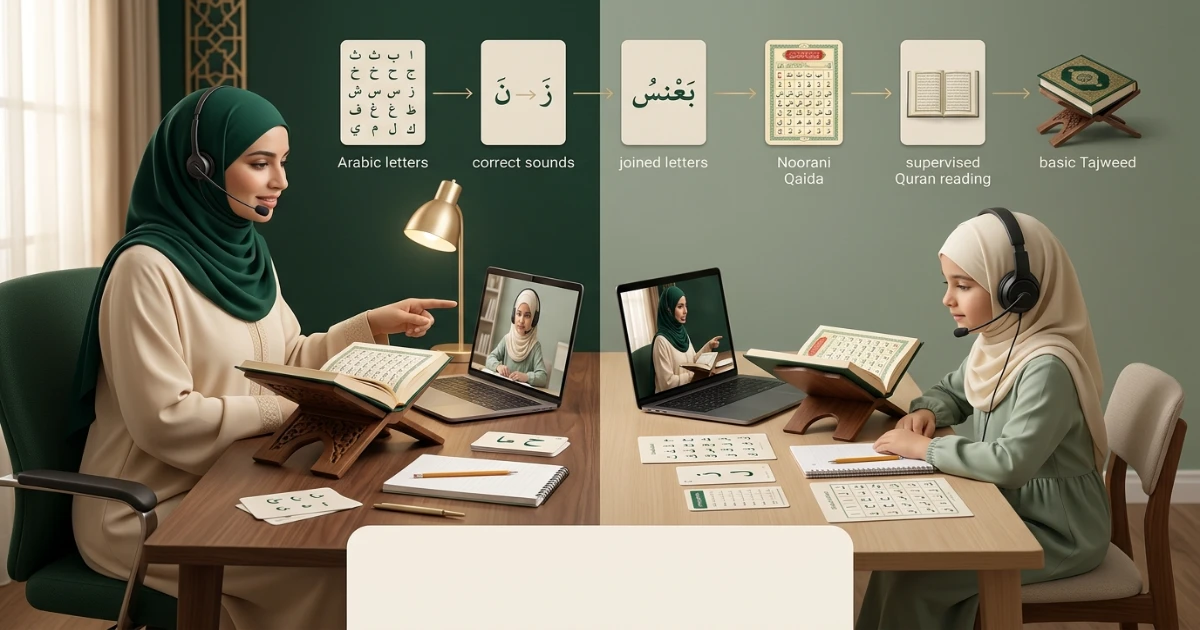
Start with a live level assessment rather than choosing a lesson from age or previous book completion alone. A complete beginner should learn Arabic letter recognition, correct letter sounds, short vowels, joined forms, basic signs, and simple word blending through a structured Qaida. Once the learner can decode short words with decreasing help, begin supervised Quran reading while continuing pronunciation correction. Add basic Tajweed gradually, practise for 10–20 minutes on most days, and use two to five live lessons per week according to age, goal, and schedule. Track progress through independent recognition, accurate blending, smoother reading, fewer repeated errors, and stronger revision—not page count alone.
What does “Quran beginner” actually mean?
The word beginner covers several very different learners. One person may not recognize any Arabic letters. Another may know the alphabet but confuse similar shapes. A child may have completed a Qaida before yet still guess words from memory instead of decoding them. An adult may read slowly but struggle with vowels, stopping, or pronunciation. A returning learner may once have read well but now need confidence, revision, and correction.
This difference matters because the wrong starting point wastes time. Placing every beginner on the first page can feel discouraging to a returning reader. Starting directly from the Quran can overwhelm someone who cannot join letters independently. A reliable teacher listens, observes, and chooses the first lesson from demonstrated ability rather than assumptions.
Complete beginner
Does not reliably recognize Arabic letters or produce their basic sounds. Needs a structured introduction from the foundation.
Letter learner
Recognizes many isolated letters but struggles when shapes change or letters appear at the beginning, middle, and end of words.
Early decoder
Can use vowels and join short combinations but still needs frequent prompts, slow modeling, and repeated blending practice.
Returning reader
Can read parts of the Quran but needs fluency, Tajweed, stopping, confidence, or a systematic restart after a long gap.
A book completed in the past is useful background, but independent performance is stronger evidence. The teacher should check recognition, sounds, joining, vowels, simple words, reading flow, and response to correction before deciding the course.
The step-by-step roadmap for learning Quran online
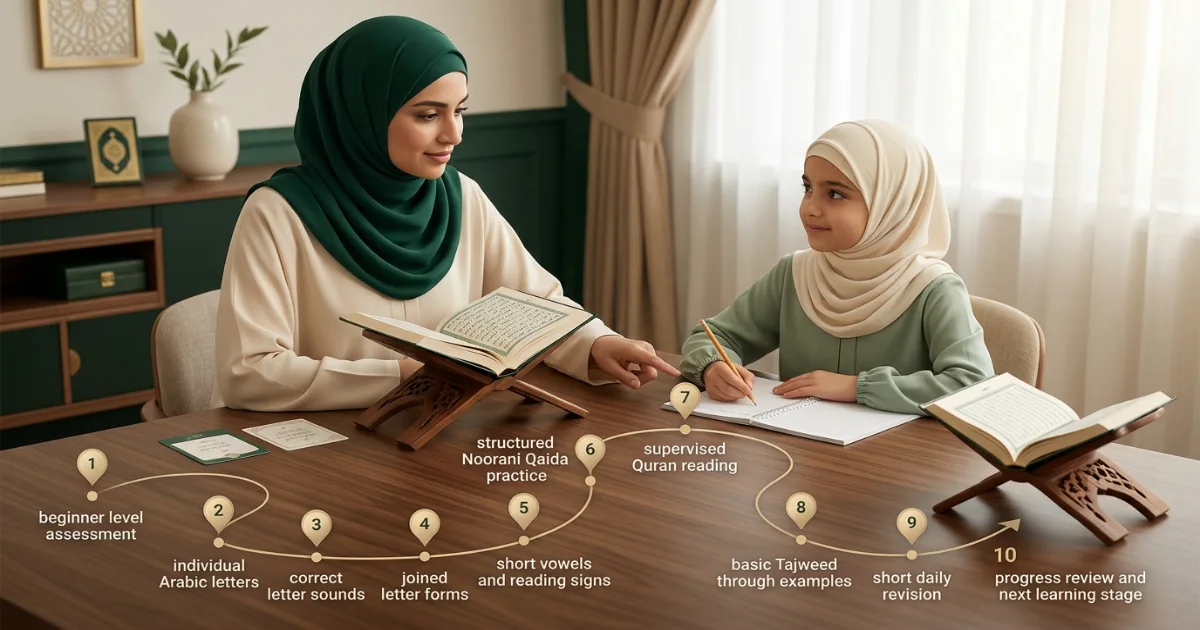
A beginner does not need to master everything at once. The most effective route is sequential: identify the level, create a stable learning setup, build letter and sound knowledge, learn how letters join, read simple combinations, begin Quran reading, add Tajweed gradually, revise consistently, and review progress. The pace may differ, but the order protects the foundation.
Define the learner’s goal
Decide whether the immediate goal is Arabic-letter recognition, Noorani Qaida, Quran reading, Tajweed improvement, memorization, Salah recitation, or restarting after a gap. A clear first goal keeps the plan focused.
Complete a live level assessment
Let the learner identify letters, produce sounds, read joined forms, decode short words, or recite a short passage independently. The teacher should explain the evidence behind the recommended starting point.
Prepare the device and learning space
Use clear audio, stable internet, a suitable book or digital lesson, a quiet desk, and a device positioned so teacher and learner can hear and see comfortably. Young children need a parent nearby.
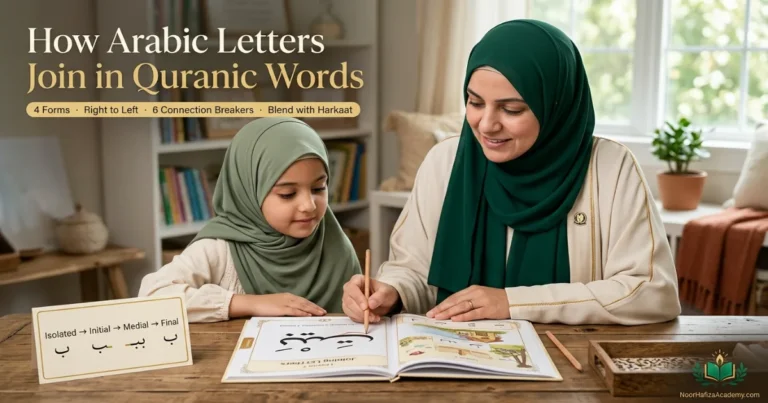
Learn Arabic letters and accurate sounds
Recognize each letter beyond memorized order, distinguish similar shapes, and imitate the teacher’s pronunciation. Accuracy matters because early sound habits influence later Quran reading.
Study vowels, joining, and reading signs
Learn short vowels, letter positions, sukoon, shaddah, madd, tanween, and the signs included in the selected Qaida. Blend gradually instead of guessing whole words.
Complete a structured Noorani Qaida pathway
Move forward only when the current pattern is recognized with decreasing help. Revision should mix old and new examples so the learner does not depend on page order.
Begin supervised Quran reading
Start with manageable lines or short surahs. Continue decoding and pronunciation correction while learning practical stopping and restarting.
Add basic Tajweed through practice
Introduce rules connected to the learner’s actual reading. The teacher should model, identify the sound difference, guide repetition, and listen for the rule again later.
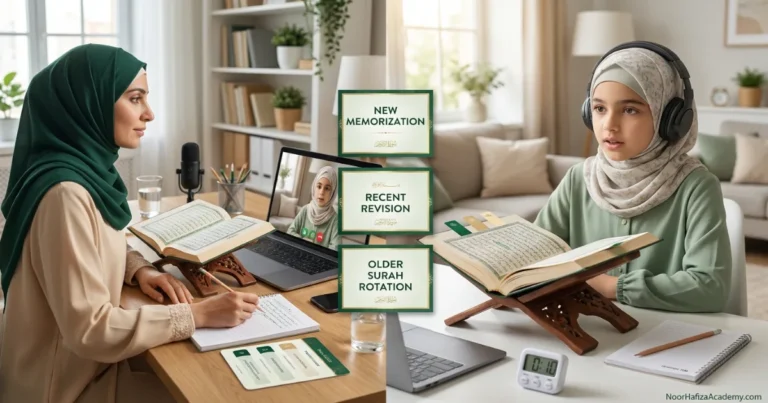
Build a short daily revision habit
Practise the exact lesson target on most days. Ten focused minutes can be more useful than a long session filled with guessing, fatigue, or uncorrected repetition.
Review progress and choose the next stage
Measure independence, accuracy, fluency, retention, and confidence. The next stage may be stronger Quran reading, beginner Tajweed, Hifz foundations, or continued Qaida repair.
How should beginners learn Arabic letters and sounds?
Arabic-letter learning is more than reciting the alphabet in order. A beginner should recognize letters when they appear randomly, distinguish letters with similar bodies and different dots, identify their changing joined forms, and produce the sound closely enough to build accurate reading. Memorizing a chant can help recall, but it does not prove recognition.
A live teacher is especially useful at this stage because a printed page cannot hear the learner. Beginners may substitute familiar sounds from English, Urdu, or another language. They may also produce two different Arabic letters in nearly the same way. The teacher should model slowly, show the point of articulation at an age-appropriate level, let the learner imitate, and revisit the sound in different examples.
Recognize independently
Mix the order of letters and vary the page. The learner should identify the shape rather than predict what comes next.
Distinguish similar forms
Compare letters that share a basic shape. Use dots, position, and sound to reduce confusion without teaching too many at once.
Imitate the correct sound
Listen, observe, repeat, and receive correction. The aim is steady improvement, not a technical lecture in the first lesson.
Young children may need movement, pointing, short turns, and visual repetition. Adult beginners often benefit from concise explanation and private correction without childish language. The method should change with the learner while the pronunciation target remains accurate.
Why Noorani Qaida is useful for online Quran beginners
A well-taught Noorani Qaida organizes reading skills into manageable patterns. It can introduce letters, joined forms, short vowels, tanween, sukoon, shaddah, madd, and other signs in a sequence that prepares the learner for Quran text. The book itself is not the full method. Progress depends on how the teacher models each lesson, checks recognition, mixes review, and prevents memorized guessing.
Beginners sometimes try to finish the Qaida quickly because the Quran feels like the “real” destination. That intention is understandable, but speed without decoding ability creates dependence. A learner may appear fluent on a familiar page and become stuck when the same pattern appears elsewhere. The purpose of Qaida is transfer: the learner should use the skill in new words and later in the Quran.
| Learning stage | Main skill | Teacher’s role | Readiness evidence |
|---|---|---|---|
| Isolated letters | Recognition and basic sound | Model accurately and mix the order | Learner identifies letters without alphabet-order clues |
| Joined forms | Recognize changing letter shapes | Compare beginning, middle, and ending forms | Learner identifies letters inside short combinations |
| Short vowels | Read consonant-vowel units | Model, blend, and correct the exact sound | Learner reads mixed examples rather than memorized rows |
| Sukoon and shaddah | Control joining and doubled sounds | Break down the pattern and rebuild it slowly | Learner applies the sign in unfamiliar examples |
| Madd and tanween | Length and ending sounds | Demonstrate timing and listen for consistency | Learner distinguishes short and lengthened reading |
| Mixed reading | Combine skills in words and lines | Reduce prompting and track repeated errors | Learner decodes new material with increasing independence |
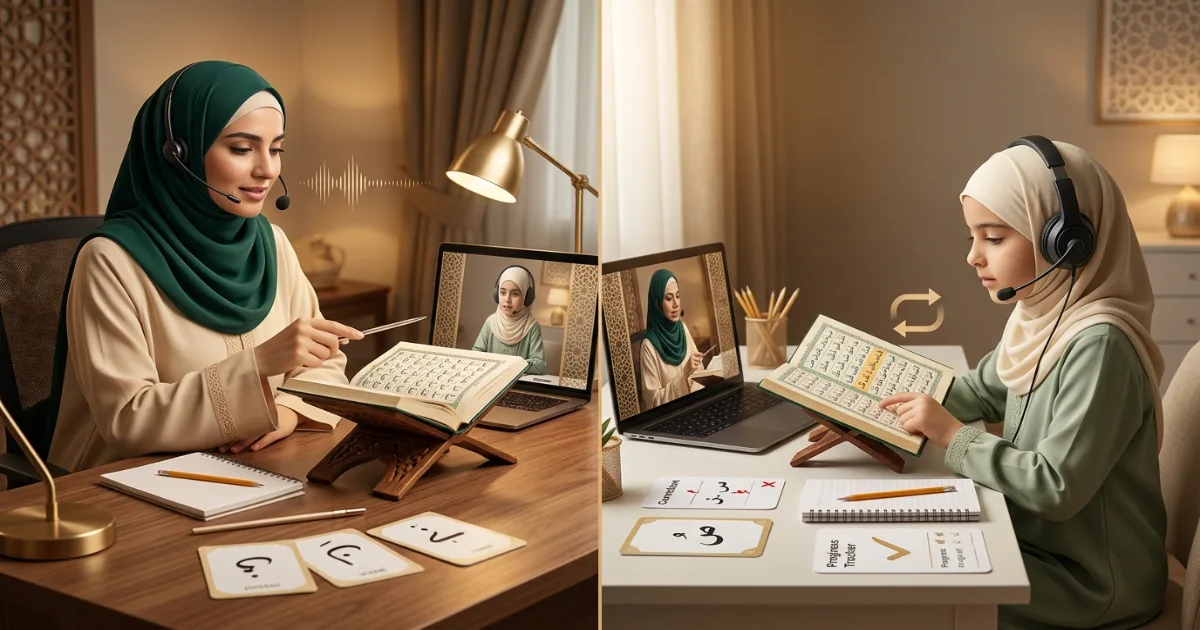
Explore Noor Hafiza Academy’s Noorani Qaida online pathway for guided beginner foundations with a female Quran teacher.
When should a beginner start reading the Quran?
A beginner can start supervised Quran reading when basic decoding is stable enough to approach short words and lines without constant guessing. This does not mean the learner must complete every possible rule before opening the Quran. It means the foundation should be strong enough that Quran reading reinforces skills rather than replacing them.
The transition may be gradual. A teacher might continue Qaida review for part of the lesson and add a short Quran passage for the remaining time. The learner can begin with familiar short surahs, selected lines, or the starting point recommended after assessment. The teacher should prioritize accuracy, manageable phrasing, and correct stopping over speed.
A learner who can recognize signs, blend common patterns, attempt unfamiliar words, and respond to correction is more ready than someone who can recite only memorized pages smoothly.
Signs the learner is ready
- Recognizes common letters in joined forms
- Uses short vowels and basic signs
- Attempts unfamiliar words instead of waiting immediately
- Can repeat a correction and try again
- Maintains focus for a short reading segment
- Retains key Qaida patterns between lessons
Signs more foundation is needed
- Guesses from the first letter or page memory
- Confuses many basic letters repeatedly
- Cannot blend without the teacher reading first
- Ignores vowel signs consistently
- Becomes overwhelmed by every new word
- Forgets the same foundation after repeated lessons
Beginners can continue through online Quran reading classes once the teacher confirms the appropriate transition.
How should beginners learn basic Tajweed online?
Tajweed should begin through listening and application, not through a large list of definitions. A beginner first needs accurate letter sounds, vowel control, joining, and reading confidence. The teacher can then introduce practical rules as they appear in the lesson: where a sound comes from, when it is lengthened, how a doubled letter is read, or where a stop changes the ending.
Technical names can be taught gradually, especially to older learners, but the sound must remain central. A useful correction sequence is simple: the learner reads, the teacher identifies one issue, models the difference, allows repetition, reduces help, and listens for the same rule later. This turns Tajweed from theory into a reading habit.
The teacher recites slowly enough for the learner to notice the target sound or length.
The learner hears how the current attempt differs from the corrected version.
The learner tries the corrected word or phrase while the example is still fresh.
The teacher removes part of the prompt to see whether the correction has been understood.
The same sound or rule is checked in another word or later line.
The teacher tracks repeated errors and returns to them in future lessons.
Learners ready for more focused rule application can explore online Tajweed classes.
How often should an online Quran beginner take lessons and practise?
The best frequency is the one that creates continuity without exhausting the learner or family. Beginners forget new sounds and patterns when too much time passes between corrections. At the same time, adding more lessons does not help when the learner is consistently tired, absent, or unable to revise.
Many beginners benefit from two to five short live lessons each week. Young children may use 20- or 30-minute sessions. Older learners and adults may choose 30 to 45 minutes depending on concentration, course, and schedule. Intensive plans are useful only when the learner can attend consistently and complete brief revision between sessions.
| Beginner schedule | Possible live lesson pattern | Home practice | Best fit |
|---|---|---|---|
| Gentle start | 2 lessons weekly | 10 minutes on 3–4 days | Busy adults, very young children, or cautious restart |
| Steady foundation | 3 lessons weekly | 10–15 minutes on most days | Qaida, early decoding, regular pronunciation correction |
| Strong continuity | 4 lessons weekly | 10–20 minutes on most days | Learners who retain well with frequent teacher contact |
| Intensive pathway | 5 lessons weekly | Short focused revision after class | Fast-track reading goals or learners preparing for Hifz foundations |
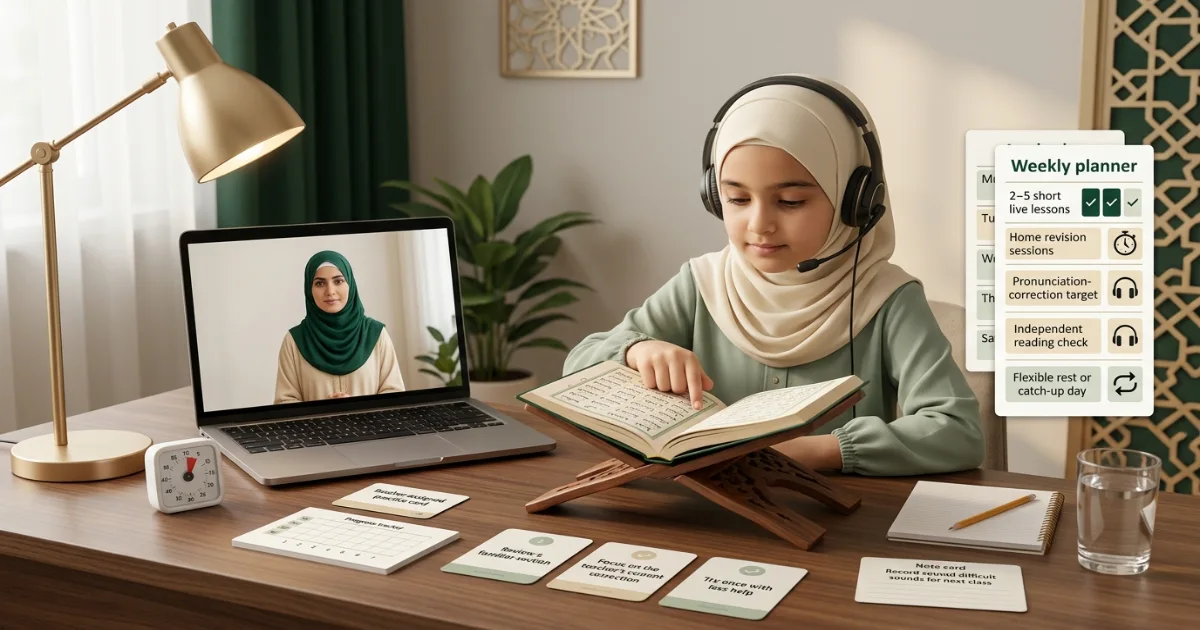
A 10–20 minute Quran practice routine for beginners
Home practice should reinforce correct learning, not create a second unstructured lesson. Use the teacher’s exact target and stop before fatigue turns practice into guessing. A short routine can be divided into review, focused repetition, and one independent check.
Repeat a small familiar section
Begin with letters, combinations, or lines the learner can already attempt. This builds confidence and reveals what was retained.
Practise the current correction
Work on one sound, sign, word pattern, or short passage. Use the teacher’s model when available and avoid adding unrelated material.
Try once with less help
Mix the examples, close a prompt, or read the line independently. Note where the learner still hesitates so the teacher can address it.
Parents should support young children without answering every item. Give the learner a moment to think, point to the correct place, and praise effort specifically. Adult beginners can note difficult sounds or words and bring them to the next lesson instead of repeatedly practising an uncertain version.
What should beginners check in an online Quran teacher?
Beginners need more than a beautiful recitation. The teacher must slow down, hear small sound differences, explain without overwhelming, repeat patiently, and choose a realistic sequence. A teacher who regularly works with fluent students may not automatically be the best foundation teacher.
Accurate modeling
The teacher produces letters and Quran reading clearly enough for the beginner to imitate and compare.
Small teaching steps
She teaches one manageable pattern, confirms understanding, and avoids moving ahead only to finish pages.
Patient correction
Repeated mistakes are addressed calmly and specifically rather than ignored or treated as laziness.
Level awareness
The teacher changes the starting point and pace according to independent performance, age, and learning history.
Safe communication
Children learn through parent-visible channels, while adult sisters receive respectful and professional communication.
Useful feedback
The learner knows what improved, what to revise, and what milestone comes next.
Use the detailed guide on how to choose an online Quran teacher when selecting for a child, or review the female Quran teacher online checklist for parents and sisters.
What should happen in a beginner Quran trial class?
A beginner trial should provide evidence, not only a sales conversation. The teacher should ask about the learner’s goal and history, listen to an independent sample, demonstrate one teaching step, correct at least one issue, and recommend a starting point. The learner should experience enough of the method to judge whether instructions feel clear and respectful.
Share the learner profile
Provide age, previous study, language needs, reading ability, schedule, and the reason for starting or restarting.
Let the teacher assess independently
A parent may help with technology, but the teacher needs to see what the learner recognizes and reads without answers.
Observe one teaching cycle
The teacher models, the learner tries, a specific correction is given, and the learner attempts again with less help.
Ask why this starting point is recommended
The explanation should connect to observed evidence, not only age or the name of a previously completed book.
Confirm the first-month routine
Discuss lesson length, weekly frequency, materials, revision, communication, and the first realistic milestone.
How long does it take a beginner to learn Quran reading online?
There is no honest universal completion time. Progress depends on the starting level, age, sound accuracy, lesson frequency, practice quality, teacher method, language background, attendance, and whether earlier gaps need repair. A learner who already recognizes letters may progress faster than a complete beginner, while a child attending more lessons may still move slowly if tired or inconsistent.
Instead of promising a fixed number of weeks, use milestones. Early progress may mean recognizing mixed letters without alphabet order. The next milestone may be reading joined forms, applying vowels, blending new words, completing Qaida patterns, reading short Quran lines, or maintaining a correction from one lesson to the next.
Independent letter recognition
The learner identifies mixed letters and produces increasingly accurate sounds without relying on a memorized sequence.
Joined-form recognition
Letters are recognized inside short combinations even when the shape changes by position.
Basic decoding
The learner uses vowels and signs to blend unfamiliar examples with fewer prompts.
Qaida transfer
Skills learned on one page appear in new words instead of remaining tied to memorized rows.
Supervised Quran reading
The learner attempts manageable Quran lines and responds to pronunciation and stopping corrections.
Growing fluency and Tajweed
Reading becomes smoother while basic rules and repeated sound corrections are applied more consistently.
Mistakes that slow down online Quran learning
Starting directly from difficult Quran pages
The learner spends the entire lesson copying the teacher because letter, vowel, or joining foundations are not stable.
Choosing speed over accuracy
Rushing through pages creates repeated pronunciation and decoding habits that later require more time to repair.
Practising an uncertain version repeatedly
Unsupervised repetition can strengthen an error. Note the difficulty and ask the teacher for a clear model.
Using too many books and apps at once
Different sequences and symbols can confuse beginners. Keep one primary curriculum and use extras only with a clear purpose.
Taking long gaps between lessons
New sound and joining patterns fade quickly when there is no short revision or regular teacher contact.
Measuring only page completion
A learner may cover many pages while still depending on prompts, guessing, or repeating the same mistakes.
Parents answering for the child
Constant rescue hides the true level and prevents the teacher from seeing where independent support is needed.
Changing teachers before identifying the problem
Timing, lesson length, level, revision, language, or technology may need adjustment before the teacher relationship is abandoned.
Should children and adults follow the same beginner roadmap?
The core sequence is similar, but the teaching style should differ. Children may need shorter lessons, visual pointing, parent support, predictable routines, and frequent changes between listening and reading. Adults often prefer concise explanations, privacy, direct feedback, and schedules around work or caregiving. Returning learners may need a respectful restart that repairs gaps without treating them as complete beginners in every area.
| Learner type | Priority | Helpful lesson design | Parent or learner role |
|---|---|---|---|
| Young child | Sound recognition and positive routine | Short instructions, visual cues, repetition, 20–30 minute sessions | Parent manages device and stays nearby |
| Older child or teen | Foundation repair and growing independence | Respectful accountability, clear milestones, private correction | Parent remains informed without answering |
| Adult complete beginner | Clear structure without embarrassment | Direct explanation, private practice, sustainable schedule | Learner tracks questions and revision |
| Returning adult | Rebuild confidence and identify gaps | Short assessment, targeted Qaida repair, supervised Quran reading | Learner accepts a temporary restart where needed |
How can families make beginner Quran classes safe and comfortable?
Children should learn through a verified academy or teacher route, a parent-approved device, a known platform, and a recurring schedule that parents understand. Young learners need an adult nearby. Communication should remain parent-visible and focused on education, attendance, revision, and scheduling. Families should also know whom to contact if the teacher, platform, timing, or child comfort needs attention.
Adult sisters should confirm privacy, recording, communication, and teacher identity before regular lessons. A neutral background, clear audio, closed personal notifications, and a quiet learning space protect both concentration and privacy. Read the full online Quran safety checklist for children for parent-specific guidance.
How Noor Hafiza Academy supports online Quran beginners
Noor Hafiza Academy offers live online Quran learning with female Quran teachers for children, girls, women, sisters, and beginners. A suitable beginner pathway may include Noorani Qaida, Quran reading and fluency, Tajweed, Hifz preparation, Islamic Studies, or a restart and revision plan. The correct route depends on the learner’s demonstrated level, age, goal, schedule, and comfort.
A trial or level check allows the teacher to listen, identify the starting point, demonstrate instruction, and recommend lesson length and frequency. Families and adult learners can then evaluate communication, correction, teacher fit, and the practical routine before confirming regular classes.
Share the learner’s age, previous Quran experience, independent reading ability, language needs, time zone, course goal, and suitable schedule. Noor Hafiza Academy can discuss a beginner assessment and current female-teacher availability.
How to learn Quran online for beginners: final checklist
Starting level
- Independent live assessment
- Clear reason for placement
- Age and learning history considered
- Realistic first milestone
Foundation
- Letter recognition
- Accurate sound modeling
- Joined forms and vowels
- Qaida skills transferred to new examples
Quran reading
- Manageable reading portion
- Live pronunciation correction
- Basic stopping guidance
- Reduced dependence on prompts
Tajweed
- Rules taught through sound
- One correction at a time
- Independent repeat attempt
- Later transfer and review
Practice routine
- Short revision on most days
- Teacher-assigned target
- No repeated uncertain reading
- Schedule the learner can maintain
Progress evidence
- Fewer repeated errors
- Better independent recognition
- Smoother reading
- Clear next milestone
FAQs about how to learn Quran online for beginners
How can a complete beginner learn Quran online?
Do beginners need to learn Arabic before reading the Quran?
Is Noorani Qaida necessary for every beginner?
How many online Quran classes should a beginner take each week?
How long should a beginner practise Quran each day?
When can a beginner start reading directly from the Quran?
Can adults learn Quran online from the beginning?
How long does it take to learn Quran reading online?
What should I look for in an online Quran teacher for beginners?
Can I request a female Quran teacher for beginner classes?
Start from your real level and build a strong Quran-reading foundation
Share the learner’s age, previous Quran experience, independent reading ability, main goal, time zone, and preferred schedule. Noor Hafiza Academy can discuss a beginner trial or level check with a suitable female Quran teacher.