Can Adults Learn Quran Online from Scratch?
Can adults learn Quran online from scratch? Yes. An adult can begin with Arabic letters, restart after years away, repair weak pronunciation, study Noorani Qaida, or move gradually into Quran reading and basic Tajweed through live online lessons. The most effective path is private, respectful, level-based, and realistic about work, family duties, confidence, memory, and available practice time.
Can adults learn Quran online from scratch successfully?
Yes. Adults can learn Quran online from scratch by completing a live level assessment, beginning with Arabic letters and sounds when necessary, studying joined forms and reading signs through Noorani Qaida, moving into supervised Quran reading, and adding basic Tajweed gradually. Adults do not need to feel ashamed about beginning late or restarting forgotten lessons. A suitable teacher should explain respectfully, correct one issue at a time, protect privacy, and build a schedule around work and family responsibilities. Progress depends on the starting level, lesson frequency, practice quality, attendance, and teaching method rather than age alone.
Why adults can learn Quran online even from the very beginning
Adults begin Quran learning for many reasons. Some did not have access to regular classes as children. Some learned letters years ago but never became independent readers. Others can read slowly yet feel unsure about pronunciation, stopping, or Tajweed. A person may also return after a long gap and discover that familiar pages no longer feel easy. None of these situations means the learner has failed or is too late.
Adult learning has genuine strengths. Adults usually understand why they want to learn, can discuss their goals, notice recurring problems, and make deliberate choices about scheduling. They may also connect learning with prayer, personal growth, family life, or the desire to read confidently without relying entirely on transliteration. The challenge is not the adult mind. The challenge is often embarrassment, an unrealistic timetable, inconsistent practice, or a course that assumes too much.
Online teaching can remove several barriers. A learner can study privately from home, select a suitable time zone, avoid travel, repeat difficult sounds in a one-to-one setting, and learn with a female Quran teacher where that supports comfort and modesty. The adult does not need to enter a children’s class or pretend to know more than she does. The starting point can be chosen from demonstrated ability.
When the teacher knows exactly what the learner can and cannot do, she can build a clean foundation instead of rushing through gaps. Clear placement often saves time because the adult stops guessing and begins working on the real obstacle.
Which kind of adult beginner are you?
“From scratch” can describe several different starting points. Two adults may both call themselves beginners while needing completely different first lessons. A live assessment should identify the closest profile and then adjust the plan.
Complete alphabet beginner
The learner does not yet recognize Arabic letters reliably and needs to build names, sounds, shapes, and visual discrimination from the beginning.
Letters known, joining weak
Individual letters feel familiar, but changing forms, connected words, vowels, or blending cause confusion.
Slow or dependent reader
The learner can read with help, memorized patterns, or transliteration but struggles to decode unfamiliar words independently.
Returning after many years
Earlier learning remains partly available, but confidence, speed, signs, or pronunciation need structured rebuilding.
Reader with pronunciation gaps
The learner moves through text but repeats letter-sound, articulation, elongation, or stopping errors that require targeted correction.
Tajweed restart learner
Basic reading is possible, but the adult wants rule application, greater accuracy, calmer fluency, and better independent practice.
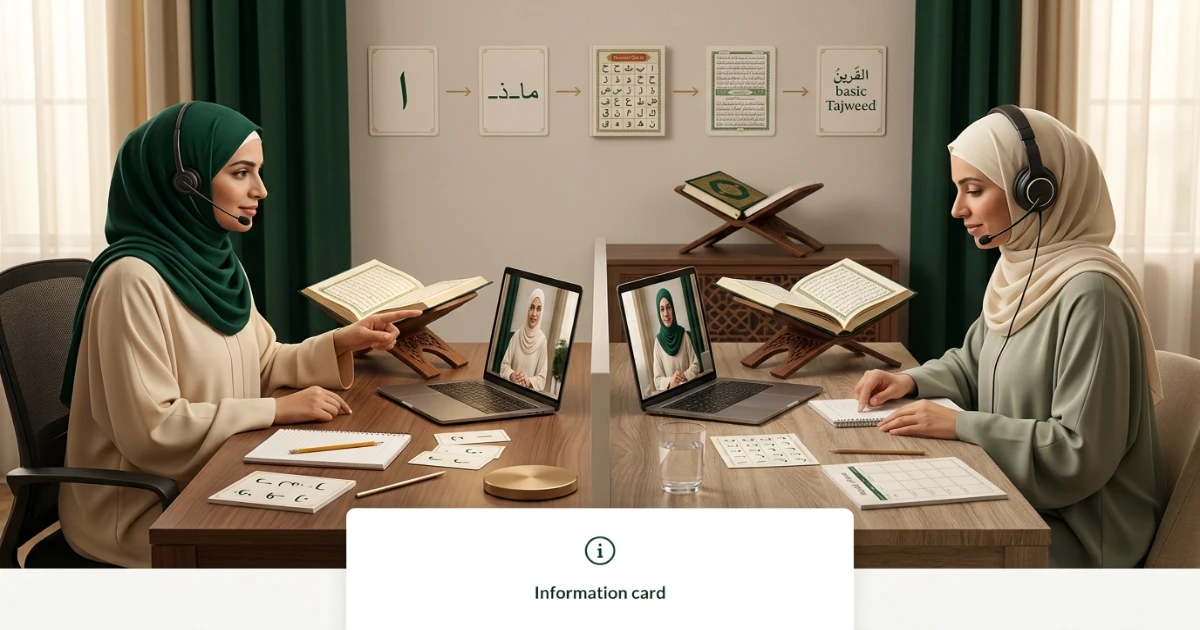
A step-by-step roadmap for adults learning Quran from scratch online
The stages below are sequential, but they are not rigid boxes. A returning learner may review several steps quickly. A complete beginner may spend longer on recognition and blending. The teacher should move forward when the skill becomes usable—not simply because a number of pages has been completed.
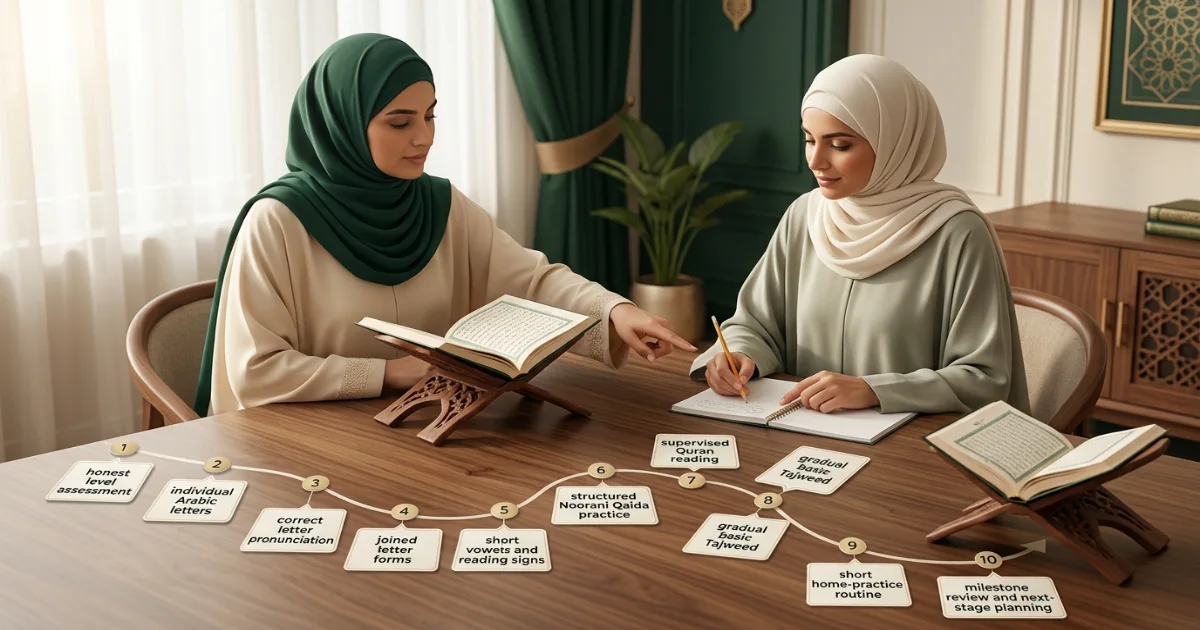
Define the personal goal
Decide whether the immediate aim is learning letters, reading Quran independently, improving prayer recitation, rebuilding after a gap, studying Tajweed, or preparing for memorization. A clear first goal prevents the course from becoming too broad.
Complete a private live assessment
The teacher checks letter recognition, sounds, joined forms, vowels, signs, blending, Quran reading, and pronunciation without assuming the level from age or past certificates.
Choose a sustainable lesson schedule
Select lesson length and weekly frequency around work, caregiving, health, study, prayer, and sleep. A smaller plan attended consistently is stronger than an intensive plan repeatedly missed.
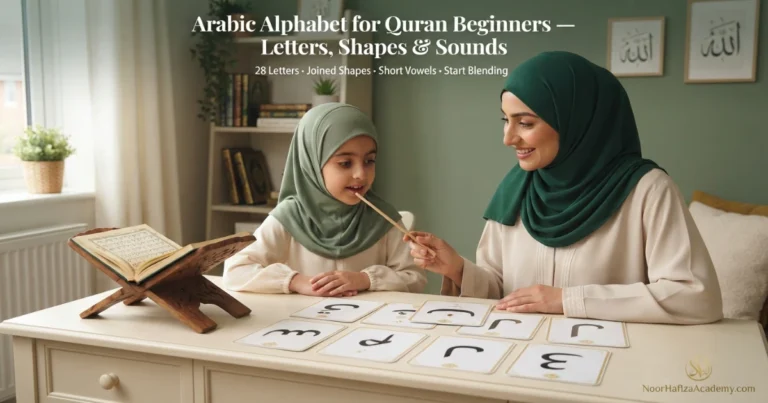
Build letter recognition and sound accuracy
Learn to recognize each letter in varied positions and produce the clearest available sound through listening, modeling, correction, and repetition.
Study vowels, joined forms, and reading signs
Practise how letters connect, how short vowels change sound, and how common signs guide blending. The goal is decoding rather than memorizing page order.
Complete a structured Noorani Qaida pathway
Use the Qaida to combine letters, signs, elongation, sukoon, shaddah, tanween, and mixed reading patterns with live correction.
Begin supervised Quran reading
Start with manageable portions while the teacher continues to correct letters, signs, pauses, and repeated patterns. Qaida review can continue where needed.
Add basic Tajweed gradually
Learn rules through actual examples. The teacher models the sound, identifies the difference, guides repetition, and checks whether the adult applies it elsewhere.
Build a short home-practice routine
Repeat the assigned target for a focused period on most days. Avoid practising an uncertain sound repeatedly without a correct model.
Review milestones and choose the next stage
Assess independence, accuracy, reading confidence, recurring errors, revision consistency, and readiness for broader Quran reading, Tajweed, or memorization.
What should happen in an adult Quran level assessment?
A respectful assessment is not an examination designed to expose weakness. It is a short teaching conversation that identifies the most efficient starting point. The teacher may ask the learner to name or sound selected letters, recognize forms inside words, use simple vowels, blend a short pattern, or read a few lines. A returning reader may also be asked to recite a familiar passage and then attempt an unfamiliar section.
| Assessment area | What the teacher checks | Possible starting decision |
|---|---|---|
| Letter recognition | Can the adult identify letters in different shapes without relying on order? | Begin with alphabet foundations or a targeted letter review. |
| Pronunciation | Can the learner distinguish and produce commonly confused sounds? | Add focused modeling and articulation practice. |
| Vowels and signs | Does the learner understand short vowels, sukoon, shaddah, tanween, and elongation signs? | Start at the relevant Noorani Qaida lesson. |
| Joining and decoding | Can connected letters be recognized and blended into an unfamiliar word? | Strengthen joined forms and mixed reading. |
| Quran reading | Can the adult attempt a new line with manageable prompting? | Begin supervised Quran reading with continued Qaida review. |
| Confidence and routine | What creates hesitation, and what schedule is realistically sustainable? | Adjust lesson length, language, pace, and revision load. |
How adults should learn Arabic letters and Quran pronunciation
Adult beginners often want to move quickly because the alphabet appears basic. Speed is useful only when recognition is stable. A learner who memorizes the sequence but cannot identify letters inside connected words will struggle later. The teacher should mix the order, show initial, middle, final, and isolated forms, and ask the learner to respond without receiving the answer immediately.
Pronunciation should be introduced carefully without turning the first lesson into an advanced articulation lecture. The adult needs a clear sound to imitate, a visible or verbal cue, a chance to repeat, and specific correction. Similar-looking and similar-sounding letters deserve deliberate contrast. The teacher may isolate the sound, place it in a simple combination, and return to it in later lessons.
A strong foundation lesson
- Mixes letters instead of using order alone
- Shows changing letter forms
- Models sounds at a learnable speed
- Compares commonly confused letters
- Checks recognition with less prompting
- Assigns a small, exact revision target
A weak foundation pattern
- Rushes because the learner is an adult
- Relies on transliteration as the main reading method
- Corrects vaguely without modeling
- Moves on while recognition remains dependent
- Assigns an entire page without priorities
- Measures only pages completed
Why Noorani Qaida can help adult beginners
Noorani Qaida is not only for children. It is a structured bridge between letter knowledge and Quran reading. Adults who recognize letters but cannot join sounds, understand signs, or decode new words often benefit from targeted Qaida study. The teacher does not need to treat the adult like a child or use childish language. The same reading sequence can be taught with mature explanation and efficient pacing.
A suitable Qaida pathway develops recognition of connected forms, short vowels, long vowels, tanween, sukoon, shaddah, and mixed signs. The learner should not merely memorize the examples. The teacher should rearrange patterns, ask for unfamiliar combinations, and check whether the skill transfers. Visit the Noorani Qaida online program to understand the foundational course structure.
Finishing the last page is useful only when the learner can recognize signs, join sounds, and attempt unfamiliar Quranic words with decreasing support. The book is a method, not the final measure of ability.
When can an adult begin reading directly from the Quran?
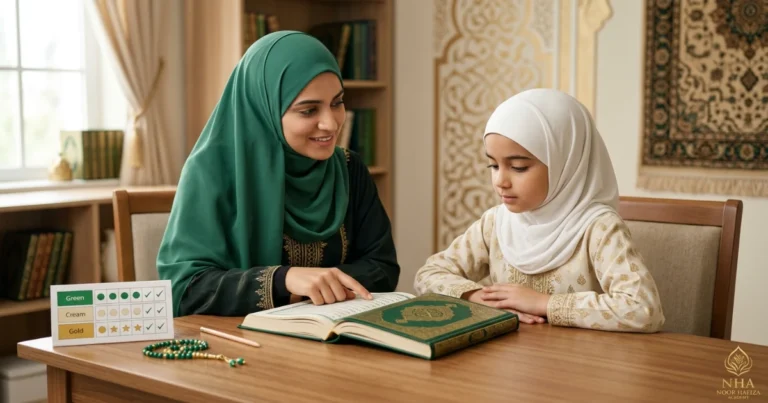
The transition does not need to wait for perfect speed. An adult can begin supervised Quran reading when common letters and signs are recognizable, connected words can be attempted, and correction leads to improvement. The first passages should be manageable enough to protect accuracy and confidence. A teacher may continue short Qaida revision alongside Quran reading when a particular sign or joining pattern remains weak.
At this stage, the adult learns to manage the visual density of the Quran page, maintain place, slow down before guessing, notice familiar patterns, and respond to stopping guidance. The teacher should prevent two opposite problems: reading so quickly that accuracy collapses, or interrupting so frequently that the learner never completes a phrase. Explore online Quran reading classes for the next stage after foundational decoding.
How should adult beginners learn basic Tajweed online?
Tajweed should support reading rather than overwhelm it. An adult beginner does not need a long list of terminology before producing a sound. The teacher can begin with the rules that appear in the current lesson, model the difference, and help the learner apply it. Technical names can be added gradually when they improve understanding.
Hear the correct model
The teacher recites clearly at a speed the adult can imitate without losing the sound.
Identify the exact difference
The learner is told which sound, length, nasal quality, stop, or articulation needs attention.
Repeat with one priority
The adult focuses on a manageable correction rather than trying to repair every feature at once.
Apply it in another example
The teacher checks whether the learner can transfer the correction instead of only copying one word.
Adults who already read but want greater accuracy may enter at this stage after an assessment. Those beginning from zero should first build enough decoding ability to apply Tajweed without constant overload. Learn more through online Tajweed classes.
What should adults look for in an online Quran teacher?
Adult beginners need accuracy and dignity together. A teacher should not assume that age means the learner can tolerate rushed explanations, public correction, or unrealistic homework. She should recognize adult responsibilities and still protect the seriousness of the learning plan. For women and sisters, a female Quran teacher may provide greater comfort, privacy, and freedom to ask questions.
Accurate recitation
The teacher models letters, signs, words, and Quran reading clearly enough for reliable imitation.
Adult-beginner experience
She knows how to explain foundations without speaking to the learner as though she were a child.
Respectful correction
Mistakes are identified specifically without embarrassment, comparison, mockery, or impatience.
Clear progression
The learner understands the starting point, current priority, revision task, and next milestone.
Schedule awareness
The plan respects work, family, caregiving, study, health, and time-zone responsibilities.
Professional privacy
Communication, platform use, recordings, and personal information follow clear boundaries.

What should happen during an adult beginner Quran trial class?
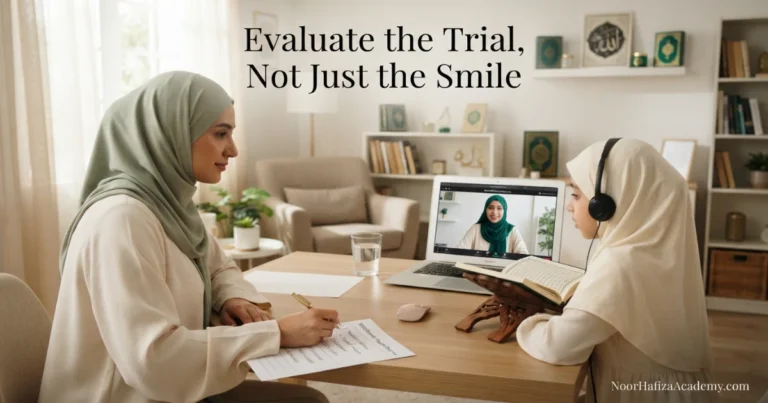
A trial should provide real teaching evidence rather than only a sales conversation. The teacher or academy should confirm the adult’s goal and previous experience, listen to a short independent attempt, demonstrate one correction, and recommend a realistic starting point. The learner should leave knowing what the first stage will be and why.
Explain the goal without embarrassment
Share honestly whether you are starting with letters, returning after a gap, relying on transliteration, or seeking Tajweed correction.
Let the teacher test the real level
Avoid preparing only a memorized passage. The teacher needs to see independent recognition and reading to recommend the correct course.
Observe the explanation style
Instructions should feel mature, understandable, and specific. The adult should know what to change and how to attempt it.
Experience one correction cycle
The teacher models, the learner repeats, and the teacher checks again with less help.
Discuss timing and revision honestly
Choose a plan that fits actual responsibilities rather than an ideal week that cannot be maintained.
Request the first milestone
Ask what progress should become visible after the initial learning period and how it will be reviewed.
How often should an adult beginner take online Quran classes?
Two to five short lessons per week can work well for many adult beginners, but there is no universal number. Frequency should depend on the starting level, lesson duration, target, availability, and home practice. A learner with little independent reading may benefit from more frequent correction because uncertain sounds should not be practised alone for long periods. A busy adult may succeed with two or three lessons plus short review on other days.
| Learning pattern | Possible lesson structure | Best suited to | Main caution |
|---|---|---|---|
| Two lessons weekly | About 30 minutes each | Busy adults with dependable home revision | Long gaps may allow uncertain pronunciation to return. |
| Three lessons weekly | 25–35 minutes each | Steady alphabet, Qaida, or reading progress | Revision still needs a defined place in the week. |
| Four to five lessons weekly | 20–30 minutes each | Fast foundation building or learners needing frequent correction | The schedule must remain sustainable around work and family. |
| Longer weekly sessions | 45–60 minutes | Adults with stronger attention, advanced reading, or combined study goals | A long class is not automatically better for a complete beginner. |
A practical Quran practice routine for busy adults
Adults often wait for a large free block that never arrives. A short, repeated routine is usually more realistic. The practice target should come directly from the teacher and remain small enough to perform accurately. Ten to twenty focused minutes on most days can be useful, while some learners may begin with five to ten minutes.
Review the teacher’s exact correction
Recall the sound, letter, sign, or word that required attention. Use the correct model when available.
Repeat the assigned line or pattern
Read slowly enough to notice rather than racing for page completion.
Test without looking at notes
Attempt recognition or reading with less support to reveal what is becoming independent.
Mark one question for class
Stop guessing when uncertain. Save the exact word, sign, or sound for teacher clarification.
Practice can be attached to an existing routine: after a prayer, before work, during a quiet lunch break, or after children sleep. The best time is the one that can be repeated. Avoid comparing your timetable with someone who has different responsibilities.
How to overcome embarrassment, memory concerns, time pressure, and fear of mistakes
“I should already know this.”
Replace shame with accurate placement. The teacher cannot build efficiently until the real starting level is visible.
“My memory is too weak.”
Use smaller targets, spaced repetition, mixed recognition, and frequent review. Difficulty remembering does not require abandoning the goal.
“I do not have enough time.”
Choose short lessons and ten-minute review blocks. Consistency matters more than waiting for a perfect hour.
“My pronunciation will never improve.”
Work on one recurring sound at a time through modeling, physical cues, comparison, repetition, and transfer.
“I am nervous reading in front of others.”
Use private one-to-one lessons where mistakes can be corrected without peer pressure or public comparison.
“I keep stopping and restarting.”
Reduce the plan until it survives difficult weeks. A modest routine maintained is better than repeated intensive beginnings.
Are private lessons better for adults learning Quran from scratch?
One-to-one lessons are often especially useful for complete adult beginners because the teacher can hear every attempt, protect privacy, match the pace, and spend the full lesson on the learner’s errors. Adults may also feel more comfortable asking basic questions that they would avoid in a group. A shorter private class can provide more active reading than a longer group session where several learners share turns.
A small, carefully matched group can still work for adults who enjoy peer motivation and have similar levels. The important questions are how much individual reading time each learner receives, whether the pace suits everyone, and whether the environment feels respectful. Read the detailed comparison of one-to-one vs group Quran classes.
How long does it take an adult to learn Quran reading online?
There is no honest single timeline. One adult begins with no letter recognition; another remembers most letters after a gap. Some attend five times weekly and practise daily. Others manage two lessons around shifts or caregiving. Language background, hearing, previous exposure, confidence, teacher method, attendance, and practice quality all affect progress.
Milestones are more useful than promised completion dates. Early progress may include recognizing letters without order, distinguishing confusing shapes, using basic vowels, joining short patterns, reading an unfamiliar word, completing a line with less prompting, applying a corrected sound elsewhere, or maintaining a consistent routine for a month.
Recognize and produce the building blocks
Letters, forms, vowels, signs, and core sounds become increasingly independent rather than dependent on sequence or memorized pages.
Attempt unfamiliar combinations and words
The adult begins to read what is actually written instead of relying mainly on memory, transliteration, or teacher prompting.
Read Quran portions with decreasing help
Fluency grows while repeated errors are tracked, corrected, and revisited.
Apply basic Tajweed and stopping guidance
The learner hears important differences and begins applying them with greater independence and calmness.
Mistakes that slow adult Quran learning from scratch
Skipping the assessment
Starting from a random page can make the course too easy, too difficult, or disconnected from the real gap.
Depending on transliteration
Transliteration may support a temporary need, but it cannot represent every Arabic sound or build true Quran-text recognition.
Practising uncertain errors
Repeated practice helps only when the model is reasonably correct. Save doubtful sounds for live correction.
Choosing an unsustainable plan
An intensive timetable that repeatedly collapses creates frustration and lost teacher time.
Measuring pages instead of skill
Page completion can hide dependent reading, repeated mistakes, or weak transfer to unfamiliar text.
Waiting for confidence first
Confidence often grows after several respectful attempts. It does not need to be complete before the first lesson.
How can adult learners protect privacy in online Quran classes?
Adults should know which platform is used, how the teacher is verified, whether lessons are recorded, who can access recordings, how communication occurs, and how schedule or teacher concerns are handled. A neutral background, closed personal files, muted notifications, secure meeting links, and an academy contact route support a professional setup.
Women and sisters may prefer a female Quran teacher online for comfort, modesty, or a women-led learning environment. This preference should be combined with the same quality checks used for any teacher: accurate recitation, relevant course experience, respectful correction, reliability, privacy, and clear progress guidance. Review the complete female Quran teacher online checklist.
How Noor Hafiza Academy supports adult beginners and sisters
Noor Hafiza Academy offers live online Quran learning with female Quran teachers for women, sisters, children, girls, and beginners. Adult learners can discuss their real starting level, preferred language, course goal, time zone, schedule, privacy needs, and previous experience before regular classes begin.
A trial or level check helps identify whether the adult should begin with Arabic letters, a selected Noorani Qaida lesson, supervised Quran reading, basic Tajweed, a Hifz restart, or another suitable pathway. The aim is not to place every adult on the same page. It is to build a practical course around demonstrated skill and sustainable attendance.
Share what you remember, what feels difficult, your available schedule, and your immediate Quran goal. A female teacher can assess the starting point and explain a manageable first stage.
Can adults learn Quran online from scratch? Your action checklist
Before the trial
- Define the immediate goal
- Share the real starting level
- Choose suitable times
- Prepare a quiet device setup
During the trial
- Complete an independent sample
- Observe one real correction
- Check teacher communication
- Request a starting recommendation
During the first month
- Attend consistently
- Use short regular revision
- Track recurring questions
- Review the first milestone
Teacher fit
- Accurate female Quran teacher
- Mature respectful explanations
- Private correction
- Professional boundaries
Progress signs
- More independent recognition
- Fewer repeated errors
- Better decoding
- Growing reading confidence
Sustainable routine
- Realistic weekly frequency
- Short practice blocks
- Clear makeup policy
- Monthly plan review
Adult learners can also read the broader guide on how to learn Quran online for beginners, explore online Quran classes for women, or begin with Noorani Qaida online.
FAQs about adults learning Quran online from scratch
Can adults learn Quran online from scratch?
Am I too old to start learning Quran?
Do I need to know Arabic before learning Quran reading?
Is Noorani Qaida suitable for adults?
How many Quran classes should an adult beginner take weekly?
How long should an adult practise Quran each day?
How long will it take me to read Quran independently?
Are one-to-one Quran classes better for adult beginners?
Can adult women request a female Quran teacher online?
What should I do if I feel embarrassed about starting?
Begin from your real level with a private adult trial class
Share what you currently recognize, where you feel stuck, your time zone, preferred schedule, and immediate Quran goal. Noor Hafiza Academy will help discuss a suitable starting pathway with a female Quran teacher.