
A Quran Learning Routine for Busy Muslim Mothers

A busy Muslim mother does not need an empty calendar before she can read, revise, or improve her Quran. The goal is to build a routine that fits the life she actually has: school runs, meals, work, babies, household responsibilities, caregiving, appointments, tired evenings, and unpredictable family days. A realistic Quran learning routine can begin with 10 to 15 focused minutes, one or two live lessons each week with a qualified female Quran teacher, one clear skill target at a time, and a simple backup plan for days when the full routine is impossible. Progress should be measured through accuracy, independence, Tajweed improvement, consistency, and confidence—not through guilt or large page targets.
What is a realistic Quran learning routine for a busy Muslim mother?
A realistic Quran learning routine for a busy Muslim mother starts with a protected minimum rather than a large daily target. Choose one dependable time window—after Fajr, after school drop-off, during a baby’s nap, before children wake, or after bedtime—and use 10 to 15 focused minutes for reading, Tajweed, Qaida review, Hifz revision, or another clear priority. Add one or two live lessons each week with a qualified female Quran teacher for assessment and correction. Keep daily practice small enough to survive busy weeks, prepare the Mushaf or Qaida in advance, turn off distractions, and use a five-minute backup routine when the full session is impossible. Review progress weekly through fewer errors, fewer prompts, stronger Tajweed, more confident unfamiliar reading, and better consistency rather than page count alone.
Why busy mothers need a different Quran routine
A Quran routine designed for someone with long uninterrupted mornings may fail immediately for a mother with a baby, school-age children, work, caregiving, or household responsibilities. The problem is not lack of seriousness. The routine may simply be designed for a life she does not have.
Busy mothers often experience fragmented time. Ten minutes appear unexpectedly, while the planned 45-minute study block disappears because a child is sick, dinner is late, work runs over, or the baby refuses to nap. A sustainable plan should therefore use short repeatable blocks rather than depend on perfect conditions.
A mother who reads accurately for 12 minutes on five days each week may build more lasting skill than someone who plans one long weekend session and frequently misses it.
A good routine also reduces decision fatigue. The mother should already know when she will open the Quran, what she will practise, how long she will continue, what to do when interrupted, and what counts as enough on a difficult day.
How to find the best Quran study time in a busy family schedule
There is no single best time for every mother. The right time is the one with the highest combination of energy, repeatability, privacy, and low interruption. Test several options rather than forcing a routine because another family recommends it.
After Fajr
Useful for mothers who wake consistently and benefit from a quiet house before children or work begin.
After school drop-off
Can work well when younger children are settled and the mother has a short protected window before chores or work.
During nap time
Helpful for mothers of babies or toddlers, but should have a backup because naps can be unpredictable.
Before school pickup
A short midday block may be easier than relying on exhausted evenings.
After Isha or bedtime
Useful for mothers who need privacy, though the session should remain short if energy is low.
Weekend anchor
A longer weekly review can support the short weekday routine and prepare the next week’s target.
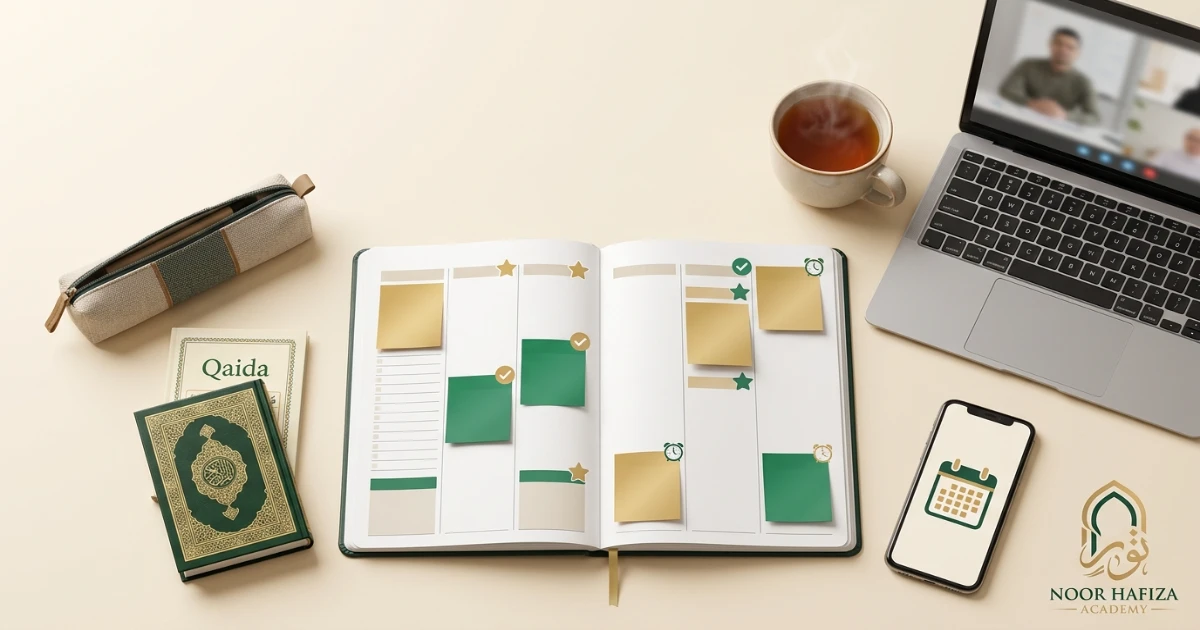
A practical 15-minute Quran routine for busy Muslim mothers
Fifteen minutes is long enough to create focused practice and short enough to fit many family schedules. The goal is not to fill every minute with new material. The goal is to connect correction, repetition, independence, and continuity.
Open the correct page, review the teacher’s main correction, silence notifications, and settle.
Read the assigned lines slowly, attempting independently before listening to a model.
Repeat two or three difficult words, sounds, Tajweed patterns, or Hifz joins.
Use one unfamiliar line or delayed recall check and note what needs teacher support.
This routine can be shortened to five minutes or extended to 20 minutes. The structure matters more than the exact number. A mother reviewing Noorani Qaida may use the reading block for joined letters. A Tajweed learner may use it for one recurring pronunciation pattern. A Hifz learner may use it for older revision rather than new memorization.
What should a busy mother focus on first?
Trying to improve Quran reading, memorize new Surahs, study Tajweed theory, review Qaida, learn Arabic vocabulary, and attend several classes at once can create pressure without clear progress. Choose the skill that currently limits the learner most.
| Current situation | First priority | Daily practice | Teacher focus |
|---|---|---|---|
| Letters or joined forms are weak | Targeted Noorani Qaida review | Short decoding and mixed-letter reading | Foundation errors and recognition |
| Quran is readable but slow | Controlled fluency | Short phrases from familiar and unfamiliar passages | Accuracy, stopping, reduced prompting |
| Reading is fluent but Tajweed is inconsistent | One Tajweed pattern at a time | Target sound or rule in real Quran words | Correction transfer |
| Hifz has become weak | Revision before new memorization | Older Surahs, joins, random starts | Retention and prompts |
| Long gap and low confidence | Level assessment and restart | Short familiar and unfamiliar reading | Smallest missing foundation |
| Busy but already accurate | Consistency and refinement | Small regular recitation with one quality target | Advanced correction and accountability |
A weekly Quran learning plan for busy mothers
A weekly plan reduces daily decision-making and leaves room for family disruptions. It should contain at least one teacher anchor, several short independent sessions, and one lighter recovery day.
| Day | Main task | Suggested time | Purpose |
|---|---|---|---|
| Monday | Live lesson or teacher-assigned focus | 20–30 minutes | Assessment, correction, weekly target |
| Tuesday | Independent practice | 10–15 minutes | Repeat the main correction |
| Wednesday | Reading plus unfamiliar test | 10–15 minutes | Check transfer and independence |
| Thursday | Second lesson or self-review | 15–30 minutes | Confirm progress and repair errors |
| Friday | Light review | 5–10 minutes | Protect continuity |
| Saturday | Longer review or Hifz revision | 15–25 minutes | Consolidate the week |
| Sunday | Rest, catch-up, or planning | 5–10 minutes | Prepare next week |

The five-minute backup routine for chaotic days
Some days will not support the normal routine. The backup prevents an all-or-nothing cycle in which one missed session becomes a lost week.
Five-minute fallback
- One minute: open the assigned place and review the teacher’s current target.
- Two minutes: read one short line, word set, or memorized passage slowly.
- One minute: repeat the hardest correction three times carefully.
- One minute: mark where to restart tomorrow and close without guilt.
The fallback is a continuity tool for illness, school events, travel, guests, deadlines, or emotionally heavy days. When life settles, return to the full routine instead of trying to repay missed time with an exhausting catch-up session.
Why a female Quran teacher can make a busy routine more efficient
Busy mothers have limited study time, so inefficient practice is expensive. A qualified female Quran teacher can identify the highest-value correction, prevent repeated wrong practice, and give a small assignment that fits the learner’s week.
Faster diagnosis
The teacher identifies whether the issue is reading, pronunciation, Tajweed, fluency, memory, or confidence.
Smaller assignments
Instead of broad “practise more” advice, the learner receives one specific task.
Accountability
A fixed lesson gives the mother a weekly anchor without requiring a complicated schedule.
Adult teaching
The lesson can be private, respectful, and adapted to an adult learner rather than a child-style curriculum.
Flexible pacing
The teacher can reduce workload during difficult weeks and increase it when family life allows.
Progress evidence
The teacher can track fewer errors, stronger Tajweed, smoother unfamiliar reading, and consistency.
How to study Quran with babies or young children at home
Mothers of babies and toddlers often cannot predict exact quiet periods. The routine should combine one protected anchor with flexible micro-sessions. Keep the Mushaf, Qaida, notebook, and headphones in one ready location so that the first few minutes are not lost to setup.
- Use nap time only if it is reasonably reliable; otherwise treat it as bonus practice.
- Choose a live lesson time when another adult can supervise children where possible.
- Use shorter teacher sessions if interruptions are likely.
- Stop and resume rather than forcing concentration through repeated child needs.
- Use the five-minute backup routine during especially difficult days.
A mother should not measure commitment by whether every lesson is perfectly quiet. The goal is to protect enough focused minutes for accurate learning while accepting the realities of caring for young children.
A Quran routine for mothers balancing employment and family
Working mothers often face two peaks of responsibility: the workday itself and the family routine before or after it. Quran learning should not automatically be placed into the most exhausted part of the day.
| Schedule pattern | Possible Quran window | Main risk | Adjustment |
|---|---|---|---|
| Early office start | Short session after Fajr | Sleep deprivation | Use 10 minutes and protect bedtime |
| Remote work | Before first meeting or lunch break | Work expands into the slot | Calendar-block the session |
| School-hours work | After drop-off or before pickup | Errands consume the time | Study before starting errands |
| Shift work | Rotating practice plus flexible lesson | No fixed rhythm | Use a weekly minimum |
| Heavy evening family load | Midday or weekend teacher lesson | Evening exhaustion | Move learning away from bedtime |
How to make Quran study work with the whole household
A mother’s routine becomes easier when the family understands that the learning time is a real commitment. It does not need to become a major household event, but expectations should be clear.
Useful family support
- Another adult handles children during the live lesson when possible.
- Older children know the 15-minute study window should not be interrupted unless necessary.
- Meals or chores are planned around one or two weekly lessons.
- The mother’s learning space stays prepared.
- Family members encourage progress without monitoring every mistake.
What to avoid
- Waiting until every family task is complete before allowing study.
- Using children’s Quran progress as a comparison.
- Moving the lesson every week without a stable anchor.
- Expecting the mother to multitask during live recitation.
- Turning one missed session into criticism or guilt.
Use an existing habit to make Quran practice easier to remember
A routine becomes easier when attached to something that already happens. This reduces the mental effort required to decide when to begin.
After Fajr
Keep the Quran beside the prayer space and begin before checking the phone.
After school drop-off
Study before starting errands, cleaning, email, or social media.
After tea or coffee
Use the same chair, headphones, and notebook so the setup becomes automatic.
Before children return
Use a short timer so the session ends before the next family transition.
After Isha
Use a light review rather than a difficult new target when energy is low.
Weekend planning
Schedule teacher lessons and prepare the week’s pages before Monday begins.
How much Quran learning is too much for a busy routine?
More classes, more homework, and more pages do not automatically create faster progress. Overloading often produces rushed reading, missed lessons, guilt, and eventual dropout.
Too many goals
Reading, Tajweed, Hifz, Arabic, and Islamic Studies are all being pushed at the same time without a priority.
Long daily targets
The routine requires 30–60 minutes every day even though family life rarely provides it.
Too much new material
The learner keeps adding pages or Hifz while old corrections remain unstable.
No recovery day
One missed session causes the entire plan to feel behind.
Study during exhaustion
The mother practises when hearing and concentration are too weak for accurate correction.
Teacher expectations ignore real life
Assignments remain the same during illness, travel, school events, or caregiving emergencies.
How busy mothers should measure Quran progress
Progress tracking should be simple enough that it does not become another burden. A weekly note can be enough.
Letters, vowels, shaddah, sukoon, Tajweed, and stopping become more reliable.
The learner needs less teacher modeling and can read before listening.
The routine survives school, work, and family responsibilities more often.
The mother begins more easily and can read unfamiliar material with less fear.
A simple weekly record might include days practised, live lessons attended, one recurring correction, one improvement, and the next target. This gives enough evidence to adjust the routine without creating a complicated dashboard.

How to restart after missing several days
Do not repay missed days with an oversized catch-up session. Return to the normal minimum. If you missed a week, begin with a short review of the last teacher target and one familiar passage. If the gap was longer, ask the teacher to reassess before increasing material.
Three-step recovery
- Return: do the smallest normal session today.
- Review: revisit the last stable skill instead of adding new material immediately.
- Replan: identify why the routine broke and adjust the time, lesson load, or family support.
A routine that can recover is more valuable than a perfect routine that collapses after disruption.
Questions busy mothers should ask before joining an online Quran program
Use these questions during a trial or enrollment discussion
- Can my lesson schedule work around school runs, work, and family responsibilities?
- Do you offer female Quran teachers experienced with adult women?
- How will you assess my current reading level before assigning a course?
- Can homework be kept short and focused?
- How do you adjust the plan during travel, illness, or difficult family weeks?
- What is the minimum lesson frequency that can still support progress?
- How will reading, Tajweed, or Hifz progress be measured?
- Can I receive a clear weekly correction target?
- What happens if I need to reschedule a lesson?
- Can the teacher help me restart after a long gap?
- How do you protect privacy during online lessons?
- What are the current fees, trial terms, and cancellation policies?
Flexible online Quran classes for busy Muslim mothers
Noor Hafiza Academy offers live online Quran classes for women, mothers, sisters, girls, adults, beginners, returning readers, Tajweed students, and Hifz learners with female Quran teachers. A suitable plan can begin with a private level assessment and may include Noorani Qaida review, Quran reading, Tajweed, fluency, Hifz revision, memorization, or Islamic Studies.
Busy mothers can discuss their family routine, work hours, children’s schedules, time zone, current Quran level, preferred lesson length, and realistic home-practice capacity before choosing a plan. Current female-teacher qualifications, availability, schedules, trial arrangements, fees, privacy practices, policies, and enrollment terms should be confirmed directly.
Share your current Quran level, family schedule, work commitments, time zone, preferred female teacher, and the number of minutes you can realistically practise on most days.
FAQs about Quran routines for busy Muslim mothers
How much Quran should a busy Muslim mother read each day?
What is the best time for a busy mother to study Quran?
Can five minutes of Quran practice still be useful?
Should a busy mother learn Tajweed and Quran reading at the same time?
How many online Quran classes per week are enough for a busy mother?
Can a working mother learn Quran consistently?
How can mothers study Quran with babies and toddlers at home?
What should I do when I miss several days?
Do I need a female Quran teacher?
How can I stay motivated when family life is exhausting?
How should a busy mother track Quran progress?
Can I restart Quran reading after a long gap while raising children?
Build a Quran routine that respects motherhood, protects consistency, and creates real progress
Share your current Quran level, family schedule, work commitments, city and time zone, preferred days, available practice minutes, and whether your priority is Qaida, reading, Tajweed, Hifz revision, or restarting after a gap.