
Makharij vs Sifaat: What Is the Difference?

Makharij vs Sifaat is one of the clearest ways to understand Arabic pronunciation in Tajweed. Makharij al-Huruf are the articulation points from which letters emerge, while Sifaat al-Huruf are the qualities that shape those letters after they come from the correct place. A simple memory rule is: Makhraj answers “where?” and Sifah answers “how?” A letter can come from the correct tongue or throat position yet still sound wrong if its heaviness, breath, strength, flow, echo, or another characteristic is missing. The opposite is also true: trying to imitate a quality without using the correct articulation point can turn one Arabic letter into another. This guide explains both systems, shows how they work together, compares common letter pairs, and gives beginners a practical learning order without making the topic unnecessarily technical.
What is the difference between Makharij and Sifaat?
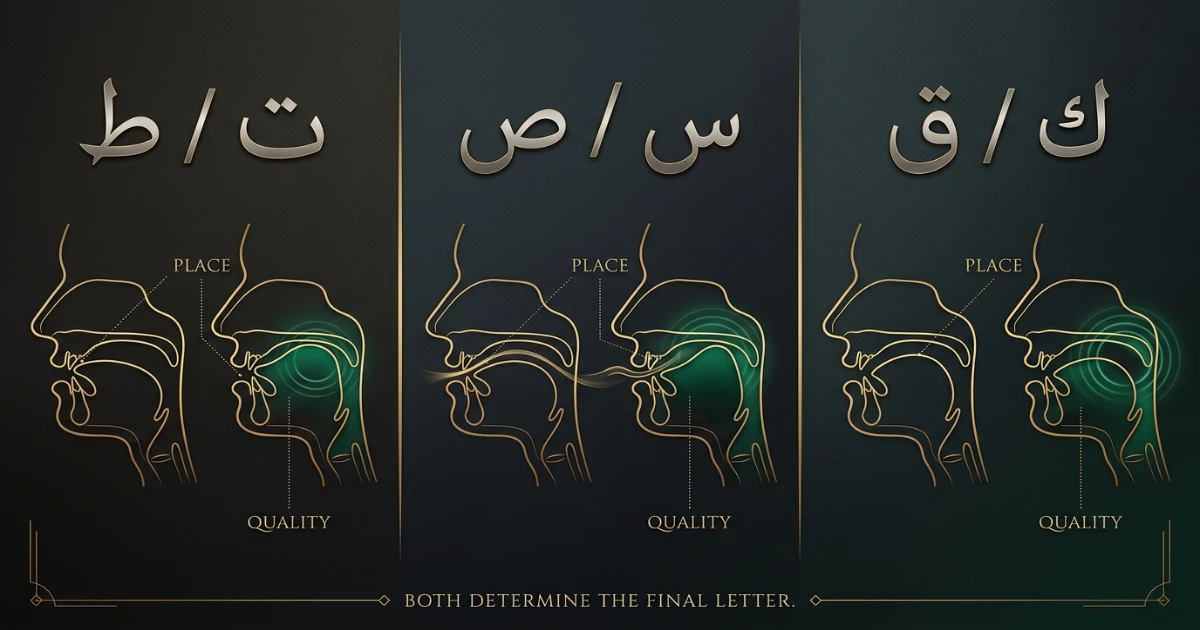
Makharij are the articulation points of Arabic letters: they tell you where a sound is formed. Sifaat are the characteristics of those letters: they tell you how the sound behaves. For example, a Makhraj may involve the back of the tongue, the lips, or a part of the throat. Sifaat then describe qualities such as heaviness, breath, strength, flow, echo, or whistling. Accurate Tajweed needs both. If the place is wrong, the letter may turn into another sound. If the qualities are wrong, the letter may keep roughly the same place but lose its correct Quranic character.
What are Makharij al-Huruf?
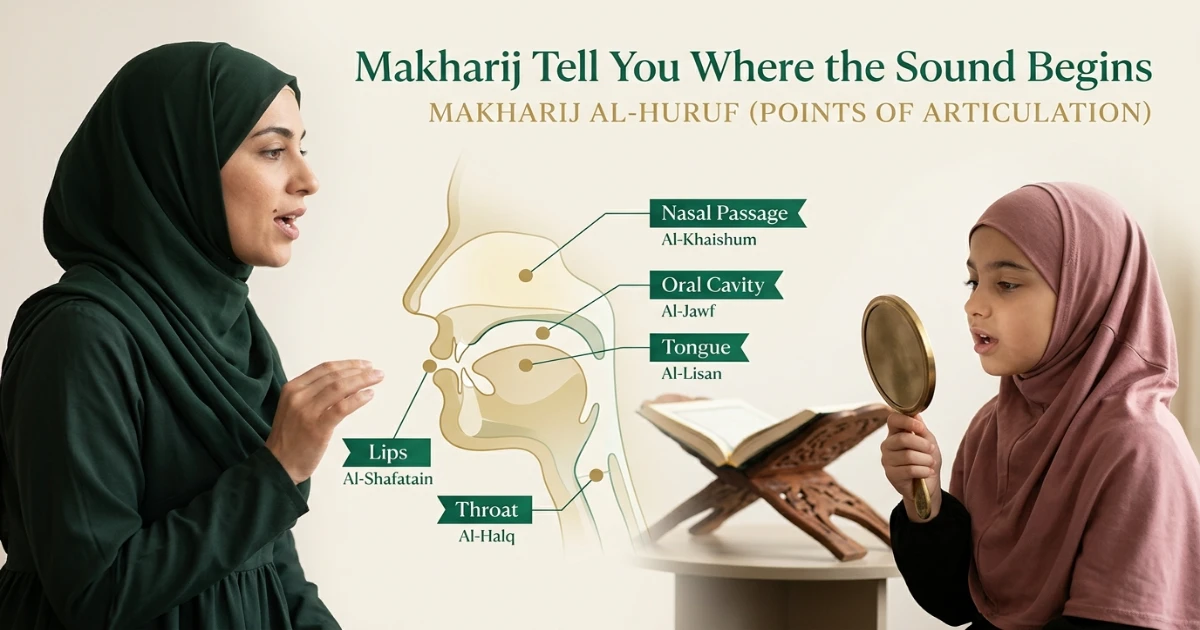
Makharij al-Huruf are the articulation points from which Arabic letters emerge. A Makhraj is not simply “the mouth” or “the tongue.” It is the particular place or contact area that allows a letter to be produced distinctly from other letters.
For beginners, teachers often introduce five broad regions: the oral cavity, throat, tongue, lips, and nasal passage. Detailed Tajweed then divides these into more precise points. A commonly taught classical arrangement counts 17 specific Makharij, though scholars and curricula can differ in how certain articulation points are grouped. That counting difference does not change the practical goal: every letter should come from its correct place.
You can often feel the tongue, lips, throat, or airflow changing as you move from one Makhraj to another.
What are Sifaat al-Huruf?
Sifaat al-Huruf are the qualities or characteristics attached to Arabic letters. They describe whether breath flows, whether the sound is held or released, whether the back of the tongue rises, whether a letter has a bouncing quality, or whether a special quality such as Safir, Tafashshi, or Qalqalah is present.
A letter has several Sifaat at once. This matters because no single characteristic tells you the whole identity of a letter. Instead, the full sound comes from the Makhraj plus a combination of qualities.
Where is the letter formed?
The answer points to the tongue, throat, lips, oral cavity, or nasal passage and then to a more exact articulation point.
How does the letter behave?
The answer describes breath, strength, heaviness, flow, echo, spread, whistle, repetition tendency, or another characteristic.

Makharij vs Sifaat side by side
| Feature | Makharij | Sifaat |
|---|---|---|
| Main question | Where? | How? |
| Focus | Place of articulation | Sound quality and behavior |
| Physical cue | Tongue, lip, throat or cavity position | Airflow, pressure, heaviness, flow or resonance |
| Main risk if wrong | Letter may become another sound | Letter may sound weak, heavy, light, breathy or distorted |
| Learning method | Placement + repetition | Listening + controlled sound practice |
| Relationship | Gives the letter its source | Gives the letter its character |
Why correct Makharij without Sifaat is still incomplete
A student may place the tongue near the correct location but still produce the wrong quality. A heavy letter can be flattened, a Qalqalah letter can be made too soft, or a letter of Hams can lose its breath flow. The Makhraj may be close, but the finished letter will still sound incomplete.
The reverse is also true. A student may understand that Qaf is heavy and strong, but if the back-of-tongue placement is wrong, the sound may drift toward Kaf. Tajweed pronunciation therefore combines location and quality rather than treating them as two unrelated memorization chapters.
How Sifaat help separate letters with nearby Makharij
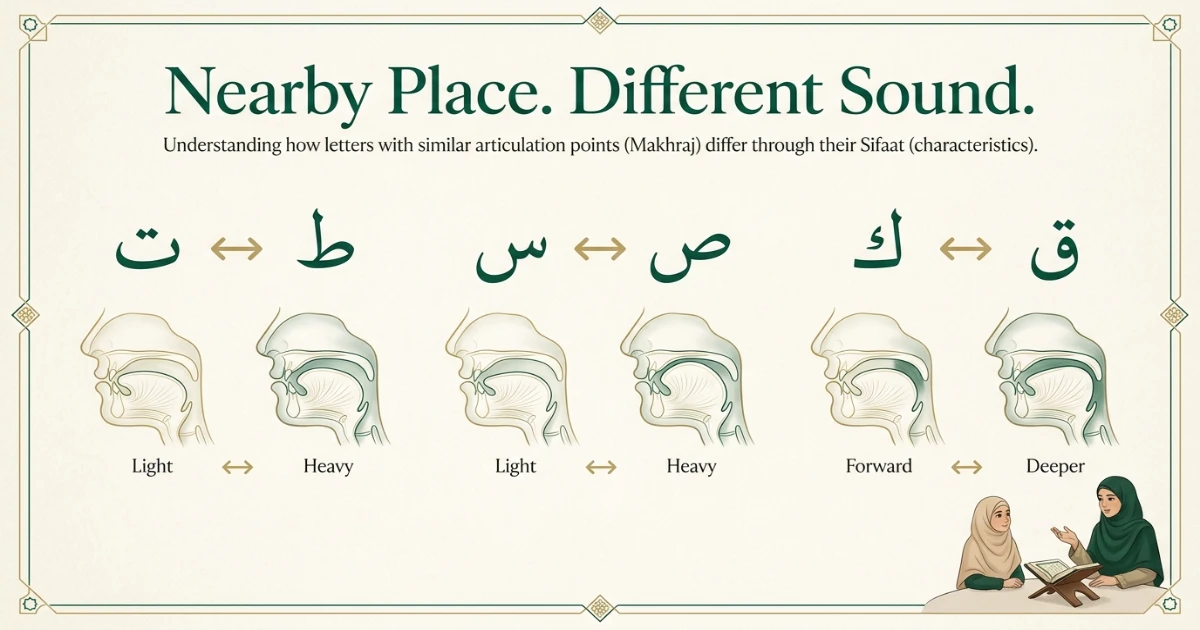
Some Arabic letters are produced from nearby areas. Their exact Makhraj gives part of the distinction, while their Sifaat strengthen the difference and make the sound clearer to the listener.
Both involve the tongue-tip region, but ط carries Isti’la and Itbaq, making it heavier and fuller.
Both carry Safir, but ص is heavy because of Isti’la and Itbaq, while س remains light.
Both come from the back-of-tongue region, but their precise Makharij differ and Qaf also carries heaviness.
Three useful Makharij and Sifaat contrast pairs
ت vs ط: The tongue-tip area is related, but ط has the heavy qualities of Isti’la and Itbaq. If the student uses only the physical contact without the heavy quality, ط may become too close to ت.
س vs ص: Both contain Safir, a whistle-like characteristic. Sad is also heavy and enclosed through Isti’la and Itbaq, while Seen is light. This shows that two letters can share one Sifah and still remain very different because their complete quality sets are not the same.
ق vs ك: Both are articulated from the back-of-tongue region but from different precise positions. Qaf is heavy; Kaf is light. Moving the place or losing the heaviness can make Qaf sound too close to Kaf.
What are the main Makharij regions?
| Broad area | Arabic term | What it includes | Examples |
|---|---|---|---|
| Oral cavity | Al-Jawf | Long-vowel space | ا و ي as Madd letters under their conditions |
| Throat | Al-Halq | Deep, middle and upper throat | ء ه ع ح غ خ |
| Tongue | Al-Lisan | Many consonants | ق ك ج ش ي ض ل ن ر ت د ط and others |
| Lips | Ash-Shafatan | Lip-related letters | ف ب م و |
| Nasal passage | Al-Khayshum | Ghunnah resonance | Nasal quality of ن and م in relevant states |
The five-region framework is a teaching map. Detailed study then identifies the exact point for each letter. Different classical classifications may group some specific Makharij differently, so beginners should follow their teacher’s system consistently rather than worrying about the number first.
What types of Sifaat do students learn?
Tajweed curricula often teach Sifaat in two broad families: characteristics that have opposites and characteristics that do not have direct opposites. Paired examples include Hams/Jahr, Shiddah/Rikhwah with Tawassut between them, Isti’la/Istifal, Itbaq/Infitah, and Idhlaq/Ismat in curricula that include that classification. Special unpaired qualities commonly include Qalqalah, Safir, Leen, Inhiraf, Takrir, Tafashshi, and Istitalah.
The exact count of Sifaat can vary depending on the curriculum and whether certain qualities are included or grouped separately. The practical focus is the sound: what does this characteristic make the letter do, and how does that help preserve its identity?
How can you tell whether your mistake is Makhraj or Sifah?
| What you hear | Likely issue | What to check | Example |
|---|---|---|---|
| Letter changes into another letter | Often Makhraj | Exact tongue/lip/throat position | Qaf drifting toward Kaf |
| Correct letter but too heavy/light | Often Sifah | Isti’la/Istifal and resonance | Sad flattened toward Seen |
| Letter sounds too breathy | Often Sifah | Hams/Jahr | Breath leaking into a letter incorrectly |
| Echo missing or exaggerated | Sifah | Qalqalah | ق ط ب ج د when Sakin |
| Tongue uses wrong contact point | Makhraj | Physical placement | Dental/interdental letters |
Why do beginners mix up Makharij and Sifaat?
Both affect one final sound
The ear hears the finished letter, not two separate layers called Makhraj and Sifah.
Some Sifaat change tongue posture
Isti’la raises the back of the tongue, so learners can mistakenly think it is the articulation point itself.
Charts are often taught separately
Students memorize tables without practising how place and quality combine in real words.
One error can involve both
A letter may be produced from the wrong place and with the wrong characteristic at the same time.
Should beginners learn Makharij or Sifaat first?
Most beginners benefit from learning basic Makharij first because the letter must come from the correct place before its qualities can be refined. Once the Makhraj is stable, add the key Sifaat that distinguish that letter from nearby sounds.
In real teaching, the two are often introduced together in small amounts. A teacher may say: “Place your tongue here, keep the sound heavy, and do not let the breath escape.” That combines one Makhraj correction with one or two Sifaat without forcing the learner to memorize a complete theory chart first.
Learn where the letter is produced.
Learn the qualities that most change the sound.
Use contrast pairs so the distinction becomes audible.
Practise Fathah, Kasrah, Dammah, and Sukoon where appropriate.
Apply the sound in real recitation.
Ask whether the error is place, quality, or both.
Why teacher feedback matters for Makharij and Sifaat
Makharij and Sifaat are difficult to self-diagnose because your own voice sounds different to you than it does to a listener. You may think your Qaf is deep enough, your Haa is clear enough, or your Sad is heavy enough when a trained teacher can hear a small drift.
A teacher can also tell you whether the correction belongs to the Makhraj or the Sifah. That distinction makes practice much more efficient. Instead of repeating a letter hundreds of times, you can fix the exact physical placement or sound quality causing the problem.

A simple Makharij and Sifaat practice routine
| Minutes | Focus | Exercise | Goal |
|---|---|---|---|
| 2 | Makhraj placement | Repeat one target letter slowly | Feel the exact contact point |
| 2 | Key Sifaat | Add heaviness, breath, strength, or flow as needed | Shape the correct quality |
| 2 | Contrast pair | Compare with a nearby/confusable letter | Hear the distinction |
| 2 | Quran words | Read 4–6 words containing the target letter | Transfer into real reading |
| 2 | Feedback | Record yourself or read to a teacher | Correct place and quality |
12-point Makharij vs Sifaat checklist
Use this while correcting a difficult Arabic letter
- Can I identify the letter’s broad Makhraj region?
- Do I know its more specific articulation point?
- Can I feel where the tongue, lips, or throat should be?
- Do I know the main Sifaat that affect this letter?
- Is the letter heavy or light where applicable?
- Does breath flow or remain controlled as required?
- Is the sound held, released, or flowing correctly?
- Does the letter have a special Sifah such as Qalqalah or Safir?
- Can I distinguish it from a nearby or confusable letter?
- Does the sound remain correct with different vowels?
- Can I keep the same Makharij and Sifaat inside Quran words?
- Can a teacher confirm whether my remaining error is Makhraj, Sifah, or both?

Learn Makharij and Sifaat in online Tajweed lessons
Noor Hafiza Academy offers live online Quran learning for children, girls, women, adults, beginners, returning readers, teenagers, siblings, and homeschool families with female Quran teachers. Learners can ask about Noorani Qaida, Quran reading, Tajweed, Makharij, Sifaat, Hifz, and pronunciation correction according to their current level.
A Tajweed plan may include Arabic articulation points, Sifaat al-Huruf, Tafkheem and Tarqeeq, Qalqalah, Ghunnah, Noon Sakinah and Tanween, Meem Sakinah, Madd, Waqf, rules of Ra and Lam, and guided recitation. Current teacher qualifications, female-teacher availability, class length, trial arrangements, fees, schedules, privacy practices, safeguarding policies, and enrollment terms should be confirmed directly.
Share the learner’s age, Quran level, difficult letters, Tajweed background, preferred schedule, and whether a female teacher is requested.
FAQs about Makharij vs Sifaat
What are Makharij in Tajweed?
What are Sifaat in Tajweed?
What is the easiest difference between Makharij and Sifaat?
Can two letters have nearby Makharij but different Sifaat?
Can a letter have more than one Sifah?
How many Makharij are there?
How many Sifaat are there?
Should beginners learn Makharij or Sifaat first?
Is Tafkheem a Makhraj or a Sifah?
Is Qalqalah a Makhraj or a Sifah?
Can correct Makhraj alone give perfect pronunciation?
How should beginners practise Makharij and Sifaat?
Improve Quran pronunciation by learning both where each letter comes from and how it should sound
Share the learner’s age, Quran level, difficult Arabic letters, Tajweed background, and preferred class schedule.