
Madd Rules in Tajweed: A Beginner’s Guide to Elongation

Madd rules in Tajweed teach you when a Quranic sound should be lengthened and for how long. For a beginner, the subject becomes much easier when it is learned in layers: first recognize the three Madd letters, then master Madd Asli or natural elongation, and only after that learn what happens when a hamzah or sukoon comes after the Madd letter. This guide explains the most common Madd rules taught in the recitation of Hafs ‘an ‘Asim, with simple count guidance, examples, stopping rules, comparison tables, common mistakes, and a practical study method.
What are Madd rules in Tajweed?
Madd rules are the Tajweed rules for elongating certain vowel sounds during Quran recitation. A Madd letter is normally one of three letters: an Alif preceded by a fathah, a silent Waw preceded by a dammah, or a silent Yaa preceded by a kasrah. The basic elongation, called Madd Asli or Madd Tabi‘i, lasts two counts. If a hamzah or sukoon follows, another Madd rule may apply, causing the sound to be lengthened for four, five, or six counts depending on the rule and the recitation method being followed. Beginners should first master natural Madd, then learn connected Madd, separated Madd, necessary Madd, temporary stopping Madd, and Madd Lin.
What does Madd mean in Tajweed?
The Arabic word Madd carries the idea of extending or lengthening. In Tajweed, it refers to extending the sound of a vowel in a controlled way. The key word is controlled. Madd is not simply singing a word longer because it sounds beautiful. It is a measured part of Quran recitation, and its length depends on the letter pattern in front of the reader.
A beginner often hears teachers say “two counts,” “four counts,” or “six counts.” A count is a practical teaching unit used to keep elongation even. It is not normally measured with a stopwatch. Instead, the reciter learns a stable internal rhythm. For example, a two-count Madd might feel like two equal beats: one-two. A four-count Madd should then be approximately twice as long as that natural two-count sound at the same reading speed.
This is why the length of Madd must be learned together with recitation pace. If you read slowly, the counts naturally take longer in real time. If you read more quickly, each count is shorter. What should stay stable is the proportional relationship. A six-count Madd should not suddenly become a very short stretch simply because the reciter wants to finish the verse quickly.
First decide whether you actually have a Madd letter. Then check what comes after it. The rule is determined by the letters and their vowel signs, not by guesswork or melody.
The three Madd letters: Alif, Waw, and Yaa
The first skill in learning Madd rules in Tajweed is recognizing the three letters that can produce elongation. However, Alif, Waw, and Yaa are not automatically Madd letters every time they appear. Each has a condition.
Alif Madd
An Alif becomes a Madd letter when the letter before it carries a fathah. The Alif itself has no vowel sign. The sound is extended as an “aa” sound.
The Alif after قَ lengthens the “aa” sound.
Waw Madd
A Waw becomes a Madd letter when it is saakin and the letter before it carries a dammah. The sound is extended as “oo.”
The silent Waw after قُ lengthens the “oo” sound.
Yaa Madd
A Yaa becomes a Madd letter when it is saakin and the letter before it carries a kasrah. The sound is extended as “ee.”
The silent Yaa after قِ lengthens the “ee” sound.
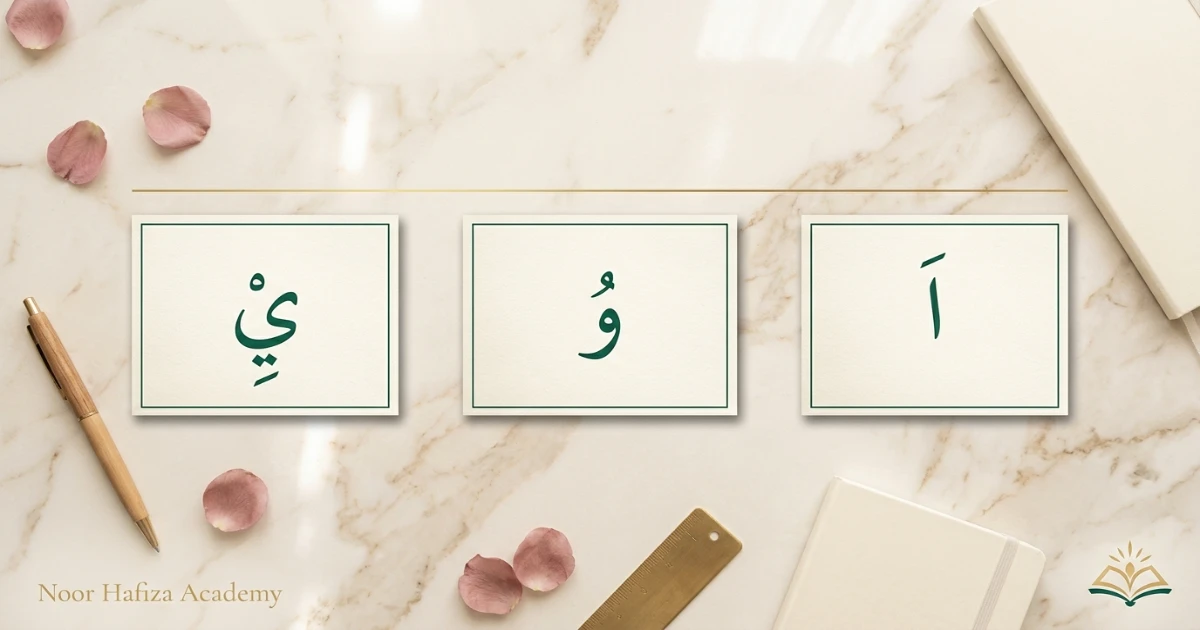
What beginners often confuse here
A Waw with a vowel is not the same as a Waw Madd. A Yaa with a vowel is not the same as a Yaa Madd. Likewise, a silent Waw or Yaa preceded by a fathah creates a soft lin sound rather than the normal long “oo” or “ee” of natural Madd. This distinction becomes important later when learning Madd Lin.
Madd Asli or Madd Tabi‘i: the natural two-count elongation
Madd Asli, also called Madd Tabi‘i, is the basic form of Madd. It is the foundation on which the other rules are understood. When one of the three Madd letters is present and there is no hamzah or permanent sukoon directly after it that creates another rule, the Madd is normally extended for two counts.
Madd Asli
Use two steady counts. Do not shorten it into a normal short vowel, and do not exaggerate it into four or six counts. Beginners should practise this rule until the two-count length becomes automatic.
Natural Madd appears extremely often in Quran recitation. That makes it more important than memorizing rare rule names at the beginning. A learner who can correctly identify and read natural Madd has already improved the rhythm and clarity of recitation significantly.
The sound should remain smooth. Counting is an internal measurement tool, not a reason to break one long vowel into separate beats. The ear should hear one continuous extended sound.
Main types of Madd a beginner should know
Tajweed books organize Madd in slightly different ways, but most beginner courses separate the basic natural Madd from secondary Madd caused by hamzah, sukoon, stopping, or special letter patterns. The following chart gives a practical overview for students learning the common Hafs ‘an ‘Asim recitation.
| Madd rule | What causes it? | Common beginner count | Simple clue |
|---|---|---|---|
| Madd Asli / Tabi‘i | A valid Madd letter without a stronger cause after it | 2 | The basic long vowel |
| Madd Badal | A hamzah comes before the Madd sound | 2 | Hamzah first, then Madd |
| Madd Wajib Muttasil | Madd letter followed by hamzah in the same word | 4–5 | Connected in one word |
| Madd Jaiz Munfasil | Madd at end of one word, hamzah at start of next | 4–5* | Separated across two words |
| Madd Lazim | A permanent sukoon follows the Madd letter | 6 | Necessary six-count Madd |
| Madd ‘Arid Lissukun | Stopping creates a temporary sukoon after the Madd letter | 2 / 4 / 6 | The rule appears because you stop |
| Madd Lin | Stopping after Waw/Yaa saakin preceded by fathah | 2 / 4 / 6 | Soft “aw/ay” sound when stopping |
| Madd ‘Iwad | Stopping on many words ending in fathatayn | 2 | Tanween fathah becomes an Alif-like stop |
*The exact permitted length for some secondary Madd forms can depend on the recitation route and teaching method. A beginner should follow the count used consistently by a qualified teacher.

Madd Wajib Muttasil: Madd and hamzah in the same word
Madd Wajib Muttasil occurs when a Madd letter is followed by a hamzah within the same word. The word muttasil means connected. For the common beginner teaching of Hafs ‘an ‘Asim, this Madd is usually taught as four or five counts, with the student following the consistent length used by the teacher.
How to identify Muttasil
Find a valid Madd letter. If a hamzah follows it in the same written word, the connected Madd rule applies. The most important beginner clue is not the shape of the word but the location of the hamzah relative to the Madd letter.
A frequent beginner error is reading Muttasil as only two counts because the student notices the long vowel but does not check the next letter. Another error is overextending the hamzah itself. The elongation belongs to the Madd vowel before the hamzah. The hamzah should still be pronounced clearly at the end of the stretch.
Madd Jaiz Munfasil: Madd and hamzah in separate words
Madd Jaiz Munfasil occurs when a word ends with a Madd sound and the next word begins with a hamzah. The word munfasil means separated. In the common Hafs teaching used in many beginner Tajweed programs, students are often taught a consistent four or five count length. Some recitation routes allow other lengths, which is one reason learners should not mix recordings and counting systems randomly.
How to identify Munfasil
The Madd is at the end of one word. The hamzah that affects it appears at the beginning of the next word. Because the cause is split across two words, beginners need to look beyond the current word before deciding the count.
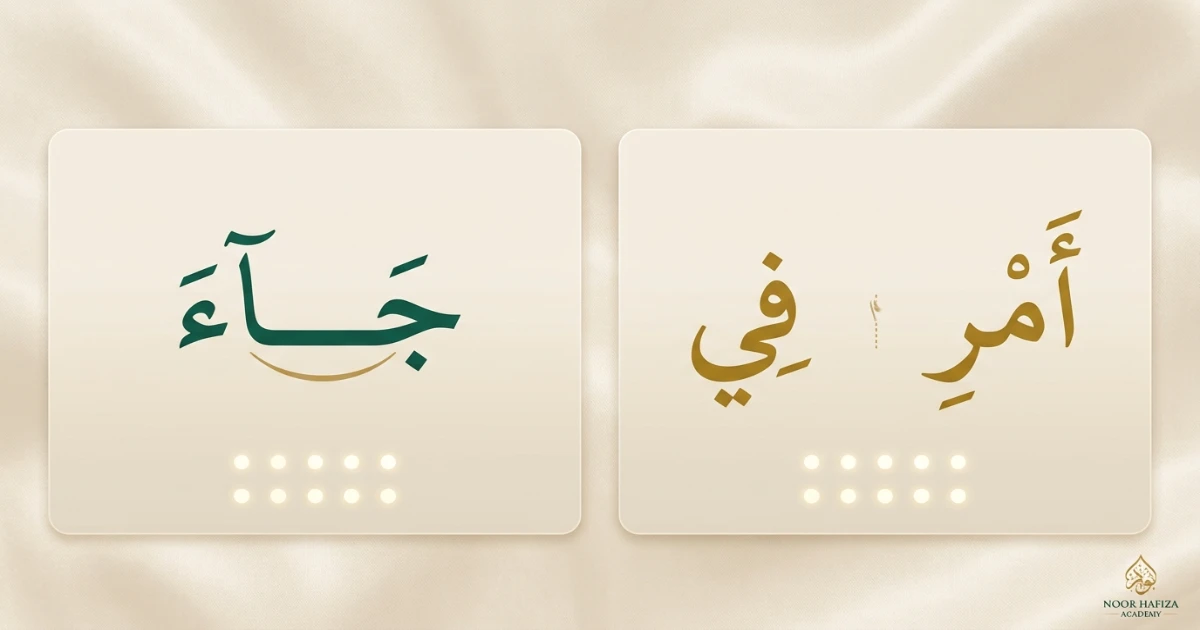
Muttasil: Madd + hamzah in the same word. Munfasil: Madd at the end of one word + hamzah at the beginning of the next word. Do not try to memorize the names without seeing this structural difference.
Madd Badal: when hamzah comes before the Madd sound
Madd Badal is different from Muttasil and Munfasil because the hamzah comes before the Madd sound rather than after it. In the common Hafs beginner approach, Madd Badal is generally read for two counts.
Beginner clue for Madd Badal
If you see or hear the hamzah first and then a Madd sound follows as part of the same word, ask whether the pattern is Madd Badal. A teacher will help students recognize its spelling forms inside the Mushaf.
Madd Lazim: the necessary six-count elongation
Madd Lazim occurs when a Madd letter is followed by a permanent sukoon. Unlike a temporary sukoon created only when stopping, the sukoon here belongs to the word or letter structure itself. Madd Lazim is read for six counts.
Why it is called “necessary”
The cause remains present whether you continue or stop. This makes the six-count elongation stable. Beginners usually meet Madd Lazim first in clear word examples, then later learn its detailed categories.
Advanced Tajweed texts divide Madd Lazim into types such as Kalimi Muthaqqal, Kalimi Mukhaffaf, Harfi Muthaqqal, and Harfi Mukhaffaf. For a beginner, the priority is to recognize the idea: a Madd sound is followed by a permanent sukoon or a structure that contains it, so the Madd is extended for six counts. The exact subcategory can be learned after the core rule is secure.
What about the disconnected letters at the beginning of some surahs?
The special letters at the beginning of some surahs, such as the letters in الم, have their own detailed Tajweed treatment. Several of these contain Madd Lazim Harfi patterns. Because the rules depend on how the letter names are pronounced, this area is better learned by listening directly to a qualified teacher rather than guessing from the printed letter alone.
Madd ‘Arid Lissukun: temporary sukoon when you stop
Madd ‘Arid Lissukun appears when you stop on a word and the final vowel becomes temporarily silent. If a Madd letter comes before that final letter, the stop creates a temporary sukoon after the Madd. This allows a choice of two, four, or six counts in the common Hafs recitation.
The rule depends on stopping
If you continue reading, the final letter keeps its normal vowel and the temporary Madd ‘Arid situation disappears. This is why a reciter must know whether she is stopping before deciding the Madd length.
Suppose a word ends with a normal vowel in connected recitation. When you stop, that final vowel is dropped and the letter becomes saakin for the stop. If a Madd letter is directly before it, the stopping rule can extend the sound. Beginners should practise the same word both in continuation and at a stop so the difference becomes audible.

Should a beginner switch between 2, 4, and 6 randomly?
No. Although the rule permits more than one length, beginners should learn consistency. During a single style of recitation or guided practice, it is better to use the length taught by the teacher rather than changing counts without awareness. Consistency trains the ear and prevents uncertain stretching.
Madd Lin: Waw or Yaa saakin preceded by fathah
Lin means softness or ease. Madd Lin is related to a silent Waw or Yaa preceded by a fathah, producing sounds similar to “aw” or “ay.” When stopping on a word where this pattern occurs before the final letter, the soft sound may be extended for two, four, or six counts, depending on the accepted stopping option being used.
Waw Lin
A Waw saakin preceded by fathah gives a soft “aw” sound. It is not the same as Waw Madd, which requires a dammah before the silent Waw.
Yaa Lin
A Yaa saakin preceded by fathah gives a soft “ay” sound. It is not the same as Yaa Madd, which requires a kasrah before the silent Yaa.
This distinction is a common test of whether the student understands the vowel conditions or is simply looking for the letters Waw and Yaa. Ask: what vowel comes before the silent Waw or Yaa? Dammah before Waw or kasrah before Yaa indicates normal Madd. Fathah before either one indicates Lin.
Madd ‘Iwad: the two-count replacement when stopping
Madd ‘Iwad is commonly taught as the elongation used when stopping on many words ending with fathatayn or tanween fathah. When stopping, the tanween sound is not pronounced as “an.” Instead, it is replaced by an Alif-like two-count sound.
Only when stopping
If you continue into the next word, you pronounce the tanween according to the normal Tajweed rule that follows. Madd ‘Iwad is specifically a stopping behavior.
There are exceptions and special spellings, especially around taa marbutah and some Quranic orthography. A beginner should not force Madd ‘Iwad onto every word that appears to end with fathatayn. Learn the common pattern first and let the teacher point out exceptions during real recitation.
Madd Silah: elongation linked to the pronoun Haa
A useful early-intermediate Madd topic is Madd Silah, which relates to the masculine singular pronoun هُ / هِ in specific connected conditions. When the pronoun Haa falls between two moving letters and the next letter is not hamzah, the short connecting sound is called Silah Qasirah and is generally read for two counts.
If a hamzah follows, the longer form is called Silah Kubra. Its length follows the relevant hamzah-based Madd approach used in the recitation route being taught. Because students can easily confuse an ordinary Haa with the pronoun Haa, this topic should be learned through actual Quran examples rather than by applying a rule to every ه.
A simple Madd decision process for beginners
Instead of memorizing isolated names, use a repeatable decision process. Every time you see a possible long vowel, move through the same questions.
Is there a valid Madd letter?
Check the vowel before Alif, Waw, or Yaa. If the condition is not met, do not automatically apply natural Madd.
What comes immediately after the Madd letter?
If nothing special follows, it is usually natural Madd for two counts. If hamzah or sukoon follows, continue checking.
If there is hamzah, where is it?
Hamzah in the same word points to Muttasil. Hamzah at the start of the next word points to Munfasil. Hamzah before the Madd sound may indicate Badal.
If there is sukoon, is it permanent or temporary?
A permanent sukoon can create Madd Lazim. A temporary sukoon caused by stopping can create Madd ‘Arid Lissukun.
Are you stopping on a Lin pattern?
Silent Waw or Yaa preceded by fathah may create Madd Lin when stopping.
Apply the count used by your teacher
Use one consistent system. Do not mix different recordings, qira’at, or recitation routes without understanding why their lengths differ.
Common Madd mistakes beginners make
1. Turning short vowels into Madd
A fathah, kasrah, or dammah by itself is short. Stretching every vowel makes words distorted and can affect pronunciation.
2. Ignoring the vowel before Waw or Yaa
The same letter can behave differently depending on the preceding vowel. This is the main difference between Madd and Lin.
3. Reading every Madd for two counts
Natural Madd is two counts, but Muttasil, Munfasil, Lazim, and stopping rules may require or allow longer lengths.
4. Stretching based on emotion or melody
A beautiful tone should sit inside the Tajweed rule. The rule should not be changed simply to make the recitation more dramatic.
5. Changing count in the middle of the stretch
The sound should be even from beginning to end. Do not accelerate or slow down halfway through one Madd.
6. Copying several reciters without a method
Different accepted recitation routes can use different lengths. A beginner needs one consistent model before comparing advanced variations.
7. Forgetting that stopping changes the word
Madd ‘Arid, Madd Lin, and Madd ‘Iwad depend on the stop. If you continue, another rule may apply.
8. Counting with the fingers but not the ear
Finger counting can help temporarily, but the long-term goal is to hear and feel the correct proportion without visible counting.
How to practise Madd rules without becoming overwhelmed
A common mistake in Tajweed study is trying to memorize every Madd category in one sitting. That usually creates rule recognition without stable recitation. A better approach is to build one layer at a time and apply each layer to real Quran reading.
Train the three Madd letters
Read short examples containing Alif after fathah, Waw saakin after dammah, and Yaa saakin after kasrah. Do not study secondary Madd yet.
Make two counts automatic
Practise Madd Asli in one short passage. Record yourself and check whether every natural Madd has approximately the same two-count proportion.
Compare Muttasil and Munfasil
Mark the hamzah in several examples. Say aloud whether it is in the same word or the next word before you recite.
Practise the six-count Lazim
Use a small set of teacher-approved examples. Focus on keeping six counts smooth rather than making the sound loud or dramatic.
Practise stopping Madd
Read the same words once in continuation and once while stopping. Listen for how Madd ‘Arid or Lin appears only in the stopping form.
Mix the rules slowly
Recite a short passage and identify the rule before each marked Madd. Accuracy is more important than reading speed.
Recite without labels
Now read naturally without naming each rule aloud. The goal is to transfer knowledge from conscious analysis into fluent Quran recitation.

How do you count 2, 4, 5, and 6 counts in Madd?
Counting should be proportional and steady. Imagine a regular pulse at your current recitation speed. A two-count Madd occupies two equal units. A four-count Madd is twice that length. Five counts adds one more equal unit, and six counts is three times the basic two-count Madd.
Beginners can use finger taps, light hand movement, or silent internal counting for a short training period. However, the best long-term method is listening and repetition with correction. Tajweed is an oral science. A student can understand the written definition perfectly and still make the Madd too short, too long, uneven, nasalized, or disconnected from the following letter.
Do not use one fixed number of seconds for Madd. Tajweed counts are relative units. The same reciter may read more slowly in teaching mode and more quickly in normal recitation while preserving the correct relationship between the lengths.
How to hear the difference between Madd lengths
Train your ear before expecting perfect production. Listen to one short example of a two-count Madd and one six-count Madd from the same teacher or reciter. Do not compare examples from multiple reciters at different speeds. Repeat the pair several times until the longer Madd feels clearly proportional rather than simply “more stretched.”
Next, shadow the recitation. Shadowing means listening to a short phrase and repeating immediately with the same pace and elongation. Keep the phrase short enough that you remember the sound accurately. Over time, move from imitation to reading the same phrase directly from the Mushaf.
Recording yourself is especially useful because Madd errors can feel correct while you are reciting. On playback, a natural Madd that was accidentally stretched to four counts becomes much easier to notice. A teacher can then compare your recording with the target and give one precise correction.
How Madd works together with Ghunnah, Qalqalah, and stopping rules
Tajweed rules do not operate in isolation. A word can contain Madd and another rule nearby. For example, a Madd sound may be followed later by a letter requiring Ghunnah or Qalqalah. The correct response is not to blend the rules together. Each rule keeps its own sound quality and timing.
Ghunnah is a nasal sound associated especially with Noon and Meem in certain conditions. Madd is vowel elongation. A long vowel should not become nasal simply because a Ghunnah rule appears later. Similarly, Qalqalah creates a controlled echo-like bounce on specific letters when they are saakin; it is not a Madd and should not be stretched like a long vowel.
Stopping rules are especially important because they can create new sukoon. This is why a student who only studies words in isolation may miss what changes at the end of an ayah. Practising both wasl (continuation) and waqf (stopping) helps Madd rules become practical rather than theoretical.
How to teach Madd rules to children
Children usually learn Madd more successfully through sound patterns before technical terminology. Start with the three Madd letters and use a simple visual count. A child can hold up two fingers for natural Madd, then compare it with a six-count Madd using a slow, even hand movement. Once the ear recognizes the difference, attach the Arabic rule name.
Avoid giving a young learner a full chart of every Madd subtype before she can reliably read basic long vowels. Too much terminology can make Quran reading feel like a memory test. A better sequence is: identify the letter, hear the sound, copy the sound, use the count, then learn the rule name.
Parents can help by listening for one target at a time. If the weekly goal is natural Madd, do not correct every Tajweed issue in the same practice session. Ask the teacher which rule should receive priority and use the same counting language at home.
Beginner Madd checklist before moving to advanced Tajweed
- I can name the three Madd letters and their vowel conditions.
- I can read Madd Asli for a consistent two counts.
- I can tell Waw Madd from Waw Lin.
- I can tell Yaa Madd from Yaa Lin.
- I check whether hamzah is in the same word or the next word.
- I know that Madd Lazim is a six-count Madd in the common Hafs teaching.
- I understand that stopping can create Madd ‘Arid Lissukun.
- I understand that Madd Lin is usually discussed in connection with stopping.
- I can keep a long Madd smooth without breaking the sound.
- I follow one consistent count system taught by my teacher.
Why Madd is easier to learn with live correction
Written guides are useful for understanding the structure of Madd rules, but they cannot fully replace listening and correction. A student may identify Muttasil correctly and still pronounce it at an uneven length. Another student may count six correctly but alter the quality of the vowel. A live teacher can hear those details immediately.
A qualified Tajweed teacher can also keep the student on one coherent recitation method. This matters because accepted recitation routes can differ in the length of some secondary Madd forms. When beginners collect rules from random videos, they may think two teachers contradict each other when they are actually using different recognized transmission options.
Noor Hafiza Academy offers live online Quran and Tajweed learning with female Quran teachers for children, girls, women, sisters, beginners, and students improving their recitation.
FAQs about Madd rules in Tajweed
What is Madd in Tajweed?
How many counts is normal Madd?
What are the three Madd letters?
What is the difference between Madd Muttasil and Madd Munfasil?
How long is Madd Muttasil?
How long is Madd Munfasil?
What is Madd Lazim?
What is Madd ‘Arid Lissukun?
What is Madd Lin?
What is Madd Badal?
What is Madd ‘Iwad?
Why do some teachers give different Madd counts?
Can I learn Madd rules without a teacher?
What should I learn after Madd?
Learn Madd with a clear count, a trained ear, and recitation you can repeat confidently
Start with the three Madd letters, build a reliable two-count natural Madd, then learn how hamzah, permanent sukoon, and stopping change the elongation. Noor Hafiza Academy can help learners practise these rules live with a female Quran teacher.