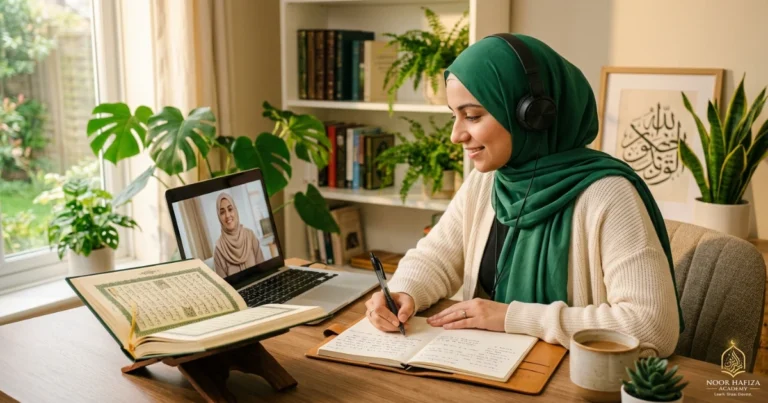
How Women Can Restart Quran Reading After a Long Gap

Women who have not read the Quran regularly for months or years often believe they must “start from zero,” hide their mistakes, or wait until life becomes less busy. A better approach is to restart from the level that exists today. Some women need only a short fluency review. Others need to revisit joined letters, vowels, sukoon, shaddah, Makharij, stopping, or basic Tajweed. The safest path is a calm assessment, a small daily practice routine, and guided correction from a qualified female Quran teacher. Progress should be measured by accuracy, independence, confidence, and consistency—not by how quickly pages are completed.
How can a woman restart Quran reading after a long gap?
Begin with a calm level assessment rather than restarting blindly from the first Qaida page or jumping directly into long Quran passages. Read a short familiar passage and a short unfamiliar passage to identify whether the main difficulty is letter recognition, joined forms, vowels, sukoon, shaddah, fluency, Makharij, Tajweed, stopping, or confidence. Repair only the weak foundations, then use a short daily routine—often 10 to 15 minutes—supported by one or more live lessons each week with a qualified female Quran teacher. Read slowly, allow correction, repeat difficult words, test unfamiliar text, and track progress by fewer errors and prompts rather than pages completed. A woman returning after years away does not need to feel embarrassed; she needs a suitable starting point, manageable practice, and consistent support.
Why women often delay returning to Quran reading
A long gap can create more emotional difficulty than academic difficulty. A woman may remember reading well as a child and feel discouraged when familiar words now require effort. She may compare herself with relatives, daughters, friends, or an earlier version of herself. She may fear that a teacher will judge her or ask why she stopped.
Life circumstances also matter. Marriage, motherhood, caregiving, work, relocation, illness, grief, study, household responsibility, or lack of female-teacher access can interrupt regular learning. The goal of a restart plan is not to investigate every past reason before allowing progress. It is to create a respectful route back from the situation that exists now.
Many returning women still recognize letters, remember common Surahs, understand basic symbols, or respond quickly once a teacher provides the right cue. Assessment helps separate forgotten skills from buried skills.
Another common delay is perfectionism. Some women believe they should first improve privately before reading to a teacher. This often strengthens incorrect habits because there is no reliable correction. A teacher is not the final exam; she is part of the learning process.
Start with an honest Quran reading level assessment
The assessment should feel respectful and practical. It is not designed to embarrass the learner or force her to restart every lesson she once studied. A useful assessment normally includes a short conversation and several reading samples.
Learning history
Share when you last studied, which books you used, whether you read from the Mushaf, and what feels difficult now.
Familiar passage
Read a Surah or passage you know to observe confidence, flow, stopping, and remembered Tajweed.
Unfamiliar passage
Read a short new section to reveal decoding, vowel recognition, guessing, and prompt dependence.
Foundation check
When needed, review joined letters, vowels, sukoon, shaddah, madd, and basic blending.
Pronunciation check
The teacher listens for recurring Makharij or sound-quality issues that affect several words.
First milestone
Choose one realistic starting target instead of trying to repair everything in the first week.

Should an adult woman restart Noorani Qaida from the beginning?
Not always. Some women need a full foundational restart, but many need only a targeted review. Returning automatically to page one can feel discouraging and may waste time when the learner already recognizes letters and basic symbols.
| Current evidence | Likely starting point | What to review | Progress check |
|---|---|---|---|
| Letters are frequently confused | Foundational Qaida review | Isolated and joined forms, similar shapes and sounds | Mixed-letter recognition without prompts |
| Letters are known but blending is weak | Intermediate Qaida review | Vowels, sukoon, shaddah, joined reading, word building | Unfamiliar word decoding |
| Quran is readable but very slow | Direct Quran reading with targeted repair | Phrase flow, stopping, repeated symbol errors | Controlled unfamiliar passage |
| Reading is fluent but Tajweed is weak | Tajweed correction route | Makharij, timing, ghunnah, qalqalah, heaviness and stopping | Application in connected recitation |
| Only memorized Surahs sound fluent | Reading assessment route | Independent decoding from unfamiliar Quran text | Short new passage without prior model |

Step-by-step Quran reading restart plan for women
Choose one clear goal
Decide whether the immediate priority is accurate reading, confidence, Tajweed repair, fluency, Hifz revision, or a complete beginner restart.
Complete a live level check
Read familiar and unfamiliar material to a qualified female teacher and identify recurring patterns.
Repair the smallest missing foundation
Review only the letters, symbols, pronunciation, or rule application that blocks progress.
Create a short daily routine
Use a realistic practice window connected to an existing habit such as after Fajr, after school drop-off, or before sleep.
Read independently before listening
Attempt the word or line first so the teacher can see your actual reading rather than your ability to imitate.
Record recurring corrections
Keep a short list of two or three priority issues instead of collecting every mistake.
Test unfamiliar text
Use a fresh passage regularly to check whether the skill transfers beyond familiar pages.
Review progress after four weeks
Compare errors, prompts, fluency, confidence, and consistency before changing the plan.

Why returning women should focus on accuracy before fluency
Speed can create the feeling of progress while hiding guessing, missed vowels, added sounds, weak shaddah, or incorrect stopping. Slow, controlled reading gives the teacher and learner enough time to hear what is actually happening.
This does not mean reading should remain painfully slow forever. Fluency grows when accurate patterns become familiar. The first stage is controlled accuracy; the next stage is smoother phrase reading; later stages include better stopping, Tajweed consistency, and confidence in unfamiliar passages.
Letters, vowels, sukoon, shaddah, and word endings are stabilized.
The learner reads complete words without adding, dropping, or guessing.
Words are connected into short meaningful reading units.
Tajweed, stopping, and unfamiliar reading become more consistent.
How to rebuild Tajweed after years away
Returning learners often remember rule names but cannot apply them consistently. Others apply some rules naturally without remembering the terminology. The teacher should begin with the sound and the recurring reading pattern, then add terminology only when it helps.
| Priority area | Common returning-learner issue | Teacher response | Progress evidence |
|---|---|---|---|
| Makharij | Similar letters merge or are produced from a familiar-language position | Isolate the sound, use a simple mouth-position cue, return to the word | Correct sound appears in fresh words |
| Short and long vowels | Short vowels are stretched or madd is shortened | Contrast timing with clear examples | Timing remains stable in connected reading |
| Sukoon | An extra vowel is added after the consonant | Practise clean closure and word connection | No added sound in unfamiliar examples |
| Shaddah | Doubling is weakened or missed | Separate the two-part action and rebuild the word | Shaddah remains audible across passages |
| Ghunnah and qalqalah | Sound is absent, exaggerated, or applied in the wrong place | Use short target practice within real Quran words | Balanced application without prompting |
| Stopping | Stops change word endings or occur at unsuitable places | Teach practical stopping and restart choices | Cleaner endings and more controlled phrasing |

How much should a woman practise when restarting?
A restart routine should be small enough to survive ordinary life. A plan that works only during a highly motivated week is not yet sustainable. Many women benefit from 10 to 15 minutes of focused practice on most days, combined with one or more live lessons each week according to need.
A simple 15-minute practice structure
- Two minutes: open the correct page, review the teacher’s priority, and remove distractions.
- Five minutes: read the assigned words or lines slowly without listening first.
- Three minutes: repeat the two or three most difficult words or sounds.
- Three minutes: read a short unfamiliar line to test independence.
- Two minutes: note one success and one issue to ask the teacher.
More time is not always better. Fatigued repetition can strengthen errors. Stop when attention and hearing become unreliable, then return at the next planned time.
A gentle 30-day Quran reading restart plan
| Week | Main goal | Home practice | Teacher check |
|---|---|---|---|
| Week 1 | Assessment and routine setup | Short familiar and unfamiliar reading; prepare a fixed practice time | Identify current level and first two priorities |
| Week 2 | Foundation repair | Target letters, symbols, or recurring pronunciation issues | Confirm correction in fresh examples |
| Week 3 | Controlled Quran reading | Short phrases, stopping, and one unfamiliar passage | Track fewer prompts and repeated errors |
| Week 4 | Consistency and next plan | Repeat successful routine and review weak areas | Compare baseline, accuracy, confidence, and next milestone |

What to look for in a female Quran teacher for adult women
A returning adult needs a teacher who can correct accurately without treating her like a child. The teacher should respect the learner’s life experience while remaining honest about the reading level.
Accurate recitation
The teacher models letters, timing, Tajweed, and stopping clearly and consistently.
Adult teaching experience
She understands embarrassment, confidence, busy schedules, and the need for practical explanations.
Diagnostic listening
She identifies the cause of difficulty instead of saying only that the learner needs more practice.
Respectful correction
She corrects clearly without shame, comparison, sarcasm, or unnecessary pressure.
Realistic planning
The lesson frequency and homework fit work, family, health, and current energy.
Progress evidence
The teacher tracks accuracy, prompts, fluency, Tajweed transfer, and consistency.
Can a woman restart Quran reading through self-study alone?
Self-study can support routine, listening, review, and confidence, but it has limits. A learner may not hear her own added vowels, incorrect articulation, shortened madd, missed shaddah, or stopping habits. Recordings can provide models, yet they cannot diagnose the reason for a repeated error or decide which correction should come first.
A balanced approach uses live teaching for assessment and correction, then self-practice between lessons. The teacher protects accuracy; the learner’s daily routine builds familiarity and confidence.
Attempt first, compare carefully, note the difference, and bring recurring issues to the teacher.
How to return without shame, fear, or comparison
Embarrassment becomes smaller when the learning plan becomes specific. “My Quran is weak” feels overwhelming. “I need to review joined letters and shaddah for four weeks” feels manageable.
- Use private one-to-one lessons when group reading creates anxiety.
- Tell the teacher that the goal is a respectful restart after a long gap.
- Do not compare your pace with daughters, friends, or social media learners.
- Track small evidence: fewer prompts, one clearer sound, a stable routine, or a new line read independently.
- Allow mistakes to become information rather than proof that you cannot learn.
- Choose a teacher who can maintain both kindness and accurate correction.
Confidence should grow from evidence. Encouragement is important, but the deepest confidence comes when the learner can read something today that she could not read independently several weeks earlier.
How to restart Quran reading with work, children, or caregiving
A woman does not need an empty schedule before she begins. She needs a protected minimum routine. The most successful time is often not the most ideal time on paper; it is the time that can be repeated.
| Life situation | Possible routine | Main risk | Useful adjustment |
|---|---|---|---|
| Young children at home | Short practice during nap, quiet play, or after bedtime | Frequent interruption | Use a 10-minute minimum and keep material ready |
| Full-time work | Early morning, lunch break review, or evening lesson | Mental fatigue | Choose shorter lessons on predictable days |
| Caregiving responsibilities | Flexible weekly lesson plus brief daily reading | Unplanned schedule changes | Confirm makeup and rescheduling policies |
| Irregular shifts | Rotating teacher slots or weekend review | Loss of continuity | Protect a minimum number of weekly contacts |
| Low energy or health recovery | Five-minute reading plus listening and one weekly lesson | Overambitious goals | Track consistency before volume |
How women should measure Quran reading progress after restarting
Progress should be visible enough to encourage the learner and guide the teacher. It does not require complicated scores.
Letters, vowels, shaddah, sukoon, and endings become more reliable.
The learner reads before hearing the teacher and needs less first-sound help.
Reading includes fewer unnecessary pauses and restarts.
Practice and live lessons continue across ordinary busy weeks.
A monthly review can compare one familiar passage, one unfamiliar passage, recurring Tajweed issues, practice frequency, and confidence. This provides a clearer picture than counting pages alone.

Mistakes to avoid when restarting Quran reading
Waiting to feel ready
Confidence often comes after several supported lessons, not before the first one.
Restarting everything blindly
A full beginner restart may waste time when only a few foundations are weak.
Reading too fast
Speed can hide guessing, missed symbols, and incorrect word endings.
Using only familiar Surahs
Memorized passages may hide decoding weakness and prompt dependence.
Collecting too many corrections
Trying to fix every Tajweed issue at once can reduce confidence and transfer.
Choosing unrealistic homework
Long assignments are often abandoned after a busy week.
Comparing with younger learners
Adults bring different responsibilities, strengths, and learning histories.
Ignoring teacher fit
A knowledgeable teacher may still be unsuitable if communication, pace, or respect is poor.
Questions to ask before joining an online Quran class for women
Use these questions during an assessment or trial
- Will you assess familiar and unfamiliar Quran reading?
- Do I need a full Qaida restart or only targeted review?
- What are my first two reading or Tajweed priorities?
- How much experience does the female teacher have with adult returners?
- How will corrections be explained and recorded?
- What lesson length and weekly frequency fit my level?
- How much home practice is realistic?
- How will unfamiliar reading and reduced prompting be measured?
- When will my first progress review take place?
- Can the schedule change when work or family responsibilities shift?
- What happens if the teacher and learner are not a suitable match?
- What are the current fees, privacy, absence, and rescheduling policies?
Online Quran restart classes for women with female teachers
Noor Hafiza Academy offers live online Quran classes for women, sisters, girls, adults, beginners, returning readers, Tajweed students, and Hifz learners with female Quran teachers. A restart plan can begin with a private level assessment and may include targeted Noorani Qaida review, Quran reading, fluency, Makharij, Tajweed, Hifz revision, or Islamic Studies.
Women can share their current reading confidence, previous learning, last regular study period, work or family schedule, city and time zone, preferred lesson length, and immediate goal. Current female-teacher qualifications, availability, schedules, trial arrangements, fees, privacy practices, policies, and enrollment terms should be confirmed directly.
Share your previous Quran experience, current difficulty, preferred schedule, time zone, learning goal, and whether you want reading, Tajweed, Qaida review, or Hifz revision.
FAQs about restarting Quran reading after a long gap
How do I start reading Quran again after many years?
Do I need to restart Noorani Qaida from the beginning?
Is it embarrassing to relearn Quran reading as an adult?
How much should I practise each day?
Can I restart Quran reading through online classes?
Should I focus on Tajweed or fluency first?
Can I learn with a female Quran teacher?
How long will it take to read Quran fluently again?
What should I read during the first week?
Can listening to recitation help me restart?
How can I stay consistent with children and work?
How will I know that I am improving?
Return to Quran reading with a calm assessment and a plan you can sustain
Share your previous Quran experience, current reading difficulty, preferred female teacher, city and time zone, available days, family or work schedule, and whether you need Qaida review, reading, Tajweed, fluency, or Hifz revision.