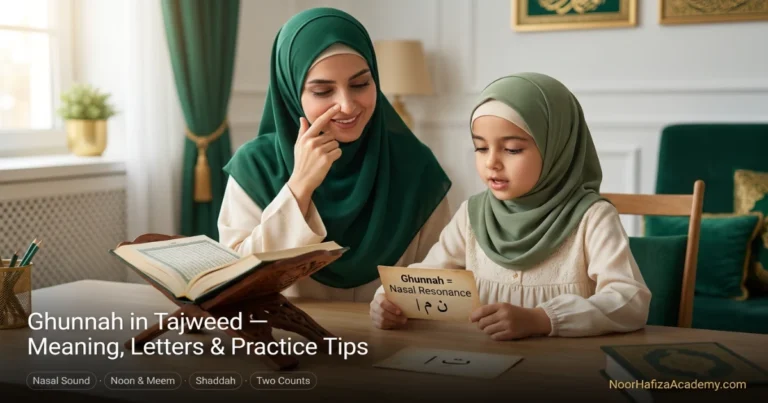
Online Quran Classes for Girls with Female Teachers: Parent Guide

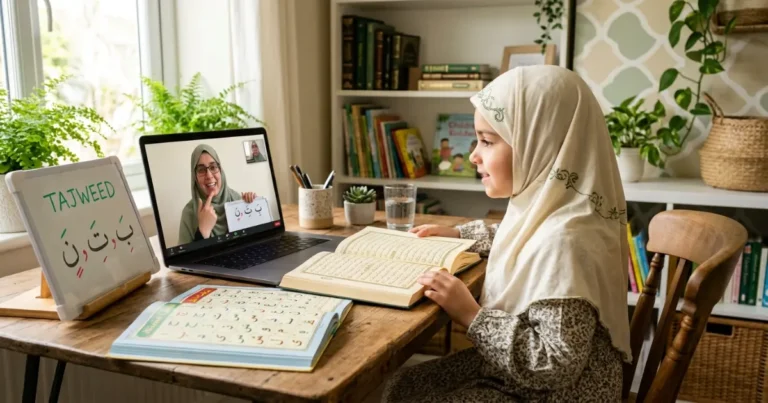
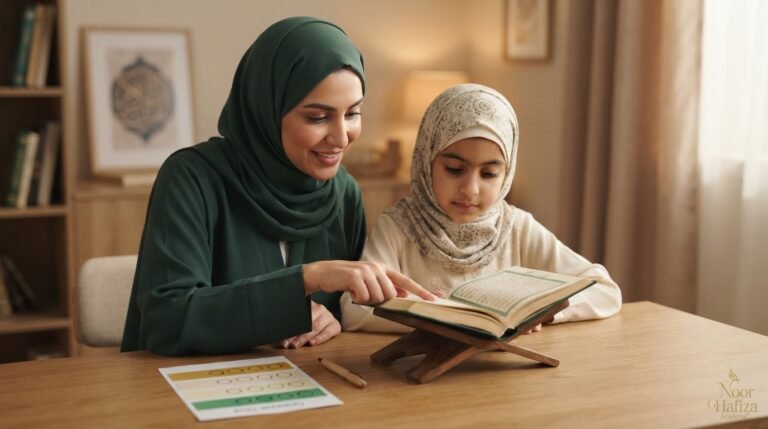
Online Quran classes for girls with female teachers can give families access to live Quran instruction without travel while allowing girls to learn in a familiar home environment. A suitable program may offer Noorani Qaida, Quran reading, Tajweed, Hifz, revision, Islamic Studies, and beginner support through private or small-group lessons. For many parents, a female teacher can make communication, privacy, modesty, and age-sensitive guidance easier—especially as girls grow older. However, the teacher’s gender alone does not prove quality. Parents should also evaluate recitation accuracy, teaching experience, safeguarding, lesson structure, schedule, technology, parent communication, and measurable Quran progress.
Are online Quran classes with female teachers a good option for girls?
Yes, online Quran classes with female teachers can be a strong option for girls when the teacher is qualified, the class is safe, the course matches the learner’s level, and progress is reviewed. Benefits may include privacy, comfort asking questions, access to female teachers beyond the local area, flexible scheduling, no commute, one-to-one attention, parent visibility, and continuity during travel or relocation. Parents should still verify the teacher’s Quran recitation, Tajweed knowledge, experience with the girl’s age and course, communication style, safeguarding practices, technology, attendance policy, homework expectations, and progress-report system. A trial class should show whether the girl understands the teacher, reads independently, accepts correction, feels respected, and receives a realistic learning plan.
Why parents choose online Quran classes for girls
Families choose online Quran learning for different reasons. Some live far from a suitable madrasa. Some need a female teacher who is not available locally. Others need a schedule that fits school, homework, sports, work shifts, prayer, meals, and bedtime. A girl may also need private correction because she feels shy in a large group or has a specific reading or Tajweed weakness.
Online learning can expand the teacher pool. Parents are no longer limited to the nearest class. They can look for a teacher whose recitation, language, age experience, personality, and course expertise match the learner. This can be especially helpful for girls who need a teacher experienced in Noorani Qaida, Quran reading, Tajweed, Hifz, revision, or adult-beginner support.
It is the ability to create a sustainable learning arrangement in which the girl receives accurate instruction, enough independent recitation, respectful correction, family-visible support, and measurable progress.
Parents should avoid assuming that every online class is private, flexible, or child-friendly. The actual teacher, class size, lesson length, technology, academy policies, and progress system determine the quality of the experience.
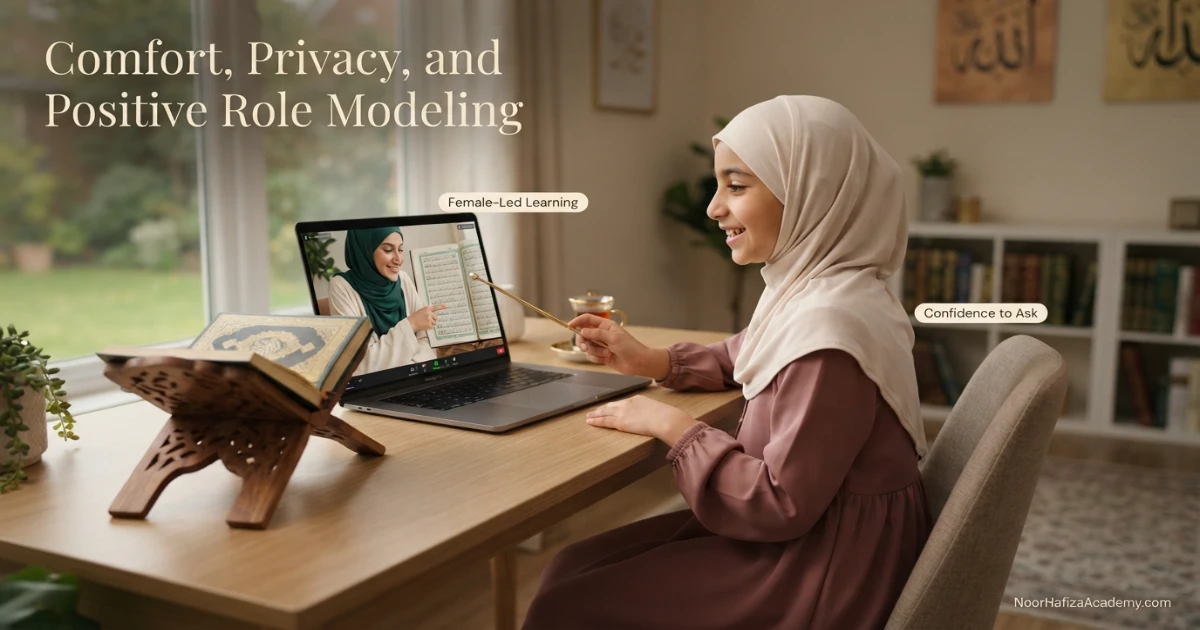
Why a female Quran teacher may be especially suitable for girls
Comfort and privacy
Many girls feel more comfortable reciting, asking questions, and discussing learning concerns with a female teacher.
Age-sensitive communication
A suitable female teacher may understand how communication needs change from early childhood to adolescence.
Positive role modeling
A knowledgeable, respectful female teacher can model disciplined learning, adab, consistency, and confidence.
Parent reassurance
Families may feel more comfortable with a women-led teaching environment and parent-visible communication.
Questions without embarrassment
Older girls and women may find it easier to ask course or practical questions within a female learning relationship.
Long-term continuity
A girl may be able to continue with female instruction as she moves from Qaida into reading, Tajweed, Hifz, or advanced study.
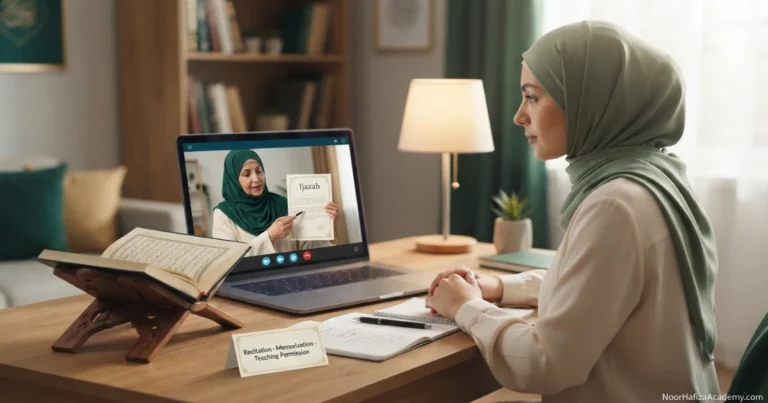
Teacher gender should be one selection factor, not the only factor. Parents should also verify the teacher’s Quran accuracy, teaching skill, course experience, reliability, online competence, and safeguarding awareness. The guide on online Quran teacher qualifications explains what to check.
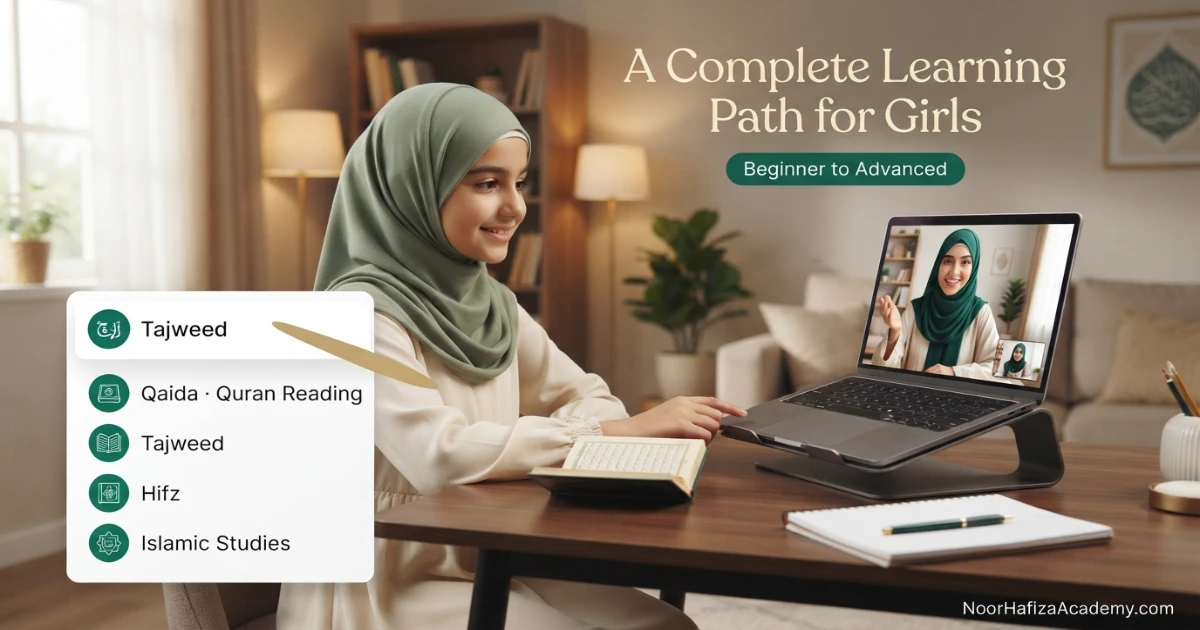
What can girls learn in online Quran classes?
| Course | What the girl learns | Teacher should track | Suitable for |
|---|---|---|---|
| Noorani Qaida | Letters, joined forms, vowels, sukoon, shaddah, long-vowel foundations, and blending | Independent recognition and unfamiliar decoding | Complete beginners and learners rebuilding foundations |
| Quran reading | Accurate word reading, phrase flow, stopping, fluency, and confidence | Errors, prompts, unfamiliar text, and independence | Qaida graduates and returning readers |
| Tajweed | Makharij, Sifat, timing, ghunnah, qalqalah, stopping, and rule application | Correction transfer into connected recitation | Readers who want greater accuracy |
| Hifz | New memorization, recent revision, older revision, joins, and retention | Sabaq, sabqi, manzil, prompts, and random starts | Beginners, partial Hifz, and full memorization routes |
| Quran revision | Repair of weak Surahs, fluency, Tajweed, and retained memorization | Weak passages and delayed retention | Students returning after a break |
| Islamic Studies | Beliefs, worship, manners, stories, duas, and practical understanding | Comprehension and age-appropriate application | Children, teens, and family learning plans |
Should girls take private or group Quran classes?
One-to-one classes and group classes can both work, but they create different learning conditions. A private lesson often provides more independent recitation, targeted correction, flexible pacing, and privacy. A small group can add peer motivation, shared activities, and a sense of belonging.
| Factor | One-to-one class | Small group class | Parent decision |
|---|---|---|---|
| Teacher attention | Focused on one learner | Shared between students | Ask how much independent recitation each girl receives |
| Pace | Can follow the exact learner | Must balance group levels | Check whether students are grouped appropriately |
| Confidence | Private correction may reduce embarrassment | Peers may encourage participation | Consider the girl’s personality and class culture |
| Social learning | Limited peer contact | Shared routine and discussion | Meet community needs elsewhere if private |
| Scheduling | Often more flexible | Usually fixed | Choose the schedule the family can sustain |
| Specific weakness | Strong for targeted correction | May provide less individual repair time | Use private lessons when diagnosis is the priority |
The best format depends on the learner rather than a universal rule. A shy girl may flourish privately, while another may gain motivation from a carefully managed girls-only group.
How parents can create a safe online Quran class for girls
Online learning gives parents useful visibility, but safety should still be structured. Families need to know who teaches, how the child joins, who can communicate with her, whether lessons are recorded, and how concerns are reported.
Parent safety checklist
- Confirm the female teacher’s identity and academy role.
- Keep scheduling and feedback in parent-visible communication channels.
- Use an appropriate shared family learning space for younger girls.
- Confirm camera, microphone, messaging, and recording policies.
- Ask who can access lesson links and student information.
- Know how to report a concern or request a teacher change.
- Confirm whether the same teacher will continue after the trial.
- Review the academy’s absence, makeup, and privacy procedures.

How to choose a female Quran teacher for your daughter
Parents should match the teacher to the girl’s age, current level, course, language, confidence, and learning goal. The most impressive profile is not always the best fit.
Verify recitation and course knowledge
The teacher should model accurately and understand the Qaida, reading, Tajweed, Hifz, or Islamic Studies level she teaches.
Review relevant experience
Ask about experience with girls of the same age, course, confidence, language, and attention profile.
Observe communication
The girl should understand instructions and receive calm, specific correction without shame or confusion.
Check lesson structure
The student should read independently, receive correction, retry, and apply the skill in a new example.
Confirm reliability and safety
Review punctuality, communication, privacy, attendance, replacement, and academy oversight.
Request a clear learning plan
The trial should end with the level, course, lesson length, frequency, homework, and next review.
How online Quran classes should change as girls grow
Simple instructions, letter recognition, sound practice, movement breaks, and nearby parent support.
Qaida completion, unfamiliar reading, short assignments, and consistent correction.
Quran fluency, Tajweed targets, Hifz revision, self-correction, and clearer progress goals.
Respectful communication, collaborative goals, deeper Tajweed, Hifz, revision, and Islamic Studies.
A teacher who works well with a five-year-old may not automatically be the best choice for a teenager. Parents should reassess teacher fit, lesson length, course goals, and privacy as the girl matures.
How to choose the best Quran class schedule for school-age girls
The best schedule is one the girl can attend with enough energy and the family can maintain without regular conflict. A theoretically ideal teacher at a poor time may produce weak focus, lateness, and resistance.
| Time option | Possible advantage | Possible challenge | Best use |
|---|---|---|---|
| After school | Fits weekday routine | The girl may be hungry or mentally tired | Allow food, prayer, rest, or movement first |
| Early evening | Homework may already be organized | Can conflict with dinner or bedtime | Use a short predictable slot |
| Weekend morning | Often better energy and less school pressure | Family activities may interrupt | Protect the same weekly time |
| Weekend afternoon | More flexibility for longer Hifz review | Social plans or tiredness | Schedule before the day becomes unstructured |
| Short frequent classes | Supports young attention and regular contact | Requires more weekly coordination | Qaida, reading repair, and early Hifz |
| Longer fewer classes | May suit older girls and detailed study | Fatigue and weaker continuity | Teens, adults, advanced Tajweed, or review |
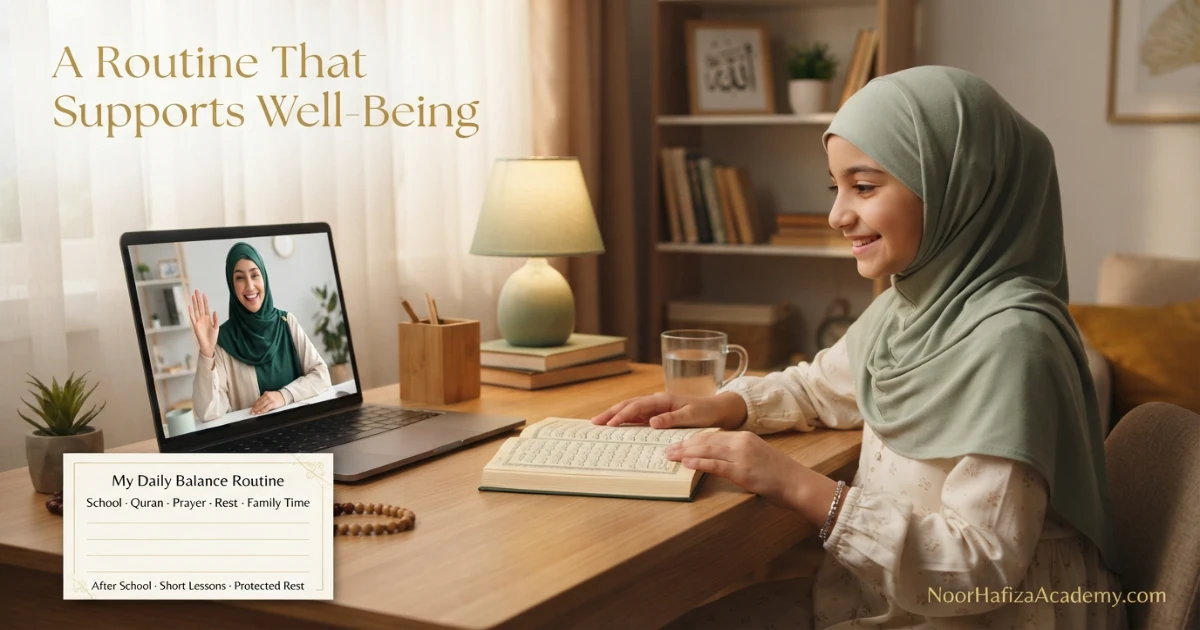
What girls need for a focused online Quran lesson
The home setup does not need to be expensive, but it should support attention, audio clarity, modesty, and preparation.
- A stable laptop or tablet positioned at a comfortable height
- Reliable internet and clear microphone or headphones where needed
- A quiet, well-lit, family-appropriate learning space
- The correct Qaida, Mushaf, notebook, pencil, and assigned material
- Notifications, television, toys, and unrelated browser tabs removed
- A parent nearby for younger girls without answering for them
- A predictable five-minute preparation routine before class
Parents should test the microphone before Tajweed or pronunciation lessons. A teacher cannot assess subtle recitation accurately through distorted sound.
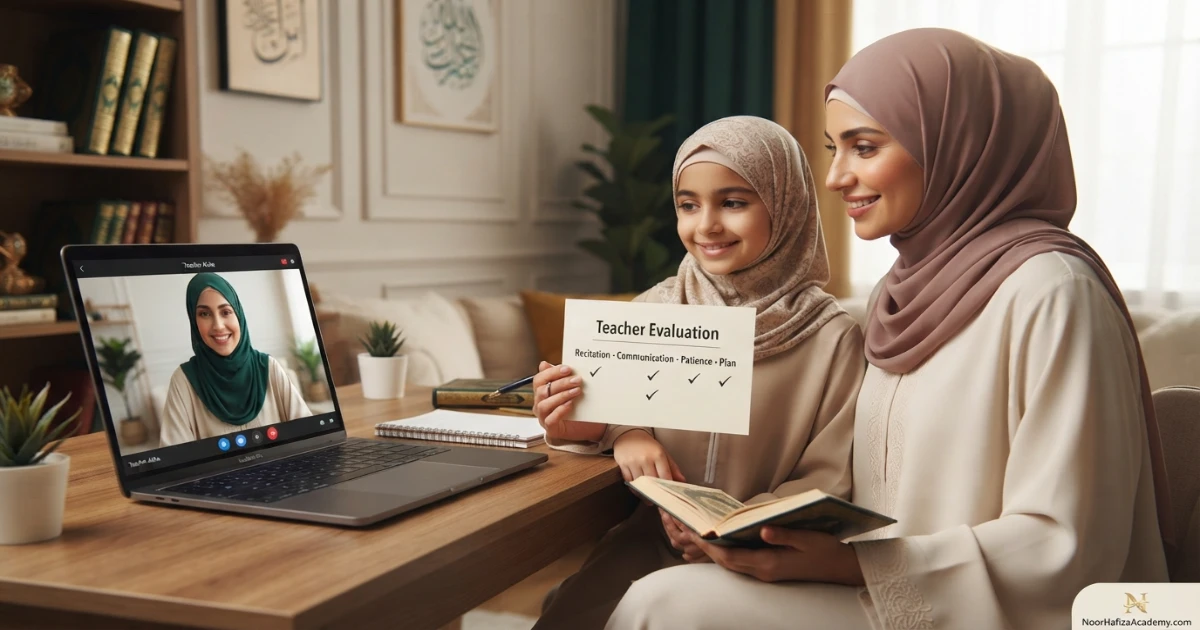
What parents should evaluate in a free trial Quran class for a girl
A trial should show how the teacher assesses, communicates, corrects, and plans—not only how warmly she greets the family.
| Area | Strong evidence | Weak evidence | Parent question |
|---|---|---|---|
| Comfort | Girl can attempt, make mistakes, and retry | She appears fearful or completely confused | Can confidence grow with this teacher? |
| Assessment | Teacher hears independent reading | Placement is based only on parent description | Does the starting level make sense? |
| Correction | Specific explanation, model, retry, and transfer | Teacher says only “wrong” or supplies every answer | Will this method build independence? |
| Communication | Age-appropriate and respectful | Instructions are too technical or childish | Does the girl understand clearly? |
| Plan | Course, schedule, homework, and review are explained | Generic recommendation | Is the next step realistic? |
Use the complete free trial Quran class checklist before enrollment.
How parents should receive progress updates
Parents should receive more than “she is doing well.” A progress report should explain the current level, stable strengths, priority weakness, attendance, homework, independent performance, and next target.
Current level
Where the girl is in Qaida, reading, Tajweed, Hifz, revision, or Islamic Studies.
Stable strengths
Skills she can perform accurately without repeated prompts.
Priority weakness
The most important issue the teacher will address next.
Evidence
Examples from unfamiliar reading, delayed recall, prompts, or correction transfer.
Home practice
A clear, manageable assignment with the expected parent support level.
Next review
When the academy will check whether the plan is producing improvement.

What parents should do without taking over the lesson
Parents should
- Prepare the device and materials.
- Protect the class time from interruptions.
- Remain nearby when age or safety requires it.
- Support a short home-practice routine.
- Read teacher feedback and ask questions.
- Report schedule, attention, or motivation concerns early.
Parents should avoid
- Whispering every answer.
- Correcting over the teacher.
- Comparing the girl with siblings or classmates.
- Threatening consequences during recitation.
- Demanding page completion over accuracy.
- Changing teachers after one ordinary difficult lesson.
Common parent concerns about online Quran classes for girls
Will online classes provide enough discipline?
Discipline comes from clear expectations, reliable attendance, prepared lessons, teacher consistency, and family routine—not from physical location alone. A private online class can be highly structured when the academy tracks attendance, assignments, and progress.
Will my daughter miss community?
A one-to-one class provides limited peer interaction. Families can meet community needs through mosque activities, Islamic Studies circles, girls’ programs, family events, or a carefully managed small group.
Is screen time a problem?
Quran class screen use should be active rather than passive. The girl should read, recite, answer, retry, and use a physical Mushaf or Qaida where suitable. A focused educational call is different from entertainment scrolling, though lesson length should still match age and attention.
What if my daughter is shy?
Tell the teacher before the trial. A suitable teacher may begin with familiar material, simple questions, short responses, and gradual independent reading. Shyness should be supported without allowing the parent to answer everything.
What if she does not like the first teacher?
Ask what felt difficult or uncomfortable. Review whether the issue was the teacher, class time, lesson level, technology, or normal first-class anxiety. When a pattern shows a poor match, discuss an adjustment or teacher change.
Warning signs in an online Quran program for girls
Teacher identity is unclear
The family cannot confirm who teaches, whether the trial teacher continues, or how the academy supervises her.
No real level assessment
The girl is placed into a course without independent reading, recitation, or knowledge checks.
Correction is harsh or vague
The teacher shames, compares, threatens, or says only “wrong” without helping the learner improve.
Parent communication is weak
Attendance, concerns, assignments, and progress are not reported clearly.
Only pages are tracked
The academy reports completion without accuracy, unfamiliar reading, Tajweed, or retention evidence.
Privacy policies are missing
The family cannot understand class links, recordings, messaging, student data, or complaint procedures.
Unrealistic promises
Fluency, Tajweed mastery, or Hifz completion is promised within a fixed period before assessment.
The schedule harms wellbeing
The girl repeatedly attends exhausted, hungry, distressed, or too close to bedtime without adjustment.
Questions parents should ask before enrolling a girl
Use these questions during the trial or enrollment discussion
- Who will teach my daughter, and will the same female teacher continue?
- What Quran and teaching qualifications does the teacher have?
- How much experience does she have with this age and course?
- Is the class one-to-one, girls-only group, or mixed format?
- How do you assess the starting level?
- How do you protect privacy and parent-visible communication?
- What lesson lengths and schedules are available in our time zone?
- How much home practice is expected?
- How do you track Qaida, reading, Tajweed, or Hifz progress?
- How often will parents receive feedback?
- What happens after absence, technical failure, or teacher mismatch?
- What are the current fees, trial terms, and cancellation policies?
Online Quran classes for girls with female Quran teachers
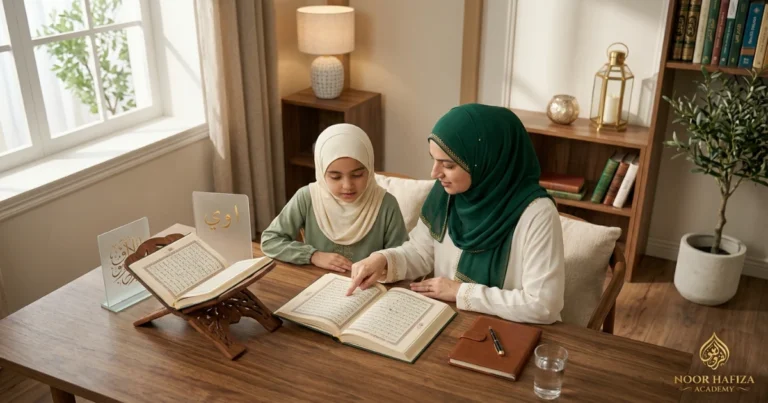
Noor Hafiza Academy offers live online Quran classes for girls, children, women, sisters, adults, beginners, readers, Tajweed students, and Hifz learners with female Quran teachers. A suitable plan begins with the learner’s age, current level, course goal, previous experience, time zone, school schedule, preferred lesson length, and available home practice.
Families can discuss Noorani Qaida, Quran reading, Tajweed, Hifz, revision, Islamic Studies, trial arrangements, one-to-one learning, teacher fit, parent feedback, and progress reviews. Current female-teacher availability, schedules, programs, fees, privacy practices, policies, and enrollment terms should be confirmed directly.
Share her age, current Quran level, course goal, previous classes, city and time zone, preferred days, attention needs, and whether the family prefers one-to-one or girls-only group learning.
FAQs about online Quran classes for girls with female teachers
Are online Quran classes with female teachers suitable for girls?
What can girls learn in online Quran classes?
Why do some parents prefer a female Quran teacher?
How do I know whether a female Quran teacher is qualified?
Are one-to-one Quran classes better for girls?
How long should an online Quran class be for a girl?
How can parents keep online Quran classes safe?
What should happen in a trial class?
How is a girl’s Quran progress tracked online?
Can girls memorize the Quran online?
What if my daughter is shy during class?
Can a girl combine online Quran classes with mosque activities?
Help your daughter learn Quran with a qualified female teacher and a plan she can grow with
Share her age, current Quran level, course goal, previous learning, city and time zone, school schedule, preferred days, lesson format, and any attention or confidence needs. Noor Hafiza Academy can discuss suitable female-teacher availability and a trial.