Islamic Manners for Kids: Respect, Honesty and Everyday Adab
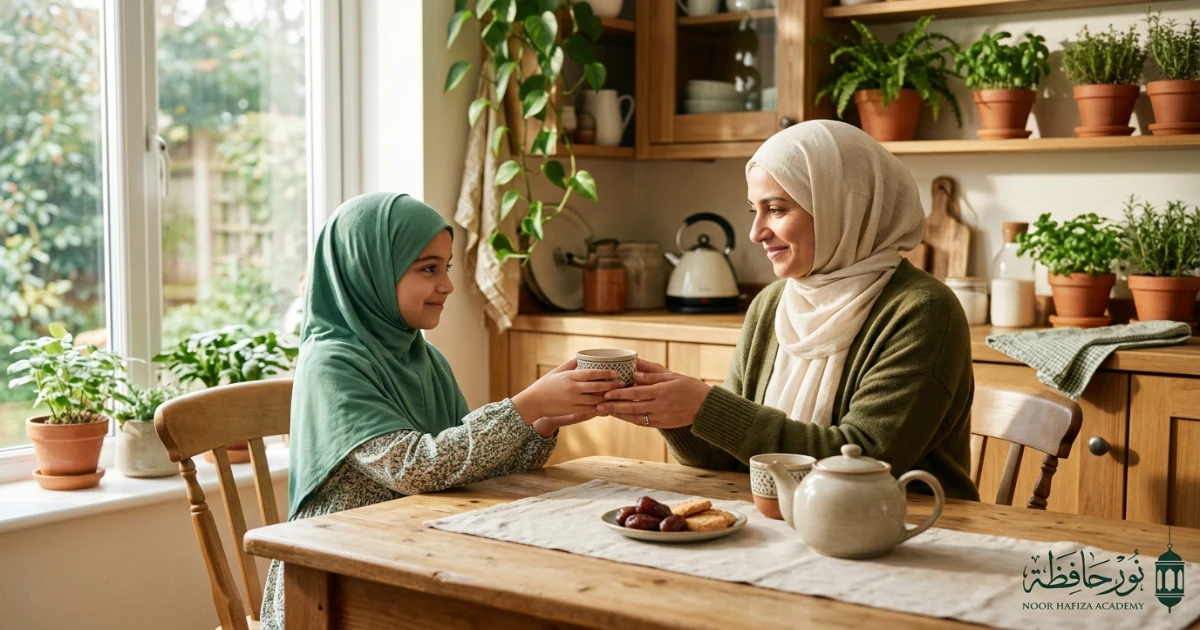
Islamic manners for kids are not a separate subject that children learn once and finish. Adab is built through daily interactions: how a child speaks to parents, answers a teacher, greets others, shares, apologizes, tells the truth, eats, enters a room, handles anger, and responds after making a mistake. Parents do not need to teach every rule at once. A better approach is to choose a few age-appropriate habits, model them clearly, explain why they matter, and repeat them until they become part of family life. Islamic Studies classes can support this process by connecting everyday behavior with values such as respect, honesty, kindness, responsibility, patience, gratitude, and care for others. The goal is not a child who performs perfect manners in front of adults, but one who gradually understands and practises good character even when no reward is offered.
How do you teach Islamic manners to children?
Teach Islamic manners through short explanations, adult example, role-play, reminders, and daily repetition. Start with practical habits children use every day: greeting politely, speaking respectfully, telling the truth, asking permission, saying thank you, sharing, apologizing, eating neatly, respecting parents and teachers, and taking responsibility after a mistake. Focus on one or two habits at a time instead of giving a long list of rules. Praise sincere effort, correct calmly, and explain the reason behind the behavior. For older children, add discussion about intention, consequences, empathy, and self-control so manners become part of character rather than only obedience.
What does adab mean for children?
In everyday Islamic education, adab refers to good manners, respectful conduct, proper behavior, and the way a person carries values into daily life. For children, that can include how they speak, listen, share, ask, respond, eat, learn, disagree, and repair mistakes.
Adab is broader than “being quiet” or “doing what adults say.” A child may sit silently but still be dishonest. Another child may be energetic yet kind, truthful, and respectful. Good character should therefore be taught through clear behaviors rather than vague labels. Parents can make the idea easier by naming the action: “wait until she finishes,” “return what you borrowed,” “tell me the truth even if you are worried,” or “ask before taking something that belongs to someone else.”
Instead of saying “have good manners,” show the child what good manners look and sound like in that exact situation.
Core Islamic manners every child can practise
Respect
Speak politely, listen without mocking, and treat parents, teachers, siblings, guests, and classmates with consideration.
Honesty
Tell the truth, admit mistakes, return what is not yours, and avoid inventing excuses to escape responsibility.
Kindness
Help others, share fairly, use gentle words, notice someone left out, and avoid enjoying another person’s embarrassment.
Responsibility
Take care of belongings, complete simple duties, keep promises when possible, and repair what can be repaired after a mistake.
Teaching children respect for parents without creating fear
Respect for parents can be taught through tone, listening, helpfulness, gratitude, and appropriate response to instructions. The aim should not be to make children afraid to ask questions or explain what happened. A respectful child can still say, “I do not understand,” “Can I finish this first?” or “I am upset,” without shouting or insulting.
Children can disagree or ask questions without yelling, mocking, or deliberately using hurtful language.
Teach the child to hear the instruction fully before answering or negotiating.
Age-appropriate chores can connect respect with practical responsibility rather than words alone.
Parents also model respect by speaking to children without humiliation. A home that demands politeness from children while adults frequently insult or shout teaches mixed messages. Correction can still be firm, but firmness does not require disrespect.
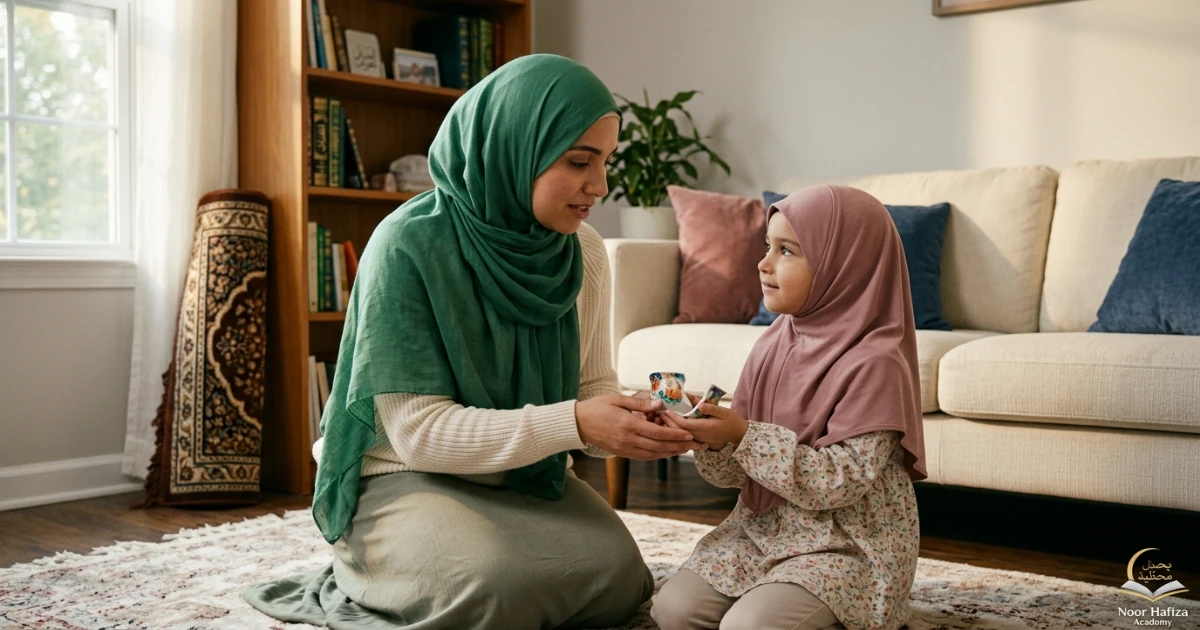
How to teach honesty without making children afraid to admit mistakes
If children believe that telling the truth always leads to a harsh reaction, they may learn to hide mistakes. Honesty grows when adults make truth-telling safer than deception while still keeping reasonable consequences. A child who admits breaking something may still need to help repair or replace it, but the family can recognize that telling the truth was the right step.
| Situation | Helpful response | What it teaches | Avoid |
|---|---|---|---|
| Child spills something | Thank them for telling you, then clean it together | Truth + responsibility | Shaming |
| Child broke a rule | Ask what happened and keep the consequence connected | Accountability | Interrogation |
| Child blames sibling | Slow down and separate facts from excuses | Fairness | Instant accusation |
| Child admits a lie | Address the lie and recognize the later honesty | Repair is possible | Calling the child “a liar” |

Teach greetings, polite speech, and everyday courtesy
Daily greetings are one of the easiest manners to practise because they happen naturally. Children can learn to greet family members, respond politely, say thank you, ask before interrupting, and use respectful language with guests. These habits are small, but they train children to notice that other people are present and deserve consideration.
Teach children not to enter a room as if no one else is there.
Young children need repeated practice not to interrupt every conversation immediately.
Simple phrases such as “please,” “may I,” and “thank you” build respectful habits.
When children forget, use a short cue rather than a public lecture. A quiet “try that again politely” often teaches more than a long speech in front of guests.
Everyday Islamic eating manners for kids
Eating is another routine where adab can become practical. Keep the teaching age-appropriate and consistent rather than correcting ten things at every meal. Children can learn gratitude, reasonable portions, neat eating, patience, respect for shared food, and helping clear the table.
Begin mindfully
Teach the child the family’s meal-opening habit and encourage gratitude before eating.
Eat neatly
Take manageable bites, keep food on the plate where possible, and avoid unnecessary mess.
Respect shared food
Do not grab selfishly or take more than can reasonably be eaten.
Finish with gratitude
Clear the place, help where appropriate, and appreciate the food and effort.
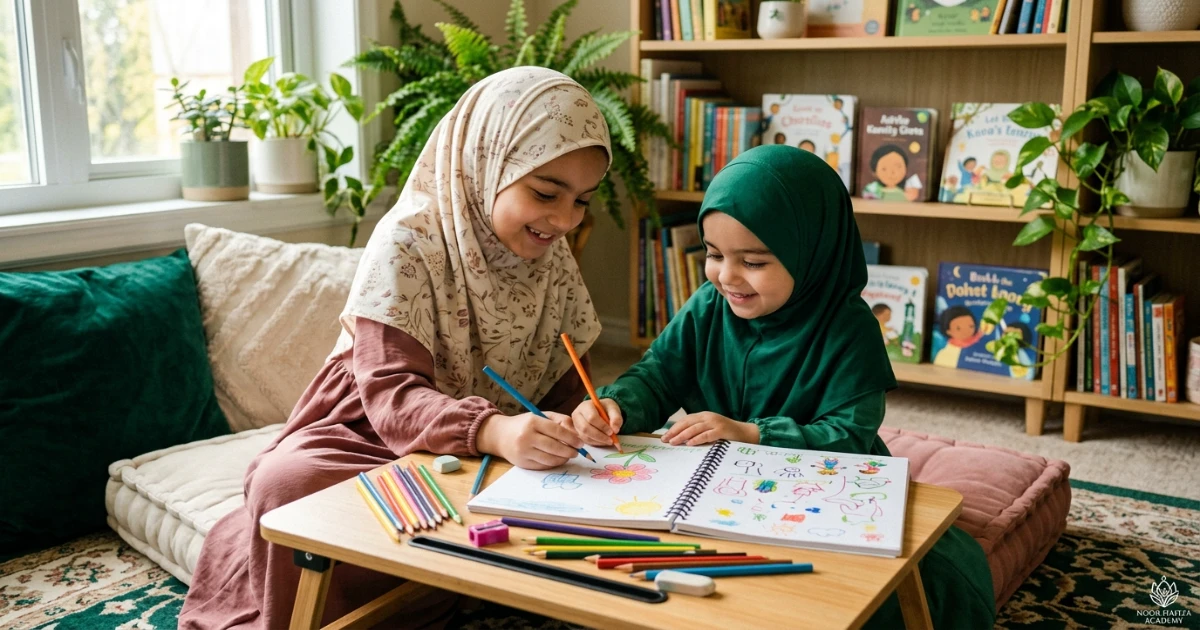
How to teach kindness, sharing, and empathy
Kindness should not be reduced to forcing a child to give away every toy immediately. Children can learn generosity while still understanding boundaries and ownership. A better approach is to teach taking turns, offering help, sharing selected items, and recognizing when another person needs support.
Teach children to notice others: Is someone left out? Is a younger sibling struggling? Did a friend get hurt? Can the child offer help, share time, or use a kinder sentence? Empathy grows when adults help children look beyond their own immediate feelings.
Simple acts like carrying something, tidying, or checking on a sibling build practical kindness.
Teach children to notice when someone is being excluded.
An apology can include words plus an action that helps fix the harm.
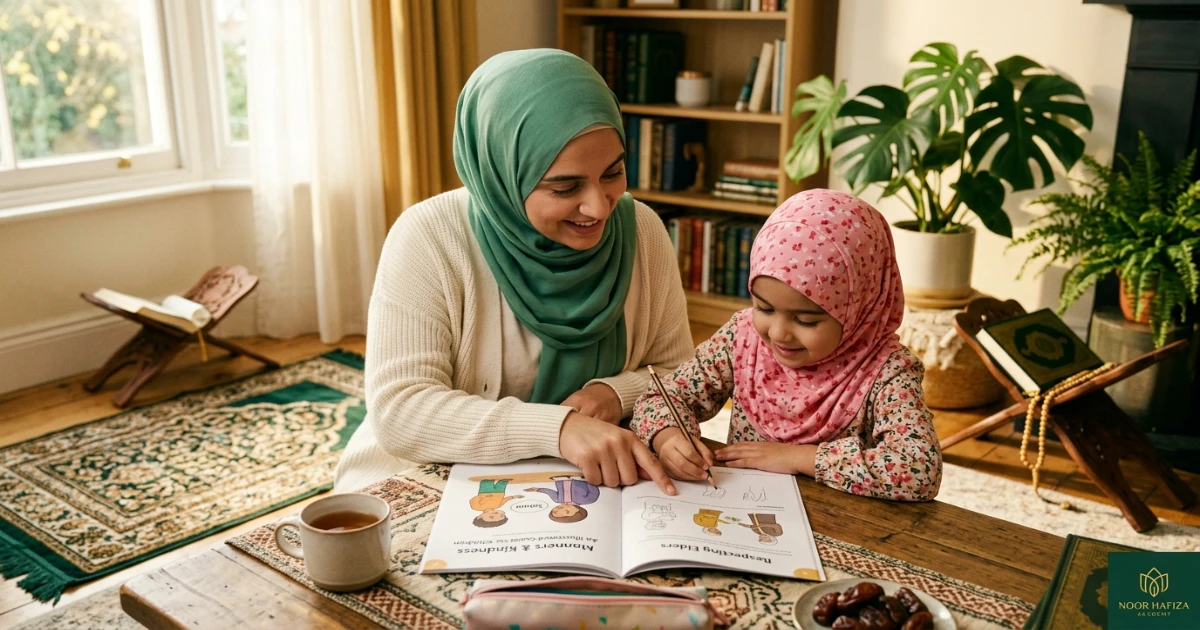
Respect for teachers and online class manners
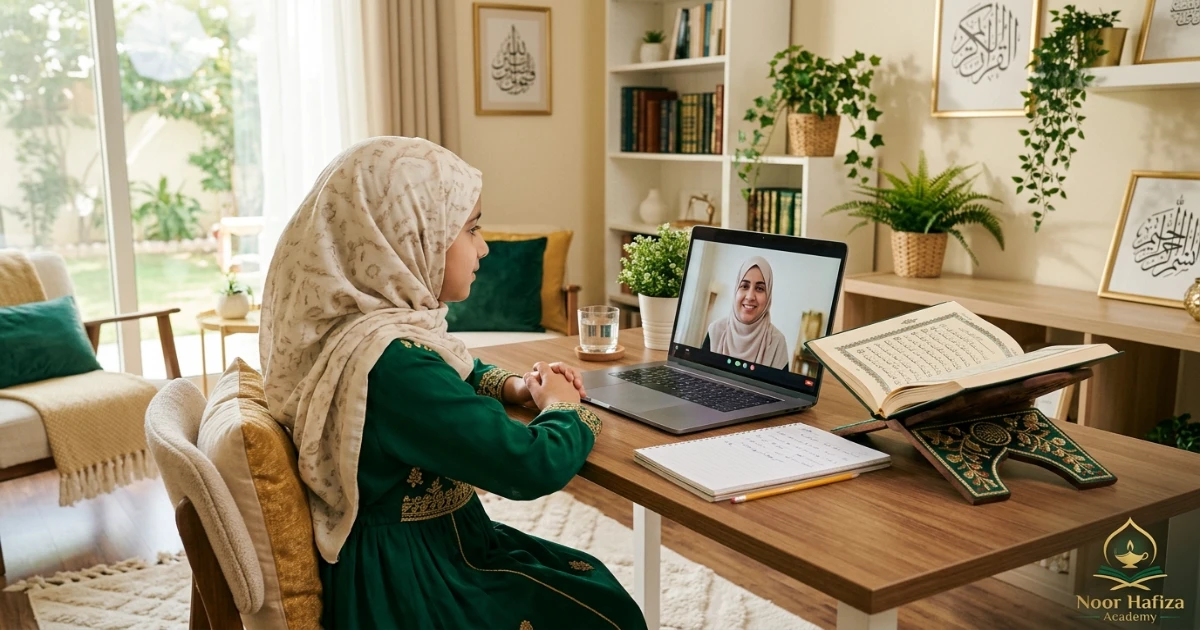
Children need explicit teaching about how to behave in an online Quran or Islamic Studies class. Adults should not assume that a child automatically understands classroom etiquette because the lesson happens at home. A child may need reminders to prepare the book, sit where the teacher can hear clearly, avoid games or toys during class, and wait for a turn to speak.
| Class habit | What it looks like | Why it matters | Parent support |
|---|---|---|---|
| Be ready | Device, book and pencil prepared | Shows respect for class time | Help younger children prepare |
| Listen | Wait while teacher explains | Makes correction easier | Reduce distractions |
| Ask politely | Use respectful words and tone | Builds confident communication | Model questions |
| Accept correction | Try again without arguing or shutting down | Learning requires feedback | Praise effort, not perfection |
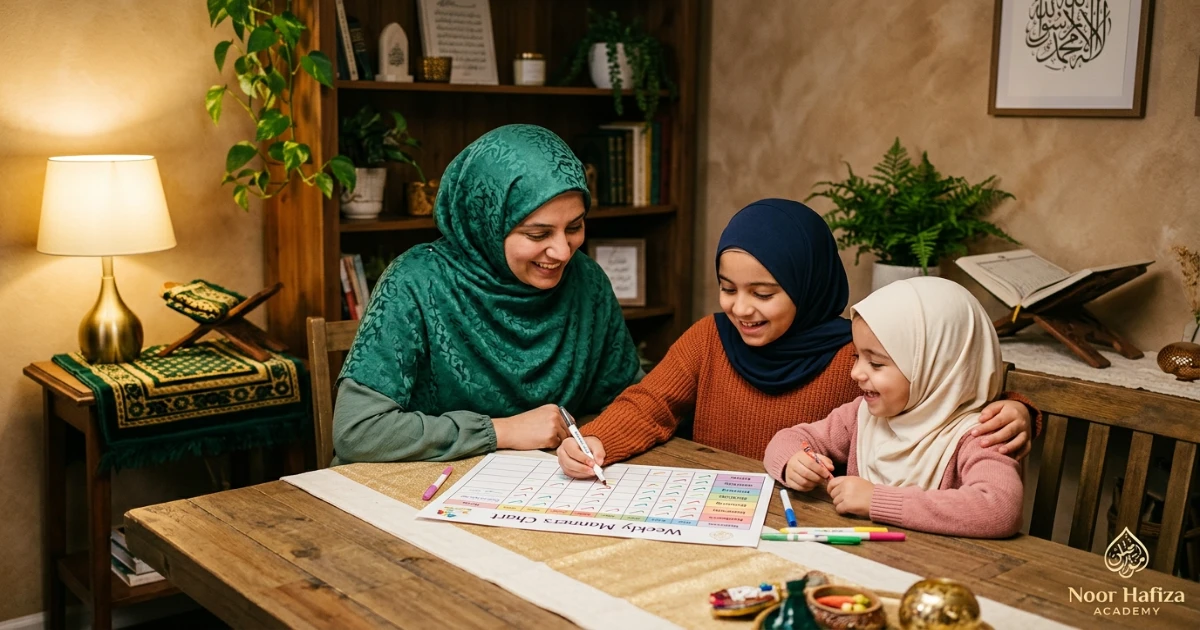
Teaching adab during anger and disagreement
Good manners are easiest when everyone is calm. The more important test is what happens when a child is disappointed, corrected, or told no. Children need practical tools, not only the instruction “do not be angry.”
Teach a child to stop before shouting, hitting, or saying something hurtful.
“I am angry” or “I need a minute” is better than insulting another person.
After calming down, apologize, return what was taken, or help repair what was damaged.
Adults can coach this after the child is calm. During a full emotional outburst, a long lecture is unlikely to be remembered. The teaching moment often comes later, when the child can reflect on what happened and practise a better response.
How to teach adab at different ages
| Age/stage | Best teaching style | Good focus | Avoid |
|---|---|---|---|
| Early childhood | Model + repeat | Greetings, sharing, simple polite words | Long lectures |
| Primary years | Explain + practise | Honesty, responsibility, teachers, siblings | Only rewards |
| Pre-teen | Discuss consequences | Self-control, privacy, friendship, speech | Talking down |
| Teenager | Reason + reflection | Integrity, digital manners, responsibility | Childish presentation |
Children develop at different rates, so age ranges are only a guide. A younger child with strong language skills may enjoy discussion, while an older child may still need visual reminders and role-play.
Everyday adab also applies online
Older children increasingly practise character through messages, games, school platforms, and social media. Parents can extend the same values into digital spaces: do not mock people in group chats, do not forward private messages without permission, do not lie about age or identity, and do not use a screen as permission to speak more harshly than you would face to face.
Digital manners are easier to teach when parents discuss realistic examples rather than only saying “be good online.” Ask what the child would do if a friend shared an embarrassing photo, if classmates excluded someone from a chat, or if they received a message that made them uncomfortable.
A simple weekly Islamic manners routine for families
Parents do not need a formal class every night. A five-minute family habit can be enough to keep adab visible and practical. The goal is repetition without turning the home into a constant lecture.
Choose one phrase the family will practise during disagreements.
Discuss a simple scenario and what truthful repair would look like.
Each person chooses one helpful action for someone at home.
Practise greeting and responding warmly when entering a room.
Name something you appreciated from another family member.
Ask which habit was easiest, hardest, and worth repeating next week.
Use stories and scenarios to make manners memorable
Children often remember a short story better than a rule list. Parents and teachers can use simple scenarios: a child finds money that does not belong to them, two siblings want the same toy, a student is embarrassed after making a reading mistake, or a friend is excluded from a game. Ask the child what a respectful, honest, or kind response could look like.
The purpose is not to force one-word answers. Let the child explain the reasoning. Older children can compare several possible responses and discuss which one protects honesty, dignity, fairness, and kindness at the same time.
Common mistakes when teaching Islamic manners to kids
Teaching too many rules at once
The child remembers none of them well enough to build a habit.
Using manners only during punishment
Adab becomes associated with lectures instead of normal life.
Demanding respect without modelling it
Children hear polite language rules but experience harsh speech from adults.
Rewarding only public behavior
The child learns to perform manners when adults are watching.
Labeling the child
Words such as “rude” or “liar” turn a behavior problem into an identity.
Ignoring repair
The child says sorry but does not learn how to fix the harm caused.
Expecting adult self-control
Young children are corrected for emotions they do not yet know how to manage.
Giving lectures instead of practice
The child can repeat the rule but does not know what to do in a real situation.
12 reflection questions to teach adab without a lecture
Use one question at a time
- How could you say that in a more respectful way?
- What happened before you became angry?
- What is the truthful version of what happened?
- How do you think your sibling felt?
- What could you do to repair the mistake?
- What would you want someone to say to you in the same situation?
- Did you ask before taking it?
- What can you do if you disagree with an adult respectfully?
- How can you include someone who is left out?
- What should you do after interrupting someone?
- What is one helpful thing you can do without being reminded?
- Which adab habit do you want to practise this week?
Islamic Studies and everyday adab for children
Noor Hafiza Academy offers live online Quran and Islamic learning for children, girls, women, adults, new Muslims, returning readers, teenagers, siblings, and homeschool families with female Quran teachers. Families can ask about Islamic Studies lessons that include age-appropriate learning about manners, worship, Seerah, daily duas, character, and practical Muslim life alongside Quran learning.
A suitable children’s Islamic Studies plan may include short stories, scenarios, role-play, simple reflection questions, home-practice habits, and parent feedback. Current teacher qualifications, course content, lesson length, age groups, schedules, trial arrangements, fees, privacy practices, safeguarding policies, and enrollment terms should be confirmed directly.
Share the child’s age, current Islamic Studies background, preferred schedule, and whether you want support with manners, daily duas, Salah, Seerah, or a broader Islamic Studies curriculum.
FAQs about Islamic manners for kids
What are Islamic manners for kids?
What is adab in simple words for children?
What manners should young children learn first?
How do I teach my child to respect parents?
How can I teach honesty without making my child afraid?
Should children be forced to share everything?
How do I teach manners during anger?
What is good classroom adab for online Quran classes?
How many manners should I teach at one time?
How can I make Islamic manners practical at home?
Can online Islamic Studies classes teach adab?
What should I send when asking about Islamic Studies for my child?
Teach Islamic manners through daily example, simple practice, and consistent family routines
Share the child’s age, current Islamic Studies background, preferred schedule, and whether the main focus is manners, daily duas, Salah, Seerah, or a broader curriculum.