
How to Keep Children Focused During Online Quran Classes

Learning how to keep children focused during online Quran classes begins with understanding that attention is not created by repeated reminders to “sit properly” or “concentrate.” A child’s focus is affected by age, lesson length, Quran level, school-day fatigue, hunger, sleep, screen setup, background noise, task difficulty, teacher interaction, movement needs, confidence, and the amount of waiting inside the lesson. The most effective plan improves the conditions around attention instead of blaming the child for every distraction.
How can parents keep a child focused during an online Quran class?
Keep the class at a time when the child is awake, calm, and not rushing from school or another activity. Use a quiet desk with the correct Mushaf or Qaida, stable audio, good lighting, water, and only the materials needed for that lesson. Choose a class length that matches age and attention, and ask the teacher to divide the lesson into short active tasks such as review, reading, repetition, correction, recall, and a clear closing target. Allow a brief movement or posture reset when attention drops. Parents should remain close enough to support technology and routine but should avoid answering for the child. Track repeated patterns—such as focus dropping after twenty minutes or during difficult reading—and review them with the female Quran teacher.
What does “focused” mean during an online Quran class?
A focused child does not need to remain completely motionless, stare at the screen every second, or complete a lesson without looking away. Real learning focus means the child can return attention to the assigned Quran task, respond to the teacher, attempt the reading or memorization, accept correction, and complete a meaningful portion of the lesson. Younger children may move their hands, adjust their seat, or need brief reminders while still learning effectively.
Parents sometimes judge focus only through appearance. A child may look still but be passively copying the teacher without decoding. Another child may shift position while accurately reading, recalling, and answering questions. The better measure is participation: Can she find the correct page? Can she attempt before receiving help? Can she repeat the corrected word? Can she reconnect it to the phrase? Can she explain what the home task is at the end?
The aim is to reduce unnecessary distraction while giving the child enough movement, interaction, and success to remain mentally present. A lesson that demands adult-style stillness may create conflict without improving Quran learning.
This distinction helps parents and teachers respond more accurately. Instead of saying, “She never focuses,” identify the exact behavior: she leaves after fifteen minutes, looks away during explanation, guesses when the passage becomes difficult, plays with browser tabs, needs every first word, or becomes restless while waiting for correction. A specific behavior can be changed. A broad label usually cannot.
Why children lose focus during online Quran classes
Attention problems during an online Quran lesson rarely have only one cause. The child may be tired after school, the class may begin too close to dinner, the task may be above her current reading level, the teacher may be speaking for long periods, or the device may contain games and notifications. A child may also avoid a task because she expects correction, feels embarrassed about slow reading, or cannot hear the teacher clearly.
Poor timing
The lesson begins when the child is sleepy, hungry, emotionally unsettled, or rushing from school, tutoring, sports, or another screen activity.
Lesson too long
The child participates well at first but becomes passive, restless, or inaccurate during the final part of class.
Task difficulty
The reading, Tajweed, or memorization assignment requires skills the child has not yet made stable.
Too much waiting
Long explanations, slow page searching, technical delays, or repeated parent interruptions leave the child without an active task.
Screen distraction
Notifications, games, messages, open tabs, background television, toys, siblings, or movement in the room compete with the lesson.
Low confidence
The child avoids attempting because she expects to be wrong, corrected publicly, compared, or interrupted before she can think.

Use three lessons as an observation period. Note the start time, how the child felt before class, what subject was taught, when attention first changed, and what restored it. One difficult class is not a reliable pattern. Repeated behavior across several lessons gives the parent and teacher better evidence.
Choose an online Quran class length that protects active attention
A class can be educationally appropriate and still be too long for a particular child at a particular time. Younger children often benefit from shorter lessons with frequent participation. Older children may manage longer sessions when the work is varied and purposeful. Hifz testing may require a different structure from beginner Qaida instruction. The correct duration is the longest period in which the child can continue learning accurately—not the longest period she can be kept in the chair.
| Age or stage | Useful starting length | Focus-friendly structure | Review sign |
|---|---|---|---|
| Approximately 4–6 | 15–20 minutes | Very short tasks, repetition, praise, visual pointing, one brief reset | Frequent leaving, guessing, or loss of response after the first task |
| Approximately 7–9 | 20–30 minutes | Warm-up, guided reading, independent attempt, correction, closing review | Strong first half but repeated errors or passivity near the end |
| Approximately 10–12 | 25–35 minutes | Clear target, active practice, one deeper correction, short responsibility at close | Multitasking, hiding difficulty, or rushing to finish |
| Teen learner | 30–45 minutes | Private goal, respectful feedback, independent work, measurable progress | Passive attendance without home transfer or participation |
These are starting ranges, not fixed rules. A five-year-old who actively enjoys a twenty-minute lesson may continue well. A ten-year-old returning tired from school may need twenty-five minutes even if she can manage longer on weekends. Read the full duration guide at how long an online Quran class should be for a child.
When focus falls at the same point in several lessons, shorten the class or place the hardest work earlier. Do not automatically add stronger discipline to a duration problem. A class that is five minutes shorter but consistently active may produce more progress than a longer class filled with reminders.
Prepare the child before the class begins
Many focus problems begin in the five minutes before class. The child is called suddenly from play, arrives without the correct book, cannot find the teacher link, or hears a parent giving several instructions while the teacher is already waiting. A predictable transition reduces this stress.
Give a calm five- or ten-minute reminder
Use the same short phrase each time. Avoid repeated warnings that turn the lesson into a negotiation.
Allow bathroom, water, prayer, and emotional transition
A child who has just returned from school or active play may need a few quiet minutes before sitting.
Open the correct page and place materials ready
The Mushaf, Qaida, notebook, pencil, headphones, and lesson link should be available before the teacher joins.
State one simple lesson goal
For example: “Today you will revise yesterday’s lines and work on one new joining pattern.”
Let the teacher take control of the lesson
Once class begins, the parent should avoid adding a second stream of instructions.
The transition should be supportive rather than dramatic. Avoid statements such as “You must focus today because you were terrible yesterday.” They place the child in a defensive state before learning begins. Use neutral preparation: materials ready, body settled, goal clear.
Create a distraction-free online Quran learning setup
The learning space does not need to be expensive, large, or perfectly silent. It needs to reduce the distractions that repeatedly interrupt this child. For one learner, the main problem is television in the next room. For another, it is a tablet full of games. For another, the chair is uncomfortable or the Mushaf is placed too far from the screen.
Keep only lesson materials visible
- Mushaf or Qaida on a suitable stand or desk
- Notebook and pencil when required
- Water placed safely away from the device
- Headphones when the room cannot remain quiet
Reduce digital distraction
- Close games, videos, messages, and extra tabs
- Disable nonessential notifications
- Use full-screen lesson view when helpful
- Keep the parent account separate from the child’s entertainment profile
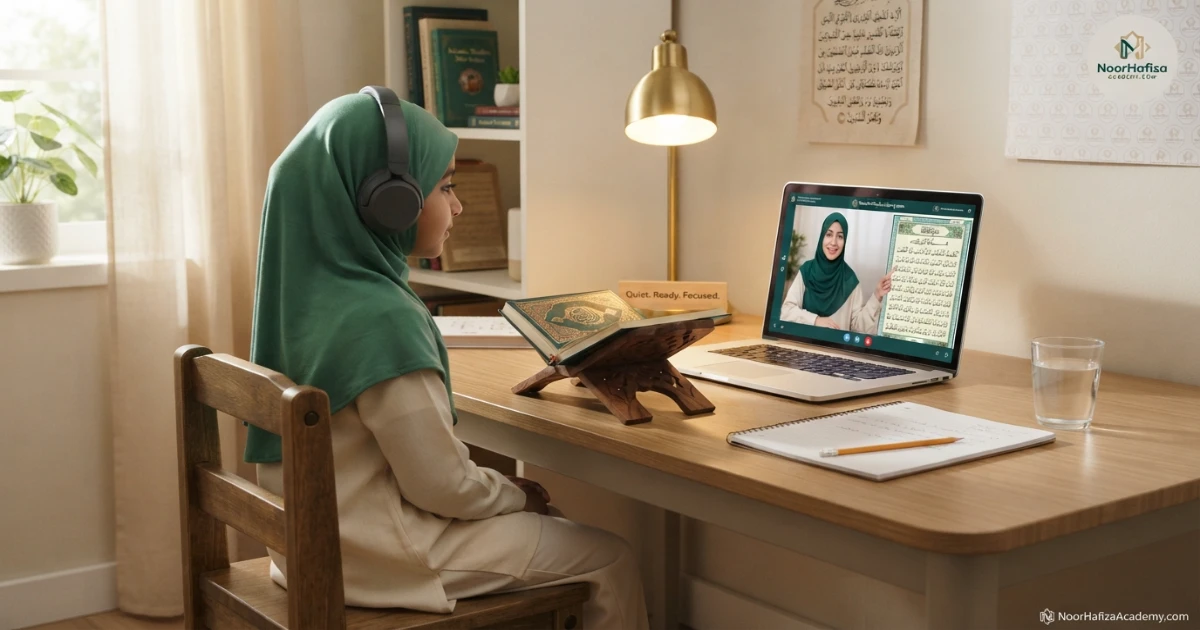
Place the screen so the child can see the teacher without twisting away from the Mushaf. Good lighting should fall on the page rather than creating glare. The camera should be stable enough that the teacher can observe whether the child is following the correct line. For young learners, a parent may sit nearby but outside the child’s direct line of sight.
Siblings should have a quiet waiting activity. They should not enter the class repeatedly, supply answers, or ask when their own lesson begins. When several children study in one room, headphones and back-to-back lesson times may help.
Use a child-focused online Quran lesson structure
Children lose focus when they wait too long without a clear task. A strong lesson alternates listening, looking, speaking, pointing, reading, recalling, and receiving feedback. The teacher may still explain, but explanation should lead quickly to a child response.
| Lesson stage | Possible length | Child action | Focus purpose |
|---|---|---|---|
| Warm-up | 2–4 minutes | Recite familiar material or complete one easy recognition task | Build confidence and enter the lesson quickly |
| Review | 4–8 minutes | Read or recall the previous assignment independently | Activate memory and reveal the real starting point |
| New teaching | 5–10 minutes | Watch one model, answer, point, repeat, or identify | Introduce only the amount that can be practised |
| Guided practice | 5–10 minutes | Attempt, receive correction, retry, and reconnect | Keep participation high and make correction useful |
| Independent check | 2–5 minutes | Read or recite without immediate prompting | Test real learning rather than imitation |
| Close | 1–3 minutes | Repeat the home task and one success point | Finish clearly before attention is exhausted |
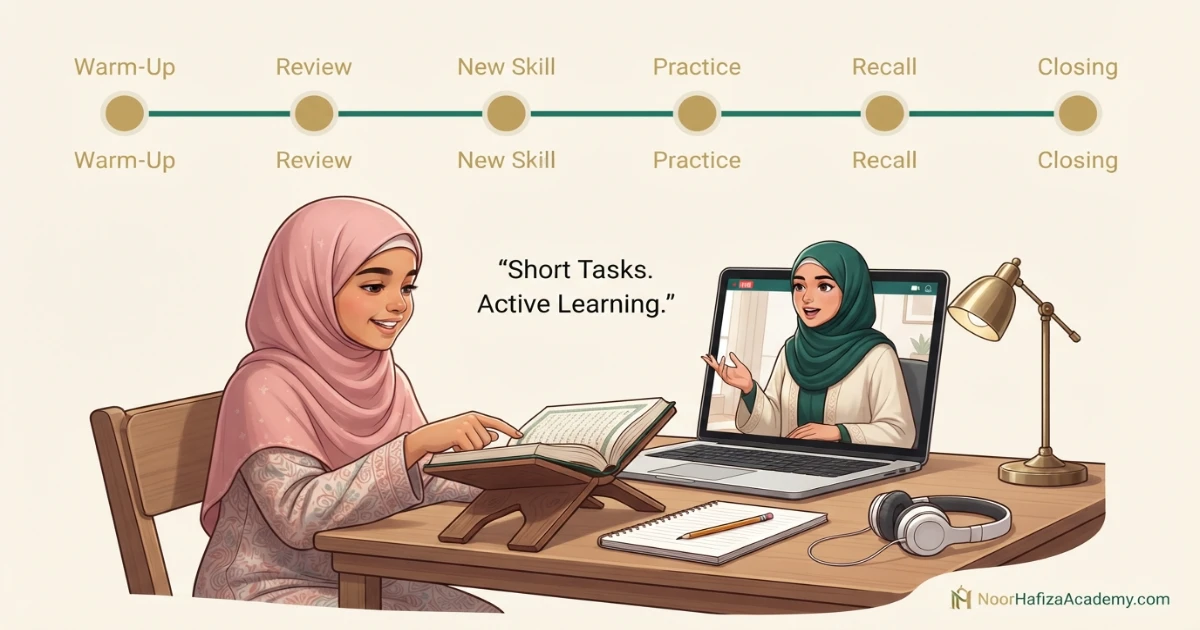
The exact minutes should change with the child and course. The principle is more important: avoid a long block in which the teacher speaks and the child only listens. Ask small questions, request a fresh attempt, change the starting point, or let the child identify the error after hearing two versions.
Give one instruction at a time and make the goal visible
Children may appear distracted when the instruction contains too many steps. “Open your notebook, write the date, find yesterday’s page, revise the first three lines, remember the madd rule, and then read the next line” creates several opportunities to stop. Break the direction into a sequence.
- “Open page twelve.”
- “Point to the first line.”
- “Read the first three words slowly.”
- “Listen to this correction.”
- “Try the same phrase again.”
- “Now read the whole line.”
A visible lesson goal can help older children: one review target, one new skill, and one closing check. Do not display a long checklist that makes the class feel overwhelming. The goal should answer, “What are we trying to improve today?”
Use movement breaks and attention resets appropriately
A brief reset can restore attention before frustration grows. It does not need to become a long play break. The teacher can ask the child to sit tall, relax the shoulders, take a sip of water, stand beside the chair for one short recitation, stretch the hands, or look across the room for several seconds before returning to the page.
Posture reset
Feet supported, page closer, shoulders relaxed, screen and Mushaf aligned.
Micro-movement
Stand, stretch gently, or complete one recitation while standing beside the desk.
Attention reset
Close the eyes briefly, listen to one model, then reopen and attempt independently.

Use resets before the child becomes completely disengaged. If the same reset is needed every few minutes, review the class length, time, task level, or environment. Movement is a support, not a way to force an unsuitable lesson to continue indefinitely.
How focus strategies change for Qaida, reading, Tajweed, Hifz, and Islamic Studies
Noorani Qaida
Qaida focus improves when the teacher uses short recognition tasks and asks the child to decode before repeating. Keep the assigned pattern visible and reduce page searching. Alternate recognition, pointing, reading, and one short transfer example. Repetition should remain attentive rather than becoming a chant the child can say without looking.
Quran reading
Reading lessons should combine a familiar passage with a manageable unfamiliar section. The teacher can mark phrase boundaries, ask the child to preview a word, and correct the smallest useful unit. Repeatedly restarting the full page after one mistake can exhaust attention. See how to improve Quran recitation for a complete fluency method.
Tajweed
Focus one lesson on one main pronunciation or timing target. The child may practise the sound alone, inside a word, and then inside the verse. Too many rule names and corrections at once can reduce participation. Major errors should still be addressed, but the session needs one memorable priority.
Hifz
Hifz focus improves when the session separates new memorization, recent revision, and older revision. Use random beginnings and short recall tests instead of allowing the child to rely only on one long chain. Parents should give thinking time rather than immediately supplying the first word. Additional guidance is available in how parents can help a child memorize the Quran.
Islamic Studies
Use stories, short questions, examples from daily life, choice between two answers, and one simple takeaway. Avoid turning the entire lesson into a lecture. The child should speak, explain, match, choose, or apply something regularly.
What parents should do during an online Quran class
The parent’s role is to protect the conditions around learning: time, device, materials, quiet, attendance, and calm encouragement. The female Quran teacher should lead the technical lesson. When the parent repeats every instruction, corrects every sound, or provides the next answer, the child receives two teachers at once and may stop responding independently.
| Helpful parent action | Why it helps | Action to avoid | Better alternative |
|---|---|---|---|
| Prepare the device and materials | Class begins without technical delay | Searching for links after the teacher joins | Open the room and correct page five minutes early |
| Remain nearby for young children | Technology and routine can be supported | Sitting beside the child and answering | Stay slightly behind or outside direct sight |
| Give the teacher behavioral context | The teacher can adjust timing and task level | Criticizing the child during class | Message privately after the lesson |
| Praise one observable effort | The child understands what to repeat | General pressure or comparison | Notice independent attempts or calm correction |
| Complete the assigned home step | Learning transfers beyond the screen | Adding extra pages as punishment | Use the exact teacher-approved task |
For young children, the parent may quietly point to the teacher or page when attention drifts, then withdraw. Use the least assistance that restores participation. If constant parent involvement is required, the class may need a different length, teaching method, level, or time.
Use encouragement that improves participation rather than performance anxiety
Children often focus better when they can see progress and expect a realistic success. Praise should describe a useful behavior: “You found the line yourself,” “You waited and tried before asking,” or “You repeated the corrected sound inside the whole phrase.” This helps the child understand what successful learning looks like.
Small visual progress systems can help some children: attendance marks, completed practice days, Surahs kept strong, or a list of mastered Qaida patterns. The system should not become a competition between siblings or a payment for every verse. Rewards should support the routine, not replace the meaning of Quran learning.
Correct the behavior calmly, restore the task, and review the cause later. Shame and repeated criticism may make the child focus on avoiding mistakes rather than learning the Quran.
Protect sleep, school transition, meals, prayer, and family routine
A well-designed lesson cannot fully compensate for a poorly chosen daily schedule. A child who is consistently tired, hungry, or late will need more reminders. Choose a repeatable window that fits school dismissal, transportation, homework, meals, prayer, activities, and bedtime. The guide to the best online Quran class schedule for school-age children provides detailed planning examples.
After-school child
Allow a predictable transition before class. The child may need prayer, water, a snack when appropriate, or quiet time before learning.
Morning learner
Avoid beginning immediately after waking. Use a stable wake, wash, breakfast, and preparation sequence.
Weekend learner
Keep the time stable enough that family outings do not cause repeated cancellation or last-minute rushing.
A class that frequently conflicts with dinner, a sports departure, or bedtime creates divided attention. The child knows another activity is waiting and rushes the lesson. Move the class rather than repeating reminders every week.
Build a weekly child Quran focus routine
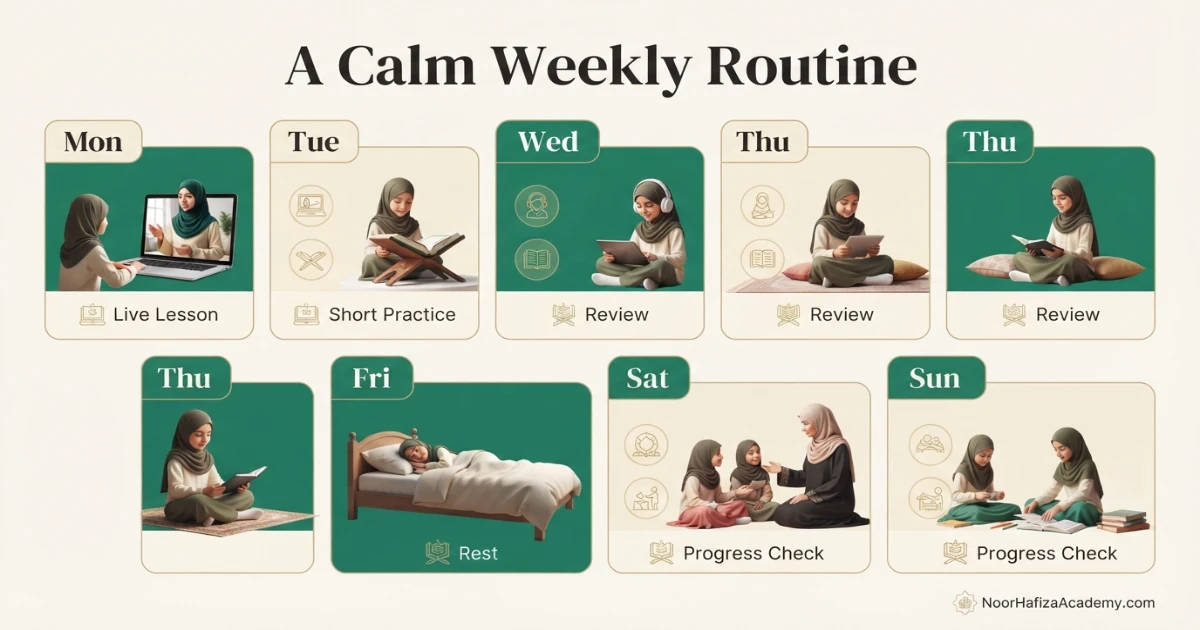
Focus becomes easier when the week is predictable. The child should know which days include live lessons, which days use a short home review, and which day is lighter. A routine reduces negotiation and prevents parents from assigning large catch-up sessions after several missed days.
Live lesson
Review, teach one main target, practise actively, and end with a clear home step.
Short practice
Use five to fifteen focused minutes on the exact correction or revision task.
Second lesson
Check whether the skill remains and transfer it to a fresh line or random starting point.
Listening or review
Use a lighter task when school or activities make a full practice session unrealistic.
Progress check
Notice independence, accuracy, attention length, and the exact point that still causes difficulty.
Flexible recovery
Use familiar recitation, a short review, or a rescheduled lesson without doubling the workload.
How to know a child’s focus is improving
Do not measure focus only by how many reminders were given. Attention should lead to learning evidence. Compare several lessons and look for changes in preparation, participation, independence, accuracy, recovery after distraction, and home-practice transfer.
| Area | Improvement evidence | Question to ask | Possible next step |
|---|---|---|---|
| Preparation | Child arrives with correct page and device ready | Is the transition predictable? | Keep the same pre-class routine |
| Participation | More reading, answering, pointing, or recalling | Which task keeps her most active? | Use that pattern earlier in class |
| Independence | Fewer first-word prompts and parent answers | Does she receive enough thinking time? | Delay prompts and use a clear ladder |
| Endurance | Accurate participation lasts longer | When does attention still drop? | Adjust segment order or duration |
| Recovery | Child returns after a reminder or short reset | Which reset works without conflict? | Use it predictably before full disengagement |
| Learning | Correction transfers to a new word, line, or lesson | Is attention producing retention? | Increase difficulty only after stability |

The review should end with one specific change: move the class fifteen minutes later, shorten it by five minutes, place revision before new work, remove a device distraction, add one planned reset, or reduce the home task. Changing several things at once makes it difficult to know what helped.
Adjust the plan for individual learning and support needs
Some children need more movement, shorter directions, visual schedules, reduced sensory distraction, or more repetition. Parents do not need to wait for a label before using respectful supports. Tell the teacher what helps the child at school or during other learning: a visual timer, standing briefly, one instruction at a time, a preview of changes, or a quieter background.
Online Quran classes should not be used to diagnose attention, anxiety, hearing, vision, language, or learning conditions. When focus difficulties appear across settings, significantly affect daily life, or come with concerns about development, health, hearing, vision, sleep, or emotional wellbeing, parents should seek appropriate professional guidance. The Quran teacher can adapt instruction but should not replace a qualified health or educational professional.
A child may also need a different teacher fit. The right female Quran teacher should be patient, specific, able to vary tasks, and comfortable giving the child thinking time. Use the female Quran teacher online guide to review communication, correction style, privacy, and lesson compatibility.
Child-friendly online Quran classes with female Quran teachers
Noor Hafiza Academy offers live online Quran learning for children, girls, women, sisters, beginners, developing readers, Tajweed students, and Hifz learners with female Quran teachers. A child’s first focus plan should begin with her real level, age, current class length, school routine, existing Quran skills, home setup, and the point at which participation usually changes.
A suitable lesson may include Noorani Qaida, Quran reading, Tajweed, Hifz, revision, or Islamic Studies. The teacher can use short stages, independent attempts, active correction, planned review, and a realistic home task. Current teacher availability, schedules, programs, trial arrangements, fees, policies, and enrollment terms should be confirmed directly.
Share the child’s age, location and time zone, school schedule, Quran level, current class length, repeated distractions, preferred lesson time, learning setup, and the result you hope to improve.
FAQs about keeping children focused during online Quran classes
Why does my child lose focus during online Quran classes?
How long can a child focus in an online Quran lesson?
Should a parent sit with the child during Quran class?
How can I remove distractions from an online Quran class?
What should the teacher do when a child becomes restless?
Are movement breaks helpful during online Quran classes?
How can a Quran teacher make an online lesson more engaging?
Should I reward my child for focusing in Quran class?
What is the best time of day for a child’s online Quran class?
How can I tell whether the lesson is too difficult?
What should I discuss with the Quran teacher about my child’s focus?
Can online Quran classes work for children who need extra learning support?
Build an online Quran lesson your child can actively join
Share the child’s age, Quran level, current lesson length, school routine, time zone, learning setup, repeated distractions, and the point where attention usually changes. Noor Hafiza Academy can discuss a suitable focus and level assessment with a female Quran teacher.