One-to-One vs Group Quran Classes: Which Is Better?

One-to-one vs group Quran classes is not a simple contest in which one format wins for every learner. Private lessons usually provide more individual reading time, faster correction, flexible pacing, and easier scheduling. Group lessons can provide peer motivation, shared discussion, social confidence, and a lower cost per student. This guide helps parents choose the format that best fits their child’s age, Quran level, attention, personality, course, and family routine.
One-to-one vs group Quran classes: which is better?
One-to-one Quran classes are usually better when a learner needs precise pronunciation correction, a personalized pace, flexible scheduling, privacy, foundational rebuilding, or intensive Hifz supervision. Group Quran classes may be better when students are at a similar level, benefit from peer motivation, enjoy discussion, can wait for turns, and need a more economical option. For most young beginners and children with recurring reading mistakes, private lessons offer stronger individual support because the teacher can hear more of the child’s recitation. For Islamic Studies, selected Arabic activities, revision circles, and socially confident learners, a well-managed small group can work very well. The best format is the one that gives the learner enough active reading, accurate correction, emotional safety, and a sustainable routine.
What is the main difference between private and group Quran lessons?
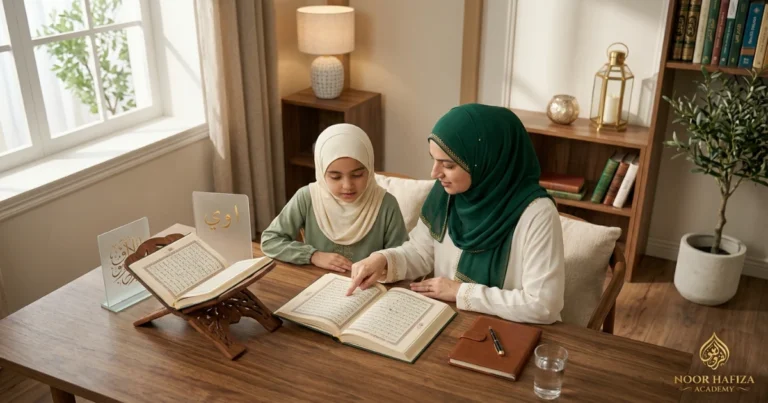
The main difference is how teacher attention and lesson time are distributed. In a one-to-one class, the teacher works with one student. Every question, example, correction, pause, and review can be adapted to that learner. In a group Quran class, the teacher divides time across several students. Learners receive less individual recitation time, but they may benefit from hearing peers, joining discussion, observing common mistakes, and feeling part of a learning community.
This distinction affects almost every part of the experience: pace, correction, confidence, scheduling, cost, progress reporting, and the amount of time a child spends actively reading. A thirty-minute private lesson can sometimes provide more direct recitation than a sixty-minute group session because the learner does not wait for several other students to complete their turns.
One learner, one teacher, one pace
The teacher can begin exactly where the learner is, listen to every assigned line, repeat difficult sounds, adjust lesson length, and build a plan around the student’s goal and response.
- Maximum individual attention
- More active reading time
- Specific real-time correction
- Flexible pace and lesson focus
- Private feedback and accountability
Several learners, shared instruction, common pace
The teacher organizes turns, shared explanations, practice activities, and discussion for students learning together at a broadly similar stage.
- Peer examples and motivation
- Social learning atmosphere
- Shared questions and discussion
- Often lower cost per learner
- Fixed class community and routine
Benefits of one-to-one Quran classes
Private Quran lessons are built around the individual learner. This is especially valuable because Quran reading requires the teacher to hear the student, identify a precise pronunciation or fluency issue, model the improved sound, and check whether the learner can repeat it independently. In a private class, the teacher does not need to shorten this correction cycle to make room for several other students.
More individual recitation time
The child can spend most of the class reading, listening, repeating, and applying correction instead of waiting for multiple turns.
Personalized starting point
The teacher can begin at the learner’s demonstrated level rather than placing the child according to age, school grade, or the average group pace.
Immediate specific correction
Recurring mistakes in Makharij, vowels, joining, elongation, stopping, or fluency can be addressed as soon as the teacher hears them.
Flexible teaching method
The teacher can use visual pointing, slower modeling, repetition, short breaks, more examples, or less prompting according to the child’s response.
Privacy for shy learners
A child who fears making mistakes in front of peers may participate more freely when only the teacher is listening.
Clearer progress reporting
Feedback can focus on the child’s exact strengths, recurring errors, revision task, attendance, and next milestone.
Flexible scheduling
Private lessons are often easier to arrange around school, work shifts, sports, family routines, and Eastern, Central, Mountain, or Pacific time zones.
Better fit for specialized goals
Hifz, advanced Tajweed, Quran revision, reading repair, and adult restart programs often require individual listening and custom pacing.

When one-to-one Quran classes may not be the perfect choice
One-to-one classes are highly supportive, but they are not automatically perfect. Private tuition often costs more per learner than a shared group. Some socially motivated students enjoy learning with peers and may find a long private class intense. A child can also become dependent on constant teacher prompts if the lesson is not designed to increase independence gradually.
A strong private teacher should not fill every silence, answer before the child attempts, or correct so continuously that the learner cannot complete a phrase. Individual attention should be used to build independent reading—not permanent dependence. Parents should observe whether the teacher reduces prompts, asks the child to try again alone, and expects short revision between classes.
The value of one-to-one teaching depends on the teacher’s accuracy, explanation, correction style, reliability, and ability to help the learner become more independent. Use a live trial and the guidance in our online Quran teacher selection guide.
Benefits of group Quran classes
Group learning can be valuable when the group is small, students are placed carefully, the teacher manages turns well, and the course benefits from discussion or shared practice. Children can hear peers attempt the same skill, learn from common corrections, and feel encouraged by seeing others work through difficulty.
Peer motivation
Students may feel more motivated when they see classmates preparing, revising, answering, and progressing alongside them.
Learning from examples
A child can hear another student’s mistake, listen to the teacher’s correction, and notice the same pattern in personal reading.
Discussion and questions
Islamic Studies, selected Tajweed theory, Arabic vocabulary, and reflective activities may benefit from shared conversation.
Social confidence
A carefully managed group can help children practice speaking, taking turns, listening respectfully, and participating in a faith-centered community.
Lower cost per learner
Because teacher time is shared, group tuition is often more affordable than individual teaching, although prices and class sizes vary.
Shared routine
A recurring group time can create accountability and a sense of belonging when attendance and level placement remain consistent.

What are the disadvantages of group Quran classes?
The main limitation is reduced individual time. If five students share a thirty-minute lesson equally, each learner cannot receive thirty minutes of direct listening. The teacher also needs time for introductions, transitions, explanations, questions, and behavior management. This does not make the class useless, but parents should understand how much active recitation their child will actually receive.
Limited individual correction
The teacher may hear only a small portion of each child’s reading, allowing recurring pronunciation or fluency patterns to receive less attention.
One pace for different learners
Faster students may become bored while learners with weaker foundations may feel rushed or embarrassed.
Waiting and distraction
Young children can lose focus while classmates take turns, especially when the group is large or lesson management is weak.
Less scheduling flexibility
The class time is fixed for everyone. A family that misses the session may not receive an individual makeup lesson.
Performance anxiety
Shy learners may avoid reading or feel embarrassed when corrected in front of peers, even when the teacher is kind.
Weak level matching
A group described simply as “beginners” may contain children with very different letter recognition, fluency, and attention.
One-to-one vs group Quran classes: complete comparison
| Comparison area | One-to-one Quran class | Group Quran class | Better choice when |
|---|---|---|---|
| Teacher attention | Reserved for one learner | Shared among several learners | Choose private for intensive correction; group when shared learning is part of the goal. |
| Active recitation time | Usually much higher | Limited by turns and group size | Private is stronger for reading, Tajweed application, and Hifz listening. |
| Learning pace | Personalized | Set for the class | Private suits uneven foundations; group suits genuinely similar levels. |
| Correction privacy | Fully private | Correction may be heard by peers | Private supports shy, anxious, older beginner, or self-conscious learners. |
| Peer motivation | Limited | Strong potential | Group suits children who learn well through social energy and shared goals. |
| Scheduling | Often more flexible | Fixed shared schedule | Private helps families with school, work shifts, or changing routines. |
| Cost | Usually higher per learner | Often lower per learner | Compare price with active reading time and correction—not the fee alone. |
| Progress feedback | Individual and detailed | May be broader or less frequent | Private suits parents who need precise individual targets. |
| Social interaction | Teacher-student relationship | Peer interaction included | Group suits discussion, shared revision, and community learning. |
| Special needs and attention | Easier to adapt | Depends on group management | Private often supports attention, processing, sensory, or confidence needs. |
Which format is better for Qaida, Tajweed, Hifz, and Islamic Studies?
Beginners need frequent sound modeling, letter recognition checks, joining practice, and correction that follows their exact pace.
Private lessons maximize the amount of reading the teacher can hear and make it easier to track recurring mistakes.
Rules can be introduced in a group, but individual recitation remains important because knowing a rule is different from applying it accurately.
Memorization requires individual listening, correction, new lesson tracking, recent revision, and older retention checks.
Discussion, stories, questions, reflection, and age-based activities can benefit from respectful peer participation.
Vocabulary and conversation may suit groups, while pronunciation, reading repair, and personalized grammar support may suit private lessons.
Many families use a blended approach: private Quran reading or Hifz lessons plus a separate small-group Islamic Studies or Arabic activity. The combination preserves individual correction where it matters and adds peer learning where it adds genuine value.
Are one-to-one Quran classes better for kids?
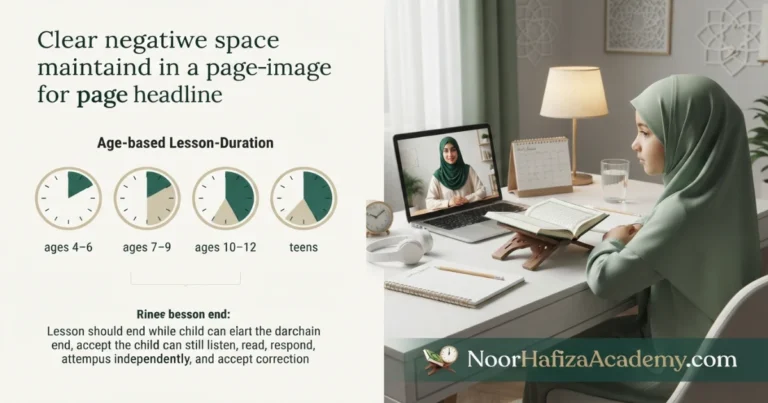
For many young children, one-to-one lessons are the safer starting point because the teacher can adjust the task quickly when attention changes. A five-year-old may need a fifteen- or twenty-minute lesson with visual pointing and repeated sound imitation. A group designed for older or more advanced learners may move too quickly, while a group of very young children may spend significant time managing turns and distractions.
Private lessons are also useful when a child has not yet developed classroom confidence, needs frequent encouragement, or is rebuilding after an unsuccessful previous experience. The teacher can learn the child’s signals, use the preferred communication language, and introduce structure gradually. Read our guide to the best age to start Quran classes for readiness factors beyond age.
A small group can still work for children who are close in age and level, can wait for turns, enjoy peer interaction, and have a teacher who protects participation. Parents should ask for the class size, age range, level criteria, and expected individual reading time before enrolling.
Choose according to the child’s personality and emotional needs
Private often feels safer
A child who fears public mistakes may read more honestly and accept correction more calmly in a private lesson.
Small group may motivate
A child who enjoys shared goals, friendly participation, and hearing peers may become more engaged in a carefully matched group.
Private allows quick redirection
The teacher can shorten tasks, vary the activity, call the child by name, and respond immediately when attention drops.
Watch the emotional effect
A group can motivate healthy effort, but comparison should never turn Quran learning into shame, status, or pressure.
Which format offers better value for money?
Group classes often have a lower monthly fee because several students share the teacher’s time. Private lessons usually cost more per student, but the learner may receive much more active reading and correction. A fair comparison should therefore consider the cost per useful teaching minute—not only the total class duration or headline monthly price.
A sixty-minute group class is not automatically better value than a thirty-minute private lesson. If six students share the group and the teacher spends most of the hour on turns, the individual learner may receive less direct correction. Conversely, a well-designed small group may offer excellent value for Islamic Studies or discussion-based learning. See our guide to online Quran class costs in the USA for a fuller pricing framework.
How scheduling differs between private and group classes
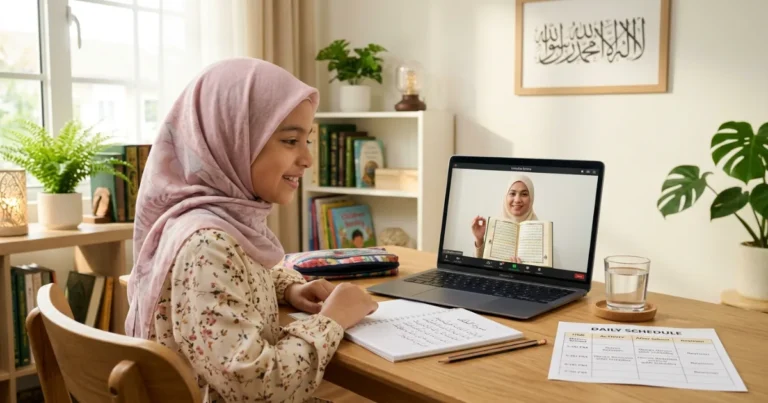
Private classes are generally easier to match to a family’s preferred time because only the teacher and one student need to agree. This can help families across USA time zones, children with changing school schedules, parents who work shifts, or siblings who need different lesson times. Some academies may also offer a clearer route for rescheduling a private class when advance notice is given.
Group classes use a fixed shared time. This can build routine, but one family cannot usually move the class without affecting everyone. Parents should ask whether a recording, alternate session, makeup, or lesson summary is available after an absence. They should also confirm whether recurring lateness affects the child’s turn or participation.
Is one format safer for online Quran learning?
Safety depends more on the academy’s systems, teacher verification, parent visibility, approved communication, professional boundaries, and device setup than on class size alone. Both private and group lessons should use a parent-approved platform, known schedule, clear teacher identity, and a route for concerns.
In private lessons for young children, parents should remain aware of the class and keep the learning area accessible. In group lessons, parents should know who can join, whether student names or video feeds are visible to others, how invitations are controlled, and whether recordings or screenshots are permitted. The academy should explain these expectations before enrollment.
Parents should know the teacher, platform, schedule, class participants, communication route, progress process, and how to report a concern. Young learners should use a supervised family device in an appropriate home area.
Use a trial class before choosing one-to-one or group learning
A trial should reveal how the child actually behaves in the format. A learner who appears quiet in a group may simply need time—or may receive too few opportunities. A child who enjoys private attention may still need stronger structure. Observe the teaching process rather than asking only whether the child “liked it.”
Measure participation
How much time does the child spend reading, repeating, answering, pointing, or receiving correction rather than waiting?
Watch the correction cycle
Does the teacher identify the issue, model the improved sound, allow another attempt, and check independent application?
Notice emotional comfort
Does the learner remain willing to try after a mistake? In a group, does the child fear peers or feel encouraged by them?
Assess pace and level
Is the lesson challenging but understandable? Does the child spend too much time waiting or feel rushed beyond the current foundation?
Check teacher management
In private lessons, does the teacher build independence? In groups, does she distribute turns fairly and keep students engaged?
Ask for a recommendation
The teacher should explain which format, lesson length, weekly frequency, and course pathway fit the observed learner.

How to decide which Quran class format is best for your child
Identify the learner’s real need
Record age, reading level, course goal, confidence, attention, previous learning, preferred language, schedule, and how much home revision is realistic.
Test participation and correction
Use a trial to see how much the child reads, how the teacher corrects, whether the pace fits, and how the learner responds emotionally.
Reassess after the first month
Check attendance, comfort, progress, recurring mistakes, revision, teacher communication, and whether the selected format still serves the goal.
Questions to ask before enrollment
- How many students are in the group, and what ages and levels are included?
- How much individual reading time should each learner receive?
- How are students assessed and placed before joining?
- How does the teacher correct pronunciation in a group without embarrassing a child?
- Can the lesson pace change when a student needs extra review?
- What happens when the child misses a fixed group session?
- How are parents informed about individual progress?
- Can a child move from group to private lessons or from private to group?
- Which format does the teacher recommend for the learner’s current goal?
- Can the family observe a real trial before paying?
Choose one-to-one when—and choose group when
One-to-one is usually better when
- The learner is beginning Noorani Qaida
- Pronunciation or fluency needs repair
- The child is shy, anxious, or easily distracted
- The student is older but still a beginner
- Hifz requires daily individual listening
- The family needs flexible scheduling
- The learner progresses much faster or slower than peers
- Parents want detailed individual feedback
A small group may be better when
- Students are genuinely close in age and level
- The course includes discussion or shared activities
- The child learns well through peer examples
- The learner can wait for turns without disengaging
- The teacher limits class size and manages participation
- The family needs a lower-cost option
- The goal includes social confidence and community
- Individual recitation support is available when needed
Why Noor Hafiza Academy emphasizes one-to-one Quran teaching
Noor Hafiza Academy provides live one-to-one Quran classes with female Quran teachers for children, girls, women, and beginners. The private format allows the teacher to assess the learner’s actual level, listen to more recitation, correct the child’s specific mistakes, adjust the pace, and communicate clearer individual goals to parents.
This approach is particularly useful for Noorani Qaida, Quran reading, Tajweed application, Hifz, revision, and learners who need confidence or flexible scheduling. Families can discuss age, current level, preferred course, time zone, lesson frequency, and schedule before a regular plan is confirmed. A free trial helps both the teacher and parent decide whether the proposed pathway fits the learner.
A short live trial can show whether the child needs private foundational support, a different lesson length, a stronger revision routine, or a future group activity alongside individual Quran teaching.
So, are one-to-one or group Quran classes better overall?
For foundational Quran reading, pronunciation correction, Tajweed application, Hifz, shy learners, uneven levels, and flexible family schedules, one-to-one lessons usually offer the stronger educational fit. They give the teacher more time to hear the learner and make precise adjustments. For discussion-based Islamic Studies, selected Arabic activities, peer revision, socially motivated students, and families seeking a lower-cost option, a carefully placed small group can be valuable.
The wrong question is “Which format is always better?” The better question is “Which format gives this learner enough active participation, accurate correction, emotional safety, and sustainable progress?” Start from the child’s need, observe a real lesson, and review the decision after several weeks.
FAQs about one-to-one vs group Quran classes
Are one-to-one Quran classes better than group classes?
Which format is better for young Quran beginners?
Are group Quran classes cheaper?
Which format is better for Tajweed?
Which format is better for Hifz Quran?
Can shy children learn well in group Quran classes?
How many students should be in an online Quran group?
Can siblings learn Quran together in one group?
Can a child switch from group to one-to-one Quran classes?
Does Noor Hafiza Academy offer one-to-one Quran classes?
See how individual teaching fits your child in a free trial class
Share the learner’s age, current Quran level, main goal, USA time zone, and preferred schedule. Noor Hafiza Academy can arrange a live one-to-one trial with a female Quran teacher and recommend a practical course, lesson length, and weekly routine.