Online Quran Classes for Kids: The Complete Parent Guide
Choosing online Quran classes for kids involves more than finding an available tutor. Parents need to understand the child’s starting level, the right course, teacher suitability, lesson length, safety, home revision, and how real progress should look. This guide brings those decisions together in one practical roadmap.
What are online Quran classes for kids?
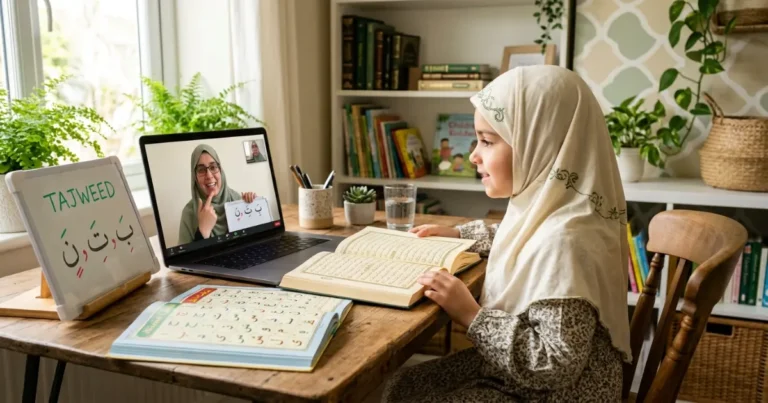
Online Quran classes for kids are live lessons in which a child studies with a Quran teacher through a video platform from home. A well-structured program begins with a level assessment, places the learner in the right pathway, and uses age-appropriate teaching to develop skills such as Arabic letter recognition, Noorani Qaida, Quran reading, Tajweed, memorization, revision, and Islamic Studies. The teacher listens in real time, corrects mistakes immediately, sets a manageable practice task, and adjusts the pace as the child improves. Parents support the routine by preparing the learning space, protecting attendance, supervising younger children, and helping with short revision between lessons.
Are online Quran classes the right fit for your child?
Online Quran learning can work very well for children when the format solves a real family need and the teaching remains personal. It is especially useful for families who want one-to-one attention, need access to a female Quran teacher, live far from a suitable local program, manage busy school schedules, or prefer to learn without regular travel. It can also help a shy child who feels overwhelmed in a large group or a learner whose level does not match the pace of a local class.
The convenience of learning at home is valuable, but convenience alone does not guarantee progress. A child still needs a teacher who can hold attention, hear small pronunciation errors, break difficult skills into manageable steps, and respond warmly when the learner struggles. The family must also protect the lesson from distractions. A video call running in the background while the child plays, moves around, or receives constant parental answers is not the same as a focused online class.
Ask whether this specific teacher, class structure, schedule, and home routine help your child listen, participate, accept correction, revise consistently, and make measurable progress. The quality of the learning system matters more than the location of the screen.
What is the best age to start online Quran classes for kids?
There is no single age that is correct for every child. Some young children can sit, listen, imitate sounds, and follow simple instructions for a short lesson. Others need more time before formal online study feels comfortable. Readiness is better judged through behavior than through a birthday alone.
A child may be ready when they can remain at a table for a short focused period, respond to a teacher on screen, point to a letter or line, repeat a sound, and accept gentle correction without becoming distressed. Parents should also consider language development, school workload, sleep routine, and the child’s familiarity with devices. A short trial lesson is the most practical way to judge readiness because it shows how the child responds to a real teacher.
Introduction and comfort
Keep sessions very short, visual, and interactive. Goals may include listening, recognizing a few Arabic letters, repeating simple sounds, learning short duas, and becoming comfortable with a teacher.
Foundation building
Many children can begin a structured Noorani Qaida pathway, practice letter joining, learn basic reading patterns, and develop a simple home revision habit with parent support.
Fluency and independence
Learners may work on Quran reading, Tajweed application, selected memorization, Islamic Studies, and greater responsibility for preparation and revision.
Goals and accountability
Teenagers often benefit from respectful one-to-one teaching, clear milestones, deeper Tajweed, stronger fluency, Hifz planning, revision recovery, and privacy with a female teacher.
These age bands are practical starting points, not rigid rules. A seven-year-old beginner may need shorter lessons than another child of the same age. A ten-year-old who has already studied Qaida may be ready for Quran fluency or Tajweed. The right plan should begin with the learner’s actual skill and attention, then grow gradually.
Which Quran course should your child begin with?
Parents sometimes choose a course by age, by the name of the book used at a previous academy, or by what another child in the family is studying. A better approach is to identify the next skill the learner truly needs. A child may have “completed Qaida” but still struggle to recognize joined letters. Another may read quickly but repeat pronunciation mistakes. A memorization student may know new portions while older revision is weak. Placement should respond to those differences.
Noorani Qaida for Beginners
Best for children learning Arabic letters, vowels, joined shapes, basic pronunciation, and gradual word reading. Explore Noorani Qaida online.
Quran Reading and Fluency
Best for children who know the foundation but read slowly, hesitate often, confuse vowel marks, or need supervised practice. See online Quran reading classes.
Tajweed for Children
Best for readers ready to improve articulation, elongation, nasalization, stops, starts, and consistent rule application. Visit online Tajweed classes.
Hifz Quran
Best for children ready to memorize with a balanced system for new lesson, recent revision, older revision, listening, and retention. Learn about Hifz Quran online.
Islamic Studies
Best for age-appropriate learning about salah, duas, beliefs, manners, Seerah, worship, and Muslim character. Explore Islamic Studies online.
Restart and Revision
Best for children who studied before but lost confidence, fluency, or consistency. A focused check can repair gaps without restarting everything. See Quran restart and revision.
A live level check is more reliable than choosing from a list. The teacher can listen, identify the strongest foundation and the biggest gap, and recommend one clear starting pathway.
How to choose the right online Quran teacher for a child
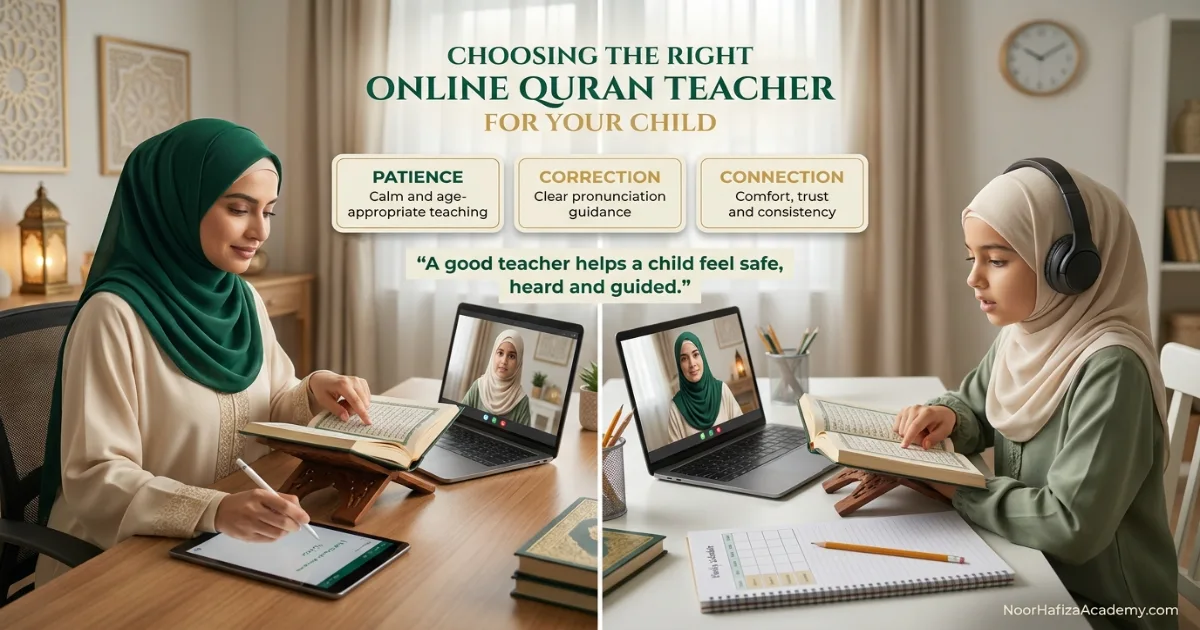
Quran knowledge is essential, but teaching children requires more than knowing the subject. A child-friendly teacher can explain simply, repeat without irritation, change the activity when attention falls, praise improvement without exaggeration, and correct mistakes without embarrassing the learner. The teacher should also understand when a child needs encouragement and when they need calm accountability.
During a trial, notice whether the teacher uses the child’s name, checks understanding, waits for an answer, and listens to the complete attempt before correcting. Good correction is specific. Instead of repeatedly saying “wrong,” the teacher identifies the sound, demonstrates it, asks the child to repeat, and then checks the same skill again. The student should leave knowing what improved and what to practice.
Clear Quran pronunciation
The teacher should model sounds accurately and make corrections the child can hear and imitate.
Patience without passivity
A kind teacher still maintains structure, protects lesson time, and helps the child complete the objective.
Age-appropriate language
Instructions should be short enough for the child to understand and specific enough to act on.
Active listening
The teacher should hear patterns in the child’s mistakes rather than correcting random words without a plan.
Positive teacher-student rapport
The learner should feel safe to try again, ask a question, and admit when a lesson is difficult.
Parent communication
Parents should receive a clear learning target and know how to support revision without using a conflicting method.
What should happen during an online Quran lesson for kids?
A useful class has a repeatable structure. The teacher does not simply open a page and ask the child to read until time ends. Each part of the lesson has a purpose, and the balance changes according to the learner’s program.
Welcome and settle
The teacher greets the child, confirms the correct material, and gives a simple opening instruction. This short transition helps the learner move from home activity into focused study.
Review the previous target
The child reads or recites the assigned portion. The teacher checks whether last lesson’s correction was retained and whether home revision was completed accurately.
Teach one manageable skill
The teacher introduces a sound, joining pattern, reading technique, Tajweed rule, memorization portion, dua, or Islamic Studies objective. Children usually respond better when the purpose is clear and limited.
Model, listen, and correct
The teacher demonstrates. The child repeats or reads. The teacher identifies the exact mistake, models the improved version, and asks the learner to try again while the correction is still fresh.
Check independent performance
Prompts are gradually reduced. The teacher asks the child to apply the new skill in another word, line, or passage to see whether the learning has begun to transfer.
Set a clear revision task
The class ends with an achievable target such as repeating a letter set, reading selected lines twice, reviewing one short surah, or practicing a single Tajweed pattern.
For a young beginner, the lesson may include more repetition, visual pointing, and short changes of activity. A fluent reader may spend more time reciting and applying corrections. A Hifz student needs a balanced structure that protects older revision rather than focusing only on new memorization. Parents should be able to describe the lesson objective in one sentence after class.
How long and how often should kids take Quran classes online?
The best schedule is one the child can attend consistently while still having enough time and energy to revise. More classes are not automatically better if the learner is exhausted, rushed from another activity, or unable to practice between sessions. Less frequent classes may also slow improvement when too much time passes between correction and review.
| Age or goal | Practical starting lesson length | Possible weekly pattern | What parents should watch |
|---|---|---|---|
| Ages 4–5, early introduction | About 15–20 focused minutes | Short and regular sessions | Comfort, listening, imitation, and whether the child remains positively engaged. |
| Ages 6–8, Qaida foundation | About 20–30 minutes | Two to four lessons, depending on revision | Letter recognition, joining, pronunciation, and the ability to follow a short home task. |
| Ages 9–12, reading or Tajweed | About 25–40 minutes | Two to four lessons with home practice | Fluency, recurring mistakes, rule application, and growing independence. |
| Teenagers | About 30–45 minutes | Based on goal and school workload | Consistency, respectful accountability, clear milestones, and sustainable timing. |
| Hifz program | Depends on new lesson and revision load | Frequent listening with structured revision | Retention of older portions, not only the number of new lines. |
These ranges are not fixed rules. A child who is tired after school may learn better with a shorter lesson at another time. Another child may manage a longer class because the teacher varies the activity and keeps the session interactive. Start conservatively, observe attention and retention, and adjust based on real performance.
What does your child need for Quran learning at home?
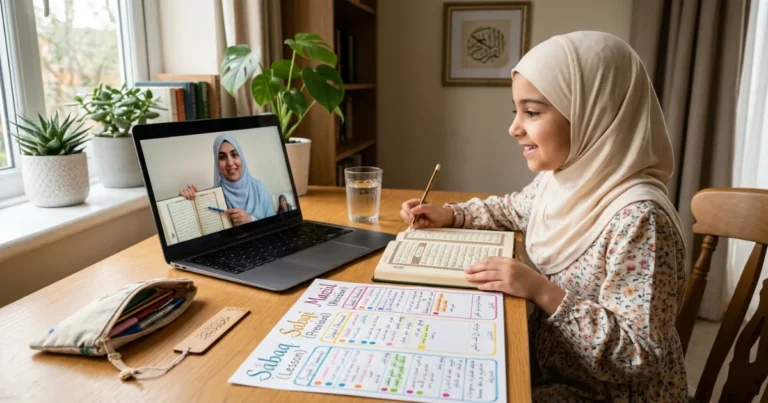
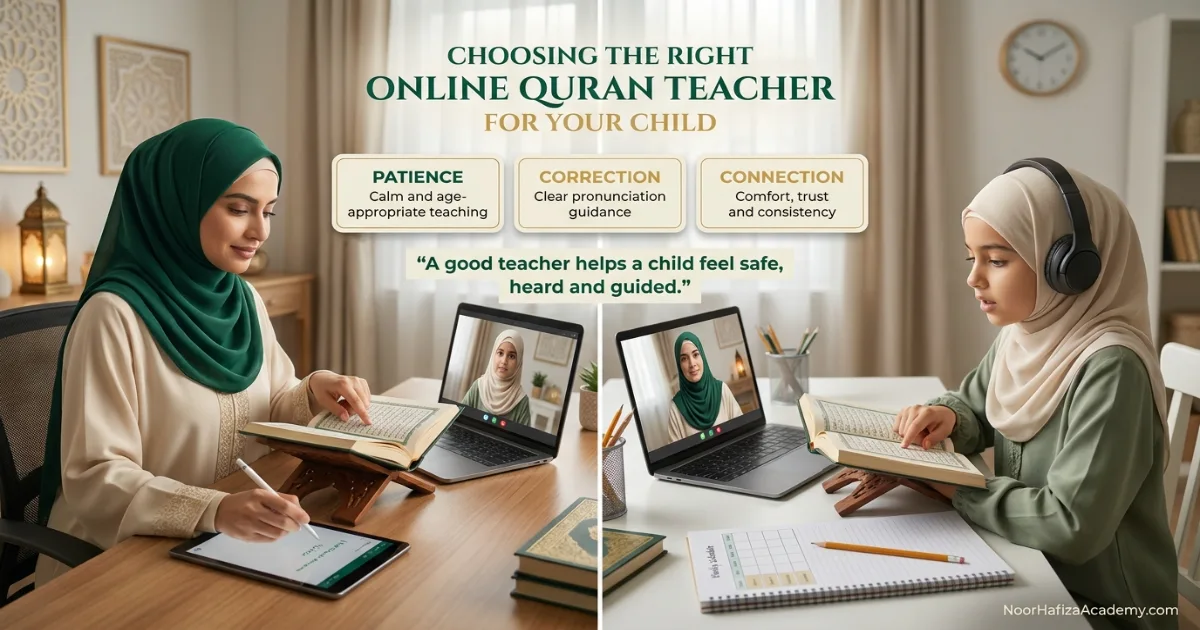
Most families already have the essential equipment. The goal is not to build an expensive classroom; it is to create a dependable space where the child can hear clearly, see the teacher, handle the learning material, and remain free from unnecessary interruption.
Essential class setup
- A phone, tablet, laptop, or desktop with stable video calling
- Clear microphone and speaker or suitable headphones
- The assigned Quran, Noorani Qaida, or lesson material
- A comfortable chair and stable surface
- Good lighting and a camera angle that supports communication
- A quiet area where younger children can be supervised
Simple preparation routine
- Open the class link before the lesson begins
- Charge the device and test the audio
- Place the correct book, notebook, and pencil within reach
- Close games, videos, notifications, and unrelated browser tabs
- Offer water and complete bathroom needs before class
- Help the child arrive calm rather than rushing at the final minute
How involved should parents be in online Quran classes for children?
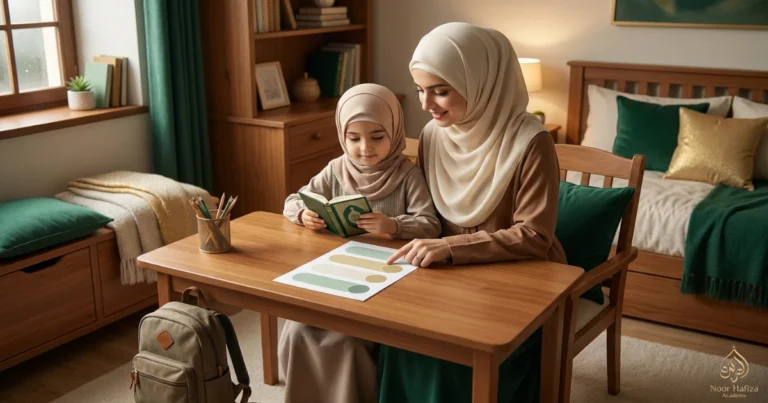
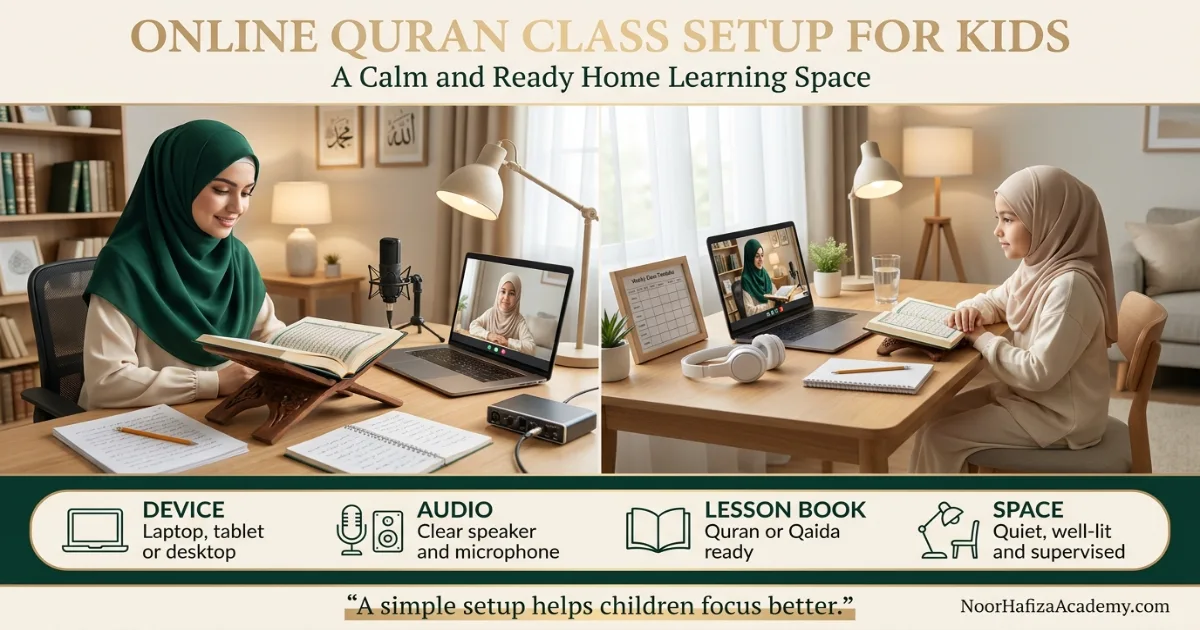
Parents make the routine possible, but the teacher should lead the lesson. The ideal level of involvement changes with age. A young child may need help opening the call, locating the correct page, holding the book steady, and returning attention gently. An older learner may only need a reminder, a prepared space, and a brief check after class.
Prepare, do not pressure
Set up the device, keep materials ready, and remind the child of the lesson. Avoid turning the minutes before class into a stressful test of everything studied during the week.
Stay available without supplying answers
Help with technology or attention when necessary, but allow the teacher to hear the child’s genuine reading. Whispered answers can hide the true level and slow independent learning.
Turn feedback into a small routine
Ask what the child learned, praise effort, and complete the specific revision task. Short practice on several days is usually more sustainable than one long session before the next class.
Parents should also communicate meaningful changes. Tell the academy when school schedules shift, the child becomes anxious, a hearing or attention issue affects the lesson, or the current timing repeatedly produces poor focus. Good communication allows the teacher to adjust rather than misreading tiredness as lack of effort.
How can parents keep online Quran classes safe?
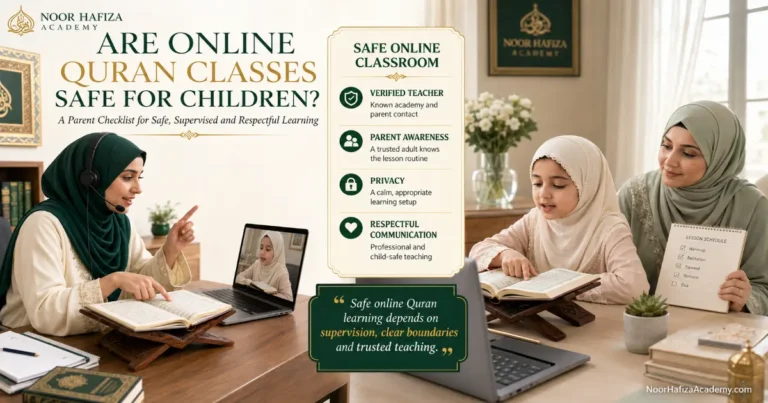
Online classes can offer useful parent visibility because the lesson happens at home, but families still need clear safeguards. Parents should know who teaches the child, which platform is used, when classes occur, how communication is handled, and how to contact the academy if anything feels unclear. Younger children should learn in a shared or supervised area, and private communication should remain limited to approved educational channels.
Use the agreed class link and parent-approved device. Keep scheduling and feedback visible to the family. Do not move a young learner into unapproved private chats, and contact the academy promptly when a concern needs clarification.
Parent safety checklist
- Confirm the teacher’s identity through the academy
- Keep the lesson schedule and contact route documented
- Supervise younger children appropriately
- Use a neutral background and remove private documents
- Teach the child not to share passwords or personal information
- Report unusual communication or boundary concerns immediately
Healthy lesson boundaries
- Communication stays focused on learning and scheduling
- The teacher does not request unnecessary personal details
- Parents remain informed about changes in timing or platform
- The child knows they can speak to a parent about discomfort
- Recordings, screenshots, or shared content follow agreed policies
- The academy provides a clear route for feedback or complaints
How should parents measure Quran learning progress?
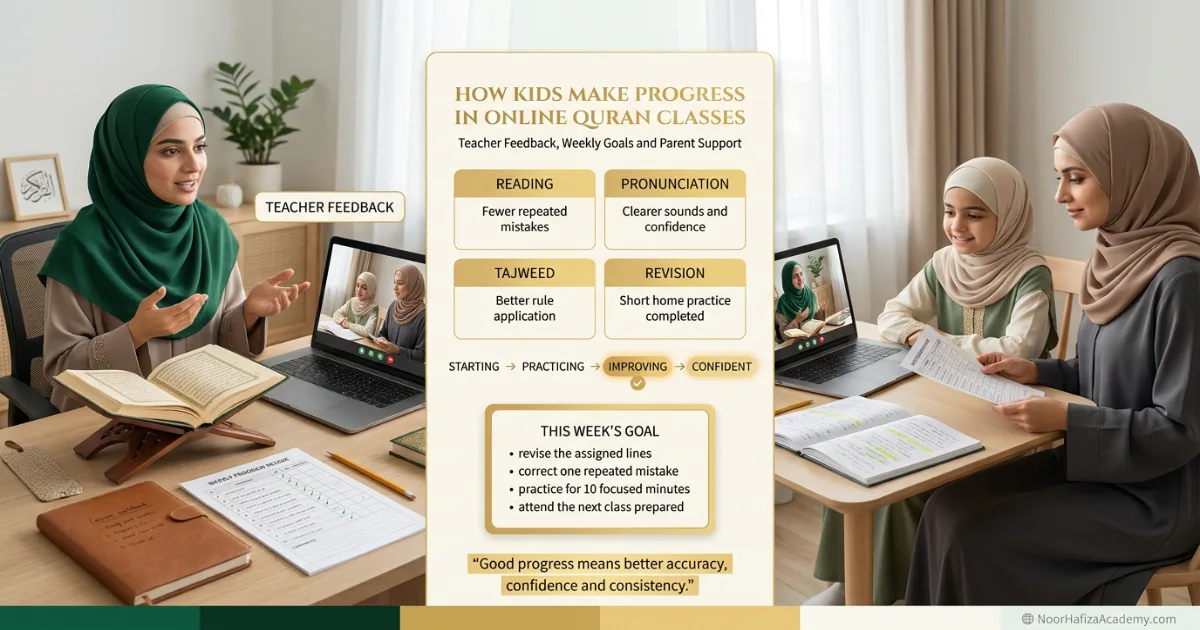
Page numbers are visible, but they are not enough. A child may move quickly through a book while repeating the same vowel or pronunciation errors. Another child may spend longer on a smaller section but build a foundation that makes future reading more accurate and independent. Parents should look for improvement in skill, not only movement through material.
Signs of meaningful progress
- Recognizes letters or words with less prompting
- Reads with fewer repeated vowel and joining mistakes
- Produces difficult sounds more clearly after correction
- Applies a Tajweed rule in a new place
- Reads longer phrases with smoother pacing
- Retains memorization across recent and older revision
- Prepares for class and accepts feedback more independently
Useful questions for the teacher
- What specific skill improved this week?
- Which mistake is still repeating?
- What exact portion should be revised at home?
- Is the current pace suitable for this child?
- Does the learner need more repetition or a different explanation?
- What is the next realistic milestone?
- How can we support the same method at home?
What should happen during the first 30 days?
The first month should create a stable foundation for the learning relationship. Parents should not expect complete fluency, perfect Tajweed, or large memorization gains immediately. Early success means that the starting level is accurate, the teacher and child understand each other, the schedule is practical, the home routine is clear, and the child is beginning to respond to correction.
Assessment and comfort
The teacher confirms the starting point, observes attention and confidence, checks the technology, and introduces the first small objective.
Routine and repetition
The child becomes familiar with the lesson structure. Parents test whether the class time and home revision target are realistic.
Correction and transfer
The teacher checks whether earlier corrections appear in new words, lines, or recitation rather than only in the original example.
Review and adjust
The family and teacher identify what improved, what remains difficult, and whether pace, duration, timing, or revision should change.
Your child should know the teacher, understand the class routine, arrive with the correct material, recognize the current learning goal, and show at least one observable improvement in accuracy, confidence, attention, fluency, or revision. Clear direction matters more than impressive volume.
What if your child is distracted, shy, resistant, or progressing slowly?
Children do not respond to online learning in the same way. A challenge does not always mean the format has failed. It may point to a timing problem, an unsuitable lesson length, a weak teacher match, unclear revision, or an expectation that is too advanced for the current foundation.
The child cannot stay focused
Shorten the lesson, move it away from a tiring part of the day, remove background distractions, and ask the teacher to use smaller activity changes. Focus should be developed gradually rather than demanded all at once.
The child is shy with the teacher
Allow several lessons for trust to grow. Avoid answering on the child’s behalf. A patient teacher can begin with simple choices, short repetition, and predictable routines before expecting longer independent reading.
The child dislikes repeated correction
Ask whether too many errors are being corrected at once. Prioritizing one recurring pattern can feel more achievable. Praise an improved attempt, not only a completely perfect result.
Progress feels slow
Check attendance, home practice, starting level, and whether the same mistakes are being tracked. Foundations sometimes require patient repetition before visible speed appears.
The teacher-child match feels weak
Give normal adjustment time, then describe the specific issue to the academy. A genuine mismatch may involve communication style, pace, energy, language, or scheduling—not necessarily teacher quality.
Home revision causes arguments
Reduce the task until it becomes repeatable. Use the teacher’s exact target, choose a calm time, and stop turning every practice session into a test of the entire syllabus.
Online Quran classes vs. mosque or center classes for kids
Both formats can be beneficial. The stronger choice is the one that gives the child qualified teaching, accurate correction, emotional comfort, a sustainable routine, and enough consistency to improve. Online classes often provide flexibility and individual attention, while local group classes may offer in-person community and peer interaction.
| Feature | Online one-to-one classes | Typical local group classes |
|---|---|---|
| Teacher attention | Individual listening and correction | Attention is shared among multiple children. |
| Learning pace | Can follow the child’s actual level | Often follows the group’s average progress. |
| Scheduling | More recurring time options | Usually limited to center hours. |
| Travel | No commute | Requires transport, weather planning, and travel time. |
| Social environment | Private and focused. | Can provide in-person peer interaction. |
| Parent visibility | Easy to observe the routine | Parents may see less of the teaching process. |
| Technology | Requires reliable audio and internet | Does not depend on home internet during class. |
A parent checklist before enrolling your child
A polished website can explain a program, but the trial lesson reveals how the teacher actually interacts with your child. Use the trial and enrollment conversation to understand the learning process, not only the price and available time.
Ask about placement
How is the starting level checked? Will the child begin from demonstrated ability or automatically restart from page one?
Meet the teacher
Observe pronunciation, patience, clarity, correction style, rapport, and the child’s comfort with the female Quran teacher.
Understand the class format
Confirm whether lessons are live, one-to-one or group-based, how long they last, and what happens during a normal session.
Clarify revision
Ask how home practice is assigned, how missed work is handled, and how memorization revision is protected.
Check progress communication
Parents should know what is improving, what remains difficult, and what the next milestone will be.
Review policies
Confirm current fees, teacher availability, rescheduling, missed classes, communication routes, safety expectations, and cancellation terms directly.
Noor Hafiza Academy provides live online Quran learning for children with female Quran teachers. Families can review the dedicated Quran classes for kids program, explore all online Quran programs, understand how online Quran classes work, or view options for online Quran classes across the USA.
FAQs about online Quran classes for kids
Are online Quran classes effective for kids?
What age can a child start Quran classes online?
How long should an online Quran class be for a child?
Can a complete beginner learn Noorani Qaida online?
Can children learn Tajweed online?
Are online Quran classes suitable for Hifz?
Do parents need to stay during the lesson?
How often should kids take online Quran classes?
Can parents request a female Quran teacher for their child?
What happens during a free trial class?
Find the right Quran starting point with a free trial class
Share your child’s age, current Quran level, main learning goal, time zone, and preferred schedule. Noor Hafiza Academy will help you identify a suitable pathway and arrange a trial with a female Quran teacher.