Noorani Qaida vs Quran Reading: What Comes First?

Noorani Qaida vs Quran reading is not a choice between two competing courses. They are two connected stages of the same learning journey. Noorani Qaida teaches the mechanics of reading Quranic Arabic: letter recognition, joined forms, vowels, sukoon, shaddah, tanween, basic madd, and controlled blending. Quran reading then asks the learner to apply those skills inside real Quran words, verses, stopping signs, and longer passages. For a true beginner, Qaida usually comes first. For a learner who already reads accurately, a teacher may place them directly into Quran reading or use only a short Qaida review.
What comes first: Noorani Qaida or Quran reading?
Noorani Qaida normally comes first for a complete beginner because it teaches the reading tools needed to understand Quranic script. The learner practices letters, joined forms, short and long vowels, sukoon, tanween, shaddah, and blending in controlled exercises. Quran reading comes next, when those skills can be applied to real words and verses with less prompting. However, age does not decide the starting point. A child, teenager, or adult who can already read unfamiliar Quran words accurately may begin directly with Quran reading after a teacher checks their level. A learner who has “finished Qaida” but still guesses or confuses signs may need targeted Qaida revision before continuing.
Noorani Qaida vs Quran reading: the clearest comparison
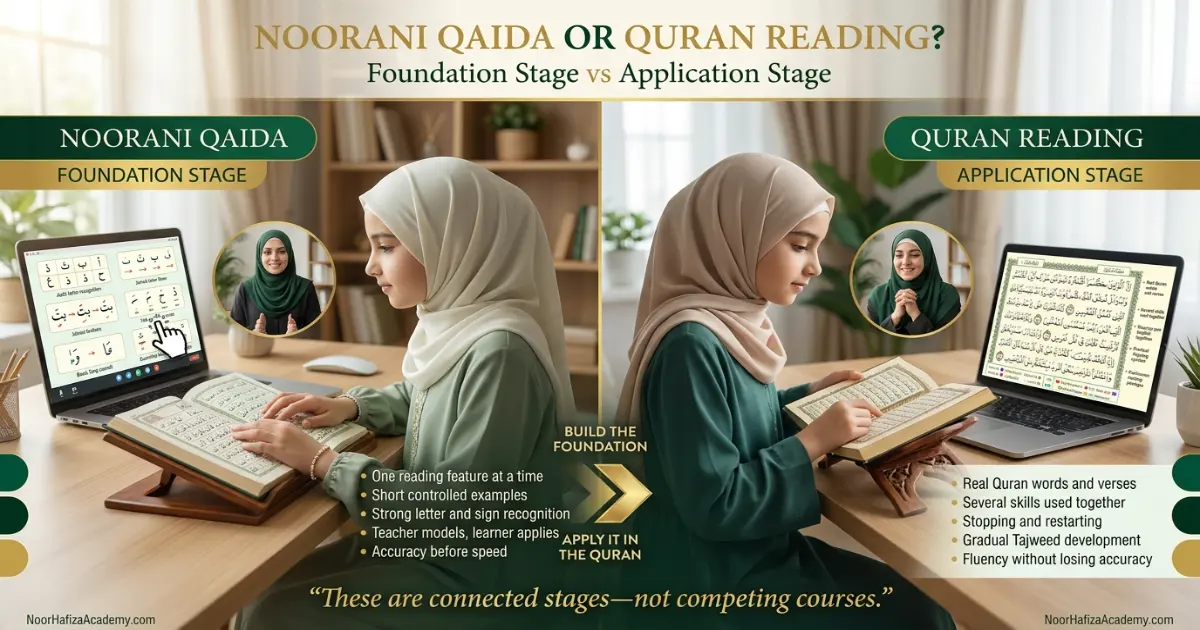
The difference becomes easier to understand when the two stages are treated as foundation and application. Noorani Qaida gives the learner a simplified environment in which one reading feature can be introduced at a time. Quran reading brings those features together in authentic verses, where the learner must recognize word shapes, maintain sound length, respond to stopping signs, and continue across a full line.
Neither stage should be treated as more valuable than the other. Qaida without transition can become a book-completion exercise. Quran reading without foundation can become guessing, memorized imitation, or constant dependence on the teacher. The strongest pathway connects both stages and moves forward only when the earlier skill appears in unfamiliar examples.
Noorani Qaida
A graded beginner primer that isolates the mechanics of Quranic Arabic reading.
- Individual and joined Arabic letters
- Fathah, kasrah, and dammah
- Tanween, sukoon, and shaddah
- Short and long sound control
- Blending unfamiliar combinations
- Early pronunciation correction
Quran Reading
Direct reading from the Mushaf or Quran text using the foundation already built.
- Real Quran words and complete verses
- Mixed signs appearing together
- Stopping and restarting correctly
- Consistent application of Tajweed
- Longer attention and reading flow
- Growing fluency without losing accuracy
What Noorani Qaida should teach before the Quran
A good Qaida lesson does more than move through a printed page. It teaches the learner to notice exactly what changes the sound. The teacher may present a letter alone, then with a short vowel, then in a joined form, and finally inside a mixed combination. This repeated contrast builds recognition and reduces guessing.
Different editions may use a different order or visual layout, but the essential learning outcomes remain similar. A beginner should gradually learn to recognize Arabic letters outside the familiar alphabet sequence, identify the same letter in different positions, produce short vowels briefly, control letters with sukoon, strengthen a doubled letter with shaddah, and distinguish short sounds from long sounds.
Letter recognition
Identify letters in mixed order rather than relying on memorized alphabet sequence.
Joined forms
Recognize how a letter changes at the beginning, middle, and end of words.
Short vowels
Read fathah, kasrah, and dammah without stretching or adding extra sounds.
Controlled blending
Move through connected sounds without stopping after every letter or guessing the word.
Sukoon and shaddah
Understand silent-vowel patterns and doubled consonants through guided practice.
Long vowels
Distinguish brief sounds from basic lengthening patterns before deeper Tajweed study.
Listening accuracy
Hear the difference between similar letters and compare the teacher’s model with the learner’s attempt.
Independent attempts
Read unfamiliar examples before the teacher gives the answer.
The word “completion” can be misleading. A learner has not benefited fully from Qaida merely because the final page was reached. The real test is transfer: can the student read a new combination, notice a familiar sign inside a Quran word, and correct the same type of mistake in another example?
What changes when the learner begins direct Quran reading?
Quran reading places the learner inside a more complex visual and recitational environment. Instead of practicing one sign repeatedly, the learner may meet several rules in one word and several word patterns in one line. The page also includes verse endings, pause signs, repeated expressions, and changes in rhythm. This is why a student may appear comfortable in Qaida but become slow again during the first weeks of Quran reading.
That slowdown is not failure. It is the normal cost of transferring a skill from controlled exercises into authentic text. The teacher should reduce the size of the reading portion, keep correction specific, and revisit the Qaida rule only when necessary. Returning briefly to a foundation exercise is useful; restarting the entire book automatically is often unnecessary.
Real word recognition
The learner applies familiar signs to words that were not practiced in the same sequence during Qaida.
Continuous lines
Reading moves beyond isolated examples and requires attention across a complete line or verse.
Stopping and starting
The teacher introduces practical places to stop, restart, and preserve the word correctly.
Tajweed application
Rules are no longer separate ideas; they must be noticed and applied while reading.
Reading flow
Pauses between letters gradually become shorter as recognition becomes automatic.
Self-correction
The learner begins to hear when a sound, length, or joining pattern is wrong and tries again.
Who should start with Qaida, and who can begin Quran reading?
Placement should come from a live reading assessment, not age, confidence, or a previous certificate. Some adults need the complete Qaida sequence. Some children have already developed strong foundations and can begin direct Quran reading. Some returning learners need only several lessons focused on joined forms, sukoon, or shaddah.
| Learner profile | Best starting point | Reason | First teaching goal |
|---|---|---|---|
| Complete beginner | Noorani Qaida | Letters and signs are not yet recognizable | Connect shape, name, and sound |
| Knows letters in sequence only | Early Qaida review | Recognition may depend on memorized order | Identify letters in mixed order |
| Knows letters but cannot blend | Middle Qaida lessons | Joined reading and signs are still weak | Blend two- and three-part combinations |
| Finished Qaida but reads slowly | Bridge lessons | Foundation exists but transfer is incomplete | Apply patterns to short Quran words |
| Reads Quran with repeated mistakes | Quran reading with targeted review | A full restart may not be needed | Correct recurring error patterns |
| Reads independently and accurately | Quran reading and Tajweed | Basic decoding is already established | Improve fluency, stopping, and rule consistency |
How to know when a learner is ready to move from Qaida to Quran
A learner does not need perfect speed before entering the Quran, but the foundation should be stable enough that the Quran page does not become a guessing exercise. The teacher can test readiness using a mixture of familiar Qaida patterns and unfamiliar Quran words. Reading should be slow but purposeful, with fewer prompts than before.
Signs the learner may be ready
The learner can attempt new examples with reasonable independence.
- Recognizes letters in joined positions
- Reads short vowels without stretching them
- Notices sukoon and shaddah
- Distinguishes basic short and long sounds
- Blends without adding unnecessary vowels
- Accepts correction and applies it to another word
Signs more Qaida work may help
The learner still depends heavily on page memory or teacher prompting.
- Confuses similar letters repeatedly
- Cannot recognize a letter after its shape changes
- Reads only after hearing the teacher first
- Skips or invents vowel sounds
- Treats sukoon and shaddah as ordinary vowels
- Cannot transfer a corrected pattern to a new example

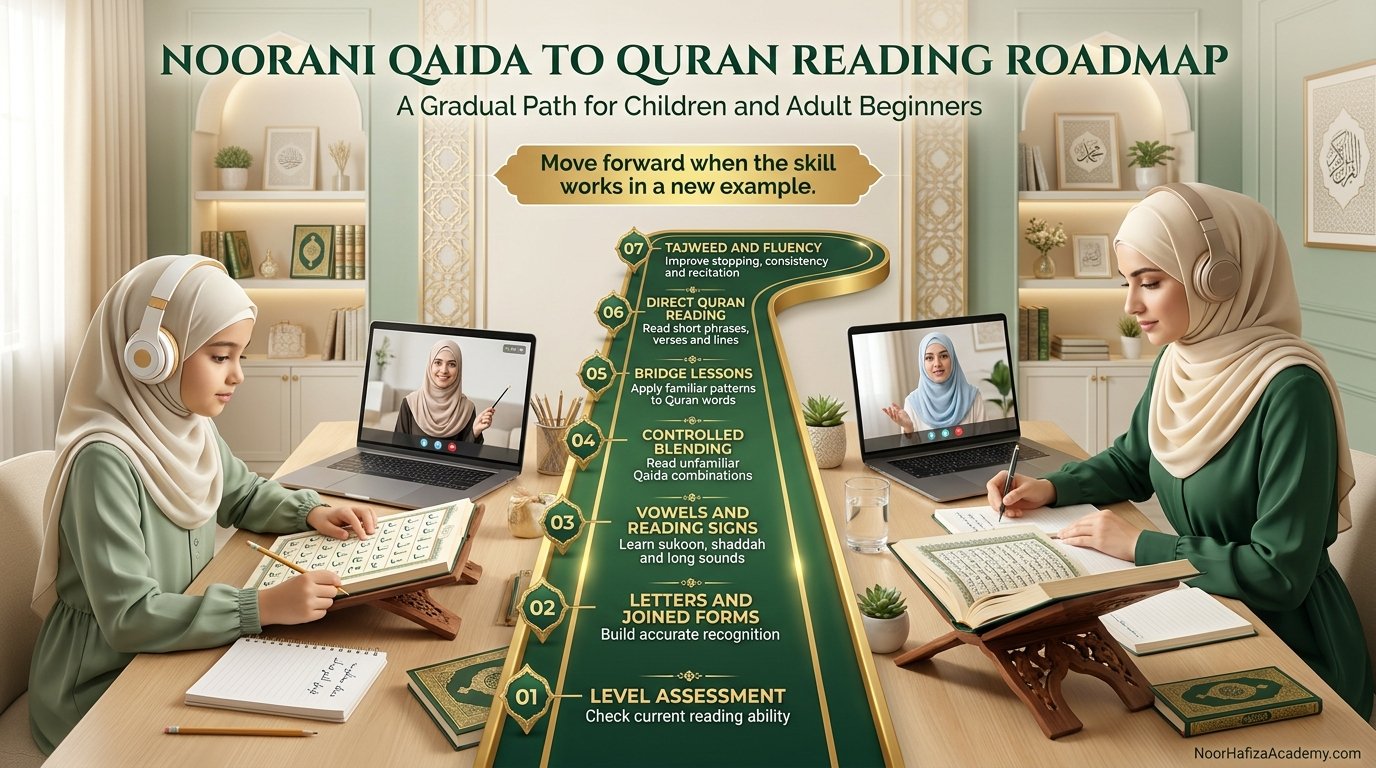
The transition should be a bridge, not a sudden jump
One common mistake is to finish the last Qaida lesson on one day and assign a full Quran page the next day. The learner then faces a new script density, smaller text, longer lines, and mixed signs without enough support. A bridge stage keeps the challenge controlled.
During this stage, the teacher may select short Quran words that contain familiar patterns, read only part of a line, enlarge the text on screen, or alternate between a Qaida review and a Quran application. The proportion gradually changes until most of the class is direct Quran reading.
Confirm the foundation
Test letters, joined forms, vowels, sukoon, shaddah, and basic lengthening without allowing the learner to depend on page order.
Select familiar Quran patterns
Choose short words containing signs the learner already understands so the first transfer feels recognizable.
Read small Quran portions
Begin with one word, a short phrase, or part of a verse rather than measuring success by page quantity.
Correct one issue at a time
Prioritize the mistake that most changes accuracy instead of interrupting the learner for every minor weakness.
Return briefly when needed
Use a targeted Qaida example to rebuild a weak rule, then test it immediately in a different Quran word.
Increase continuous reading
Move from words to phrases, then lines, as recognition becomes faster and the learner needs fewer prompts.
Add fluency and Tajweed depth
Once decoding is stable, give more attention to stopping, starting, repeated rules, rhythm, and smooth recitation.
Starting the Quran too early—and staying in Qaida too long
Both extremes can slow progress. Moving too early places the learner in material that requires skills they do not yet control. Staying too long in the same primer can reduce motivation and prevent the learner from seeing how the skills work in the Quran.
Entering the Mushaf through imitation
The learner repeats after the teacher but cannot read the same pattern independently in another word.
Measuring progress by pages
Finishing a Qaida page or Quran page says little unless accuracy, retention, and transfer are also checked.
Restarting every weak learner from page one
Targeted review may be more respectful and efficient when only one or two foundation areas are weak.
Waiting for perfect fluency
A learner can begin controlled Quran reading before reading becomes fast, provided the signs are recognized accurately.
Using speed as the main reward
Fast reading can hide skipped signs, shortened vowels, and guessed words. Accuracy must remain the first measure.
Treating age as ability
Adults may need foundations, while children may be ready for the Quran. Placement must follow evidence.
Where does Tajweed fit in the learning order?
Tajweed should not be postponed completely until the learner becomes fluent. Correct sound formation, basic length control, and careful listening begin during Qaida. However, completing Qaida does not mean that the learner has mastered all Tajweed rules. The primer provides a foundation; deeper Tajweed develops through repeated Quran application.
A beginner does not need a long technical lecture for every rule. The teacher can model the correct sound, explain one practical difference, and guide repetition. As Quran reading becomes more stable, the learner can understand the names, conditions, and repeated application of rules in greater detail.
Sound awareness
Hear and produce letters carefully during early Qaida lessons.
Basic reading control
Apply short vowels, sukoon, shaddah, and simple lengthening.
Rule recognition
Notice recurring Tajweed patterns while reading selected Quran words.
Consistent application
Maintain the rule across verses, stopping points, and longer reading.
The order is the same, but the teaching style should change by learner
The foundation-to-application sequence works for children and adults, but the lesson design should be appropriate to age, attention, goals, and previous experience. A young child may need shorter activities and visible repetition. An adult may progress quickly through letter recognition but need more time for unfamiliar articulation. A returning learner may need a respectful diagnosis rather than a full beginner restart.
Short, active foundation lessons
Use clear visuals, brief repetition, and parent help with setup while allowing the child to answer independently.
Protect confidence during review
Explain that targeted Qaida work is skill repair, not punishment or a return to “baby work.”
Teach from zero without embarrassment
Use mature language, practical explanations, and a schedule that fits work and family responsibilities.
Review only what is missing
Test current ability first and rebuild weak signs, joining, or sound patterns before increasing Quran reading.
How online Qaida and Quran reading lessons should work
Online learning can support both stages when the teacher can see the material, hear every attempt, control the pace, and provide immediate correction. The lesson does not require complicated software. Clear audio, a stable connection, visible text, and an environment where the learner can read aloud are more important.
In a Qaida lesson, the teacher normally presents a narrow skill target, demonstrates briefly, and gives the learner several independent examples. In a Quran reading lesson, the teacher listens to a larger portion, identifies recurring patterns, and balances correction with reading flow. The difference is not simply the book on the screen; it is the level of independence expected.
| Lesson feature | Noorani Qaida class | Quran reading class | What quality looks like |
|---|---|---|---|
| Main objective | Build one reading skill | Apply several skills together | The goal is clear before reading begins |
| Teacher modeling | Frequent but brief | Used for correction and difficult patterns | The learner is not echoing every word |
| Reading portion | Short controlled examples | Words, phrases, verses, and lines | Quantity matches current accuracy |
| Correction | Focuses on shape, sign, and sound | Focuses on recurring reading and Tajweed errors | Correction is specific and transferred to a new example |
| Home practice | Repeat a small skill set | Review the assigned lines and error pattern | Practice is short enough to be consistent |
A simple home-practice plan for each stage
Practice should reinforce what the teacher has already introduced. Parents and adult learners do not need to add random pages, unfamiliar rules, or multiple apps at the same time. A short routine repeated consistently is usually more useful than a long session completed occasionally.
Review a small group of letters or signs in mixed order, then read several unfamiliar combinations without hearing them first.
Read one Qaida pattern, then locate and read the same type of pattern in a selected Quran word.
Repeat the assigned line or verse slowly, marking the one recurring mistake that needs attention.
For young children, ten focused minutes may be more productive than a long argument over practice. For adults, linking practice to a stable daily moment—after a prayer, before work, or before sleep—can make consistency easier. The amount should be adjusted to the learner’s attention and schedule.
What the teacher, parent, and learner should each do
Progress becomes clearer when every person has a defined role. The teacher diagnoses and corrects. The learner attempts and practices. A parent supports routine and safety without reading every answer for the child.
Choose the correct starting point
Assess recognition, pronunciation, blending, and independent reading before assigning a full course or level.
Explain and correct precisely
Identify whether the error comes from the letter, vowel, joining, sound length, or a repeated Tajweed pattern.
Attempt before receiving the answer
Independent attempts reveal real ability and help the teacher separate recognition from memorized repetition.
Support the routine, not the response
Prepare the device and material, remain nearby for young children, and avoid answering before the child tries.
Review progress by skill
Ask what the learner can now recognize, apply, or correct—not only how many pages were completed.
What to check before enrolling in Qaida or Quran reading classes
A course title alone does not guarantee correct placement. Before enrollment, ask how the teacher assesses beginners, how often progress is reviewed, whether the learner can move between Qaida review and Quran reading, and how pronunciation is corrected online.
Live level assessment
The teacher listens to actual reading instead of placing the learner only by age or previous course name.
Relevant teaching experience
The teacher understands how to teach children, adults, or returning learners at the appropriate pace.
Clear correction method
The learner hears the correct model, understands the error, retries, and applies it in another example.
Progressive transition
The program does not keep learners in Qaida unnecessarily or move them into the Quran before they can decode.
Practical home revision
Assignments are specific, short, and connected to the exact skill taught in class.
Parent-visible communication
For children, scheduling, feedback, and learning updates remain clear and professional.
A short live assessment can show whether the learner needs full Noorani Qaida, targeted revision, bridge lessons, or direct Quran reading.
How Noor Hafiza Academy supports the Qaida-to-Quran journey
Noor Hafiza Academy offers live online Quran learning for children, girls, women, sisters, and beginners with female Quran teachers. A learner’s previous experience, reading ability, age, language needs, time zone, and schedule can be discussed before regular classes begin. The purpose of the initial trial or assessment is to identify a suitable starting point rather than assume that every beginner needs the same lesson.
A complete beginner may begin with Arabic letters and Noorani Qaida. A returning learner may receive a targeted foundation review. A learner who can already decode Quranic Arabic may begin Quran reading with correction and gradual Tajweed development. Current teacher availability, class schedules, lesson frequency, fees, materials, and enrollment terms should be confirmed directly with the academy.
Personalized starting level
Placement can reflect the learner’s actual reading rather than a fixed age-based sequence.
Female Quran teachers
Families and adult sisters can discuss teacher preference and current availability before enrollment.
Progressive course path
Lessons can move from Qaida foundations into Quran reading, revision, Tajweed, and fluency according to progress.
So, which one comes first for your learner?
Choose Noorani Qaida first when the learner cannot reliably identify letters, joined forms, vowels, sukoon, shaddah, or basic lengthening. Choose bridge lessons when the learner has completed Qaida but cannot yet transfer the skills into unfamiliar Quran words. Choose direct Quran reading when the learner can decode independently, even if the pace is still slow. Continue with Tajweed and fluency development when the learner can read lines accurately and is ready to improve consistency, stopping, and recitation quality.
The best answer is not determined by age, confidence, or how many pages were completed in the past. It is determined by what the learner can read today without being given the answer first.
Noorani Qaida vs Quran reading FAQs
What comes first, Noorani Qaida or Quran reading?
Can a beginner start reading the Quran without Noorani Qaida?
Does finishing Noorani Qaida mean a learner is ready for the Quran?
Should a child restart Noorani Qaida after a long break?
Is Noorani Qaida only for children?
Can adults begin directly with Quran reading?
Does Noorani Qaida teach Tajweed?
How long is the transition from Qaida to Quran reading?
What should happen in a Qaida-to-Quran assessment?
Can I request a female teacher for Noorani Qaida or Quran reading?
Not sure whether to begin with Noorani Qaida or Quran reading?
Share the learner’s age, previous experience, current reading level, time zone, and preferred schedule. A live trial can help identify whether the learner needs full Qaida, targeted review, bridge lessons, or direct Quran reading.