How Arabic Letters Join in Quranic Words
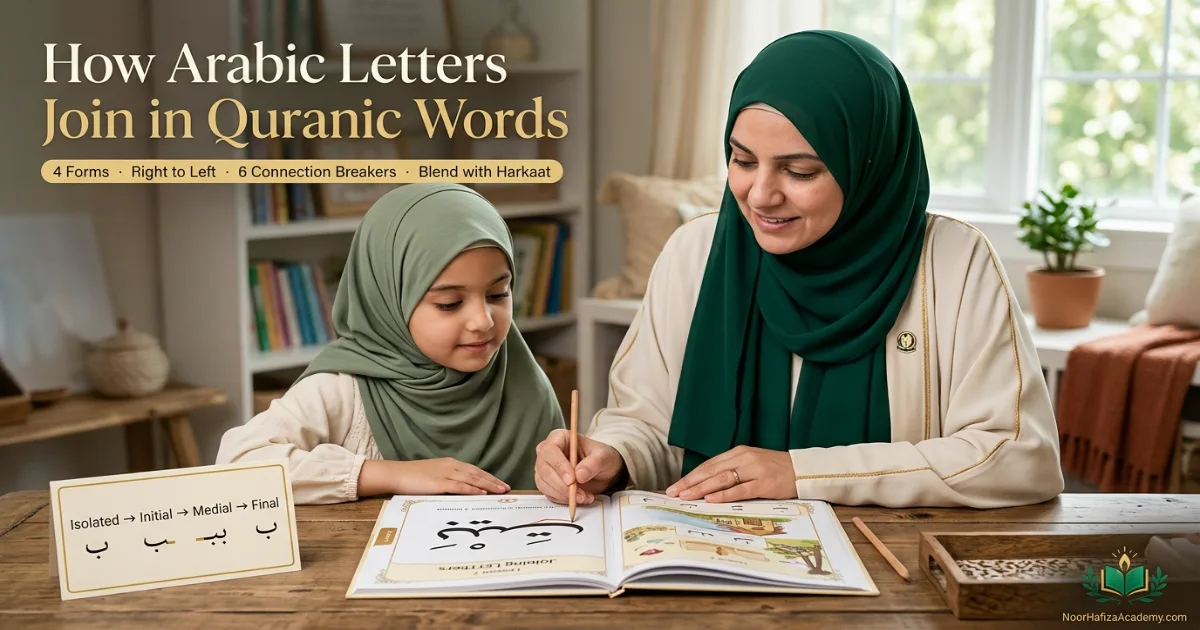
Arabic letters join together in Quranic words because Arabic is a connected script written from right to left. Most letters can connect to the letter before them and the letter after them, so their shapes may look different at the beginning, middle, or end of a connected group. Six common letters—ا, د, ذ, ر, ز, and و—do not connect to the letter that follows them in normal Arabic writing, which creates a visible break inside a word. For Quran beginners, learning these joining rules is one of the most important steps between memorizing the alphabet and reading real words.
How do Arabic letters join in Quranic words?
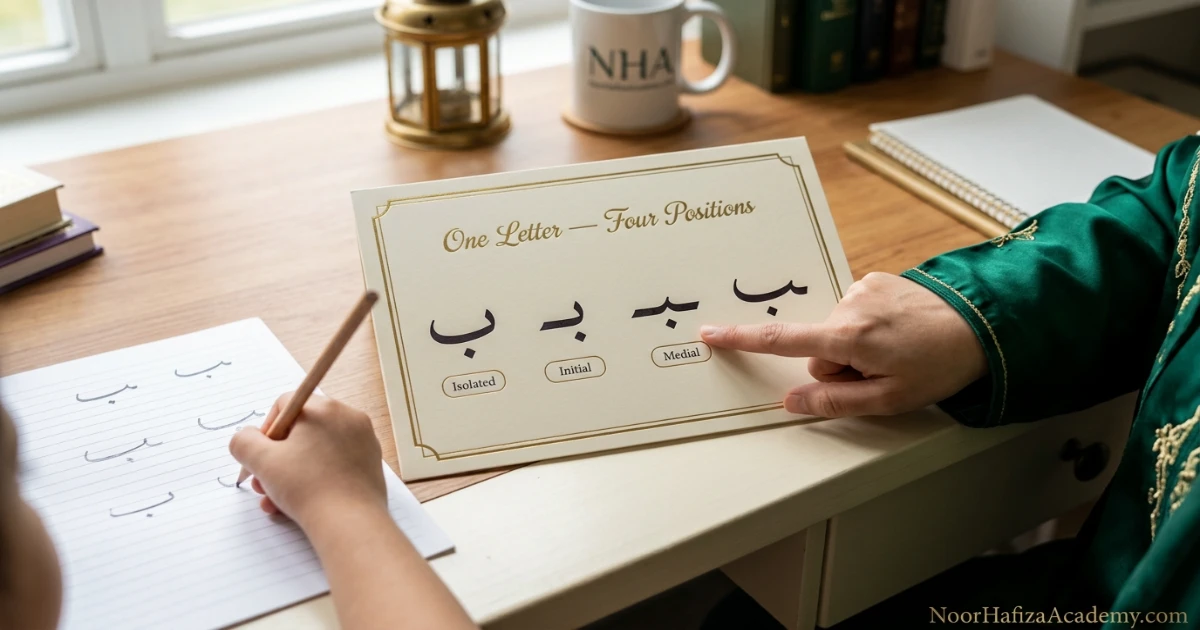
Arabic is written from right to left, and most letters connect into a flowing word shape. A letter may therefore appear in an isolated form when standing alone, an initial form at the beginning of a connected group, a medial form inside a connected group, or a final form at the end. Most letters can connect with neighboring letters on both sides. However, six letters—ا, د, ذ, ر, ز, and و—do not connect to the letter that follows them, so the next letter begins a new visual group. Beginners should learn the joining behavior of each letter and then practise recognizing the same letter in unfamiliar words. The letter’s identity does not change; only the connecting stroke and surrounding shape may change.
Why Quran beginners struggle when letters start joining
A beginner usually learns the Arabic alphabet as separate symbols: ب, ت, ث, ج, ح, خ and so on. Then a Qaida or Quran page suddenly presents those letters inside connected words. The learner may feel as if the alphabet has changed. It has not. Arabic simply modifies the connection strokes so letters can flow together.
The difficulty is mainly visual. A learner who knows ب in isolation may not immediately recognize its connected form at the beginning or middle of a word. A learner may also assume every letter must connect continuously, then become confused when a word contains د, ر, و, or another letter that breaks the connection.
Dots, basic curves, teeth, loops, and position help the learner recognize the same letter even when its connection strokes look different.
Isolated, initial, medial, and final Arabic letter forms
The labels isolated, initial, medial, and final describe how a letter appears according to its position in a connected group. Not every letter has four dramatically different visual forms, but the framework helps beginners understand Arabic handwriting and Quran print.
The letter stands alone or appears where no joining is possible on either side.
The letter begins a connected group and joins to the next compatible letter.
The letter sits inside a connected group and joins on both sides.
The letter ends a connected group and joins to the compatible letter before it.
Bā’ is a useful example because its dot remains below the shape in every form. The body stretches differently when joining, but the dot and basic identity remain recognizable.
Which side do Arabic letters connect to?
Because Arabic is read from right to left, the terms “before” and “after” can feel confusing. A safer beginner explanation is to think in reading order. Most letters can connect to the letter that comes before them in the word and also to the letter that follows them, provided the neighboring letters themselves allow the connection.
The connecting stroke is visual. It does not create an extra sound. The vowel marks, Sukoon, Shaddah, Tanween, and other symbols determine how the connected letters are pronounced.
Dual-joining behavior
Bā’ can usually connect to compatible letters on both sides, so it commonly appears in initial, medial, and final joined forms.
Shape stretches
Sīn keeps its recognizable teeth while the joining stroke changes according to position.
Shape may change more
‘Ayn can look quite different in isolated and medial positions, so repeated visual exposure is especially important.
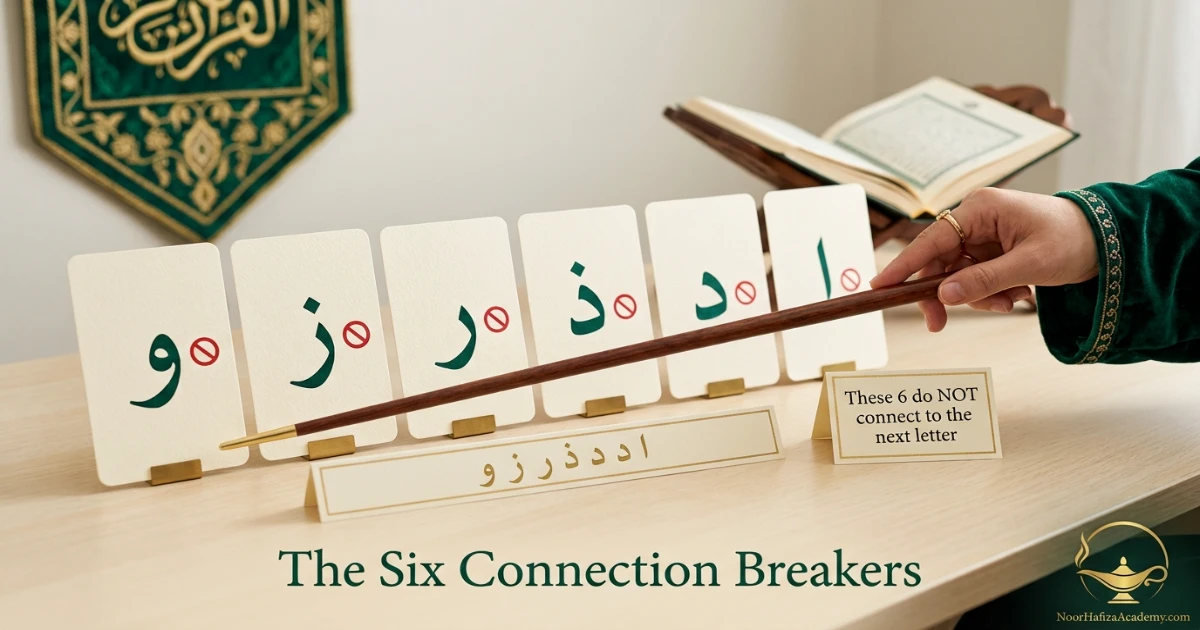
Which six Arabic letters do not connect to the following letter?
The six commonly taught letters are ا, د, ذ, ر, ز, و. Each can connect to a compatible letter before it, but it does not connect forward to the letter that follows it in reading order. The following letter therefore starts a new visual segment.
| Letter | Name | Joining behavior | Beginner memory cue |
|---|---|---|---|
| ا | Alif | Can receive a connection before it; does not connect forward | The next letter starts separately |
| د | Dāl | Does not connect forward | Break after dāl |
| ذ | Dhāl | Does not connect forward | Same joining behavior as dāl |
| ر | Rā’ | Does not connect forward | Next letter begins new group |
| ز | Zāy | Does not connect forward | Same joining behavior as rā’ |
| و | Wāw | Does not connect forward | Expect a visible break after wāw |
Use Arabic shape families to recognize joined letters faster
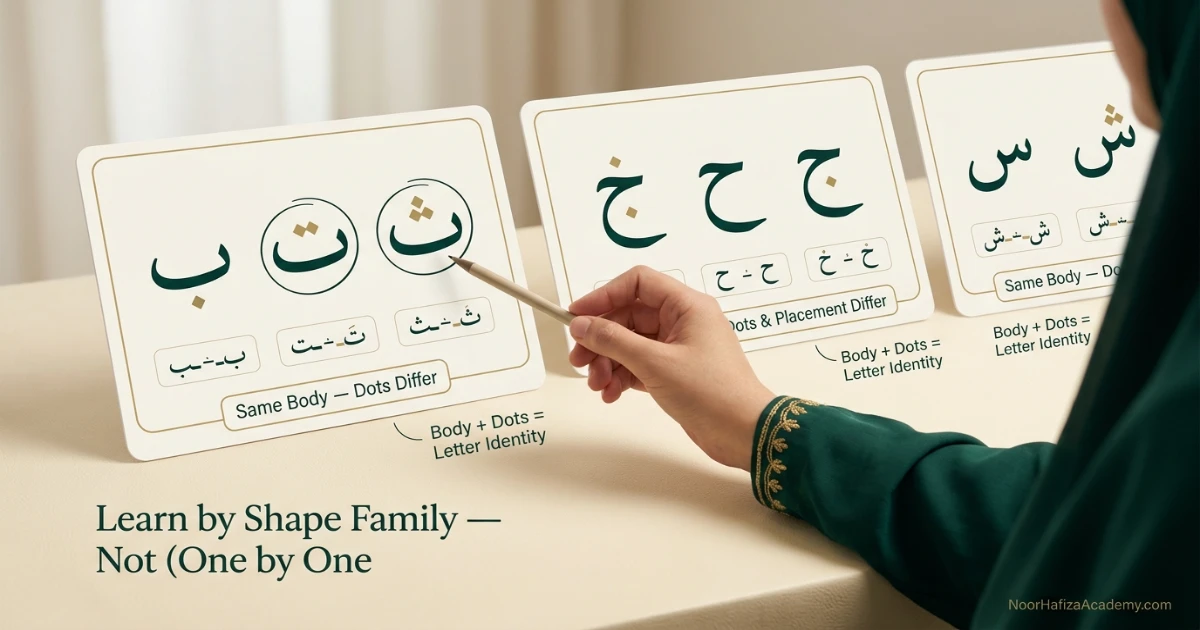
Many letters share the same core body and differ mainly by dots. This remains true when the letters join. Learning families helps the beginner read connected text without treating every joined shape as a brand-new symbol.
| Shape family | Letters | What stays recognizable | What beginners should watch |
|---|---|---|---|
| Bā’ family | ب ت ث | Same low curved body | Dot number and position |
| Jīm family | ج ح خ | Same bowl-like structure | Dot below, none, or above |
| Sīn family | س ش | Repeated teeth | Three dots on shīn |
| Ṣād family | ص ض | Heavy rounded body | Dot on ḍād |
| ‘Ayn family | ع غ | Distinctive curved form | Dot on ghayn and changed medial shape |
| Fā’/Qāf | ف ق | Related rounded forms in many scripts | Dot pattern and script style |
Examples of letters that look different when joined
Some Arabic letters change only slightly, while others become much more compact in medial form. Beginners should therefore practise several families rather than memorizing only one demonstration letter.
| Letter | Isolated | Initial | Medial | Final |
|---|---|---|---|---|
| Bā’ | ب | بـ | ـبـ | ـب |
| Tā’ | ت | تـ | ـتـ | ـت |
| Sīn | س | سـ | ـسـ | ـس |
| ‘Ayn | ع | عـ | ـعـ | ـع |
| Mīm | م | مـ | ـمـ | ـم |
| Hā’ | ه | هـ | ـهـ | ـه |
Exact appearance can vary somewhat by Arabic font and Mushaf style. Beginners should therefore learn the structural identity rather than one digital font only.
What happens when Lām joins Alif?
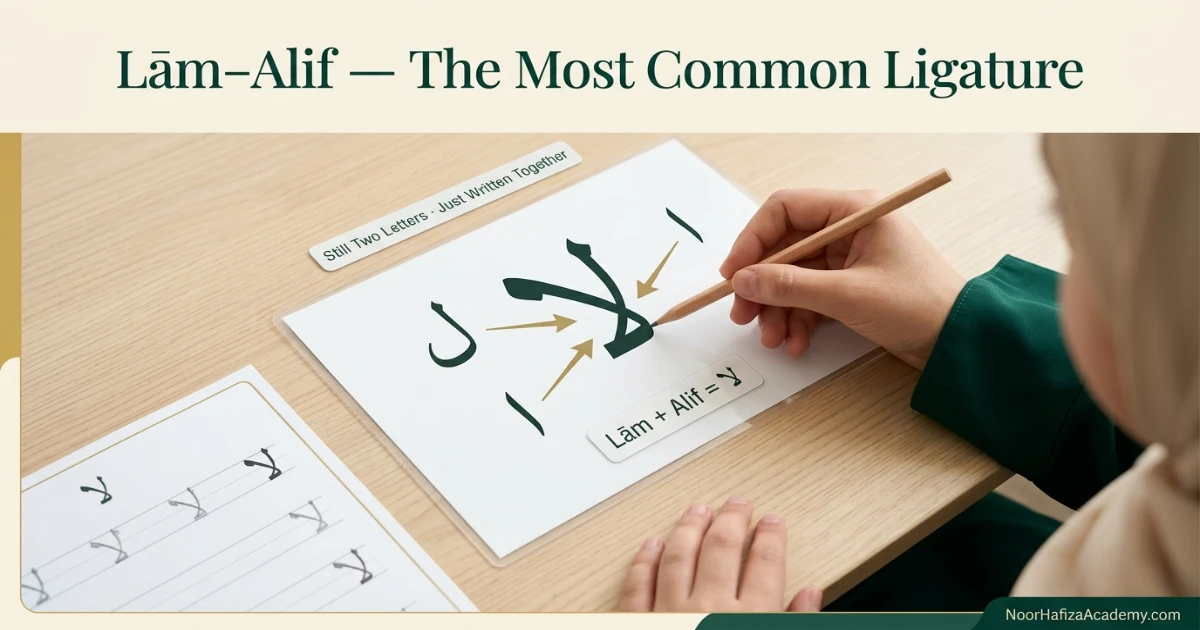
When Lām is followed by Alif, Arabic commonly uses the familiar combined form لا. This is often called the Lām–Alif ligature. It does not create a new alphabet letter. It represents Lām followed by Alif written in a standard combined shape.
For beginners, this pattern matters because it may look like an unfamiliar symbol at first. Once the learner knows that لا contains ل + ا, the shape becomes predictable.
Do Harkaat, Sukoon, Shaddah, and Tanween affect how letters join?
The joining shape and the reading marks perform different jobs. Joining tells you how letters are visually connected. Harkaat, Tanween, Sukoon, Shaddah, Madd signs, and other Quran marks tell you how those letters are pronounced.
A letter can be medial and still carry Fathah, Kasrah, Dammah, Sukoon, or Shaddah. The learner should first identify the underlying letter, then notice the reading mark. This two-step habit reduces confusion when a Quran word contains both unfamiliar joining shapes and multiple vowel signs.
Identify the base letter
Look at shape family, dots, and position before reading the vowel mark.
Check the joining boundary
Notice whether a non-connecting letter creates a visual break.
Read the mark
Apply Harkah, Sukoon, Shaddah, or Tanween after identifying the correct consonant.
How Noorani Qaida helps beginners learn joined letters
Noorani Qaida commonly moves learners from isolated letters to joined forms in a controlled order. A good teacher should not simply ask the student to repeat a page until it sounds familiar. The teacher should check whether the learner can identify the same shapes in a new order.
Recognize the isolated letter
The learner identifies the core letter and dot pattern confidently.
Match joined versions
The teacher shows the same letter at the beginning, middle, and end of different groups.
Spot connection breakers
The learner identifies ا د ذ ر ز و and predicts where a visual break will occur.
Add Harkaat
Joined letters are read with short vowels instead of being recognized visually only.
Blend short groups
The learner connects sounds without pausing after every letter.
Test unfamiliar examples
Fresh combinations prove that the learner understands the joining pattern rather than the page order.

Common mistakes beginners make with joined Arabic letters
Seeing every joined form as a new letter
The learner forgets that connection strokes can change while the letter identity remains the same.
Ignoring dots
Letters from the same family are confused because the learner looks only at the body shape.
Forcing every letter to connect
The learner forgets that ا د ذ ر ز و create a break before the following letter.
Reading from shape memory
A familiar Qaida line sounds correct, but a fresh word with the same letters becomes difficult.
Ignoring the base letter under marks
The learner focuses on Harkaat or Shaddah before correctly identifying the consonant.
Using one font only
The learner recognizes digital textbook shapes but becomes confused by a different Mushaf font.
Stopping after every letter
The learner identifies letters correctly but never develops connected word blending.
Advancing before joining is stable
Full Quran reading begins while medial and final forms are still being guessed.
A simple 30-day joined-letter practice plan
| Week | Main focus | Home practice | Teacher checkpoint |
|---|---|---|---|
| Week 1 | Isolated to initial forms | Match common letters with their initial connected forms | Check visual recognition without alphabet order |
| Week 2 | Medial and final forms | Mix letters from several shape families | Test unfamiliar connected groups |
| Week 3 | Six non-connecting letters | Predict and mark visual breaks inside short words | Check connection logic and letter identity |
| Week 4 | Vowels and blending | Read short joined groups with Harkaat, Sukoon, and simple mixed patterns | Confirm readiness for more direct Quran reading |

How do you know a beginner understands Arabic joining?
Useful readiness indicators
- Recognizes common letters in isolated, initial, medial, and final forms.
- Identifies shape families using dots and core body shape.
- Recalls that ا د ذ ر ز و do not connect to the following letter.
- Can predict where a word will visually break.
- Can identify the same letter in a different font or fresh example.
- Reads joined letters with Harkaat instead of naming letters only.
- Begins blending short groups rather than stopping after every symbol.
- Can attempt unfamiliar Qaida examples before the teacher models them.
Questions to ask a Quran teacher about joined-letter instruction
Use these questions during a trial or Qaida assessment
- Do you teach isolated, initial, medial, and final forms explicitly?
- How do you teach the six letters that do not connect forward?
- Do you group letters by visual family?
- How do you test joined-letter recognition in unfamiliar words?
- Do students identify the base letter before reading the Harkah?
- How do you teach Lām–Alif to beginners?
- Do you use more than one Arabic font or Mushaf style over time?
- How do you prevent page memorization?
- When do students begin blending joined groups?
- How much joined-letter practice should be done at home?
- How do you know the learner is ready for Quran reading?
- How do you report progress in letter recognition and blending?
Online Noorani Qaida classes for joined Arabic letters
Noor Hafiza Academy offers live online Quran learning for girls, women, children, adults, new Muslims, complete beginners, and returning readers with female Quran teachers. Beginners can start with an assessment of isolated letters, joined forms, Harkaat, Tanween, Sukoon, Shaddah, blending, and current Qaida level.
A suitable plan may include Arabic alphabet recognition, joined-letter practice, Noorani Qaida, connection rules, Makharij foundations, Harkaat, blending, and controlled Quran reading. Current female-teacher qualifications, availability, schedules, trial arrangements, fees, privacy practices, policies, and enrollment terms should be confirmed directly.
Share the learner’s age, current Qaida level, letter recognition, main joining difficulty, time zone, and whether the challenge is initial forms, medial forms, non-connecting letters, or blending.
FAQs about how Arabic letters join in Quranic words
Why do Arabic letters change shape in words?
How many Arabic letter forms are there?
Which Arabic letters do not connect to the following letter?
Do joined Arabic letters become different letters?
What is an initial Arabic letter form?
What is a medial Arabic letter form?
What is a final Arabic letter form?
What is Lām–Alif?
Do Harkaat change whether letters connect?
How should beginners practise joined Arabic letters?
Why can I read alphabet letters but not Quran words?
When is a beginner ready for full Quran words?
Recognize Arabic letters in every position and move from alphabet practice to confident Quran words
Share the learner’s age, current Qaida level, letter recognition, time zone, schedule, and whether the main difficulty is initial forms, medial forms, final forms, connection breakers, or blending.