Should a Child Learn Tajweed Before Starting Hifz?
Parents often feel torn between two good goals: helping a child memorize the Quran early and making sure every word is recited correctly. The best answer is not to delay Hifz until a child masters every Tajweed rule. Instead, build a practical Tajweed foundation first, then teach memorization and Tajweed together from the beginning.
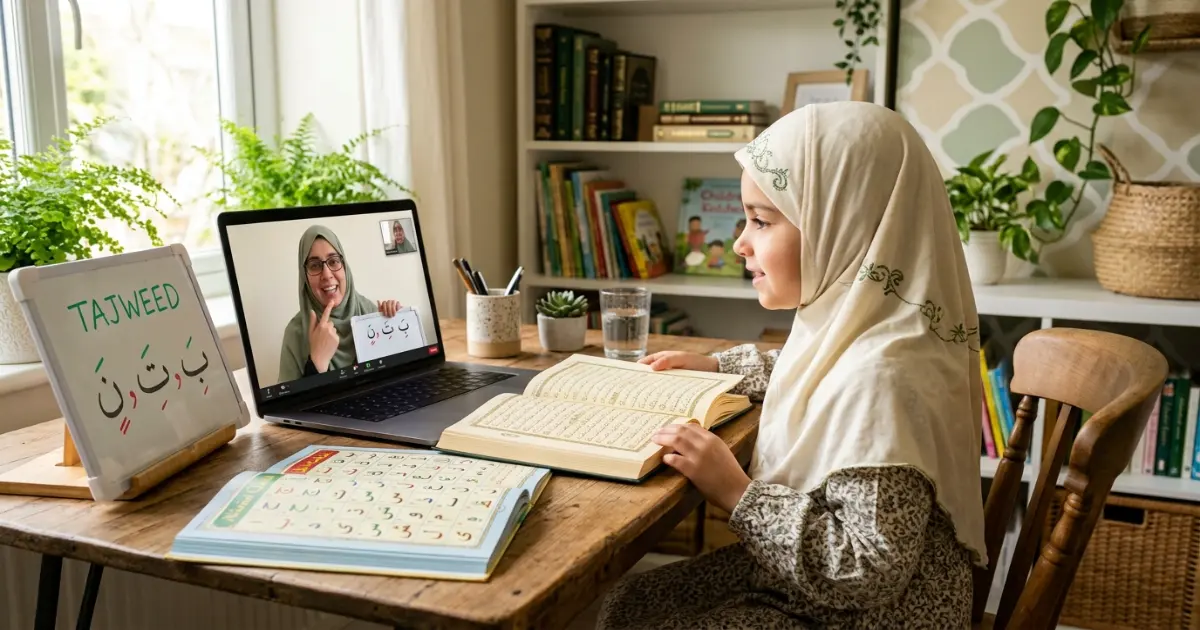
A child should learn enough Tajweed to pronounce Arabic letters and common recitation patterns correctly before starting serious Hifz, but full Tajweed mastery is not required. The most effective approach is to begin with basic makharij and guided reading, then teach Hifz and Tajweed together so the child memorizes each verse correctly from the start.
The best sequence: foundation first, then parallel learning
The question “Should a child learn Tajweed before starting Hifz?” is often treated as an either-or decision. In practice, the strongest learning path combines both goals.
A child does not need to complete an advanced Tajweed syllabus before memorizing any Quran. Waiting for complete mastery can delay a motivated child unnecessarily. At the same time, beginning Hifz with weak pronunciation can make incorrect sounds, word endings, or stopping habits deeply familiar. Once a mistake has been repeated hundreds of times, correcting it may require more patience than learning it correctly the first time.
The balanced approach is simple: first establish the minimum skills needed for safe memorization. The child should recognize the Arabic letters, pronounce the main letter sounds with reasonable accuracy, follow a teacher’s recitation, and understand that memorization must be checked before it is repeated independently. After that, the child can begin short surahs while continuing to learn Tajweed in context.
Do not make a child wait for perfect Tajweed, and do not treat Hifz as sound-only memorization. Start with a basic Tajweed foundation, then let every new Hifz lesson become a practical Tajweed lesson as well.
This approach respects both accuracy and motivation. It allows the child to experience the joy of memorizing early while protecting the recitation from avoidable errors. It also reflects how children learn best: through listening, imitation, repetition, correction, and gradual understanding rather than through long technical explanations alone.
Why Tajweed matters before and during Quran memorization
Tajweed is the practical discipline of reciting the Quran with correct articulation, sound qualities, lengthening, nasalization, stopping, and connection between words. For a young child, Tajweed should not begin as a heavy list of Arabic terms. It should begin as learning how to hear and produce the words correctly.
Hifz is not only remembering the order of words. It is preserving the recitation itself. A child may remember a verse fluently while still replacing one letter with another, shortening a required madd, missing ghunnah, or stopping in an awkward place. Some pronunciation errors are minor and some can affect meaning, so accurate teaching is important from the first stage.
Children remember what they hear repeatedly. A clean teacher model helps the child store the verse with the right sounds and rhythm.
Correcting one line immediately is easier than repairing a whole surah after the same error has become automatic.
A child who knows how letters should sound is less likely to guess, rush, or feel nervous when reciting to a teacher.
Qur’an 73:4 emphasizes measured recitation. For children, this means teaching them to slow down enough to pronounce clearly rather than rewarding speed alone. A child who memorizes fewer lines accurately is often building a stronger Hifz foundation than a child who memorizes more lines with unstable pronunciation.
Tajweed also gives structure to revision. When a teacher says, “Repeat this letter from its correct articulation point,” “hold this madd,” or “do not stop here,” the child has a specific correction target. Without this guidance, revision can become simple repetition of the same mistakes.
What Tajweed should a child know before serious Hifz?
The minimum foundation depends on the child’s age, reading ability, and memorization method. A child who reads from the Mushaf needs stronger decoding skills than a younger child who begins by listening and repeating short surahs. However, the following abilities are useful before starting a regular Hifz schedule.
- The child can distinguish most Arabic letters and does not regularly confuse similar sounds.
- The child can imitate the teacher slowly without adding, dropping, or changing words.
- The child has begun learning basic makharij, especially commonly confused letters.
- The child understands short vowels, sukoon, shaddah, and basic madd at an age-appropriate level.
- The child can pause and repeat one phrase several times without becoming distressed.
- The child accepts correction and is willing to repeat a line before moving forward.
- The parent understands that new memorization must be checked by a qualified teacher.
The child does not need to explain every rule by name. A six-year-old may correctly apply ghunnah or madd through imitation before learning the formal terminology. Application is more important than memorizing definitions at the beginning.
The five essential Tajweed areas for a beginner Hifz student
The child learns where key letters are produced and practices sounds that are commonly confused.
The child learns not to stretch short vowels or shorten sounds that require madd.
The child hears doubled letters clearly and avoids inserting extra vowels into still letters.
The teacher demonstrates these sounds in actual verses rather than teaching them only as theory.
The child learns where to pause safely and how to restart without breaking the flow of meaning.
The most important rule is that every new portion is listened to and approved before independent repetition.
Three learning pathways based on the child’s age and level
There is no single starting sequence that fits every child. The right method depends on whether the child is a pre-reader, an early reader, or already able to read Quranic Arabic with some confidence.
Pathway 1: Young child who cannot yet read Arabic
A young child can memorize short surahs through listening before reading independently, provided the teacher models every phrase carefully. In this pathway, Tajweed is taught through sound and imitation. The child listens to a short phrase, repeats it, receives correction, and only then repeats it several times.
The goal is not to teach long rule names. The teacher may say, “Make this sound deeper,” “hold this sound for two counts,” or “close your lips here.” This practical language protects pronunciation without overwhelming the child. Alongside Hifz, the child can begin Noorani Qaida so reading skills gradually catch up with memorization.
Pathway 2: Child working through Noorani Qaida
This child can begin limited Hifz while continuing Qaida. Short surahs are appropriate because they provide motivation and help the child experience success. However, the memorization portion should remain small enough that Qaida progress does not stop. A balanced weekly plan may include two or three days of Qaida and short Hifz practice in every class.
The teacher should connect the two subjects. When the child learns shaddah in Qaida, the teacher points it out in the memorized surah. When the child learns madd, the same rule is reinforced in recitation. This makes Tajweed meaningful because the child sees it in the Quran immediately.
Pathway 3: Child who already reads Quran
A child who can read independently should complete a focused Tajweed assessment before starting an intensive Hifz schedule. The teacher listens for letter substitutions, vowel mistakes, unstable madd, missing ghunnah, and poor stopping. The child does not need to become perfect first, but repeated foundational errors should be corrected before the daily memorization load increases.
For this child, Hifz and Tajweed can be integrated into the same lesson: revision first, new recitation correction second, memorization third, and a short Tajweed focus at the end. This is often more effective than separating Tajweed into a purely theoretical class.
Tajweed before Hifz vs. Tajweed during Hifz: what works best?
| Approach | Advantages | Possible risk | Best use |
|---|---|---|---|
| Complete Tajweed first | Strong theoretical foundation | Hifz may be delayed; young children may lose motivation | Older students who enjoy formal study |
| Start Hifz with no Tajweed | Fast beginning and early excitement | Pronunciation mistakes may become deeply memorized | Not recommended without close teacher correction |
| Basic Tajweed, then parallel learning | Balances motivation, accuracy, and steady progress | Requires a teacher who corrects consistently | Best choice for most children |
| Pause Hifz to repair major errors | Protects future memorization quality | Child may feel disappointed if not explained gently | Children with repeated foundational mistakes |
For most families, the third option is the most practical: basic Tajweed first, then Hifz and Tajweed together. The child gains early memorization experience without treating pronunciation as something to fix later.
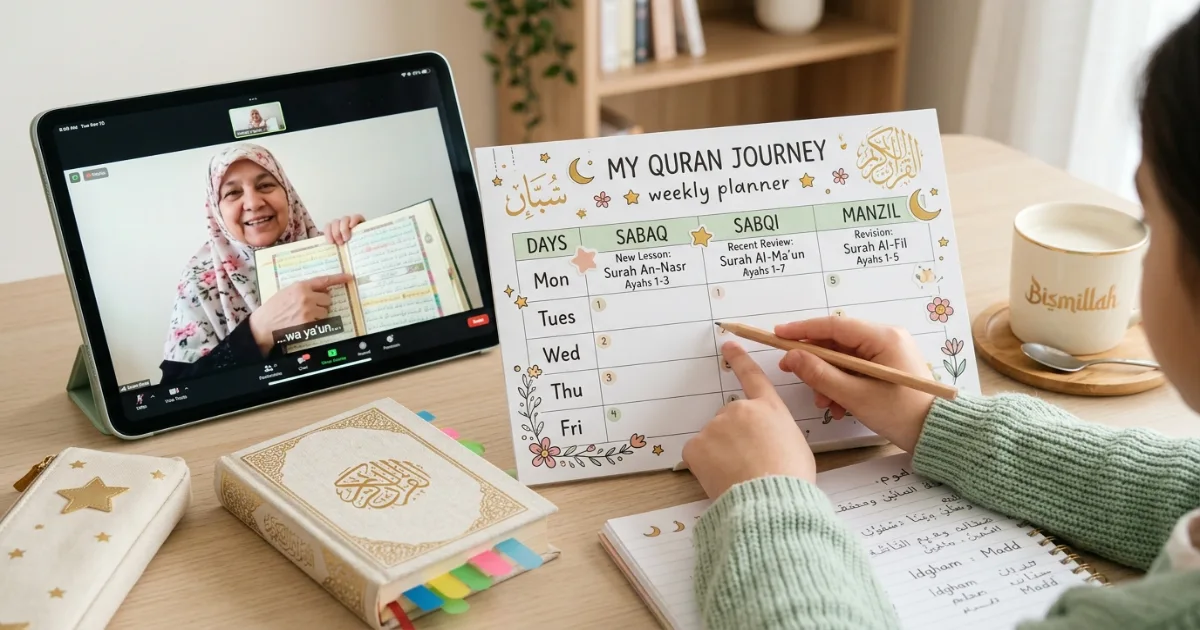
A practical weekly plan for Tajweed and Hifz together
A good schedule does not overload the child with new material every day. It balances four needs: correct recitation, new memorization, recent revision, and older revision. The exact amount should be adjusted to the child’s age, school routine, attention span, and retention.
Sample three-class weekly plan
- Class 1: Review older surahs, correct recurring Tajweed mistakes, and introduce a small new portion.
- Class 2: Test the new portion, revise recent memorization, and focus on one practical Tajweed point.
- Class 3: Combine the week’s new memorization, review difficult words, and test fluency without rushing.
- Home practice: Five to fifteen minutes daily, using only the teacher-approved recitation and exact assigned portion.
For younger children, a “small and accurate” target works better than a large target. One or two lines learned correctly may be enough. Older children with strong reading and revision habits may memorize more, but the teacher should never increase the amount simply because the child can repeat it quickly once.
Use sabaq, sabqi, and manzil in an age-appropriate way
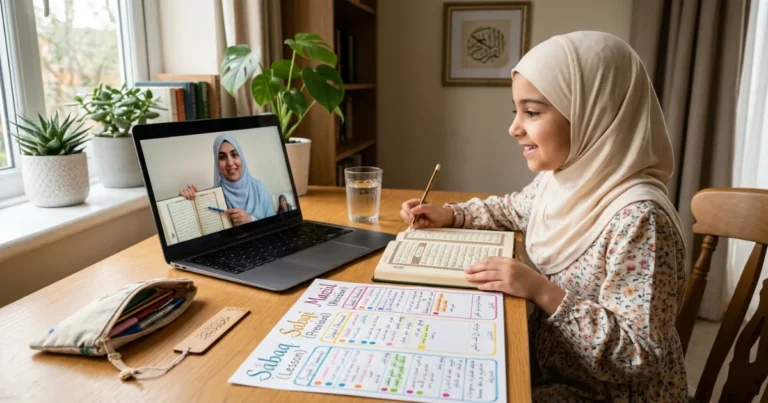
As the child’s memorization grows, the teacher can organize revision into three parts. Sabaq is the new portion. Sabqi is recent memorization that still needs frequent repetition. Manzil is older memorization that must remain strong over time. Children do not need complex charts at the beginning, but the principle should be present from the first surahs: new work never replaces old review.
A child who remembers today’s new lines but forgets last month’s surahs is not building stable Hifz. The schedule should therefore protect revision even when parents are eager for faster progress.
Common mistakes parents make when starting Hifz for children
1. Measuring success only by the number of pages
Page counts are easy to celebrate, but they do not show pronunciation quality or retention. A better progress report includes accuracy, fluency, revision strength, and the child’s ability to recite without prompting.
2. Using random online audio without teacher checking
Listening is helpful, but children may copy the wrong phrase boundary or mishear a difficult sound. Use one consistent reciter chosen by the teacher, and let the teacher approve the memorized portion before the child repeats it many times.
3. Correcting every tiny point at once
Too much correction can make a young child anxious. A skilled teacher prioritizes mistakes. Major letter or vowel errors are corrected immediately, while smaller refinements are introduced gradually. The child should feel that improvement is possible, not that every recitation is a failure.
4. Starting Hifz before the child can sustain revision
Some children are excited to memorize but resist reviewing. Before increasing new work, teach the habit of repeating yesterday’s lesson and reciting older surahs. Revision discipline is part of Hifz readiness.
5. Allowing different adults to teach different pronunciations
Conflicting correction confuses children. Parents should support the assigned teacher’s method and ask questions privately when unsure. A consistent model helps the child develop stable sound memory.
6. Turning every class into a test
Children need testing, but they also need teaching. A lesson should include explanation, modeling, supported repetition, encouragement, and a clear next step. Constant pressure can make the child hide mistakes instead of correcting them.
What if the child already started Hifz with weak Tajweed?
Do not panic and do not make the child feel that all previous effort was wasted. The memorization still has value. The goal is to repair it carefully without damaging confidence.
Begin with an assessment. The teacher should identify whether the errors are occasional or systematic. Occasional mistakes can be corrected during normal revision. Systematic errors—such as regularly confusing two letters, ignoring shaddah, shortening madd, or adding vowels—may require a temporary reduction in new memorization.
- Pause or reduce new sabaq for a short period if major errors are widespread.
- Choose one surah or one page at a time for repair.
- Mark repeated error types rather than correcting randomly.
- Use slow teacher modeling followed by short child repetition.
- Retest the corrected portion after one day, one week, and later revision.
- Celebrate improvement so correction does not feel like punishment.
Parents should avoid saying, “You learned it all wrong.” A better message is, “You already worked hard; now we are making your recitation even stronger.” This protects the child’s relationship with the Quran while still taking accuracy seriously.
Signs a child is ready to begin structured Hifz
Readiness is not determined by age alone. Some five-year-olds can manage a small, joyful memorization routine. Some older children need more time to build reading confidence and revision habits. Look for a combination of the following signs.
The child can listen to a short phrase and repeat it with reasonable attention.
The child can accept gentle correction and try again without becoming overwhelmed.
The family can protect a regular class and revision schedule most weeks.
The child can remember yesterday’s small portion after sleep and normal daily activities.
Major letter sounds are reasonably stable or improving under teacher guidance.
The child shows interest, pride, or calm willingness rather than constant resistance.
A child does not need all six signs perfectly. The purpose of a trial class is to observe strengths, identify obstacles, and choose a manageable starting plan. For some children, the right first step is Quran reading. For others, it is short-surah memorization with basic Tajweed. A thoughtful teacher adjusts the route without making the child feel behind.
How to choose a teacher for Tajweed and Hifz
The teacher should be able to do more than recite beautifully. Teaching a child requires patience, error detection, age-appropriate explanation, and a clear revision system. During a trial lesson, parents should observe how the teacher responds when the child makes a mistake.
- Does the teacher model the correct sound clearly before asking for repetition?
- Does she distinguish major errors from small refinements?
- Does she keep the child engaged without using fear or embarrassment?
- Does she check old memorization before adding new work?
- Does she explain what parents should revise at home?
- Does she adjust the amount of sabaq according to retention?
- Can she teach Tajweed practically inside the memorized verses?
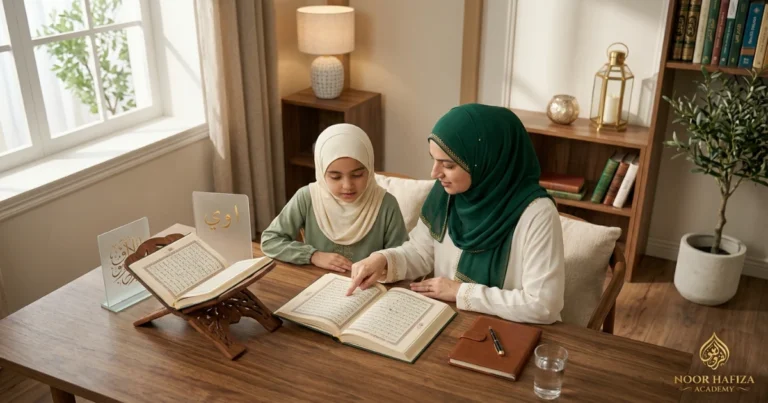
For many families, a private female Quran teacher online provides a comfortable and consistent environment for children, girls, and mothers who want to follow the learning closely. One-to-one lessons also give the teacher enough time to hear every word rather than only a short turn in a group class.
Parent checklist before starting Hifz with Tajweed
- What level of Quran reading does my child currently have?
- Which pronunciation errors should be corrected before increasing Hifz?
- How much new memorization is realistic each week?
- How will sabaq, sabqi, and manzil be organized?
- Which recitation audio should we use at home?
- How long should daily home revision take?
- How will the teacher report progress and recurring mistakes?
- When should the memorization target be reduced or increased?
Parents do not need to become Tajweed teachers. Their role is to protect the routine, encourage the child, play the approved recitation, and avoid teaching a pronunciation that conflicts with the teacher. The teacher handles technical correction; the parent makes consistent practice possible.
Final verdict: should a child learn Tajweed before starting Hifz?
Yes—a child should learn a basic, practical Tajweed foundation before beginning serious or high-volume Hifz. However, the child does not need to finish every Tajweed rule or reach perfect recitation before memorizing short surahs.
The strongest sequence is:
- Build correct Arabic letter sounds and basic reading patterns.
- Assess makharij, vowels, shaddah, madd, and stopping.
- Begin a small teacher-approved Hifz portion.
- Teach Tajweed inside the memorized verses.
- Protect daily revision before increasing new memorization.
This method prevents the two common extremes: delaying Hifz until the child loses motivation or rushing memorization while accuracy becomes weaker. A child can grow in memorization and Tajweed together, provided every new portion is taught carefully, corrected early, and revised consistently.
Frequently asked questions about Tajweed before Hifz
Start with a free Tajweed and Hifz level check
A female Quran teacher can listen to your child’s current reading or memorization, identify the most important pronunciation needs, and recommend a realistic starting plan.