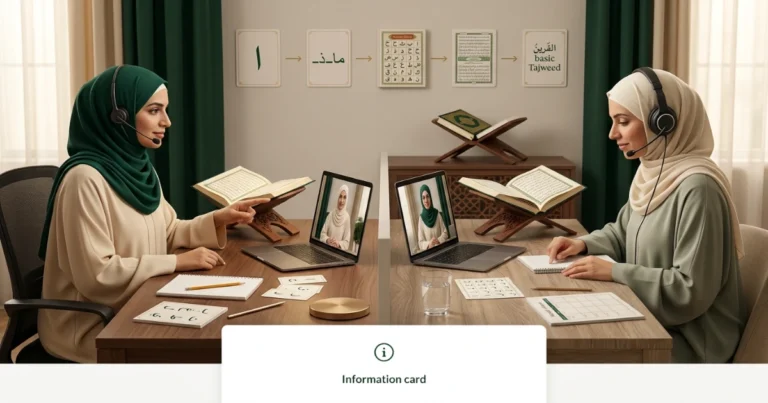
Online Quran Classes in the USA: Best Schedules for Every Time Zone

Families searching for online Quran classes in the USA often focus first on the teacher, course, or price. Schedule fit is just as important. A qualified teacher cannot produce steady progress when lessons repeatedly collide with school pickup, dinner, homework, sports, work shifts, bedtime, or changing clocks. The strongest schedule is not simply the earliest available appointment. It is a local-time routine the learner can attend calmly, practise between classes, and maintain through the school year.
What is the best schedule for online Quran classes in the USA?
For most school-age children, the best weekday window is usually 30 to 90 minutes after arriving home, or after a short snack and rest, but before the child becomes tired near bedtime. Many families begin by testing a local-time window between about 4:00 p.m. and 7:30 p.m. Adults often prefer early morning, a daytime break, or a later evening slot. The exact clock time should be written in the learner’s own time zone—Eastern, Central, Mountain, Pacific, Alaska, Hawaii, Atlantic, Samoa, or Chamorro time. The academy should also confirm how recurring classes handle daylight saving time, especially for Arizona, Hawaii, U.S. territories, and families who travel across zones.
Why the class schedule matters for Quran progress
Online learning makes it possible for a family in New York, Texas, Colorado, California, Alaska, Hawaii, Puerto Rico, Guam, or another U.S. location to connect with a suitable female Quran teacher. That flexibility is valuable, but it can create a hidden problem: a time that looks convenient on a booking screen may not fit the learner’s real day.
Children usually learn better when the class begins after they have had a chance to arrive home, use the bathroom, eat a light snack, and settle. A lesson scheduled immediately at school dismissal may be lost to traffic or pickup delays. A lesson scheduled too close to bedtime may be attended physically but not mentally. Adults may need a different pattern because work shifts, young children, college, or caregiving responsibilities can make a fixed weekday evening unreliable.
The schedule also affects home practice. A child taking Hifz classes needs time to revise the assigned portion before the next lesson. A beginner in Noorani Qaida needs short repetition between classes so letters and signs become familiar. A Tajweed learner needs enough space to practise one correction without forgetting it. When lessons are packed too tightly into a busy week, the family may attend consistently but practise inconsistently.
The lesson time, practice time, sleep, school, work, and family routine should support one another. A smaller schedule that continues for months is usually more productive than an ambitious schedule that repeatedly breaks.
Which U.S. time zone should your Quran class use?
The United States uses more time zones than the four commonly shown on continental maps. The U.S. Department of Transportation oversees national time-zone boundaries, while the National Institute of Standards and Technology publishes practical information about offsets and daylight saving time. For scheduling, families should provide a city and state or territory rather than only writing “USA time.”
| Time zone | Standard-time offset | Daylight-time offset | Scheduling note |
|---|---|---|---|
| Atlantic Time | AST · UTC−4 | U.S. Atlantic territories do not observe DST | Used in Puerto Rico and the U.S. Virgin Islands |
| Eastern Time | EST · UTC−5 | EDT · UTC−4 | Covers many East Coast and eastern states |
| Central Time | CST · UTC−6 | CDT · UTC−5 | Common across the Midwest, South, and parts of Texas |
| Mountain Time | MST · UTC−7 | MDT · UTC−6 | Most of Arizona stays on MST throughout the year |
| Pacific Time | PST · UTC−8 | PDT · UTC−7 | Used on the West Coast and in parts of the West |
| Alaska Time | AKST · UTC−9 | AKDT · UTC−8 | Most of Alaska follows this zone |
| Hawaii–Aleutian Time | HST · UTC−10 | HDT · UTC−9 in observing Aleutian areas | Hawaii does not observe DST; some Aleutian areas do |
| Samoa Time | SST · UTC−11 | No DST | Used in American Samoa |
| Chamorro Time | ChST · UTC+10 | No DST | Used in Guam and the Northern Mariana Islands |

Best online Quran class schedules for each major U.S. time zone
The clock window below is written in the learner’s local time. It is a planning starting point, not a promise that every teacher is available throughout the entire window. The family should choose two or three acceptable options and ask the academy to match them with current female-teacher availability.
ET · New York, Florida, Georgia and more
Children: 4:00–7:30 p.m.
Adults: 6:00–8:00 a.m. or 7:30–10:00 p.m.
Weekend: 9:00 a.m.–1:00 p.m.
CT · Illinois, Texas, Minnesota and more
Children: 4:00–7:30 p.m.
Adults: 6:00–8:00 a.m. or 7:30–10:00 p.m.
Weekend: 9:00 a.m.–1:00 p.m.
MT · Colorado, Utah, New Mexico and more
Children: 4:00–7:00 p.m.
Adults: 6:00–8:00 a.m. or 7:00–9:30 p.m.
Weekend: 9:00 a.m.–12:30 p.m.
PT · California, Washington, Nevada and more
Children: 3:30–7:00 p.m.
Adults: 6:00–8:00 a.m. or 7:00–9:30 p.m.
Weekend: 9:00 a.m.–1:00 p.m.
AKT · Most of Alaska
Children: 4:00–7:00 p.m.
Adults: early morning or early evening
Weekend: 9:00 a.m.–2:00 p.m.
Provide several options because global teacher overlap may be narrower.
HT · Hawaii
Children: 4:00–7:00 p.m.
Adults: morning, midday, or early evening
Weekend: 8:00 a.m.–2:00 p.m.
Hawaii does not change clocks for DST.
Families in Atlantic, Samoa, and Chamorro time should follow the same principle: choose a local window around the learner’s energy and responsibilities, then confirm teacher overlap. Guam and the Northern Mariana Islands are far ahead of the continental United States on the clock, so a morning class may create better international overlap than an evening class. American Samoa and Hawaii may also need wider availability choices.
The best after-school Quran schedule for children in the USA
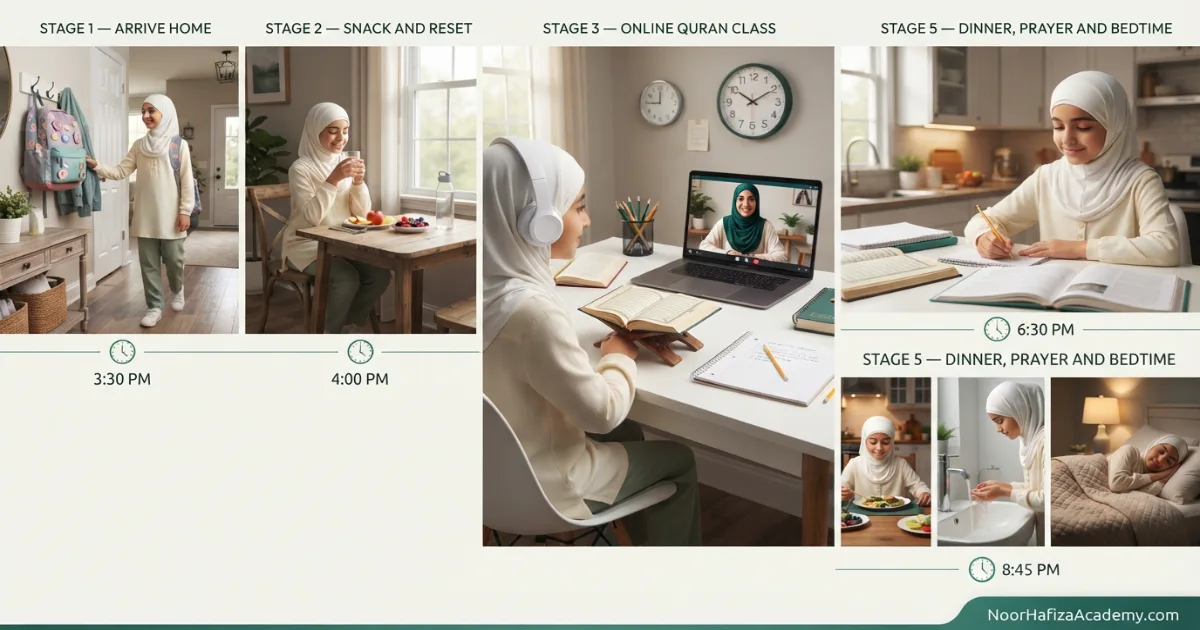
The strongest after-school schedule begins with the child’s real arrival time, not the official school dismissal time. Include pickup, bus delays, traffic, changing clothes, a snack, and a short mental break. A child who reaches home at 3:45 p.m. may not be ready for a live lesson at 4:00 p.m., even though the slot appears technically available.
Example school-day sequence
3:30–4:00 · Arrive home4:00–4:20 · Snack and reset4:30–5:00 · Quran class5:00–5:10 · Note assignmentLater · 5–15 minute review
The exact hour changes by family, but the order protects attention. A very young learner may need a 20- to 25-minute lesson. An older child may manage 30 to 45 minutes when the class includes varied reading, correction, and review.
Avoid placing the class between two rushed commitments. A child who must leave for sports in ten minutes may watch the clock instead of listening. A class immediately before dinner may be workable when the child has already eaten a snack, but it may fail when hunger is strong. A class after 8:00 p.m. can work for some older students, yet it is often too late for younger children who need school-night sleep.
Two or three classes per week?
Two weekly classes can suit a beginner whose family can maintain short home practice. Three or more classes may help a Hifz learner, a child who needs frequent pronunciation correction, or a beginner who forgets between longer gaps. Frequency should reflect the program and the family’s ability to complete revision. More classes are not automatically better when the child has no time to practise.
Best Quran class schedules for women, college students, and working adults
Adult learners often have stronger motivation but more complicated calendars. A parent may need to work around school drop-off and a toddler’s nap. A college student may have a changing timetable. A healthcare or retail worker may not have a standard Monday-to-Friday shift. The best schedule may therefore use a consistent weekly pattern, a rotating shift-based arrangement, or one fixed live lesson plus independent practice.
Choose a slot before work or school preparation when the home is quiet. Prepare the Mushaf, headphones, and notes the night before so setup does not consume the lesson.
Useful window: about 6:00–8:00 a.m. local timeA midday class may suit mothers, remote workers, retirees, or learners with flexible hours. Protect the class from calls and household tasks as you would protect an appointment.
Useful window: late morning or early afternoonAllow a transition after work. A short break, prayer, and meal may produce better concentration than starting the lesson immediately after logging off or commuting.
Useful window: about 7:00–10:00 p.m. local timeShare the repeating shift pattern before enrollment. Ask whether two approved slots or a weekly confirmation system is available rather than missing a fixed class repeatedly.
Confirm current rescheduling terms directly
How daylight saving time affects recurring Quran classes
Most of the United States changes clocks twice each year. Under the current federal rule, daylight saving time begins at 2:00 a.m. local time on the second Sunday in March and ends at 2:00 a.m. local time on the first Sunday in November. In 2026, NIST lists the daylight-saving period as March 8 through November 1. A recurring class can move by one hour relative to an overseas teacher if the calendar event is attached incorrectly or if one side changes clocks while the other does not.
Hawaii, American Samoa, Guam, Puerto Rico, the U.S. Virgin Islands, and most of Arizona do not observe daylight saving time. The Navajo Nation in Arizona does observe it. NIST also notes that daylight time applies in observing Aleutian areas but not in Hawaii. These exceptions are why “Mountain time” or “Hawaii time” should not be converted manually once and then assumed to remain correct all year.
A calendar set to “America/New_York,” “America/Chicago,” “America/Denver,” “America/Los_Angeles,” “America/Anchorage,” or “Pacific/Honolulu” can handle seasonal changes more safely than a recurring event saved only as UTC−5, UTC−6, or another fixed number.

A simple DST checklist for parents and adult students
- Confirm whether the class is booked in the learner’s named local zone.
- Check the calendar invitation one week before the March and November changes.
- Ask whether the academy or booking platform adjusts the teacher’s side automatically.
- Reconfirm the class after travel or a permanent move.
- For Arizona, provide the city rather than writing only “Mountain Time.”
- For Hawaii and U.S. territories, remind the scheduler that local clocks do not follow the mainland DST pattern.
How to book an online Quran class across time zones without mistakes
Provide the learner’s city, state, and ZIP code
This is safer than writing “East Coast” or “Mountain time,” especially near time-zone boundaries.
Write acceptable times in local time
For example: “Tuesday and Thursday between 5:00 and 7:00 p.m. Phoenix local time.”
Give two or three possible windows
A wider choice improves the chance of matching the learner with a suitable female teacher without forcing a poor time.
Confirm the first class in writing
Check the date, local clock time, time-zone label, lesson length, platform, and teacher name.
Save a time-zone-aware calendar event
Use the learner’s local zone and enable reminders. Avoid copying one manually converted hour into every month.
Recheck after a seasonal or family change
School terms, sports, work shifts, DST, and travel can turn a good slot into an unreliable one.
Choose class frequency and length according to the Quran program
| Program | Typical starting pattern | Home practice | Scheduling priority |
|---|---|---|---|
| Noorani Qaida | 2–4 short classes weekly | 5–10 minutes on most days | Frequent recognition and pronunciation practice |
| Quran reading and fluency | 2–3 classes weekly | 10–15 minutes of assigned reading | Learner should be alert enough to decode independently |
| Tajweed | 2–3 classes weekly | Short correction-focused repetition | Quiet audio environment and careful listening |
| Hifz | 3–5 classes weekly depending on level | New lesson plus recent and older revision | Enough daily space before the next teacher test |
| Islamic Studies | 1–2 classes weekly | Review notes, duas, or short assignments | A calmer weekend or early-evening learning window |
| Adult restart plan | 2 classes weekly | 10–20 minutes around work and family duties | Consistency is more important than a high weekly count |
These are planning ranges rather than fixed academy rules. The teacher may recommend a different lesson length or frequency after assessing age, reading level, goals, retention, and current availability.
How to schedule Quran classes for siblings and families
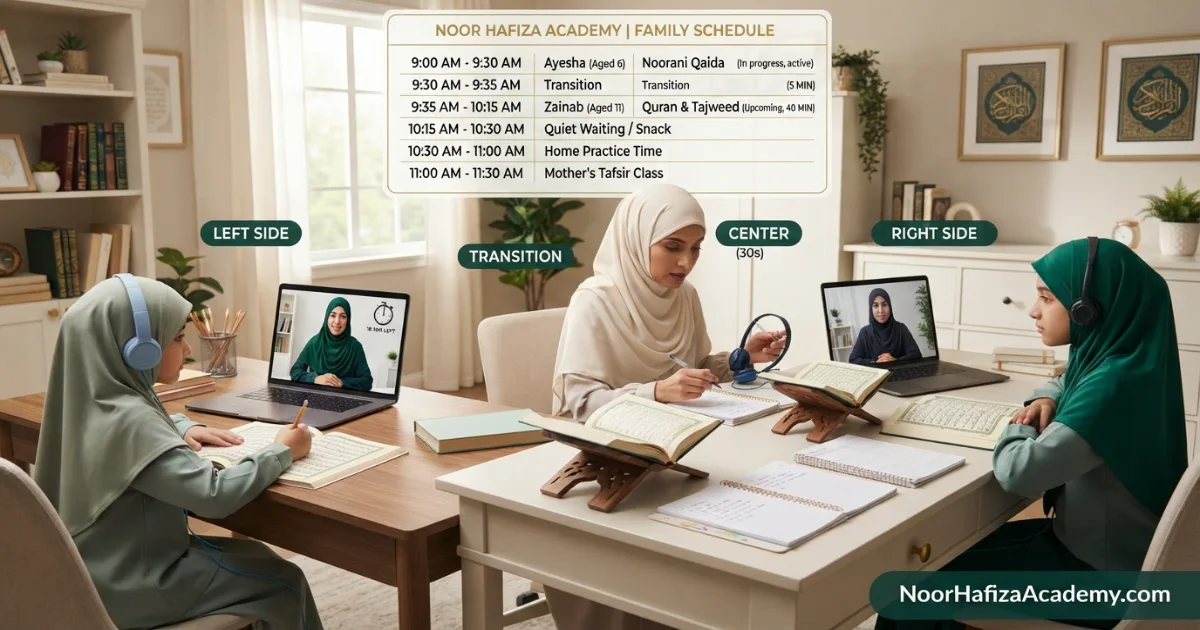
A family with two or three learners may prefer consecutive lessons, but identical times and lengths are not always appropriate. A five-year-old in Qaida, a ten-year-old in Hifz, and a mother studying Tajweed have different attention spans and practice needs. The schedule should preserve individual teaching while reducing household disruption.
Back-to-back one-to-one lessons
Useful when one device and one quiet room are shared. Add a five-minute transition so the next learner can open the correct book and the teacher can update notes.
Parallel lessons on separate devices
Can shorten the family’s total schedule but requires separate quiet spaces, reliable internet, headphones, and current teacher availability.
Children first, parent later
The parent supervises setup and then studies after bedtime or when another adult can manage the household.
Different days for different goals
Hifz may need frequent testing, while Islamic Studies or adult Tajweed may fit better on fewer, longer sessions.
Adjust the Quran schedule when the family routine changes
A schedule that works in July may fail in September. A school-year plan may need to shift when sports begin, daylight changes, or homework increases. Summer can support morning lessons or a modest increase in Hifz frequency, but families should avoid building a routine that disappears completely when school returns.
During Ramadan, some learners prefer a class before iftar, after iftar, or earlier in the day. The best time depends on local prayer timing, fasting energy, school, work, and the learner’s age. Do not assume a late-night class is suitable for a young child simply because the family is awake later. Confirm the temporary Ramadan schedule and the date when the normal schedule resumes.
Travel also needs a plan. A student who moves from Eastern to Pacific Time for several weeks should update the calendar zone rather than continuing to convert mentally. When international travel is involved, the family should share the destination city and dates before the trip.
Use the trial class to test the schedule—not only the teacher
- Was the learner ready and seated before the lesson began?
- Did school pickup, work, dinner, prayer, or bedtime create pressure?
- Was the internet quieter and more stable at this hour?
- Could the child focus for the full lesson length?
- Was there time to review the assignment later or the next day?
- Can the family maintain this slot for at least eight to twelve weeks?
- Does the teacher’s method fit the learner’s age, level, and goals?
- Are the cancellation, absence, and rescheduling rules clear?
A trial class can be educationally successful yet scheduled poorly. Tell the academy when the teacher seems suitable but the hour does not. It is better to search for another available slot than to enroll in a time the family already expects to miss.
When should parents review or change a child’s Quran class time?
Review the schedule after the first two to four weeks and whenever a major routine changes. Look at attendance, lateness, energy, homework conflict, practice completion, and the teacher’s observations. Do not change the slot after one unusually difficult day, but do not ignore a repeated pattern.
| Repeated sign | Possible schedule issue | Practical response |
|---|---|---|
| Child arrives late or flustered | Too close to school pickup or another activity | Move the lesson 30–60 minutes later |
| Frequent yawning and weak attention | Class is too close to bedtime | Try an earlier weekday or weekend slot |
| Homework remains unfinished | Lesson occupies the main study block | Move class before homework or to another day |
| Hifz revision is rarely ready | Not enough practice space between classes | Reduce frequency or reorganize revision time |
| Parent repeatedly requests rescheduling | The fixed slot does not match work or family duties | Choose a more realistic recurring window |
| Time changes by one hour unexpectedly | DST or calendar-zone error | Correct the named time zone and reconfirm |

Prepare the online learning space before the scheduled class
Even the right time can fail when setup starts after the teacher joins. Open the lesson link, charge the device, test headphones, place the Mushaf or Qaida on a rehal, and keep the assigned notebook nearby. A child should not spend the first five minutes searching for a pencil or moving between noisy rooms.
Use a quiet location where the learner can recite aloud without competing television, conversations, or kitchen noise. Position the camera so the teacher can see the learner’s face and book when appropriate. Children may need a mother or female guardian nearby for technology and safety, but the parent should avoid supplying every word or correcting over the teacher.
Sample USA Quran class schedules you can adapt
| Learner | Local-time example | Practice pattern | Best for |
|---|---|---|---|
| Young child in Qaida | Mon, Wed, Fri · 4:30–4:55 p.m. | 5–8 minutes on non-class days | Frequent recognition and short attention span |
| School-age Quran reader | Tue, Thu · 5:30–6:05 p.m. | 10 minutes most days | Fluency and Tajweed development |
| Child beginning Hifz | Mon–Thu · 6:00–6:35 p.m. | New, recent, and older review | Frequent teacher testing |
| Teen with activities | Tue evening + Sat morning | Independent midweek assignment | Busy school and sports calendar |
| Working woman | Tue, Thu · 8:30–9:10 p.m. | 10–15 minutes before or after work | Private evening study |
| Mother with young children | Mon, Wed · 11:00–11:40 a.m. | Short review during a quiet daytime period | Daytime household schedule |
| Alaska or Hawaii family | Two weekday options + one weekend backup | Confirm global teacher overlap | Narrower international scheduling windows |
| Shift worker | One fixed weekend lesson + one approved rotating slot | Written weekly plan | Changing work hours |
How Noor Hafiza Academy can discuss a USA-friendly schedule
Noor Hafiza Academy provides online Quran learning with female Quran teachers for children, girls, women, sisters, beginners, and returning learners. The suitable schedule depends on the learner’s location, age, course, current level, time zone, school or work routine, and the teacher availability at the time of enrollment.
When contacting the academy, share the learner’s city, state or territory, local time zone, age, preferred days, two or three local-time windows, desired program, and whether the schedule changes during school holidays or work shifts. For Hifz, also share the existing memorization and realistic daily revision time. For a child, mention school dismissal, bedtime, and major weekly activities.
Example: “My daughter is 9, lives in Dallas, Texas, and is available Monday to Thursday between 5:00 and 7:00 p.m. Central Time. She needs Quran reading and beginner Tajweed.”
Current teachers, exact lesson times, trial arrangements, fees, attendance rules, rescheduling options, and program availability should be confirmed directly. A schedule guide can narrow the right window, but enrollment should be based on the current teacher match and written terms.
FAQs about online Quran classes in the USA and time-zone schedules
What is the best time for online Quran classes for kids in the USA?
Do online Quran classes use Eastern Time or the student’s local time?
How do daylight saving changes affect Quran class times?
Does Arizona follow the same Quran class time as Mountain Time?
Does Hawaii change clocks for daylight saving time?
How many online Quran classes should a child take each week?
Are morning Quran classes better than evening classes?
Can siblings take online Quran classes back to back?
What schedule works best for online Hifz classes in the USA?
Can working women take online Quran classes at night?
What information should I send when asking for a Quran class schedule?
Can a class time be changed after enrollment?
Choose a local-time Quran class schedule your family can keep
Share the learner’s city, time zone, age, course, current level, preferred days, and two or three local-time windows. Noor Hafiza Academy can discuss current female-teacher availability and a realistic trial schedule.