
Online Quran Classes for Homeschool Families: Scheduling and Curriculum

Online Quran classes for homeschool families can fit naturally into a home education routine because parents are not limited to the narrow after-school window used by many traditional-school families. A child may study Quran in the morning before academic subjects, between core lessons, after lunch, or on selected afternoons depending on age, attention, family rhythm, and teacher availability. The curriculum can also be matched more precisely to each learner: one child may need Noorani Qaida and Arabic reading foundations, another may be ready for Tajweed, while a sibling may need Hifz revision or Islamic Studies. The strongest homeschool Quran plan combines flexible scheduling with clear learning targets, realistic lesson length, short home review, sibling coordination, and regular progress checks. Exact teacher availability, course structure, lesson lengths, fees, and trial arrangements should be confirmed directly.
How should homeschool families schedule online Quran classes?
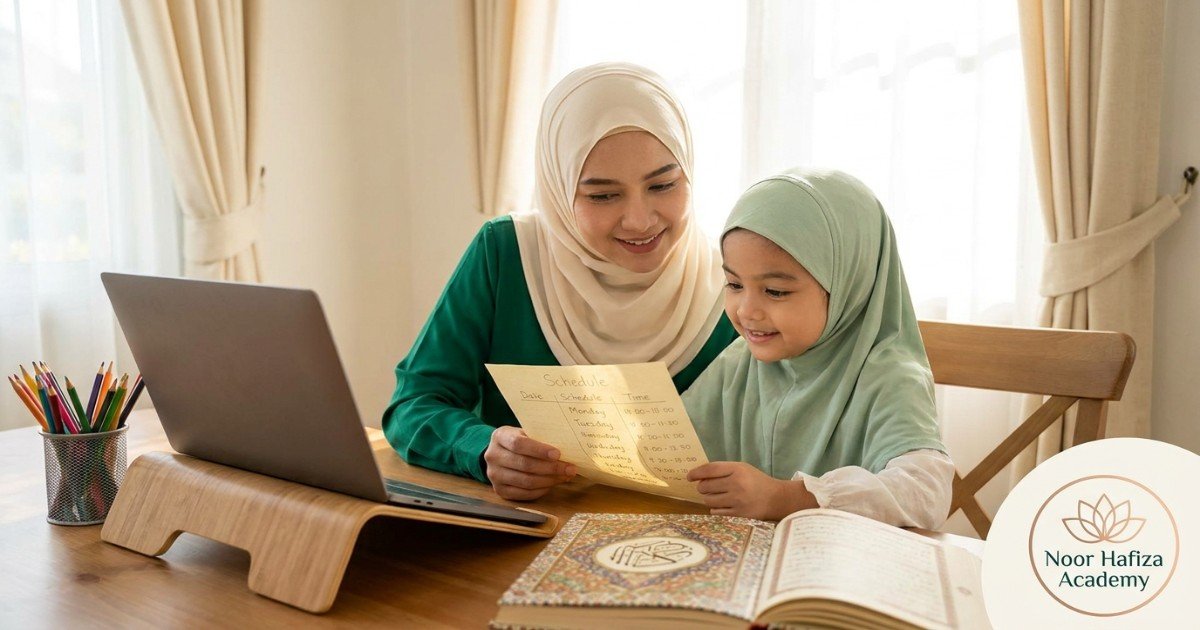
Homeschool families usually have more flexibility than after-school families, so the best Quran class time is often when the learner is mentally fresh rather than simply when the school day ends. Younger children may do well with a short morning lesson before heavy academics, older children may prefer late morning or early afternoon, and teens may choose an independent afternoon or evening slot. Build the curriculum around the learner’s level—Noorani Qaida for reading foundations, Quran reading for decoding and fluency, Tajweed for pronunciation and rules, Hifz for memorization and revision, and Islamic Studies where appropriate. If several siblings are enrolled, stagger lessons instead of expecting all children to learn at once. Use a weekly progress tracker and test the schedule during a trial class before committing.
Why online Quran classes can fit homeschool families especially well
Homeschooling gives families control over the order and timing of the school day. That makes it possible to place Quran learning during a high-attention period rather than squeezing it into a tired evening slot. A child who struggles at 7:00 PM may perform much better at 9:30 AM or 1:00 PM.
Online lessons can also reduce travel between academic subjects, co-ops, masjid programs, sports, and home responsibilities. The learner can move from math or reading into Quran with a short transition, then return to academics without losing an hour to commuting. This flexibility is especially useful for families with several children at different grade levels.
Homeschool families still need a protected recurring time. If Quran class is treated as something that moves every day, consistency can disappear even when the family technically has more free hours.
Best daily scheduling options for homeschool Quran classes
Morning Quran lesson
Useful for younger children or families who want Quran before demanding academic work begins.
Late-morning lesson
Can work after the first academic block, especially if the child needs time to wake up fully.
Early-afternoon lesson
A good option after lunch or a short break when the family prefers academics first.
Evening or weekend
Still useful when older learners, work schedules, co-ops, or outside activities fill the day.
The most important factor is attention. A schedule that looks beautiful on a planner but repeatedly catches the child hungry, restless, sleepy, or rushing from another subject will not perform well. Some families use Quran as the first academic subject of the day because it gives the lesson a protected place before interruptions begin. Others prefer to complete math and language arts first, then use Quran as a different type of focused learning block.
What should a homeschool Quran curriculum include?
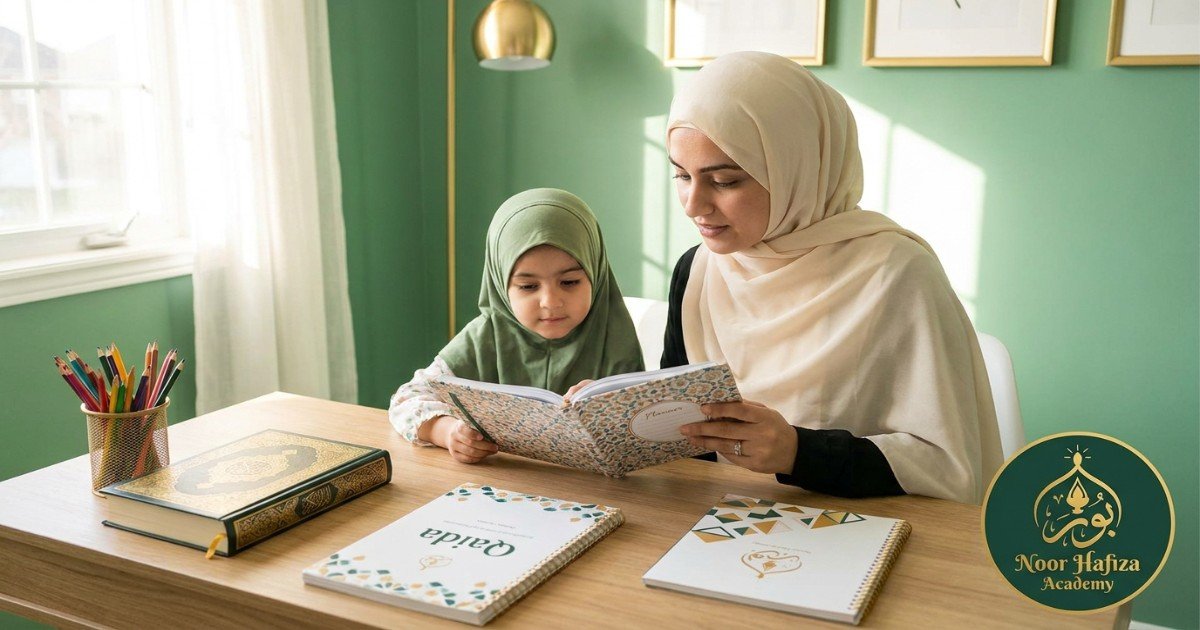
A useful Quran curriculum is level-based rather than age-only. Two children of the same age may need very different lessons if one reads Arabic fluently and the other is still learning letter shapes. Homeschooling makes it easier to respect those differences because the family does not need every child to stay on the same classroom page.
Arabic letters, Harkaat, joined forms, Sukoon, Shaddah, Tanween, blending, and reading foundations.
Accurate decoding, fluency, Makharij, stopping, and confidence in unfamiliar passages.
Ghunnah, Qalqalah, Madd, Noon and Meem rules, Waqf, and pronunciation correction.
New memorization, daily revision, old revision, listening checks, and retention planning.
Age-appropriate beliefs, worship, manners, Seerah, duas, and practical Islamic learning where offered.
Weekly or periodic checks so parents know what is improving and what still needs attention.
How to adjust Quran lessons for different homeschool ages
| Learner stage | Typical focus | Lesson style | Home follow-up |
|---|---|---|---|
| Early elementary | Letters, Qaida, short Surahs, basic duas | Short, interactive, highly guided | 5–10 minutes |
| Upper elementary | Quran reading, Tajweed basics, memorization | Guided reading + simple correction targets | 10–15 minutes |
| Middle / high school | Fluency, Tajweed, Hifz, Islamic Studies | More independent and goal-based | 15–20 minutes |
| Adult homeschool parent | Reading, Tajweed, translation study | Flexible around teaching and family duties | Short independent review |
These are planning examples, not rigid age rules. Reading level, maturity, attention, and family goals should shape the actual plan. A ten-year-old complete beginner may need a different curriculum from a seven-year-old who already reads independently.
How to schedule online Quran classes for multiple homeschool siblings
Sibling scheduling is one of the biggest advantages of online learning, but it needs structure. If every child has a different level, placing them in one lesson may reduce individual correction. Back-to-back lessons can be more efficient while still giving each child a focused block.
Stagger lessons
Book back-to-back or separated slots so each child receives focused teacher attention.
Use quiet rotation
While one child studies Quran, siblings can do independent reading, handwriting, or another quiet subject.
Share only when levels match
A small sibling group can work if reading ability, pace, and goals are genuinely similar.
Separate homework targets
Each child should leave with her own correction, revision, or memorization goal.
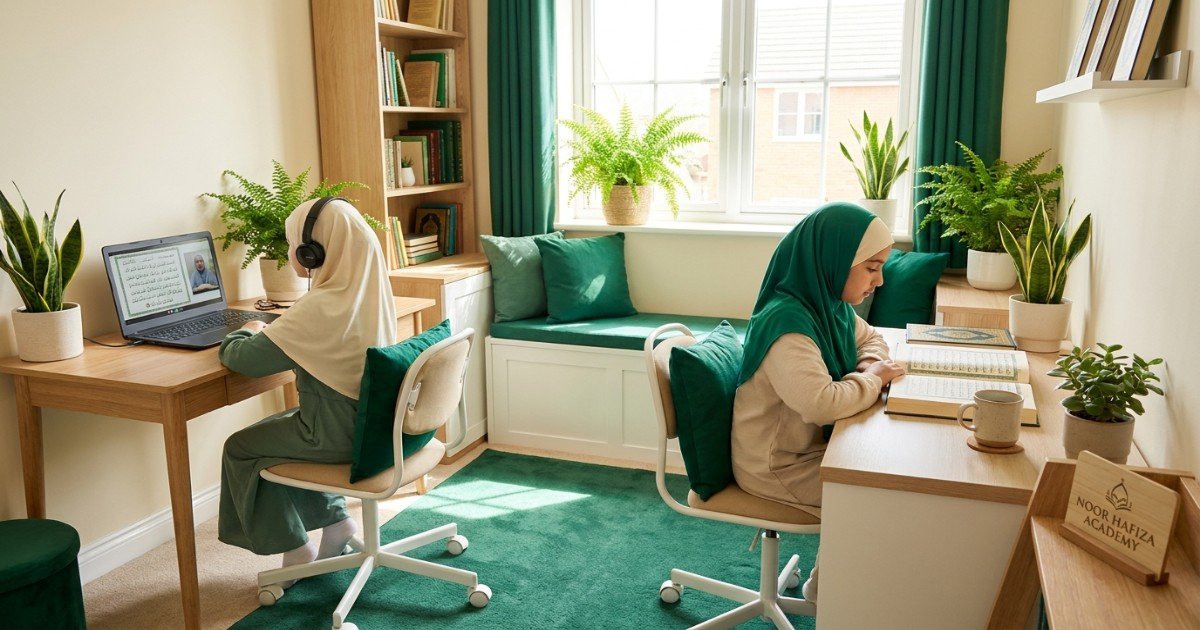
Example weekly Quran schedule for a homeschool family
| Day | Live lesson | Home practice | Main goal |
|---|---|---|---|
| Monday | Quran reading / Qaida | 10-minute correction review | New reading target |
| Tuesday | — | Reading + old correction | Stabilize skill |
| Wednesday | Tajweed / Hifz | Short focused drill | Pronunciation or memorization |
| Thursday | — | Unfamiliar reading / revision | Independent transfer |
| Friday | Islamic Studies or light review | Family recap | Connect learning to practice |
| Weekend | Optional / catch-up | Hifz revision or family Quran time | Consolidation |
The exact number of live lessons should depend on age, goals, attention, affordability, and how much practice the child can sustain between sessions. More classes are not automatically better if the learner has no time to consolidate corrections.
How to combine Tajweed and Hifz in a homeschool plan
Homeschool families sometimes have enough flexibility to work on memorization and Tajweed in parallel, but the two should support each other. Memorizing incorrect pronunciation can create habits that later need to be unlearned. A useful sequence is to have the teacher correct the new passage first, then memorize a small portion accurately, then revisit it through revision.
Teacher listens to the new lines and corrects major pronunciation and Tajweed issues first.
Repeat short sections accurately instead of rushing through a large daily target.
Old memorization should be checked regularly so errors do not become permanent.

How Quran classes can fit into a wider homeschool Islamic Studies curriculum
Some families want Quran reading to remain a separate skill lesson, while others prefer an integrated Islamic learning block. Both can work. A homeschool week might include Quran reading or Tajweed on some days and Seerah, duas, Islamic manners, basic beliefs, or worship topics on others. The family can also connect translation or age-appropriate explanation to the Surahs being read or memorized.
The curriculum should remain age-appropriate and should distinguish between Quran recitation instruction and detailed religious rulings. Questions involving legal rulings, disputed issues, or advanced theology should be referred to qualified scholars rather than improvised inside a basic reading lesson.
How to prevent Quran class from becoming “more screen school”
Homeschool children may already use laptops or tablets for math, languages, co-op classes, or educational apps. A Quran lesson can become less effective if it is placed after several hours of continuous screen learning.
Use a printed Mushaf or Qaida
Keep the teacher on screen while the learner reads primarily from a physical text where practical.
Add movement breaks
Place a short physical break before Quran if the child has just finished another online subject.
Keep lessons focused
A shorter attentive lesson can be better than a long class with fading concentration.
Use offline review
Home practice can often be done with a Mushaf, notebook, and audio rather than another live screen session.
How homeschool parents can track Quran progress
Homeschool parents are used to observing learning closely, but Quran progress should still be measured with clear skill indicators rather than intuition alone. A child can complete many pages while repeating the same pronunciation error, or memorize new Surahs while old revision weakens. A simple tracker helps separate activity from progress.
| Area | What to track | Good progress sign | Do not rely only on |
|---|---|---|---|
| Qaida / reading | Letter recognition, blending, unfamiliar words | Less guessing and fewer prompts | Pages completed |
| Tajweed | Repeated rule and pronunciation errors | Correction transfers into new passages | Rule definitions memorized |
| Hifz | New lesson, recent revision, old revision | Stronger retention after several days | New lines memorized |
| Independence | Ability to attempt before help | Fewer teacher cues | Parent confidence |
Should homeschool Quran classes be one-to-one or group-based?
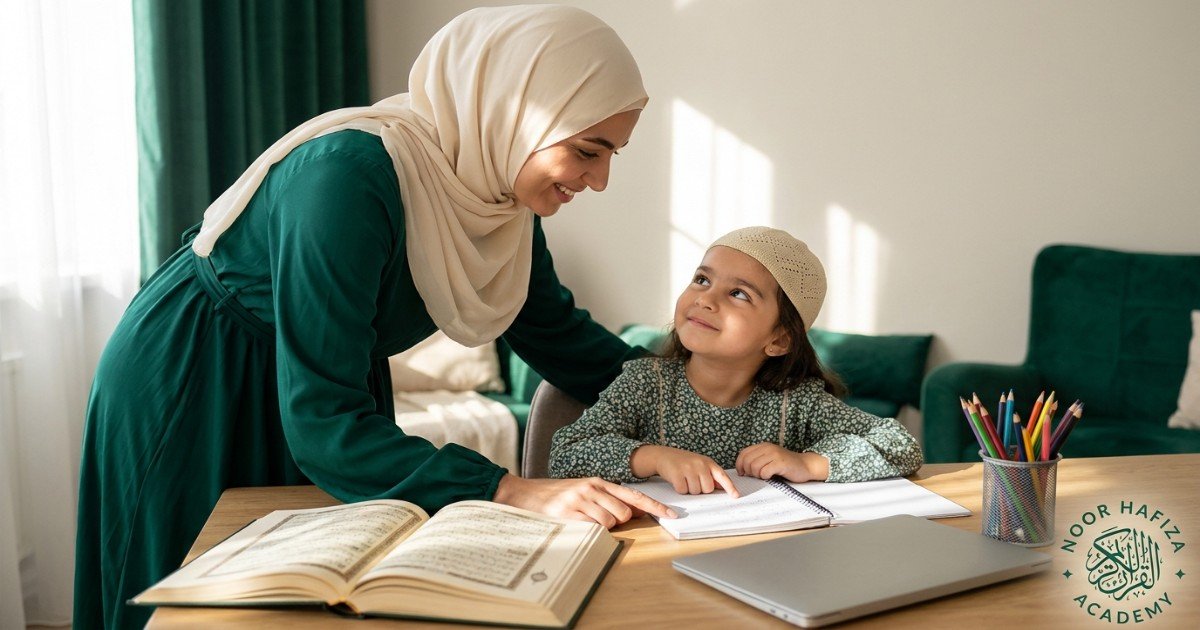
One-to-one classes can be especially useful when siblings are at different levels, a child needs intensive Makharij correction, or a Hifz student requires detailed listening. Small groups can be valuable when learners are close in age, level, pace, and goals.
A family should not choose a group only because the children are siblings. If one child is still learning letters and another is reading fluently, combining them may frustrate both. Likewise, private classes are not automatically necessary if a well-run small group gives each learner enough active reading time and specific correction.
Common mistakes homeschool families make with Quran classes
Changing the class time every week
Flexibility becomes inconsistency and the lesson never develops a stable place in the homeschool routine.
Using the same curriculum for every sibling
Different reading levels are ignored because it feels simpler administratively.
Too many live lessons
The child has little time to practise and consolidate between classes.
Too much screen time
Quran class comes after hours of online academics and attention is already depleted.
Hifz without pronunciation checks
The child memorizes repeated errors that become harder to correct later.
Only familiar reading
Page memorization hides weak decoding and makes progress look stronger than it is.
No parent feedback loop
The teacher gives corrections, but parents do not know what to reinforce during the week.
Overloading the curriculum
Qaida, Hifz, Tajweed, Arabic, Islamic Studies, and multiple goals are packed into one short lesson.
What should homeschool parents evaluate in a trial Quran class?
Use the trial to test the full homeschool fit
- Did the teacher assess the child’s real reading level?
- Was the chosen homeschool time good for attention?
- Did the teacher explain a clear learning target?
- Was the lesson interactive enough for the child’s age?
- Did the learner get enough independent reading time?
- Were corrections specific and understandable?
- Could siblings remain occupied quietly during the lesson?
- Did the parent understand what to practise before the next class?

Questions homeschool parents should ask before enrolling
Use these before choosing a program
- How do you assess each child’s Quran reading level?
- Can siblings follow different curricula and lesson lengths?
- Are morning and daytime homeschool slots available?
- Can lessons be scheduled back-to-back for siblings?
- How do you decide between Qaida, Quran reading, Tajweed, Hifz, and Islamic Studies?
- How much home practice is expected between classes?
- How do parents receive progress updates?
- Do you test unfamiliar reading, or only assigned pages?
- How is Hifz revision tracked?
- Are female Quran teachers available for our preferred schedule?
- Can the schedule change during co-op seasons, travel, or family transitions?
- Can we test the proposed routine through a trial class first?
Online Quran classes for homeschool families with female teachers
Noor Hafiza Academy offers live online Quran learning for girls, women, children, adults, new Muslims, complete beginners, and returning readers with female Quran teachers. Homeschool families can ask about weekday morning, daytime, afternoon, evening, and weekend scheduling depending on current availability.
Programs can include Noorani Qaida, Quran reading, Tajweed, Hifz support, and Islamic Studies according to the learner’s current level and goals. Current teacher qualifications, homeschool-time availability, lesson duration, curriculum details, trial arrangements, fees, rescheduling policies, privacy practices, and enrollment terms should be confirmed directly.
Share the learner’s age, reading level, homeschool hours, sibling needs, preferred days, and whether the priority is Qaida, Quran reading, Tajweed, Hifz, or Islamic Studies.
FAQs about online Quran classes for homeschool families
Are online Quran classes a good fit for homeschool families?
What time of day is best for homeschool Quran classes?
What should a homeschool Quran curriculum include?
Can homeschool siblings take Quran classes back-to-back?
Should siblings be placed in the same Quran class?
How often should homeschool students take Quran lessons?
Can homeschool students study Tajweed and Hifz together?
How can parents track homeschool Quran progress?
How can homeschool families reduce screen fatigue during Quran classes?
Can girls and women study with female Quran teachers?
Should Quran be part of the academic school day or family worship time?
What should I send when asking about homeschool Quran classes?
Build a homeschool Quran routine that is flexible, level-based, and easy to sustain
Share each learner’s age, Quran level, homeschool hours, sibling needs, preferred days, and whether the priority is Qaida, Quran reading, Tajweed, Hifz, or Islamic Studies.