How Long Does It Take to Learn Tajweed?

How long does it take to learn Tajweed? Many beginners can understand and begin applying the main Tajweed foundations within about three to six months of consistent study. Developing reliable pronunciation, rule recognition, stopping, and independent application often takes six to twelve months or longer. Strong, comfortable recitation continues to improve over years because Tajweed is not only a list of rules—it is a practical skill that must remain accurate while the learner reads real Quran passages. A returning reader may progress faster, while a complete beginner, young child, or learner repairing established pronunciation habits may need more time.
How many months does it take to learn Tajweed?
A learner who already reads Quranic Arabic and studies with a teacher three to five times per week may often build a usable Tajweed foundation in roughly three to six months. Reaching more reliable recitation—where pronunciation, madd, ghunnah, qalqalah, stopping, and common rules remain accurate across unfamiliar verses—often takes six to twelve months or longer. A complete beginner who is still learning letters and joining may first need Noorani Qaida or Quran-reading foundations. A learner correcting long-established pronunciation habits may also need a longer timeline. These ranges are planning estimates, not promises. The better measure is whether the learner can hear, understand, apply, retain, and transfer corrections during real Quran recitation.
What does it mean to learn Tajweed?
The phrase “learn Tajweed” can describe several different achievements. One learner may mean memorizing the names of common rules. Another may mean reading short surahs more accurately. A third may want advanced recitation with strong makharij, stable sifat, controlled timing, and confident stopping. These goals do not require the same amount of time.
At the first level, the learner becomes aware that Quran recitation has specific sound and timing principles. She begins to distinguish short vowels from lengthened sounds, recognizes that similar letters are not interchangeable, and understands that stopping can change the way the final sound is read. This awareness can develop relatively quickly, but awareness alone is not reliable recitation.
At the second level, the learner can apply a rule in a prepared example. She may correctly produce a ghunnah after the teacher demonstrates it, hold a basic madd for the expected duration, or correct the articulation of one difficult letter. This is guided application. It is an important milestone, yet the rule may disappear when several features occur together in a real verse.
At the third level, the learner recognizes and applies the same rule independently across unfamiliar Quran words and passages. She does not need the teacher to identify every example. Corrections remain improved in later lessons. Reading becomes smoother without sacrificing accuracy. This level takes longer because it requires listening, muscle control, visual recognition, attention, memory, and repeated Quran application to work together.
Knowing that a rule exists is valuable, but true progress appears when the learner applies the rule during continuous recitation without losing letter clarity, timing, or stopping.
A realistic Tajweed learning timeline
No universal timetable applies to every learner. The following ranges help with planning when lessons are live, attendance is generally consistent, and the learner practices briefly between classes. They should be adjusted after a teacher hears the learner read.
| Learner profile | Possible planning range | Likely first goal | Why the range changes |
|---|---|---|---|
| Quran reader with a few recurring mistakes | 2–4 months | Targeted correction and rule awareness | Reading foundation already exists; the teacher focuses on specific patterns |
| Beginner Tajweed student who reads Arabic | 3–6 months | Core rules, makharij awareness, and guided application | The learner must connect explanations to live Quran reading |
| Complete beginner in Quranic Arabic | 6–18 months or longer | Qaida, decoding, pronunciation, then Tajweed application | Reading foundations and Tajweed are being built together |
| Young child learning gradually | 6–18 months or longer | Clear sounds, short rules, and positive reading habits | Attention, speech control, repetition, and maturity affect progress |
| Adult repairing established pronunciation | 6–12 months or longer | Makharij repair and stable correction transfer | Old sound habits may feel natural and require repeated retraining |
| Advanced learner seeking refinement | Ongoing study | Consistency, subtle sifat, stopping, and recitation quality | Higher accuracy requires careful listening and sustained practice |
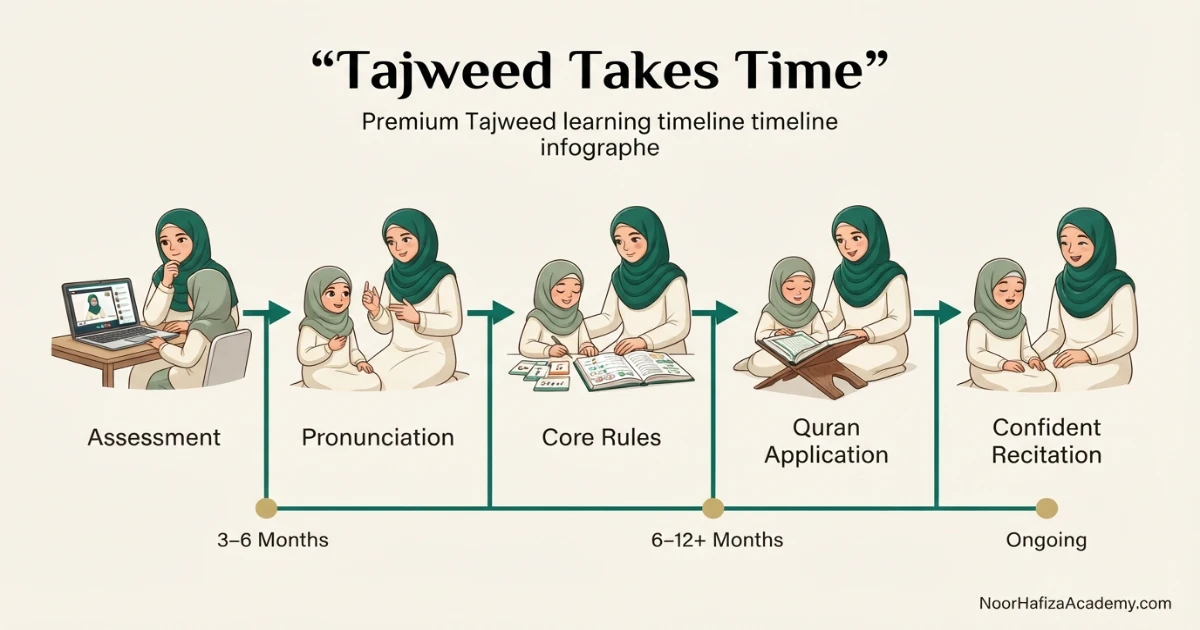
The first estimate should be treated as provisional. A learner may understand rules quickly but need more time for one articulation point. Another may have strong sounds but struggle to recognize rules while reading. A good teacher updates the timeline according to evidence instead of keeping every learner on the same calendar.
How long each Tajweed stage may take
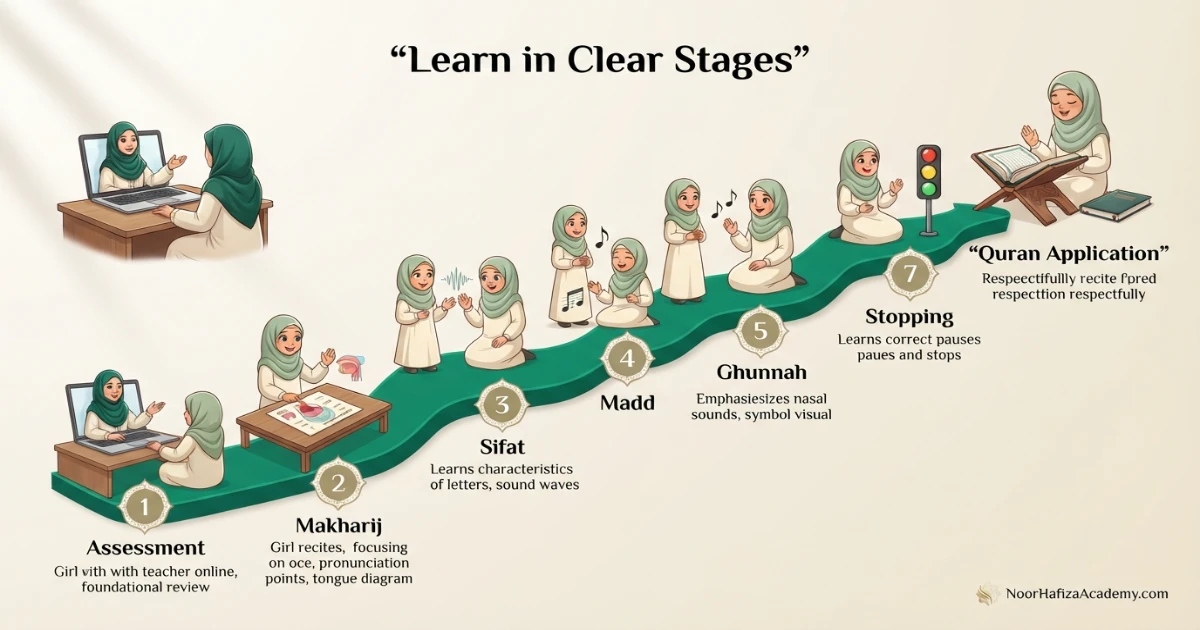
Tajweed develops in overlapping stages. A learner does not finish pronunciation completely and then begin rules. Makharij, listening, signs, timing, stopping, and fluency continue to influence one another. Still, a stage-based roadmap helps learners understand why progress may feel fast in one month and slow in another.
Live reading assessment
Usually one to three lessons. The teacher checks Quran-reading level, letter articulation, common substitutions, short and long sounds, stopping, breath control, confidence, and how well the learner responds to correction.
Makharij foundations
Often four to twelve weeks, depending on the learner. The focus is not memorizing a diagram; it is producing letters from increasingly accurate articulation points and distinguishing sounds that the learner previously treated as similar.
Sifat and sound quality
Often develops over several months and continues afterward. The learner begins controlling heaviness, lightness, airflow, strength, softness, and other practical sound qualities through listening and repetition.
Madd and timing control
Often four to ten weeks for a working foundation. The learner distinguishes brief vowels from lengthened sounds and avoids stretching every long sound according to personal rhythm.
Ghunnah, qalqalah, and common rule families
Often two to four months of guided practice. Rules may be understood in isolation before they remain stable inside full verses, especially when several rules appear close together.
Stopping and restarting
Introduced early and refined continuously. The learner practises completing words correctly at a stop, restarting from a suitable place, and keeping the meaning and reading flow in view.
Continuous Quran application
Often six to twelve months or longer. The learner reads longer portions while maintaining letter clarity, timing, rules, and stopping without becoming dependent on constant teacher prompting.
Long-term refinement
Ongoing. Advanced progress includes greater consistency, stronger listening, more precise sifat, better breath management, smoother transitions, and fewer corrections across unfamiliar passages.

Factors that affect how long Tajweed takes
Two learners can take the same course and progress at very different speeds. The difference is not always effort. Tajweed depends on the interaction of reading ability, hearing, speech habits, lesson design, practice, confidence, and the learner’s goal.
Starting reading level
A learner who already decodes Quran words can focus directly on recitation quality. A complete beginner must first learn letters, joining, signs, and reading flow.
Pronunciation habits
A newly introduced sound may be easier to build than an inaccurate sound repeated for years. Established habits need careful comparison and repeated transfer.
Weekly lessons
Frequent short lessons reduce the gap between correction and the next attempt, helping the teacher repair errors before they become comfortable again.
Practice quality
Ten accurate minutes can help more than a long session of uncertain repetition. The learner should practise the teacher’s exact target, not random material.
Age and attention
Children often need shorter, varied lessons. Adults may understand explanations quickly but have less available time and stronger existing speech habits.
Attendance
Long gaps create repeated restarting. A moderate schedule followed consistently is usually better than an intensive schedule missed repeatedly.
Teacher method
Clear modeling, one specific correction, a fresh attempt, and a transfer example create stronger learning than general comments such as “read better.”
Listening ability
The learner must hear the difference between her attempt and the model. Focused listening often improves before complete vocal control develops.
Learning goal
Improving common mistakes takes less time than reaching advanced consistency across long, unfamiliar passages.
How lessons per week change the Tajweed course duration
Tajweed is a corrected performance skill. The learner needs repeated chances to hear a model, attempt the sound, receive a precise correction, and try again. For this reason, weekly frequency affects continuity, although more classes are useful only when the learner can remain attentive and attend consistently.
| Weekly schedule | Possible learning pattern | Suggested home review | Best fit |
|---|---|---|---|
| 1 lesson weekly | Slow, highly dependent on home practice | 15–20 minutes on 5–6 days | Maintenance, advanced review, or learners with strong self-discipline |
| 2 lessons weekly | Steady but gradual | 10–15 minutes on most days | Busy adults or learners adding Tajweed to an existing Quran routine |
| 3 lessons weekly | Good continuity for many beginners | 10–15 focused minutes | Balanced progress with regular live correction |
| 4 lessons weekly | Stronger correction retention | Short target-based practice | Learners building makharij and rule application together |
| 5 lessons weekly | Fastest responsible continuity for suitable learners | Brief revision without overload | Focused learners who can sustain attendance and attention |
A five-day course is not automatically better than a three-day course. When lessons are too long, the learner becomes tired and begins guessing. When homework is excessive, practice loses precision. The strongest plan is frequent enough for correction to remain fresh and realistic enough to continue for months.
How much Tajweed practice is needed between lessons?
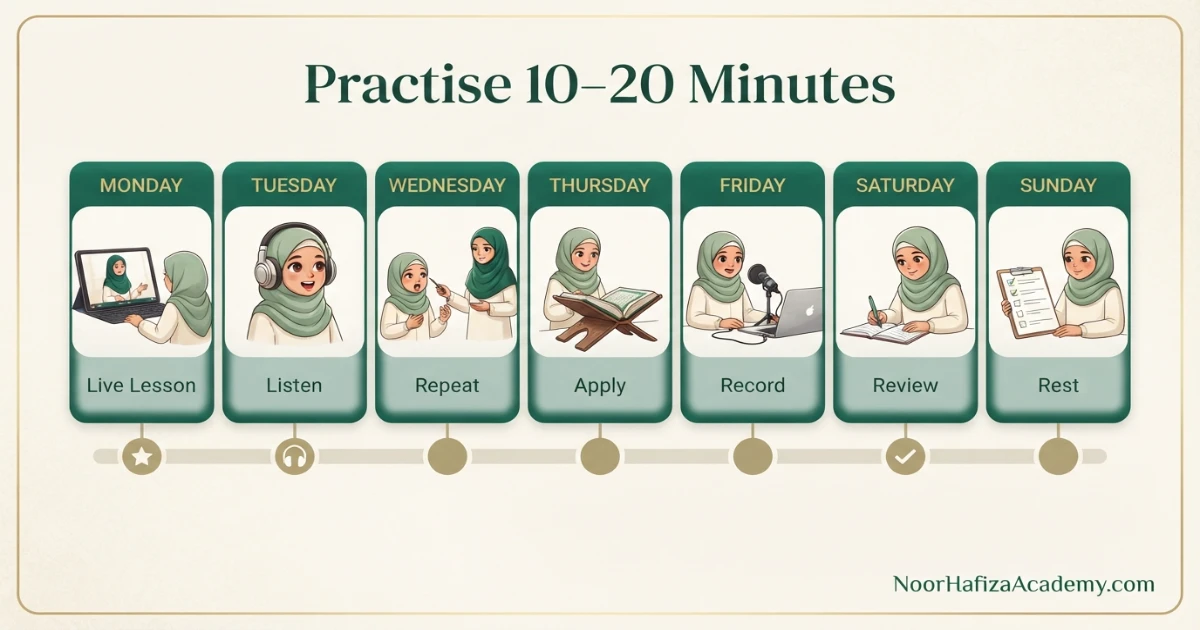
Many learners benefit from ten to twenty focused minutes on most days. Young children may need shorter sessions. Adults with a busy schedule may use two brief practice blocks instead of one long session. The purpose is not to read the largest number of pages. It is to repeat the exact sound, rule, word, or verse that was corrected and then check whether the improvement remains in another example.
Begin with the correct model
Listen to the teacher’s approved pronunciation or lesson recording when available. The learner needs a reliable sound reference before repetition.
Practise one target slowly
Repeat the specific letter, length, ghunnah, qalqalah, or stopping pattern corrected in class. Avoid turning one practice session into a full new lesson.
Use the rule in Quran words
Read a small assigned portion where the same rule appears. The goal is to transfer the correction from an exercise into recitation.
Listen to one short self-recording
A brief recording can reveal stretched vowels, unclear letters, or missed ghunnah that felt correct while reading.
Save one question for class
When uncertain, mark the word instead of repeating an unverified version many times. The teacher can correct it in the next lesson.
How to know whether Tajweed is actually improving
Page count and rule vocabulary can be useful records, but they do not prove that recitation is changing. Progress should be visible in what the learner can do with less prompting and in whether corrections remain stable when the Quran passage changes.
Clearer letter contrast
Letters that were previously merged or substituted begin to sound more distinct, even before complete consistency develops.
Better timing
Short vowels stay short, basic madd becomes more controlled, and the learner relies less on personal melody to decide length.
Rule recognition
The learner starts noticing common Tajweed patterns before the teacher points them out.
Correction retention
A corrected sound remains better in the next word, later in the same lesson, and during a future class.
Safer stopping
The learner completes word endings more carefully and becomes less likely to stop only because breath has ended.
Independent self-correction
The learner hears an inaccurate attempt, pauses, and tries again without waiting for the teacher to identify every mistake.

Do children and adults learn Tajweed at the same speed?
Children and adults can both learn Tajweed successfully, but their strengths and obstacles often differ. A child may build a new pronunciation habit with less resistance because fewer years of speech repetition must be changed. However, young learners usually need shorter lessons, simpler explanations, more repetition, and time for attention and speech control to mature.
Adults can understand explanations, record corrections, compare examples, and organize independent practice. They may progress quickly through rule awareness. Their challenge is often consistency around work and family responsibilities or correcting sounds that have been used for many years.
| Learner | Common strength | Common challenge | Helpful approach |
|---|---|---|---|
| Young child | Can imitate sounds naturally | Short attention and uneven speech control | 20–30 minute lessons, one rule at a time, visual and listening practice |
| Older child or teen | Can understand goals and track progress | May feel self-conscious about correction | Private feedback, clear milestones, respectful repetition |
| Adult beginner | Can understand concise explanations and practise independently | Busy schedule and fear of mistakes | Private classes, manageable homework, recordings, and a stable routine |
| Returning adult reader | Recognizes Quran text and familiar surahs | Established pronunciation and memorized reading habits | Targeted assessment, slow correction, transfer into unfamiliar passages |

Can Tajweed be learned very quickly?
A short intensive course can introduce terminology and highlight common mistakes. It may help a returning learner refresh known material. It cannot guarantee stable recitation for every beginner. The muscles of the tongue, lips, throat, and breath need repeated accurate practice. Visual recognition of rules must become fast enough to work during continuous reading. These changes take time.
Memorizing rule names without application
The learner can explain a rule but misses it repeatedly while reading because recognition and sound control were not practised together.
Copying the teacher word by word
The recitation sounds accurate only after immediate modeling. The same pattern remains weak in an unfamiliar verse.
Adding speed before clarity
Faster reading can hide shortened madd, unclear letters, lost ghunnah, and unsafe stopping.
Repeating uncertain sounds alone
Practice strengthens whatever is repeated. Without an accurate model, the learner may reinforce the very habit she wants to correct.
The fastest responsible route removes wasted work. It begins at the correct level, focuses on the highest-impact mistake, uses a clear model, allows a fresh attempt, and checks transfer immediately. It does not skip the foundation.
Can online classes shorten the Tajweed learning journey?
Online Tajweed lessons can be effective when audio is clear, the teacher listens to every attempt, the learner can see the text, and correction is specific. One-to-one classes are especially useful for pronunciation because the teacher can pause, model, compare, and ask for a new attempt without waiting for a group.
Technology does not replace the teacher’s ear. A recording app can help the learner hear herself, but it cannot reliably diagnose every makhraj, sifat, or stopping issue. Apps and videos are best used as revision tools after a teacher has confirmed the target.
Clear live audio
The teacher and learner need headphones or a quiet environment so small sound differences can be heard.
One correction cycle
Model, attempt, correction, retry, and transfer should happen during the same lesson.
Visible progress notes
The learner should know the current target, recurring mistake, assigned passage, and next milestone.
What kind of teacher helps a learner progress without wasting time?
A qualified teacher should do more than read beautifully. Teaching Tajweed requires the ability to hear the learner’s error, identify its cause, provide an understandable model, and choose an exercise that repairs the weakness. The learner should leave class knowing what to practise and how success will be checked.
Useful teacher qualities
- Strong Quran recitation and Tajweed knowledge
- Ability to teach makharij practically
- Specific, respectful correction
- Experience with the learner’s age group
- Clear progress goals and review
- Patience with repeated pronunciation repair
Questions to ask before enrollment
- Will the learner receive a live assessment?
- How are pronunciation errors corrected online?
- How much home practice is expected?
- How is progress reviewed?
- Can lesson frequency change by level?
- Is a female Tajweed teacher available?
How Noor Hafiza Academy plans a realistic Tajweed timeline
Noor Hafiza Academy offers live online Quran and Tajweed learning with female Quran teachers for children, girls, women, sisters, beginners, and returning readers. A suitable course begins with the learner’s demonstrated reading rather than a fixed promise that every person will finish in the same number of weeks.
During an assessment or trial, the teacher may listen for letter articulation, reading fluency, short and long sounds, ghunnah, qalqalah, common rule awareness, stopping, confidence, and response to correction. A complete beginner may first need Noorani Qaida or Quran-reading support. A learner who already reads independently may enter a targeted Tajweed pathway. A returning student may focus on recurring pronunciation and application weaknesses.
The recommended schedule can reflect age, time zone, school or work routine, current level, and goal. Progress is then reviewed through clearer sounds, better timing, fewer prompts, stronger self-correction, and more accurate reading across unfamiliar passages. Current teacher availability, schedules, fees, trial arrangements, course materials, and enrollment terms are confirmed directly.
Share the learner’s age, Quran-reading level, previous Tajweed study, pronunciation concerns, preferred schedule, and goal. A short assessment can identify the right starting point and first milestone.
A practical answer for your own Tajweed timeline
Use three questions to create a realistic plan. First, can the learner already read Quranic Arabic independently? If not, include time for Qaida and Quran-reading foundations. Second, are the main weaknesses rule awareness, pronunciation, or both? Pronunciation repair often needs more repeated live correction than written rule study. Third, what level of result is expected? Basic improvement can appear within months, while consistent, confident application across long passages takes longer.
For many learners who already read Quranic Arabic, three to six months is a reasonable range for building a beginner Tajweed foundation. Six to twelve months or more is a more realistic window for improving independent application and consistency. Advanced refinement remains ongoing. The correct timeline is the one that produces stable skill without encouraging speed, embarrassment, or memorized imitation.
How long does it take to learn Tajweed FAQs
How long does it take to learn Tajweed?
Can Tajweed be learned in three months?
How long does Tajweed take for a complete beginner?
How long does Tajweed take for a child?
Can adults learn Tajweed quickly?
How many Tajweed lessons should I take each week?
How long should I practise Tajweed each day?
Is learning Tajweed rules enough?
Why is my Tajweed progress slow?
Can I learn Tajweed without a teacher?
How do I know I have learned basic Tajweed?
Can I request a female Tajweed teacher online?
Build accurate recitation at a pace you can retain and apply
Share the learner’s age, Quran-reading level, previous Tajweed study, pronunciation concerns, time zone, and preferred schedule. Noor Hafiza Academy can discuss a live assessment and a realistic first milestone with a suitable female Quran teacher.