
Summer Quran Classes for Kids: A Productive School-Break Plan

Summer Quran classes for kids can create one of the most useful learning periods of the year because children often have fewer school deadlines, less homework, and more flexible daytime hours. The opportunity, however, should be used carefully. A productive summer plan is not simply a longer school schedule with more worksheets and bigger targets. It is a balanced program that gives the child one or two clear Quran goals, age-appropriate live lessons, short independent practice, strong revision, time for rest and outdoor activity, and enough flexibility for travel, camps, family visits, and changing sleep routines.
What is the best summer Quran class plan for kids?
The best summer Quran class plan gives the child one main learning goal, two to four live lessons per week for many reading or Tajweed learners, more frequent checks for serious Hifz students, and short practice on most days. Younger children often benefit from 20–25 minute lessons, while older children may manage 30–40 minutes when they remain engaged. The plan should include revision, outdoor play, meals, prayer, family activities, travel flexibility, and at least one lighter day. Parents should review progress midway through the break and reduce or increase the workload according to retention, energy, and consistency—not simply because more time is available.
Why summer can be an excellent time for Quran learning
During the school year, Quran learning must compete with early mornings, transportation, homework, projects, sports, tutoring, school events, and bedtime. Summer often removes several of those pressures. A child may be able to take a lesson in the morning, practise after breakfast, or attend more consistently because the family is not rushing from school pickup to dinner. This flexibility can help a beginner finish a difficult Qaida stage, help a reader become more fluent, help a Tajweed student correct recurring pronunciation errors, or help a Hifz learner strengthen weak revision.
The advantage is not only extra time. Summer allows the family to change the learning environment. A child who usually studies when tired may move to a brighter morning slot. A learner who needs repetition may use several short sessions instead of one evening session. Siblings may take back-to-back classes before family activities begin. Parents can observe more lessons and understand the teacher’s correction method.
A child should finish the break with stronger skills, greater confidence, and a routine that can continue—not with exhaustion, resentment, or memorization that disappears once school resumes.
This is why the first step is not choosing the maximum number of classes. The first step is deciding what success should look like by the end of the break. A clear goal makes the schedule easier to build and prevents every lesson from becoming a mixture of Qaida, reading, Tajweed, Hifz, Islamic Studies, and homework that is too broad to measure.
Choose one main summer Quran goal and one supporting goal
A productive summer program should usually have one primary goal and, when appropriate, one smaller supporting goal. The primary goal receives most lesson time and home practice. The supporting goal may be light revision, basic Islamic Studies, or a small memorization target that does not interfere with the main skill.
Qaida foundation
Improve letter recognition, joined forms, vowels, sukoon, shaddah, and blending so reading becomes less dependent on prompting.
Quran reading fluency
Reduce hesitation, improve phrase reading, correct stopping, and transfer progress to unfamiliar passages.
Tajweed correction
Work on a limited group of recurring errors such as Makharij, madd, ghunnah, shaddah, or stopping.
Hifz growth
Add a controlled amount of new memorization while protecting recent and older revision.
Hifz repair
Pause large new targets and rebuild weak Surahs, verse connections, similar passages, and independent recall.
Islamic Studies
Develop age-appropriate understanding of prayer, manners, daily duas, stories, and Muslim character.

Avoid vague targets such as “finish a lot of Quran” or “do intensive Hifz.” Better goals are specific: complete the remaining Qaida lessons with accurate joining, read one short passage with fewer pauses, correct three repeated pronunciation errors, strengthen ten weak Surahs, or maintain a consistent four-day practice routine for eight weeks. A measurable goal gives the teacher and parent something useful to review.
Choose a light, balanced, or focused summer program
Not every family needs an intensive program. The right model depends on the child’s level, the length of the break, travel plans, existing routine, and whether the learner is beginning, maintaining, or repairing a skill.
| Summer model | Live lessons | Home practice | Best for | Main caution |
|---|---|---|---|---|
| Light continuity | 1–2 per week | 5–10 minutes on selected days | Travel-heavy families or children needing maintenance | Progress may be gradual; keep the goal narrow |
| Balanced progress | 2–4 per week | Short practice on most days | Most Qaida, reading, Tajweed, and beginner Hifz learners | Do not increase all subjects at once |
| Focused improvement | 4–5 per week | Structured daily work | Older motivated learners, Hifz repair, or a defined short-term target | Needs strong revision, rest, and careful teacher monitoring |
The balanced model is often the best starting point. It provides enough contact for correction and continuity without making every summer day revolve around class. A focused program can be effective when the goal is narrow and the child is willing, but it should include a lighter day and regular review of energy and retention.
Summer lesson length and frequency by age and attention
School break does not automatically extend a child’s attention span. Lesson length should still match age, level, personality, and the type of work. A young beginner practising letter recognition needs a different format from a twelve-year-old revising Hifz.
| Age range | Useful starting lesson | Common weekly frequency | Home practice | Best teaching rhythm |
|---|---|---|---|---|
| 5–7 years | 20–25 minutes | 2–4 lessons | 5–8 minutes | Short tasks, repetition, praise, movement breaks |
| 8–10 years | 25–35 minutes | 2–4 lessons | 8–15 minutes | Clear target, guided practice, independent attempt |
| 11–13 years | 30–40 minutes | 2–5 lessons | 10–25 minutes depending on course | Respectful feedback, tracking, responsibility |
| Teen learner | 35–45 minutes | 2–5 lessons | Course-based and partly independent | Private goals, evidence, autonomy, review |

The final ten minutes reveal whether the lesson is too long. If the child starts strongly but becomes passive, guesses, leaves the screen, or needs constant prompting near the end, shorten the session or divide the work across more days. A shorter class with active learning is more productive than a long class that exists only on the calendar.
Morning, midday, or evening: when should children take summer Quran classes?
The best time is the period when the child is awake, fed, calm, and not being pulled toward another activity. Many families find that a morning lesson works well because attention is fresh and the class is completed before outings begin. Other children sleep later during summer and need a late-morning or early-afternoon schedule. Evening can work when daytime camps or family activities fill the day, but it should not create bedtime conflict.
Morning lesson
Useful for focused reading, Tajweed, or Hifz before outdoor plans. Protect breakfast and avoid scheduling immediately after the child wakes.
Midday lesson
Useful when mornings are slow. Avoid the hungriest time, a rushed return from camp, or the period when the child usually rests.
Early-evening lesson
Useful around camps and family outings. Leave enough time for dinner, prayer, family interaction, and a calm bedtime.
Do not assume that summer allows a different time every day. A recurring slot is easier for the child, parent, and teacher. Families can keep one or two flexible weeks for travel while using stable lesson days for the rest of the break.
A child-friendly daily summer Quran routine with learning and play
The Quran class should sit inside a healthy day rather than dominate it. A child learns better when sleep, food, movement, and family interaction are protected. The exact times will vary, but the sequence can remain simple.
| Part of day | Activity | Quran purpose | Parent note |
|---|---|---|---|
| Morning | Wake, breakfast, light movement | Prepare attention before class | Avoid beginning the lesson while the child is still sleepy |
| Primary learning window | Live Quran lesson | New instruction, correction, testing | Keep materials and device ready five minutes early |
| After class | Snack, outdoor play, family activity | Allow mental recovery | Do not add a second long study block immediately |
| Later short review | 5–20 minutes according to course | Reinforce reading or Hifz assignment | Use the exact teacher-assigned task |
| Evening | Prayer, dinner, family time | Use memorized Surahs or duas naturally | Keep the evening calm rather than turning it into another class |

Parents do not need to create an academic timetable for every hour. A few anchors are enough: wake time, live lesson, short practice, outdoor or social activity, meals, prayer, and bedtime. The anchors reduce daily negotiation while leaving the rest of summer flexible.
How the summer plan should change for Qaida, reading, Tajweed, Hifz, and Islamic Studies
Noorani Qaida
Qaida learners benefit from frequent, short contact. The goal is automatic recognition and accurate joining, not simply finishing pages. A useful plan may include three or four short lessons per week and five minutes of review on non-class days. Parents should point to the assigned line and allow the child to decode rather than giving every sound.
Quran reading
Reading learners need a combination of familiar and unfamiliar passages. Summer can be used to reduce long pauses, improve phrase flow, and correct stopping. Two or three live lessons with short reading on most days may be enough for steady progress. Use the guide on how to improve Quran recitation for a detailed fluency routine.
Tajweed
Tajweed should remain practical. Choose one or two active correction targets at a time and apply them inside recitation. A child who is taught many rule names but cannot transfer them into reading may need slower application rather than more theory. Two or three weekly lessons can work well when home practice is specific.
Hifz
Hifz may use more frequent teacher contact because new memorization and revision need testing. Summer can support a carefully increased plan, but revision should remain larger than new work. The teacher should monitor next-day recall, prompts, verse connections, similar passages, and older Surahs.
Islamic Studies
Islamic Studies can become the lighter supporting goal. A weekly lesson may include prayer understanding, manners, duas, stories, or age-appropriate discussion. Keep it interactive and connected to family life rather than treating it as a heavy written subject.
Use extra summer time to strengthen Hifz—without sacrificing revision
Summer Hifz programs often fail when families focus only on how many new pages can be added. A child may memorize quickly for several weeks and then lose the work because recent and older revision were reduced. A productive plan separates three responsibilities: new memorization, recent revision, and older revision.
Sabaq
The small new portion. Increase only when next-day recall and revision remain stable.
Sabqi
Recent memorization from the current days or weeks that still needs frequent testing.
Manzil
Older memorization rotated regularly so it remains available after the summer target is complete.
One practical model is to test revision first, correct weak joins, and add new work only when the child passes the agreed standard. A second model divides the day: new memorization in the morning, recent revision later, and older revision in a lighter evening or family recitation period. The exact amount depends on level, but the principle remains the same: new work should never consume the time needed to protect previous memorization.
Parents can support the routine by protecting quiet time, playing the teacher-approved recitation, tracking the assigned portions, and allowing the child thinking time. They should not supply the next word immediately. More guidance is available in how parents can help a child memorize the Quran.
Keep the plan productive without making children resent the break
Burnout is not always dramatic. It may appear as repeated lateness, bargaining before class, passive answers, slower practice, unnecessary mistakes, or a child who begins to associate the Quran with constant correction. These signs should be reviewed early.
- Keep at least one lighter day each week.
- Do not double work after one missed class.
- Reduce new Hifz when revision weakens.
- Use short praise that recognizes effort, correction, or consistency.
- Avoid comparing siblings or classmates.
- Do not remove all play as punishment for one difficult lesson.
- Change the time or lesson length when fatigue is repeated.
- Keep the primary goal visible so extra subjects do not keep expanding.
A short reset can be part of the plan. After travel or illness, use a revision-only lesson. During a very busy week, keep one live class and a small daily review. Continuity matters more than pretending every week of summer will look the same.
Build a flexible Quran schedule around summer changes
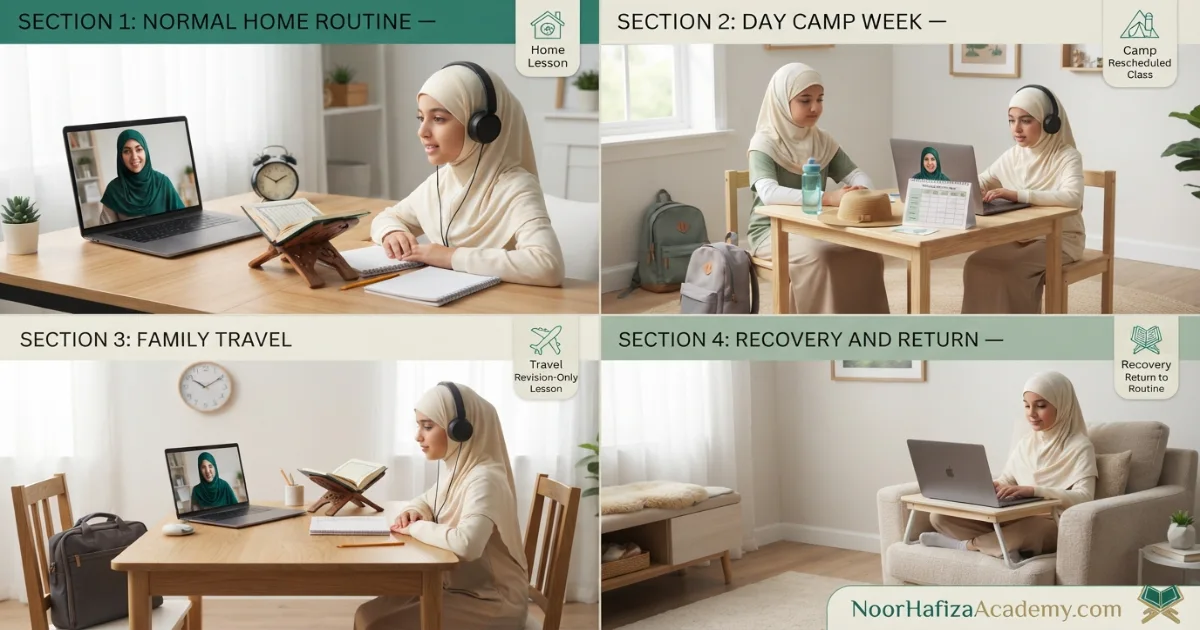
Summer often includes travel, day camps, relatives, late evenings, and temporary stays in another time zone. These changes do not require abandoning Quran learning, but they should be communicated early. Families can choose one of three approaches: keep the normal schedule, move temporarily to a lighter plan, or pause new work while maintaining review.
| Summer situation | Recommended class response | Home practice response | What to avoid |
|---|---|---|---|
| Day camp weekdays | Morning before camp or two protected evenings | Short review on non-class days | Class immediately after an exhausting camp day |
| Confirm local time, internet, and quiet space | Use revision-only plan when needed | Assuming the old time zone still applies | |
| Keep one or two stable lessons | Use a protected short morning slot | Weekly last-minute rescheduling | |
| Pause live class when audio and safety are poor | Listen, revise familiar Surahs, resume later | Trying to take a formal lesson in a moving noisy vehicle | |
| Match the teacher to the temporary local time | Reduce target during adjustment | Late-night classes caused by the original schedule |

When the family returns, the teacher should test the most recent work before restoring the previous target. The first lesson back may need to focus on review, technology, and routine rather than immediately adding new pages.
Plan summer Quran classes for multiple children without creating chaos
Back-to-back one-to-one lessons can work well during summer because school pickup is removed. Each child should still have a separate learning space, assigned materials, and a quiet waiting activity. The second child should not sit beside the first and supply answers.
Parents may use a family block, such as two consecutive lessons followed by a short shared Islamic Studies activity or family revision. This creates efficiency while preserving individual correction. For children at very different levels, avoid forcing one shared target. A Qaida beginner and a Hifz learner need different lesson lengths and home assignments.
Prepare a reliable summer online Quran learning space
The summer environment may change from bedroom to guest room, hotel, relative’s home, or vacation rental. The child still needs a stable setup: charged device, reliable audio, correct book, headphones when helpful, good lighting, and a place where the Mushaf or Qaida can be used respectfully.
- Test the microphone before the lesson.
- Use a device large enough for the teacher and text to be seen clearly.
- Keep the camera angle stable so the teacher can observe recitation and attention.
- Place the Mushaf on a suitable stand or desk, not on the floor.
- Remove games, videos, and notifications from the learning screen.
- Tell visitors that the lesson needs a short quiet period.
- Keep the lesson link, teacher contact, and local-time schedule available to the parent.
Review progress through skill evidence—not only pages or attendance
Attendance is important, but it does not prove improvement. A productive summer review should include the skill chosen at the beginning. For Qaida, measure recognition and independent joining. For reading, compare pauses, accuracy, phrase length, and stopping. For Tajweed, test whether the corrected sound remains stable in a new passage. For Hifz, test new, recent, and older portions without excessive prompting.
Consistency
Lessons begin on time and short practice happens on most planned days.
Independence
The child needs fewer first-word prompts and can attempt the assigned skill alone.
Accuracy
Recurring reading, pronunciation, or memorization errors become less frequent.
Transfer
The improvement appears in unfamiliar words, passages, or random starting points.
Retention
The child keeps previous work while adding the agreed new material.
Attitude
The child can accept correction and continue without constant conflict or avoidance.
A midpoint review is especially useful. If the goal is progressing well, the teacher may make a small increase. If practice is inconsistent or revision is weakening, the target should be reduced or changed. The final summer review should record what improved and what should continue during the school year.
Use the final summer week to build a school-year schedule
A summer program should not end abruptly on the first school day. During the final one or two weeks, move the class toward the time and frequency that can continue during school. If the child studied in the morning all summer but will need an after-school lesson, test the new slot before school begins.
Reduce new Hifz targets, consolidate recent work, organize the Qaida or reading assignment, and confirm the school-year timetable with the teacher. Parents should note dismissal time, transport, homework, activities, prayer, meals, and bedtime. The guide on the best online Quran class schedule for school-age children can help with this transition.
A smaller school-year schedule that protects the new skill is more valuable than a large summer target followed by several months of inconsistency.
How to create a productive summer Quran plan in eight steps
Choose one primary goal
Decide whether summer will focus on Qaida, fluency, Tajweed, Hifz growth, Hifz repair, or Islamic Studies.
Map the real summer calendar
Add travel, camps, visitors, appointments, family events, and the expected return-to-school date.
Select the program model
Choose light continuity, balanced progress, or a focused short-term plan.
Choose lesson length and frequency
Match the child’s age, attention, course, and home-practice capacity.
Protect a repeatable daily window
Choose a time when the child is awake, fed, calm, and not rushing to another activity.
Reserve short practice and revision
Use the exact teacher assignment and keep Hifz revision larger than new work.
Review at the midpoint
Use retention, independence, accuracy, energy, and attendance to adjust the target.
Transition before school begins
Consolidate learning and test the smaller timetable that can continue during the school year.
Online summer Quran classes with female Quran teachers
Noor Hafiza Academy offers live online Quran learning for children, girls, women, sisters, beginners, readers, Tajweed students, and Hifz learners with female Quran teachers. A suitable summer plan begins with the child’s current level, the length of the school break, the family’s time zone, travel plans, preferred lesson days, and one clear goal.
The teacher may recommend a light, balanced, or focused schedule. The plan can include Qaida, Quran reading, Tajweed, Hifz, revision, or Islamic Studies according to level. Current teacher availability, program details, trial arrangements, schedules, fees, policies, and enrollment terms should be confirmed directly with the academy.
Share the child’s age, location and time zone, school-break dates, current Quran level, existing memorization, travel or camp dates, available practice time, and the result you hope to achieve before school returns.
FAQs about summer Quran classes for kids
Are summer Quran classes good for children?
How many Quran classes should a child take during summer?
How long should a summer Quran class be?
What is the best time for summer Quran classes?
Should children do intensive Hifz during summer?
Can a child finish Noorani Qaida during summer?
How much Quran practice should children do at home in summer?
What should happen to Quran classes during travel?
How can parents prevent summer Quran burnout?
Can siblings take summer Quran classes back to back?
How should parents measure summer Quran progress?
How should the summer Quran schedule change before school starts?
Use the school break to build Quran progress your child can keep
Share the child’s age, current level, school-break dates, city and time zone, travel plans, preferred lesson days, existing memorization, and one main summer goal. Noor Hafiza Academy can discuss a realistic plan with a suitable female Quran teacher.