Madd Asli vs Madd Far’i: What Is the Difference?
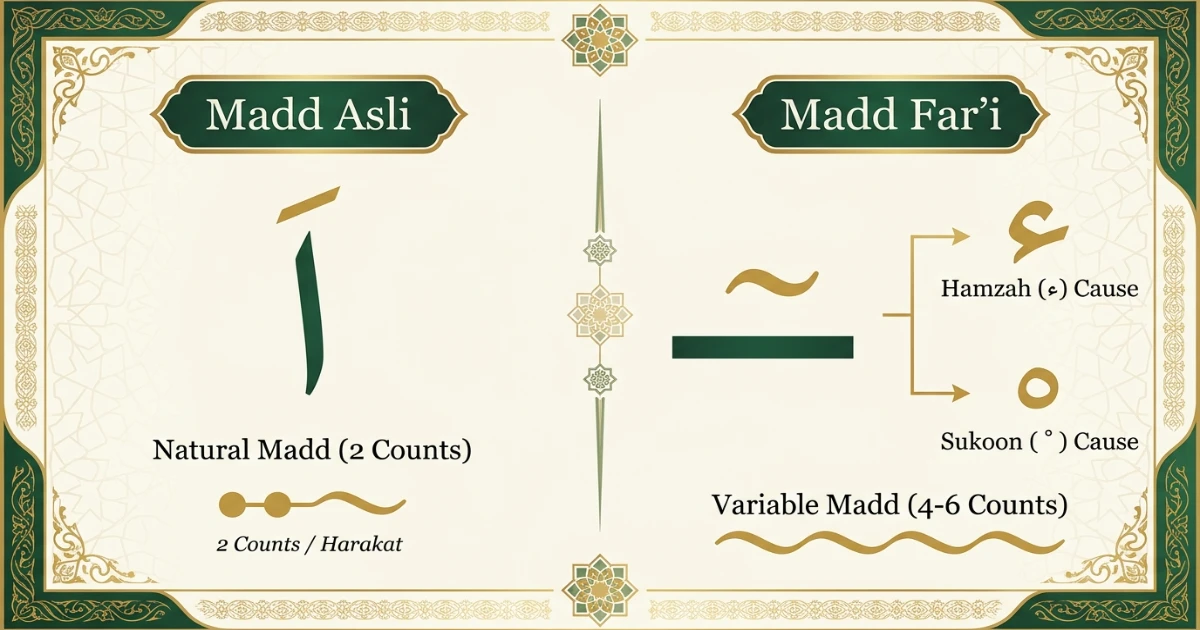
Madd Asli vs Madd Far’i is the basic division of elongation rules in Tajweed. Madd Asli, also called Madd Tabi’i, is the normal two-count elongation when there is no additional Hamzah or Sukoon cause. Madd Far’i is a secondary Madd created by an extra cause—most commonly Hamzah or Sukoon—and its timing depends on the specific category. Some Far’i types are longer than two counts, while others may still be two counts or have several valid lengths. This guide follows a common Hafs ‘an ‘Asim beginner framework.
What is the difference between Madd Asli and Madd Far’i?
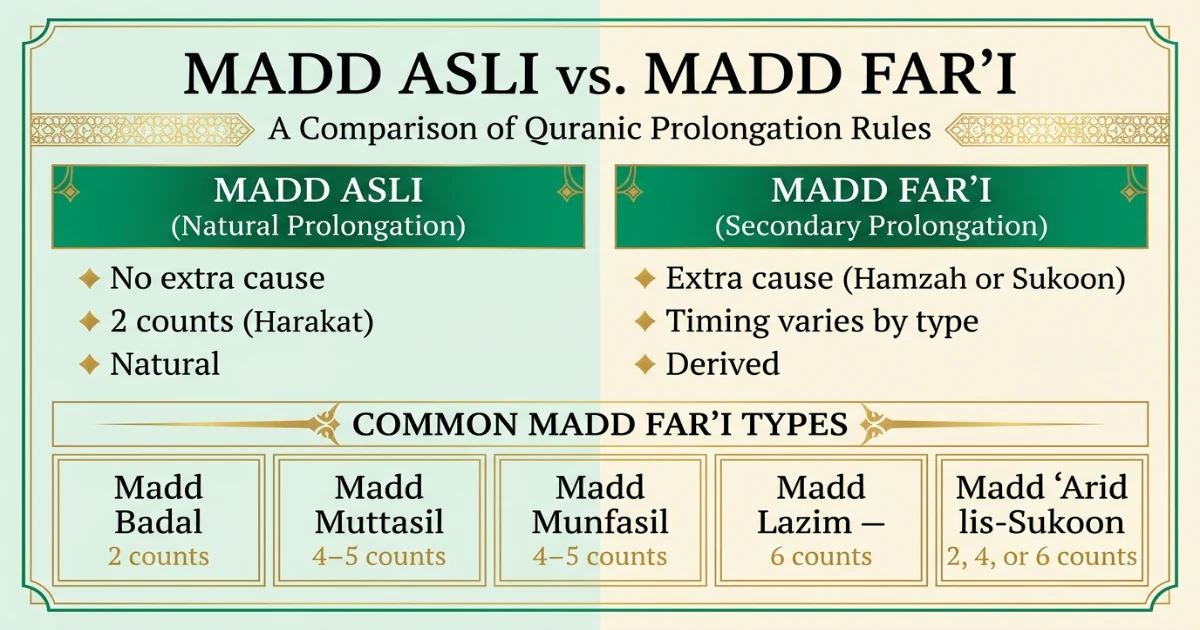
Madd Asli is the natural two-count elongation of a Madd letter when no extra cause affects it. Madd Far’i is a secondary Madd caused by an additional factor, most commonly Hamzah or Sukoon. Madd Far’i does not have one universal length: its timing depends on the specific type. For example, Madd Lazim is commonly six counts, Madd ‘Arid lis-Sukoon can be two, four, or six, and Madd Badal in Hafs is generally two counts.
Natural Madd
Two counts, no additional Hamzah or Sukoon cause, and the baseline elongation for long vowels.
Secondary Madd
An added cause such as Hamzah or Sukoon creates a special category with its own timing.
What are the three Madd letters?
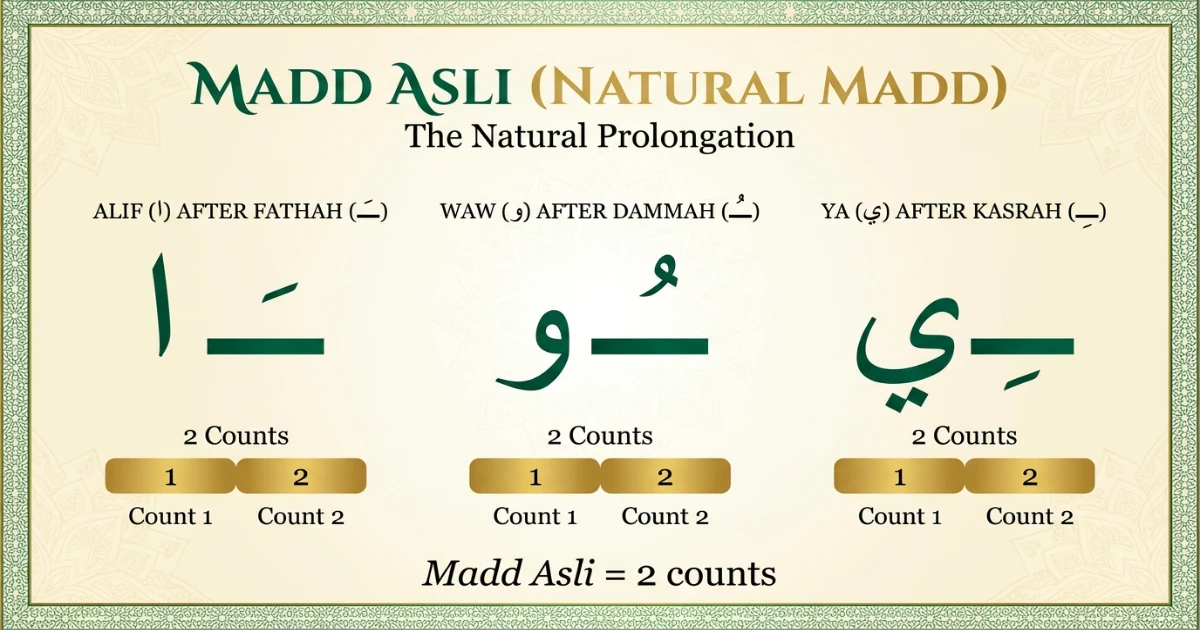
Before comparing Madd Asli and Madd Far’i, a beginner should recognize the three Madd letters in their correct conditions. Alif is a Madd letter when it follows Fathah, a Sakin Waw is a Madd letter when it follows Dammah, and a Sakin Ya is a Madd letter when it follows Kasrah. These combinations create the long vowel sounds that form the foundation of the Madd system.
Recognizing the letter by shape alone is not enough. Waw and Ya do not always function as Madd letters, and Alif has its own spelling behavior. The student should check the vowel before the letter and then look at what comes after it. That second check is what helps distinguish a simple natural Madd from a secondary Madd rule.
When no additional cause such as Hamzah or Sukoon affects the Madd letter, the elongation normally remains Madd Asli. When an additional cause is present, the reader checks which Madd Far’i category applies.
What is Madd Asli?
Madd Asli means the original or basic elongation and is also called Madd Tabi’i, meaning natural Madd. It is the normal value of a long vowel and is read for two counts in the common Hafs ‘an ‘Asim framework taught to beginners.
The defining feature of Madd Asli is that no extra cause is creating a new elongation rule. There is no Hamzah or Sukoon that changes the category. The Madd letter simply receives its natural two-count length.
Two counts are relative rhythmic beats, not two fixed seconds. A student reading slowly and a student reading more quickly can both preserve two counts as long as the proportion stays consistent with the recitation speed.
Madd Asli is the baseline for the whole Madd system. If a learner cannot keep natural Madd steady, longer Far’i timings often become inconsistent too.
What is Madd Far’i?
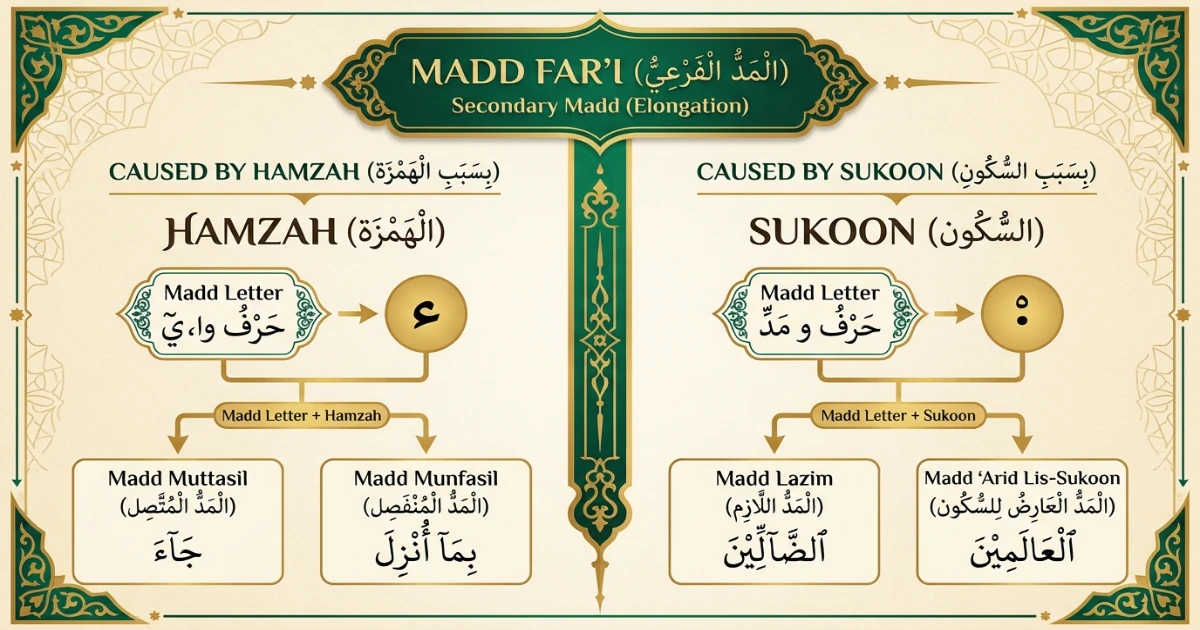
Madd Far’i means a branch, derived, or secondary Madd. It begins from the basic Madd but an additional cause changes the rule. The two major causes taught in Tajweed are Hamzah and Sukoon.
Because Madd Far’i is a family of rules rather than one rule, its timing is not one single number. Some categories are read longer than two counts, some allow more than one valid length, and some Far’i types in Hafs may still be read for two counts.
This is why the statement ‘Madd Far’i is always longer than Madd Asli’ is too simple. A better definition is that Madd Far’i has an additional cause and therefore follows a special transmitted timing rule.
Common Far’i categories include Madd Muttasil, Madd Munfasil, Madd Badal, Madd Lazim, Madd ‘Arid lis-Sukoon, and other subcategories depending on how a Tajweed curriculum organizes the topic.
Madd Asli vs Madd Far’i at a glance
Madd Asli is the natural foundation: two counts, no additional Hamzah or Sukoon cause, and no need to choose between multiple secondary categories. Madd Far’i requires one more step of analysis because the reader must identify the cause and then identify the specific branch.
With Madd Asli, the student’s main task is consistency. With Madd Far’i, the student must combine recognition with timing. The same Madd letter can be read differently depending on what follows it, whether the reader stops, and which specific Far’i rule applies.
The two systems are therefore connected rather than competing. Madd Far’i does not replace Madd Asli; it develops from the same long-vowel foundation when an extra condition appears.
How does Hamzah create Madd Far’i?
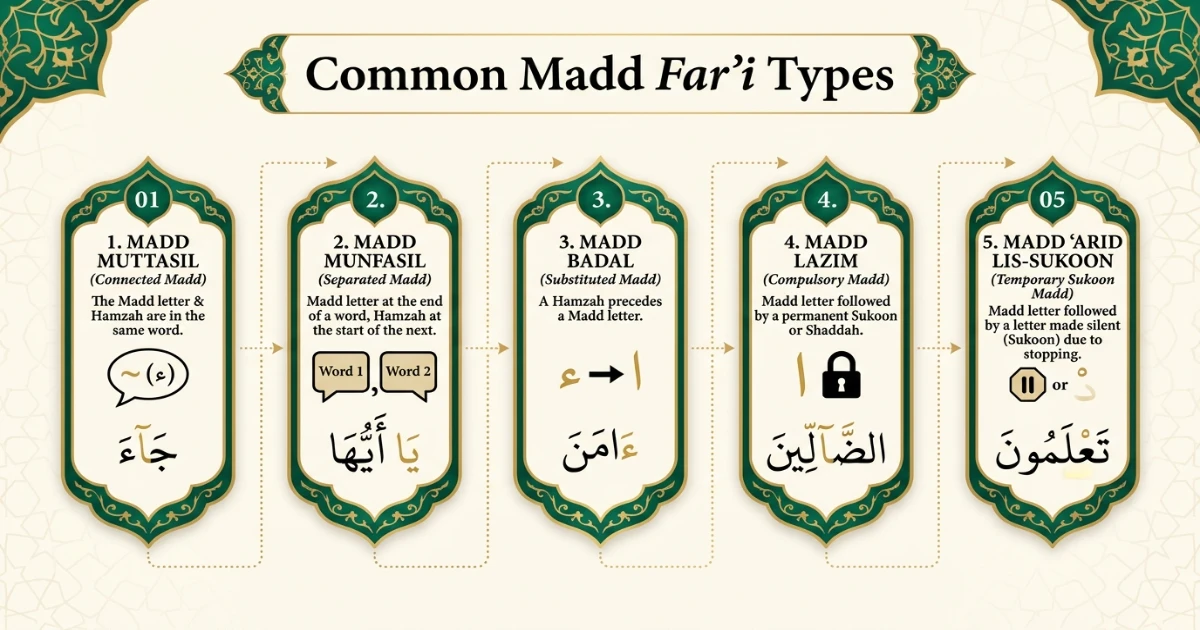
Hamzah can create several important Far’i rules. If a Madd letter is followed by Hamzah in the same word, the rule is commonly called Madd Muttasil. If the Madd letter comes at the end of one word and Hamzah begins the next word, the rule is commonly called Madd Munfasil.
Madd Badal is another Hamzah-related category in many teaching systems. Its arrangement is different because the Hamzah comes before the Madd sound. In Hafs it is generally read for two counts, which is a useful reminder that Far’i does not automatically mean more than two counts.
The precise permitted lengths for Hamzah-related Madd can depend on the Riwayah, Tariq, and teaching method. Beginners should follow one consistent Hafs system rather than mixing numbers from different charts.
How does Sukoon create Madd Far’i?
Sukoon creates another major branch of secondary Madd. If a permanent Sukoon follows the Madd letter, the rule may be Madd Lazim. Madd Lazim is commonly taught with a strong fixed elongation of six counts.
A temporary Sukoon can also appear when the reader stops at the end of a word. This produces Madd ‘Arid lis-Sukoon in the relevant conditions. In common Hafs teaching, two, four, or six counts are valid options for this type.
The distinction between permanent and temporary Sukoon is essential. Permanent Sukoon belongs to the written or structural form of the word, while temporary Sukoon appears because the reader has chosen to stop.
Which Far’i types should beginners know first?
Beginners usually benefit from learning a small set of high-frequency Far’i categories first. Madd Muttasil teaches Hamzah in the same word. Madd Munfasil teaches Hamzah in the next word. Madd Badal shows that Hamzah can also come before the Madd. Madd Lazim introduces permanent Sukoon, while Madd ‘Arid lis-Sukoon connects Madd study with Waqf.
Some curricula also discuss Madd Leen, Silah, Tamkin, and other labels in the same broader chapter. The exact organization can differ. The student should preserve the terminology and counting system used by the teacher rather than trying to force every book into one identical chart.
What matters most at beginner level is being able to answer three questions: where is the Madd letter, what extra cause is present, and what timing belongs to that specific rule?
How many counts are Madd Asli and Madd Far’i?
Madd Asli is two counts. Madd Far’i varies by category. Madd Badal in Hafs is generally two counts. Madd Muttasil is commonly taught as four or five counts. Madd Munfasil is often taught as four or five counts in many classrooms, although shorter routes exist within the broader Hafs transmission.
Madd Lazim is commonly six counts. Madd ‘Arid lis-Sukoon commonly permits two, four, or six counts. These examples show why students should not memorize one number for every Far’i rule.
A count is a relative unit. The reciter should keep the units even rather than speeding up inside one Madd and slowing down inside another. Teacher-led rhythm practice is useful because many students understand the written rule before they can produce a stable timing.
How can you tell Asli and Far’i in real Quran reading?
Start by identifying a long vowel. If nothing after it creates a secondary cause, treat it as Madd Asli and read two counts. If Hamzah or Sukoon is present in a relevant position, pause mentally and identify the branch before deciding the length.
Do not classify by how long the word looks or by how dramatic the sound seems. Classification comes from the letter pattern and the transmitted rule. A short-looking word can contain a strong Far’i rule, while a visually longer word may contain only ordinary natural Madd.
At Waqf, always re-check the ending because stopping can create Sukoon and change the Madd category. This is one of the most common ways a student correctly reads a word in connection but uses the wrong timing when stopping.
Why do students mix Madd Asli and Madd Far’i?
One common mistake is treating every visible long vowel as Madd Far’i. Another is thinking every Far’i must be longer than two counts. A third is ignoring the difference between Hamzah in the same word and Hamzah in the next word.
Students also sometimes count in seconds instead of beats. This produces unnatural recitation because the Madd becomes disconnected from the reading speed. Counts should behave like relative rhythmic units.
Another common issue is mixing valid timings from different transmission routes. A learner may hear one teacher use one length and a different recording use another, then alternate randomly. Valid variation should be learned systematically, not mixed without understanding.
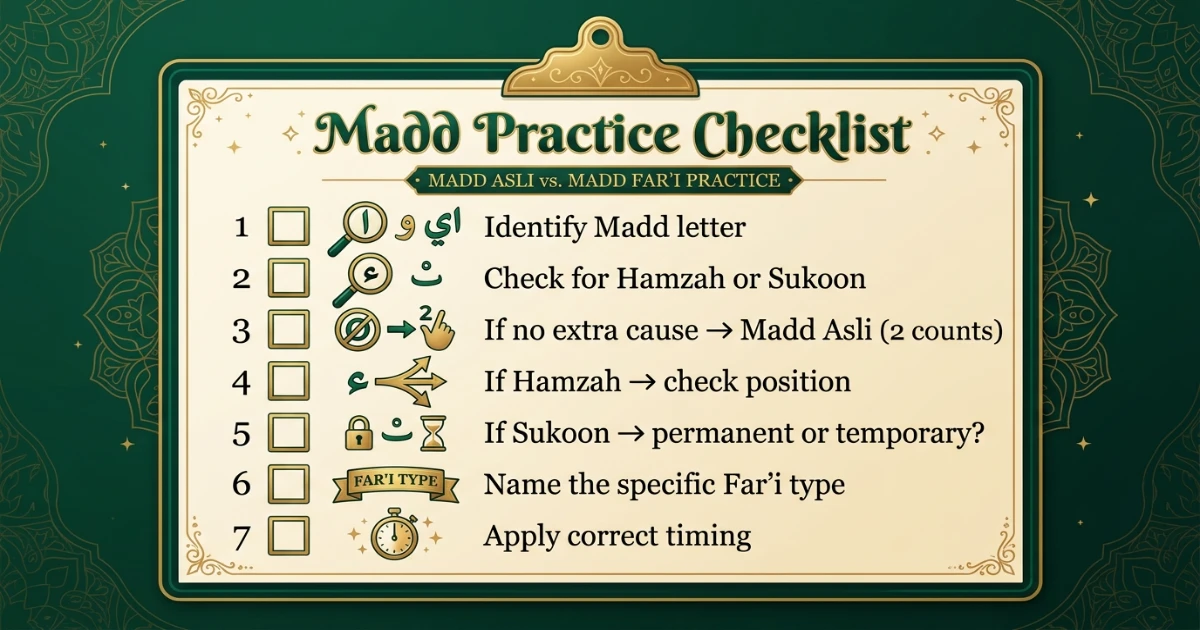
How to decide Madd Asli or Madd Far’i in six steps
First, find the Madd letter in its proper condition. Second, inspect what follows it. Third, if no Hamzah or Sukoon creates an additional rule, read Madd Asli for two counts.
Fourth, if Hamzah is involved, determine whether it is before the Madd, in the same word after the Madd, or at the beginning of the next word. Fifth, if Sukoon is involved, determine whether it is permanent or created by stopping.
Sixth, apply the timing of the specific category being studied. This sequence is more reliable than trying to guess the count directly from the appearance of the word.
How should beginners practise Madd Asli and Madd Far’i?
Separate recognition from timing. Spend one practice session only finding Madd letters and labeling Asli or Far’i. In the next session, add the count. This reduces cognitive overload and helps the student see the cause before worrying about rhythm.
Practise natural Madd first until two counts are stable. Then add one Far’i category at a time. Compare Madd Asli with Muttasil, then with Munfasil, then with Lazim and ‘Arid. Contrast practice makes the difference easier to hear.
Record a short passage and mark each Madd before listening back. Check whether the two-count Madd stays consistent and whether longer or optional Madd follows the intended rule instead of personal preference.

Why teacher feedback matters with Madd
Madd rules are transmitted recitation rules, so correct timing is best learned through listening and correction. A student may label the rule correctly but still stretch a two-count Madd to three counts or shorten a six-count Madd.
A teacher can also explain which accepted Hafs route or classroom convention is being used for Muttasil and Munfasil. This avoids confusion when the learner encounters recordings with different valid lengths.
Teacher feedback is especially valuable for Waqf because stopping can change the final vowel to Sukoon and create a new Madd condition that was not present during connected reading.
Learn Madd Asli and Madd Far’i in online Tajweed lessons
Noor Hafiza Academy offers live online Quran learning for children, girls, women, adults, beginners, returning readers, teenagers, siblings, and homeschool families with female Quran teachers. Learners can ask about Noorani Qaida, Quran reading, Tajweed, Makharij, Sifaat, Madd, Hifz, and pronunciation correction according to their current level.
A Tajweed plan may include Madd Asli, Madd Far’i, Muttasil, Munfasil, Badal, Lazim, ‘Arid lis-Sukoon, Leen, Waqf, Qalqalah, Ghunnah, Noon Sakinah and Tanween, Meem Sakinah, and guided recitation. Current teacher qualifications, female-teacher availability, class length, trial arrangements, fees, schedules, privacy practices, safeguarding policies, and enrollment terms should be confirmed directly.
Far’i always means longer
Not always. Madd Badal in Hafs is generally two counts.
Every long vowel is Asli
Check for Hamzah or Sukoon before deciding.
Counts are seconds
Counts are relative rhythmic units, not fixed stopwatch seconds.
Stopping changes nothing
Waqf can create temporary Sukoon and change the Madd rule.
12-point Madd Asli vs Madd Far’i checklist
Use this while reading a fresh Quran passage
- Can I identify Alif after Fathah, Sakin Waw after Dammah, and Sakin Ya after Kasrah?
- Is there Hamzah or Sukoon affecting the Madd?
- If there is no extra cause, am I reading exactly two counts?
- If Hamzah follows, is it in the same word or the next word?
- If Hamzah comes before the Madd, could this be Madd Badal?
- If Sukoon follows, is it permanent or caused by stopping?
- Have I named the specific Far’i type before choosing a count?
- Am I keeping my count units even?
- Am I avoiding the false rule that every Far’i must be longer than two?
- At Waqf, have I re-checked the ending for Madd ‘Arid lis-Sukoon?
- Am I following one consistent Hafs teaching method?
- Can I explain why each Madd is Asli or Far’i before reciting it?
Share the learner’s age, Quran level, Tajweed background, Madd difficulties, preferred schedule, and whether a female teacher is requested.
FAQs about Madd Asli vs Madd Far’i
What is Madd Asli?
What is Madd Far’i?
What is the easiest difference between Madd Asli and Madd Far’i?
How many counts is Madd Asli?
Is every Madd Far’i longer than two counts?
What causes Madd Far’i?
What are common Madd Far’i types?
What is Madd Muttasil?
What is Madd Munfasil?
What is Madd Lazim?
What is Madd ‘Arid lis-Sukoon?
How should beginners practise Madd Asli and Madd Far’i?
Master Madd by knowing when elongation is natural and when an extra cause changes the rule
Share the learner’s age, Quran level, Tajweed background, Madd difficulties, and preferred class schedule.