
How to Memorize the Quran: A Realistic Beginner Plan

Learning how to memorize the Quran does not begin with choosing the largest possible daily target. It begins with creating a routine the learner can repeat for months and years. A realistic beginner plan combines accurate reading, a small new portion, structured repetition, active recall, recent revision, older revision, teacher testing, and enough flexibility to recover after difficult days. The goal is not to collect pages that disappear. The goal is to build memorization that remains accessible, accurate, and connected to regular recitation.
How should a beginner start memorizing the Quran?
A beginner should first confirm that she can read the chosen passage accurately enough to avoid memorizing preventable mistakes. Then choose a very small daily portion—sometimes one verse, part of a verse, or only a few lines. Listen to a reliable recitation, read the portion several times while looking, divide it into short phrases, repeat each phrase accurately, connect the phrases, and then recite without looking. Review the new portion later the same day and again the next day before adding more. Keep separate time for recent and older revision, and recite regularly to a qualified teacher. A small portion retained for weeks is more valuable than a large portion forgotten after a few days.
What does it really mean to memorize the Quran?
Quran memorization is not simply the ability to repeat a verse immediately after reading it several times. That is short-term familiarity. Stable memorization means the learner can recite the passage without looking, preserve the correct word order, move through the joins with limited prompting, maintain reasonably accurate pronunciation and Tajweed, and return to the passage after time has passed. The passage should remain connected to a revision system so it does not gradually disappear.
A beginner often experiences a quick feeling of success because the page looks familiar. When the Mushaf is open, the next word seems obvious. Once the page is closed, however, the learner may remember only the first phrase or may need the teacher to provide every beginning. This difference is important. Recognition tells you that the page has been seen; recall shows that the passage can be produced independently.
The beginner plan should therefore include looking, listening, repetition, closed-book recall, delayed review, and teacher testing. Leaving out recall or delayed review creates memorization that feels strong today but becomes unstable tomorrow.
The long-term aim may be memorizing selected surahs, completing one Juz, strengthening prayer recitation, or pursuing full Hifz. The daily method can remain similar, but the amount of revision and the length of the commitment will change. A learner should define the first meaningful goal before calculating how many pages to cover.
Are you ready to begin Quran memorization?
A learner does not need perfect fluency or advanced Tajweed before memorizing. Many people strengthen reading and memorization together. However, the learner should be able to follow the selected passage accurately with support, distinguish the main letters and vowel signs, and accept correction. When reading is extremely hesitant or many words are guessed, a short period of reading foundation may make memorization faster and safer.
Reading readiness
Can the learner read the chosen lines with manageable help rather than copying every word from the teacher?
Routine readiness
Is there a realistic daily time for new work and revision on most days of the week?
Correction readiness
Can the learner slow down, repeat, and change a memorized version when the teacher identifies an error?
Goal readiness
Is the first goal specific enough to guide the portion, schedule, and review plan?
Support readiness
For a child, can a parent protect the routine without reciting every answer for her?
Revision readiness
Is the learner willing to revise old work even when new memorization feels more exciting?

When readiness is uneven, do not treat that as failure. Adjust the entry point. A learner may begin with a short familiar surah while continuing reading practice. Another may spend two weeks stabilizing one difficult passage before adding anything new. The right starting point reduces frustration and prevents repeated correction later.
Choose a Quran memorization goal that is specific and sustainable
“I want to memorize the Quran” is a meaningful intention, but it is too broad to manage as a daily plan. A beginner needs a first stage that can be completed, tested, and revised. That stage may be memorizing several short surahs, completing Juz Amma, learning passages used regularly in prayer, or building a stable routine for one month before increasing the amount.
| Beginner goal | Useful starting portion | First success measure | Main caution |
|---|---|---|---|
| Strengthen prayer recitation | One short surah or selected verses | Accurate recitation without prompts over several days | Do not rely only on familiarity from hearing the passage |
| Build a Hifz habit | One to three lines daily | Four consistent weeks with revision completed | Do not increase the portion after only one easy day |
| Memorize short surahs | One small phrase or verse at a time | Surah recited independently and reviewed weekly | Protect the joins between verses |
| Begin Juz Amma | Several lines based on reading level | New work remains strong while older surahs are revised | Revision volume grows quickly |
| Return after a long break | Old memorization before new work | Weak passages become independently accessible again | Do not cover weakness by adding fresh pages |
The first goal should fit the learner’s current life. School examinations, work deadlines, illness, travel, or family responsibilities may require a smaller target for a season. A reduced target is not abandoning Hifz. It is protecting continuity until more capacity becomes available.
How much Quran should a beginner memorize each day?
There is no universal daily amount. A suitable portion is one that the learner can read accurately, memorize with concentration, recall later, and revise alongside previous work. For one beginner, that may be part of a verse. For another, it may be one verse, three lines, or half a page. The amount should be based on retention, not comparison with another student.
The portion should remain stable for several weeks before increasing. If the learner completes new work but repeatedly fails yesterday’s lesson, the new portion is too large or the revision method is too weak. If the learner finishes quickly, retains accurately, and completes revision without strain for several weeks, the teacher may consider a modest increase.
Before adding new memorization, recite yesterday’s portion without looking. If it needs many prompts, repair it first. Yesterday’s weakness is more important than today’s page target.
Children may benefit from very short portions that end with a clear success. Adults may understand and repeat more at one time but have less predictable schedules. Returning learners may memorize quickly because the passage feels familiar, yet still need careful testing to separate true recall from recognition.
A practical step-by-step method for memorizing a new passage
The following sequence gives the learner several ways to process the passage: visual reading, listening, accurate production, small-unit repetition, connection, and independent recall. The exact repetition count can change. The quality of attention matters more than reaching a fixed number while the mind has stopped engaging.
Listen to the complete portion
Follow the Mushaf while listening to a reliable recitation or the teacher. Notice the beginning, ending, rhythm, repeated words, and stopping place.
Read accurately while looking
Read slowly enough to identify letters, vowels, shaddah, madd, and difficult joins. Correct the passage before repeating it many times.
Divide the passage into short phrases
Use natural word groups that fit the learner’s breath and memory. Avoid dividing at a place that makes the words harder to reconnect.
Repeat the first phrase with attention
Look at the phrase, read it accurately, then attempt it without looking. Return to the text only to repair the exact weak point.
Add the next phrase
Memorize the second phrase separately, then connect the first and second. Continue in small units rather than repeatedly restarting the entire passage.
Recite the full portion without looking
Close or cover the text. Recite from the beginning, note where recall breaks, repair that join, and test the complete portion again.
Delay and retest
Leave the passage for a short period, then return without looking. Delayed recall shows whether the memorization survives beyond the practice session.
Recite to a teacher
Teacher testing reveals hidden word changes, weak joins, pronunciation drift, and prompts the learner may not notice alone.
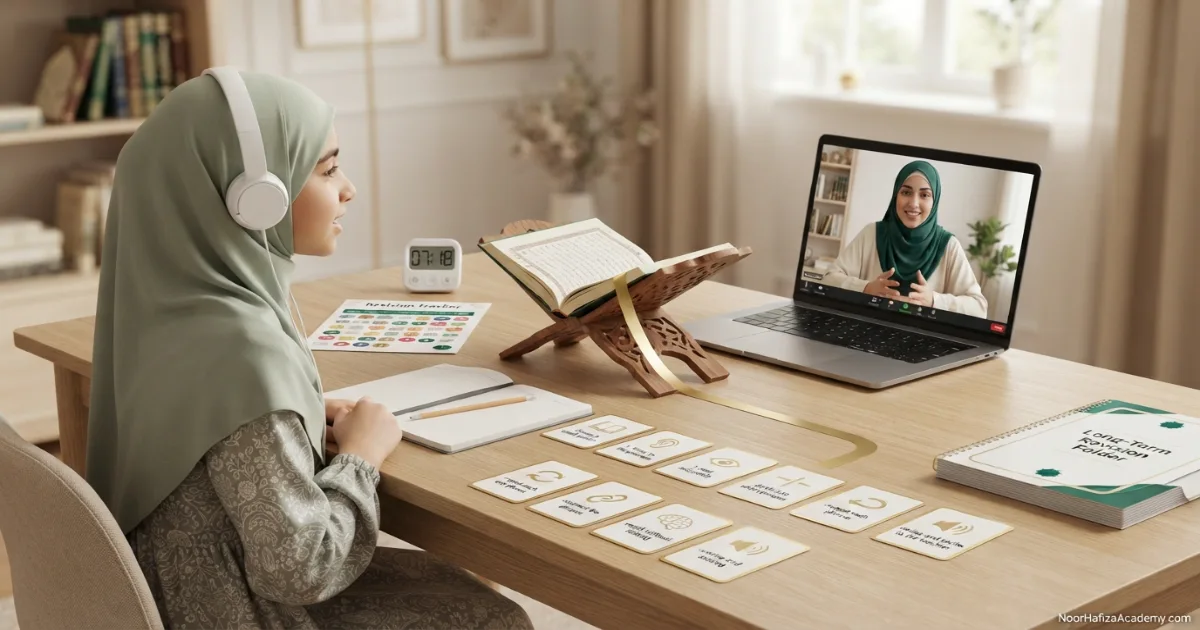
Avoid using a single mechanical repetition number as the whole method. Ten attentive repetitions can be more valuable than fifty distracted ones. The learner should know what she is checking: exact word order, the first word of each phrase, a similar ending, a difficult letter, or the join between two verses.
The balance between new memorization, recent revision, and older revision
Revision is the center of Quran memorization. New work is only a small part of Hifz. As memorization grows, the learner must carry three responsibilities: today’s new portion, recently memorized passages that are still fragile, and older passages that need regular circulation. Without this structure, the newest page may sound strong while previous weeks gradually weaken.
New memorization
A small fresh portion studied accurately and tested without looking.
Recent revision
Yesterday’s and this week’s work, reviewed frequently because it is still unstable.
Older revision
Earlier surahs or pages rotated on a schedule so they remain accessible.

A simple beginner pattern is to revise more material than is newly memorized. For example, a learner adding one short verse may revise several previously memorized verses or surahs. The exact ratio should change as the memorized amount grows. When revision begins taking longer, reduce new work rather than compressing the review.
Recent revision should be frequent enough that the passage never becomes completely unfamiliar. Older revision can be divided across the week. A learner who has memorized only a few surahs may review all of them regularly. A learner with more material needs a rotating cycle recorded in a notebook or tracker.
A realistic daily Quran memorization routine for beginners
The best time is one the learner can protect consistently. Some people concentrate well after Fajr, while others need a later quiet period. The routine should include both new work and review. When time is limited, protect revision first and reduce the new portion.
| Stage | Suggested time | Activity | Purpose |
|---|---|---|---|
| Warm-up | 2–3 minutes | Recite one familiar passage | Activate pronunciation, confidence, and attention |
| Recent revision | 5–10 minutes | Recite yesterday’s and recent portions without looking | Repair weakness before adding new material |
| New portion | 10–20 minutes | Listen, read, divide, repeat, connect, and recall | Create accurate initial memorization |
| Older revision | 5–15 minutes | Recite the scheduled older surah or page | Maintain long-term accessibility |
| Final recall | 2–3 minutes | Recite today’s new portion once without looking | Confirm retrieval before ending |
| Later check | 2–5 minutes | Retest after a gap or before sleep | Strengthen delayed recall |

A beginner does not need to complete every stage in one long sitting. New memorization may happen in the morning, while older revision is recited during another quiet period. Children may need several short sessions rather than one extended block. The routine should remain recognizable even when the minutes change.
A weekly Quran memorization plan with testing and recovery
A weekly structure prevents every day from becoming an unplanned decision. It also gives the learner room for testing, repair, and a lighter day. The example below can be adjusted for lesson frequency, age, school, work, and the amount already memorized.
New lesson + recent review
Begin a small portion and revise the previous lesson before adding anything else.
Strengthen and connect
Repeat the same portion, repair joins, and recite earlier material.
Teacher test
Recite without looking and record the words, joins, or sounds that need repair.
New work if stable
Add a small portion only when recent memorization passes the test.
Revision emphasis
Reduce or pause new work and circulate older memorization.
Weekly consolidation
Recite the week’s complete work, test random beginnings, and set the next target.

One day may remain flexible for family commitments, illness, or recovery. A missed new lesson does not require doubling the next day. Resume with revision, repair the most recent portion, and continue from the stable point.
Should you correct Tajweed before or during Quran memorization?
Pronunciation should be corrected before an error is repeated enough to become fixed, but a beginner does not need to master every advanced Tajweed detail before memorizing a short passage. The teacher should prioritize letter identity, vowels, shaddah, obvious madd, clear word order, and recurring pronunciation mistakes. The learner can continue developing wider Tajweed while memorization grows.
Memorizing a consistently inaccurate version creates additional work because the mind stores both the words and the sound pattern. Later correction may feel like replacing a familiar route. Therefore, read the passage to the teacher or use a reliable model before high repetition. When a correction is given, isolate the exact word, repeat it accurately, return it to the phrase, and then recite the full passage.
Related guidance is available in Tajweed rules for beginners, Makharij of Arabic letters, and common Quran pronunciation mistakes.
Common Quran memorization mistakes and how to correct them
Taking too much new work
The learner completes today’s page but cannot recall yesterday’s. Reduce the daily portion until recent revision becomes dependable.
Repeating while looking only
The page becomes familiar, but independent recall remains weak. Cover the text and test each phrase from memory.
Neglecting verse connections
Each verse is known separately, but transitions fail. Practise the final words of one verse together with the beginning of the next.
Adding new work before revision
The newest lesson receives all attention while older passages fade. Complete recent revision before starting fresh material.
Using many Mushafs and recordings
Constantly changing visual layout and audio style can make the routine less stable. Beginners often benefit from consistent references.
Practising errors without feedback
High repetition strengthens the wrong word or sound. Use teacher correction before repeating an uncertain phrase many times.
Comparing progress with others
Different reading levels, schedules, ages, and revision loads make comparison misleading. Measure personal retention and consistency.
Stopping after a difficult week
Missing several days becomes a complete break. Restart with familiar revision and a smaller target rather than waiting for a perfect schedule.

How to handle similar verses and repeated endings
Similar verses can create confusion because the learner recognizes the general structure but selects the wrong word, ending, or sequence. The solution is not only more full-page repetition. Compare the passages directly. Mark the exact words that differ, understand where each passage appears, and practise the unique phrase that leads into the difference.
Create a small comparison note with the beginning, the differing word, and the next phrase. Recite one version, pause, name the location or context, and then recite the other. A teacher can test from the middle rather than always beginning at the first verse. Random beginnings reveal whether the passage is stored as flexible connected units or only as one long chain.
When two passages are repeatedly confused, identify the first word where they separate and build a clear cue around that point. Repeating both passages from the beginning may hide the exact weakness.
How a beginner Hifz plan should change for children and adults
| Learner | Useful lesson pattern | Home routine | Main risk |
|---|---|---|---|
| Young child | Short, encouraging, frequent testing | Several 5–10 minute sessions with a parent protecting the routine | Fatigue, pressure, or parent giving every prompt |
| Older child or teen | Clear targets, respectful correction, visible progress tracking | New work plus independent revision recording | Rushing to match classmates or hiding weak revision |
| Adult beginner | Private scheduling, realistic portions, concise feedback | Short protected sessions around work and family duties | Irregular practice and oversized weekend targets |
| Returning learner | Assessment of old memorization before new work | Repair, random testing, and rotating revision | Mistaking familiarity for stable recall |
The emotional environment matters. Memorization includes repetition, temporary forgetting, and correction. Children need encouragement without exaggerated rewards or shame. Adults need a plan that respects responsibilities and does not treat a missed day as proof that they cannot continue.
How to know Quran memorization is becoming stable
Independent beginnings
The learner can begin the verse or passage without hearing the first word.
Stronger verse joins
The final phrase leads naturally into the next verse with fewer prompts.
Delayed recall
The passage remains available later the same day and on the next day.
Random access
The learner can continue from a selected middle point rather than only from the beginning.
Reduced correction
Word changes, omitted phrases, and pronunciation errors become less frequent.
Long-term circulation
Older memorization remains in the weekly or monthly revision cycle.
A passage should be tested under different conditions: immediately after memorizing, later the same day, the next day, after several days, and from random starting points. A smooth recitation directly after intense repetition is encouraging, but long-term retention is proven by delayed and varied recall.
What to do when Quran memorization feels slow or stuck
A plateau may mean the revision load has grown, the new portion is too large, reading errors are consuming attention, sleep and stress are affecting concentration, or the learner is repeating without active recall. Do not respond automatically by increasing repetition or adding more time. First identify where the process breaks.
Pause new memorization for several days if necessary. Strengthen recent lessons, test older material, repair similar verses, and restore the routine. The pause is part of Hifz, not a failure outside it. Many learners progress more quickly after consolidation because the next portion no longer competes with unstable previous work.
For recitation support before or alongside Hifz, see how to improve Quran recitation and online Quran reading classes.
Can a beginner memorize the Quran online?
Yes. Online Hifz can work when the learner has clear audio, a consistent Mushaf, live recitation time, specific correction, regular testing, and a written revision plan. The teacher should hear both new work and older memorization. A lesson focused only on the newest portion may allow earlier passages to weaken unnoticed.
A strong online Hifz lesson can include warm-up revision, testing of recent work, recitation of the new lesson, correction of words and joins, random prompts, and a precise home assignment. Children may need a mother or female guardian nearby to manage technology and routine. The parent should avoid giving the first word too quickly, because the teacher needs to see where independent recall breaks.
Noor Hafiza Academy offers live online Hifz support with female Quran teachers for children, girls, women, sisters, complete beginners, and returning learners. Current teacher availability, schedules, fees, trial arrangements, and enrollment terms should be confirmed directly through the academy.
Share the learner’s age, reading level, existing memorization, revision strength, available practice time, time zone, and first goal. A suitable teacher can recommend a manageable portion and the first revision cycle.
What to look for in a Quran memorization teacher
She tests old and new work
The lesson includes recent and older revision, not only the newest passage.
She corrects before high repetition
Words, vowels, joins, and major pronunciation issues are repaired before the learner stores them deeply.
She adjusts the daily portion
The target changes according to retention, attendance, age, and revision load rather than a fixed page promise.
She tracks recurring weakness
Similar verses, omitted words, weak beginnings, and repeated pronunciation problems are recorded and revisited.
She builds independent recall
The learner receives thinking time and random testing instead of constant first-word prompts.
She communicates the revision plan
Parents and adult learners understand what to revise, how often, and what evidence will allow new work.
Use the separate female Quran teacher online checklist to review teaching style, privacy, communication, and lesson fit.
A realistic Quran memorization checklist you can start this week
Choose one goal
Define the first surah, passage, Juz, or one-month routine target.
Set a small portion
Begin with an amount that can survive next-day testing.
Read accurately
Use teacher correction or a reliable model before high repetition.
Recall without looking
Cover the text, repair the exact weak point, and retest after a delay.
Revise before adding
Complete recent review and keep older work in circulation.
Test every week
Use teacher testing, random beginnings, and verse connections.
FAQs about how to memorize the Quran
How should a beginner start memorizing the Quran?
How much Quran should I memorize each day?
How many times should I repeat a verse to memorize it?
Should I memorize with or without looking at the Mushaf?
What is more important, new memorization or revision?
Can I memorize the Quran if my Tajweed is not perfect?
What is the best time to memorize the Quran?
How do I stop forgetting what I memorize?
What should I do after missing several days?
Can adults memorize the Quran?
Can children memorize the Quran online?
How do I know a passage is memorized properly?
Begin with a small portion and a revision plan you can keep
Share the learner’s age, reading level, existing memorization, available practice time, time zone, and first Hifz goal. Noor Hafiza Academy can discuss a suitable starting assessment and realistic plan with a female Quran teacher.