
Hifz for Adults: How to Memorize Quran with a Busy Schedule
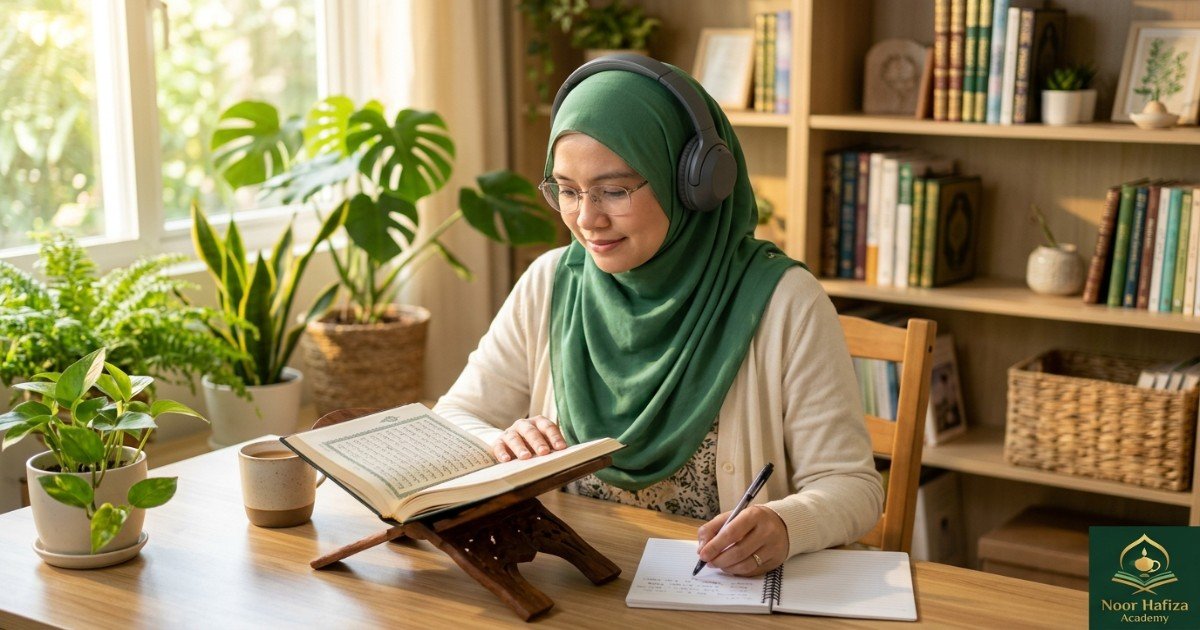
Hifz for adults can work even with a full-time job, university, parenting, caregiving, or a demanding household schedule. The plan simply has to respect adult reality. Most busy adults cannot spend several uninterrupted hours memorizing every day, so progress depends on small consistent portions, strong revision, accurate recitation, and a routine tied to parts of the day that already exist. For one learner, that may be ten minutes after Fajr and ten minutes before sleep. For another, it may be a lunch-break review plus a longer weekend session. A strong adult Hifz plan also protects old memorization. If new verses keep increasing while earlier portions weaken, the learner may feel productive without actually building durable Hifz. The goal is a sustainable system: accurate new memorization, recent revision, older revision, and regular teacher listening.
How can a busy adult memorize the Quran?
Use a small, repeatable Hifz routine instead of waiting for long free periods. Choose a realistic new-memorization target, such as a few lines or a short passage, and protect revision every day. A practical adult system has three parts: new memorization, recent revision, and older revision. Memorize when your mind is freshest, review during a second short window, and use weekends for longer consolidation rather than constantly increasing new material. Correct pronunciation before repeating a verse many times so errors are not memorized. If your old memorization becomes unstable, reduce the new target temporarily and strengthen revision.
Why adult Quran memorization needs a different plan
Adults often begin Hifz with strong motivation but limited time. Work meetings, school runs, caregiving, commuting, cooking, exams, and unexpected responsibilities can interrupt even a carefully planned week. This does not make memorization impossible, but it does mean the plan should be resilient.
Children may have structured madrasa hours and fewer responsibilities. Adults usually need to build Hifz around an existing life. That makes consistency more important than volume. A plan that survives busy weeks is more valuable than one that works only when life is unusually calm.
If a target regularly causes skipped review, the target may be too large for the current season of life.
How much Quran should a busy adult memorize each day?
There is no single daily amount that fits every adult. The right target depends on reading fluency, Tajweed, memory, available time, passage difficulty, and revision load.
Very busy season
Memorize a small phrase or a few lines and focus heavily on retention.
Moderate schedule
Use a stable small daily portion with separate revision time.
Lighter schedule
Increase the new portion only if old memorization remains strong.
Revision-heavy week
Pause or reduce new memorization when retention needs attention.
A target is realistic when you can memorize it accurately, revise it the next day, and still maintain older portions. If you are constantly carrying unfinished material into the next session, reduce the target.

Where can Hifz fit into a busy adult day?
Use an early quiet period for new verses when concentration is strongest.
Use a lunch break, safe audio review during a commute, or another short pause to strengthen the latest portion.
Recite an older section slowly, ideally without relying on audio.
You do not need all three windows every day. The point is to separate tasks so memorization does not depend on one long session. A morning ten-minute new lesson plus a ten-minute evening revision can be easier to protect than a single forty-minute block.
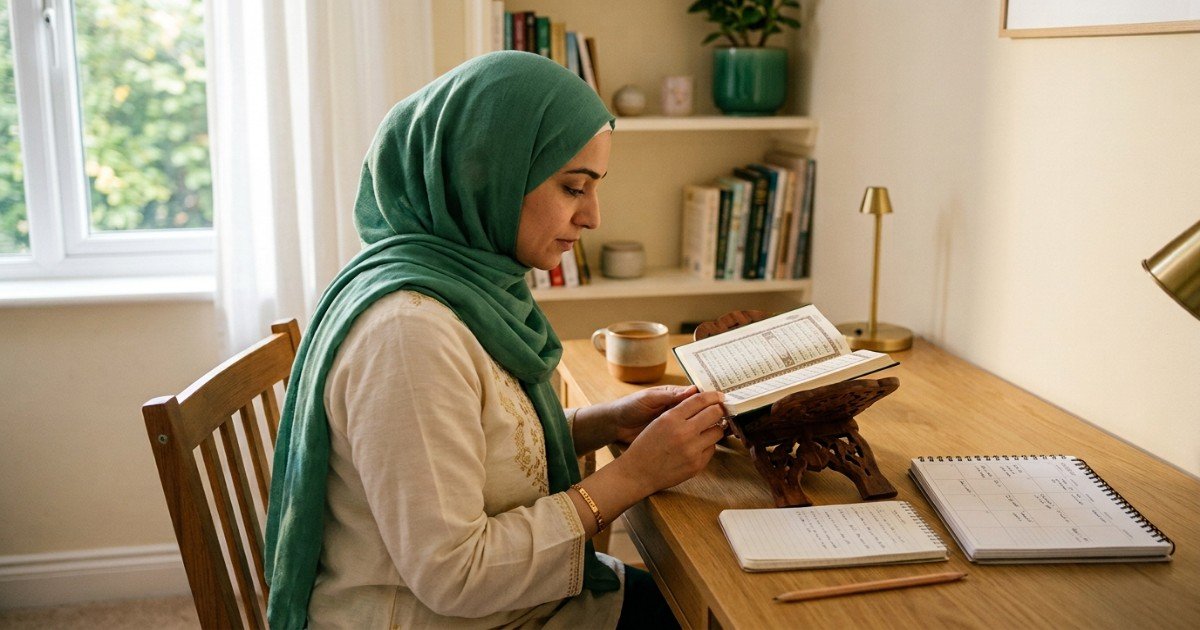
Use new lesson, recent revision, and old revision
A sustainable Hifz plan should not treat every minute as new memorization. Durable memorization depends on layers of review.
| Layer | What it means | Purpose | Busy-adult approach |
|---|---|---|---|
| New lesson | Today’s new memorization | Add new material accurately | Keep the portion small |
| Recent revision | Material memorized in recent days | Move it toward stronger recall | Review daily or on a planned rotation |
| Old revision | Earlier memorization | Protect long-term retention | Use a weekly rotation |
Some Hifz programs use terms such as Sabaq, Sabqi, and Manzil for similar layers. Terminology and exact systems can vary, but the principle is stable: new memorization should not push old memorization out of the routine.
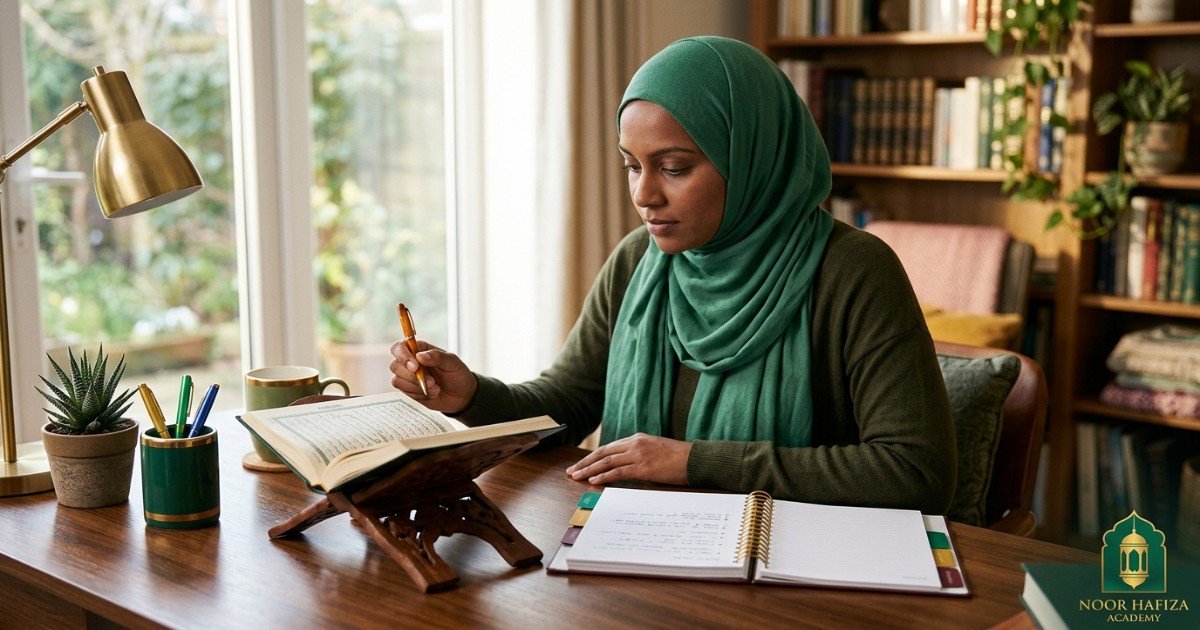
A simple memorization method for adults
Make sure the verse is being read correctly before heavy repetition begins.
Use a reliable recitation to hear pronunciation, phrase flow, and stopping.
Repeat one phrase until it becomes stable, then connect it to the next phrase.
Test recall independently instead of repeating only with the Mushaf open.
Recite the whole assigned portion from the beginning to avoid isolated fragments.
A second recall attempt helps reveal whether the memorization was truly stable.
How listening and repetition help adult Hifz
Listening can make memorization easier by strengthening the sound pattern of a passage. It is especially useful when an adult is walking, doing routine household tasks, or using another safe low-distraction period. But passive listening should support active memorization, not replace it.
For the new lesson, read first, listen carefully, then repeat accurately. When the wording is stable, recite without the recording. If you can only continue when the audio is playing, the passage is not yet independently memorized.
What should you do when old Hifz starts becoming weak?
Reduce the amount of new memorization. Weak revision is not usually solved by adding more new verses. Adults sometimes keep chasing progress because pausing feels like falling behind, but strengthening old material is part of progress.
Retention is more important than maintaining an artificial daily quota.
Create a simple rule for yourself: if recent revision reaches a certain error level, use that session for strengthening instead of adding. The exact threshold can be set with a teacher based on your level.
Use weekends for consolidation, not only catch-up
A longer weekend session can help adults who have very short weekday windows. But the weekend should not become a stressful attempt to memorize everything missed during the week.
Review the week
Recite all recent memorization without looking and mark weak transitions.
Repair old portions
Choose one older section that needs attention instead of reviewing everything randomly.
Teacher check
Use a live lesson to correct accuracy, Tajweed, and retention problems.
Plan the next week
Set a realistic target based on the week you just experienced.

How to memorize Quran while working full time
A full-time worker should build Hifz around predictable moments rather than idealized free time. The commute, lunch break, early morning, and evening can each have a different role.
| Time | Possible task | Length | Why it works |
|---|---|---|---|
| Early morning | New memorization | 10–20 min | Fresh concentration |
| Commute / walk | Listening review | Flexible | Uses otherwise passive time when safe |
| Lunch break | Recent revision | 5–10 min | Prevents long gaps |
| Evening | Old revision | 10–15 min | Separates retention from new lesson |
Do not attempt active reading or memorization while driving or in any situation where it could distract from safety. Audio listening may be useful during a commute when safe, but focused reading should happen when you can give it full attention.
How parents can memorize Quran with children at home
Parents often wait for complete silence, but that window may rarely come. A more realistic plan is to choose one protected period and make the target small enough to finish before interruptions take over.
Use a quiet morning window for the most demanding work.
Recite recent material softly or review transitions.
Use a calm evening block for older memorization if energy allows.
Why adults should correct recitation before heavy memorization
Repetition strengthens whatever is repeated. If a verse is memorized with a wrong letter, incorrect Madd, or repeated Tajweed mistake, that pattern can become difficult to remove later.
This does not mean an adult must complete an advanced Tajweed course before beginning Hifz. It means the new portion should be checked for major pronunciation and recitation errors before it is repeated heavily.
How to measure adult Hifz progress
| Measure | Weak metric | Better metric | Why |
|---|---|---|---|
| New material | Lines added | Lines recalled next day | Tests real retention |
| Revision | Pages “covered” | Errors and prompts needed | Shows stability |
| Tajweed | Rules known | Accurate application in memorized text | Measures actual recitation |
| Consistency | Perfect streak | Return after missed days | Busy adults need recovery skills |
What to do when you miss several days
Do not try to “repay” every missed day by doubling or tripling new memorization. Resume with revision first. Test the most recent portion, strengthen weak transitions, then return to new material when the base feels stable.
A missed week is not the same as a failed Hifz plan. The important skill is restarting without turning guilt into another delay.
Common adult Hifz mistakes
Setting a child-sized schedule
The adult copies an intensive madrasa routine that does not fit work and family responsibilities.
Adding new verses every day
New material grows while recent and older memorization weaken.
Waiting for a perfect hour
Short available windows are ignored because they do not feel long enough.
Memorizing before correcting recitation
Pronunciation errors are repeated until they become part of the memorized pattern.
Using weekends only for catch-up
Weekend Hifz becomes exhausting instead of strengthening retention.
Measuring only page count
The learner looks productive even when old Hifz is unstable.
Changing targets every week
The system never becomes predictable enough to build a habit.
Stopping after one difficult week
A temporary schedule problem is treated as proof that adult Hifz is impossible.
How an online Hifz teacher can help busy adults
A teacher adds accountability, recitation correction, and an external check on whether the target is realistic. Adults often need help balancing ambition with retention.
Ask these before starting adult Hifz
- How much new memorization should I begin with?
- How will we divide new lesson, recent revision, and old revision?
- How do you check Tajweed before memorization?
- What should I do if my old Hifz becomes weak?
- How often should I submit revision?
- Can my target change during busy work or family seasons?
- How should I use listening without depending on audio?
- What should I revise on weekends?
- How do you track errors and retention?
- Can I pause new memorization temporarily without losing the plan?
- What lesson schedule works for working adults?
- Are female Hifz teachers available for my preferred time?
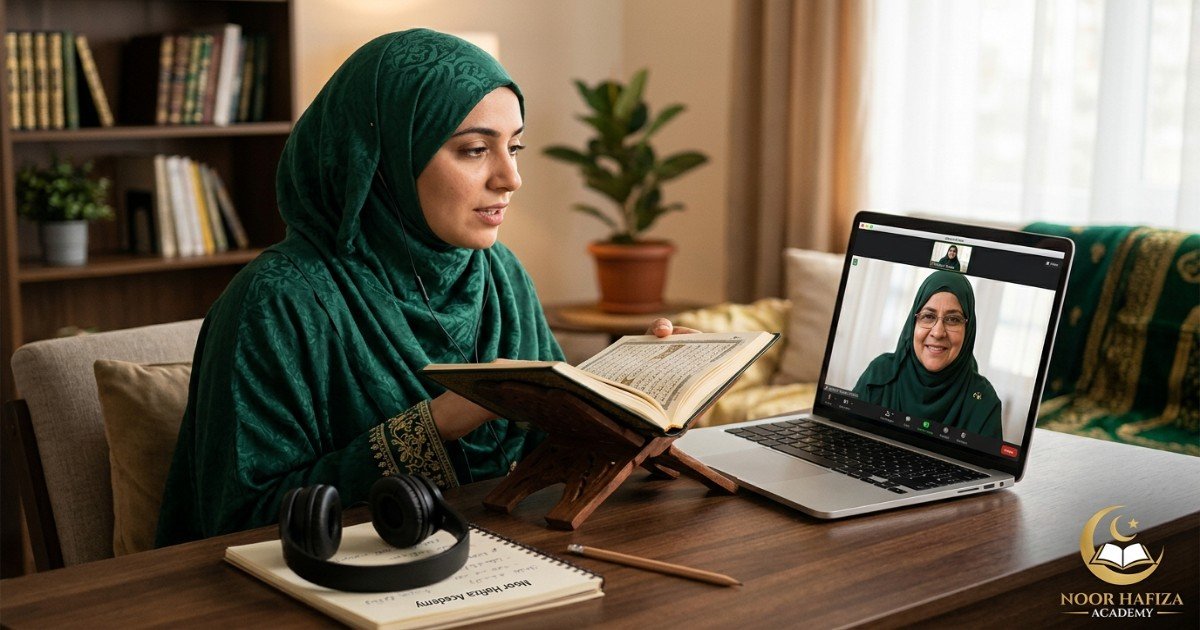
Online Hifz classes for adults with busy schedules
Noor Hafiza Academy offers live online Quran learning for women, girls, children, adults, new Muslims, returning readers, teenagers, siblings, and homeschool families with female Quran teachers. Adults can ask about Hifz support, Quran reading, Tajweed, pronunciation correction, and revision planning according to current level and goals.
A suitable adult Hifz plan may include a small memorization target, recent revision, older revision, listening practice, Tajweed correction, weekend consolidation, and periodic progress review. Current teacher qualifications, female-teacher availability, class length, trial arrangements, fees, schedules, rescheduling policies, privacy practices, and enrollment terms should be confirmed directly.
Share your current Quran level, previous memorization, daily availability, work or family schedule, revision strength, and whether the goal is short Surahs, selected portions, or a longer Hifz journey.
FAQs about Hifz for adults with busy schedules
Can adults memorize the Quran while working full time?
How much should an adult memorize each day?
How many minutes a day are enough for adult Hifz?
What is more important: new memorization or revision?
Should I memorize Quran in the morning or evening?
Can I use listening during Hifz?
Do I need perfect Tajweed before starting Hifz?
What if I miss several days of Hifz?
How can parents manage Hifz with children at home?
How should I use weekends for adult Hifz?
Can adults take online Hifz classes?
What should I send when asking about adult Hifz classes?
Memorize Quran at a pace that protects accuracy, revision, and long-term retention
Share your current Quran level, previous memorization, daily availability, revision strength, work or family schedule, and preferred class time.