
Best Online Quran Class Schedule for School-Age Children

The best online Quran class schedule for school-age children is not simply the earliest available teacher slot or the time that looks open on a parent’s calendar. It is the recurring window when a child can arrive prepared, recite aloud, accept correction, complete a manageable lesson, and still protect schoolwork, meals, prayer, family time, physical activity, and sleep. A strong schedule also leaves enough space between lessons for practice and revision. This guide helps parents choose realistic class times for younger elementary children, older elementary learners, and middle-school students while adjusting for Quran reading, Tajweed, Hifz, Islamic Studies, siblings, activities, time zones, and changing school seasons.
What is the best online Quran class schedule for school-age children?
For many school-age children, a useful starting schedule is two or three short weekday classes held after a brief recovery period from school but before the evening becomes crowded with dinner, late homework, activities, or bedtime. Younger children may begin with approximately 20–25 focused minutes, while older children may manage 25–40 minutes depending on level, course, and attention. Hifz students may benefit from more frequent teacher contact, but new memorization should not crowd out revision or sleep. The correct schedule is the one the family can repeat for at least several weeks with punctual attendance, prepared materials, regular home practice, and a child who remains alert enough to learn.
What makes an online Quran class schedule work for children?
A schedule works when it supports learning before the class begins, during the lesson, and after it ends. The child should have enough time to transition from school, gather the correct book, connect headphones, and enter the lesson without being rushed. During class, the learner should be able to sit, listen, recite, repeat, and respond to the female Quran teacher. After class, there should still be room for dinner, homework, prayer, hygiene, and sleep. When one lesson creates pressure across the entire evening, the time may be technically available but educationally unsuitable.
Parents often begin with teacher availability because that is the practical enrollment question. A better first step is to map the child’s week. Record dismissal time, travel home, snack, homework, tutoring, sports, school clubs, family responsibilities, dinner, prayer, and bedtime. Then identify two or three recurring windows that are genuinely sustainable. Sharing several acceptable local-time options gives the academy a better chance of matching the child with a suitable female teacher without forcing the family into an unstable routine.
The best Quran class window is not defined only by an empty calendar box. It is defined by the child’s energy, readiness, privacy, internet setup, and ability to practise before the next lesson.
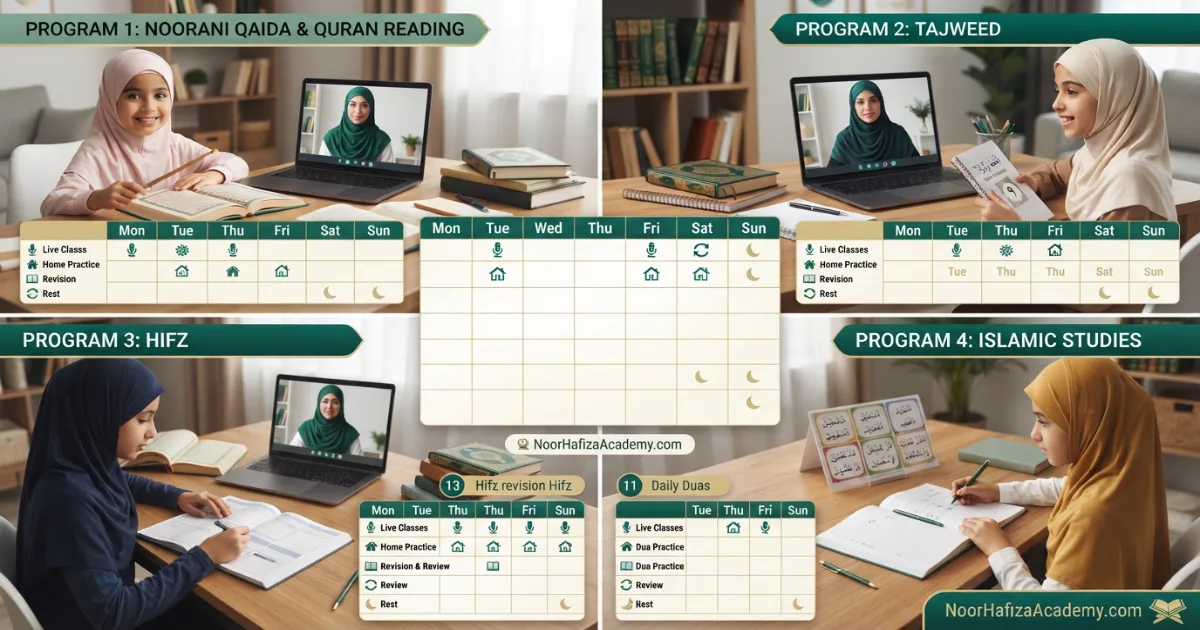
A schedule should also match the course. A beginner working through Noorani Qaida needs frequent recognition and decoding practice. A child improving Quran reading may benefit from two or three live sessions plus short independent reading. A Tajweed learner needs time to apply one correction repeatedly. A Hifz student needs space for sabaq, sabqi, and manzil. Islamic Studies may use a different weekly rhythm because discussion and review are not identical to recitation testing.
How long should a child rest before an after-school Quran class?
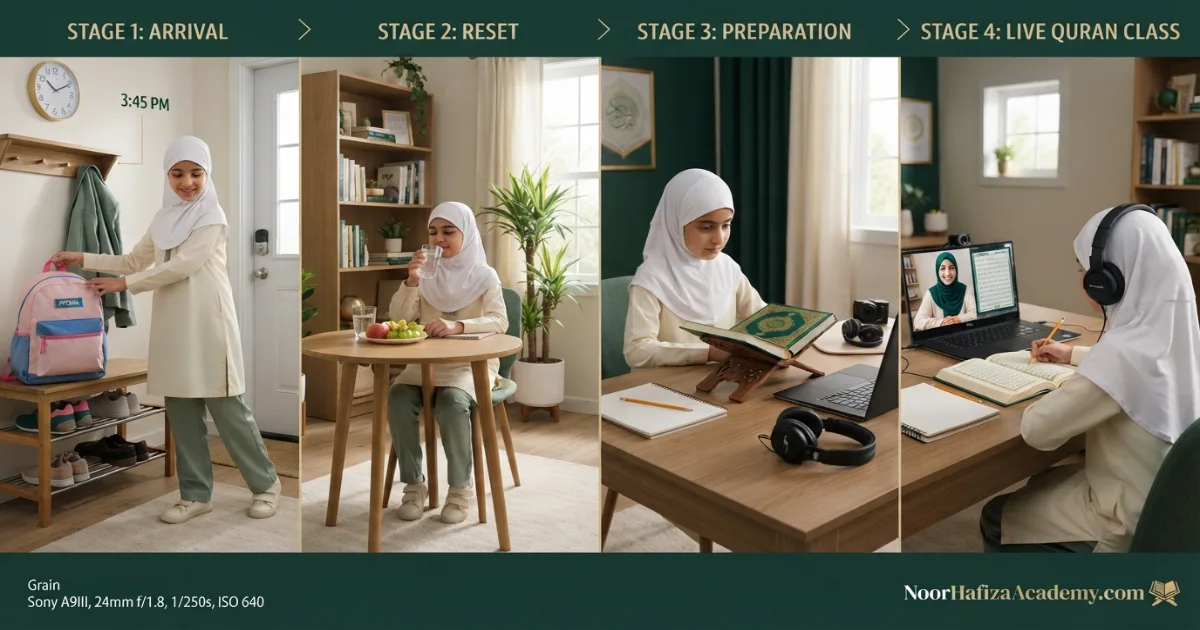
Many children need a short transition after school before they can concentrate on another structured lesson. The useful break may include arriving home, using the bathroom, changing clothes, eating a light snack, drinking water, and having a few quiet minutes. The break should restore attention without becoming so long that the child enters a new activity, becomes absorbed in a screen, or feels that the Quran class interrupts free time unexpectedly.
A practical starting point is often a 30–60 minute transition after arriving home, but the correct length depends on transportation, lunch timing, age, temperament, and whether the child attends an after-school program. A learner who reaches home at 3:20 p.m. may be ready at 4:00 p.m. Another child who spends an hour on a bus may need more food and movement before sitting again. Parents should observe the child rather than copying another family’s timetable.
Useful after-school sequence
Arrive homeBathroom and changeSnack and waterShort movement or quiet resetPrepare Mushaf or QaidaJoin class earlyAvoid placing the lesson at the exact expected arrival time. Traffic, late buses, school announcements, and pickup delays can turn a good teacher match into repeated lateness.

Best Quran class length and frequency by school-age group
Age offers a starting point, but it should not become a rigid rule. Reading level, confidence, learning needs, class format, teacher style, sleep, and the child’s school day all influence attention. A focused 20-minute lesson can produce more progress than a 45-minute class filled with redirection. Conversely, an older learner studying Tajweed or Hifz may need enough time to revise, recite, receive correction, and understand the next assignment.
Younger elementary learners
A useful starting range is often 20–25 minutes, two or three times weekly. Keep goals small, use frequent participation, and avoid late-evening classes. Some children benefit from shorter but more frequent lessons.
Older elementary learners
Many can test 25–35 minute lessons two or three times weekly. Strong readers or Hifz learners may use additional days, provided revision and schoolwork remain stable.
Middle-school learners
A 30–45 minute lesson may be suitable when the learner can sustain correction and independent recitation. Activity schedules, heavier homework, and later school dismissal often matter more at this stage.
Do not lengthen the class simply because the child is older. A middle-school student who arrives after sports practice may have less useful attention than a younger learner on a quiet day. Similarly, do not assume every younger child requires a very short lesson. Some can focus well with an engaging teacher and a clear routine. Use the trial period to observe active learning rather than only whether the child remained seated.
Compare the main class-time options for school-age children
| Time option | Possible advantage | Main risk | Best fit |
|---|---|---|---|
| Before school | Quiet mind and fewer evening conflicts | Rushed breakfast, transport, or reduced sleep | Naturally early-rising child with a calm morning routine |
| Immediately after school | Lesson finishes early | Hunger, transport delay, and mental fatigue | Child who arrives early and transitions quickly |
| After a short break | Better readiness and predictable weekday rhythm | Can conflict with homework or activities | Many elementary and middle-school learners |
| After dinner | Homework may be complete | Sleepiness and bedtime pressure | Older alert learner with a later but healthy routine |
| Weekend morning | More energy and fewer school-day transitions | Travel, sports, family plans, and irregular attendance | One longer lesson or schedule backup |
| Weekend afternoon | Flexible family preparation | The day may become unpredictable | Families with protected recurring weekend blocks |
For most families, the strongest plan uses a stable weekday window after a short break, with a weekend option for consolidation, a second course, or occasional rescheduling. Morning classes can work beautifully when they do not reduce sleep. Late-evening classes should be tested carefully, especially for young children who must wake early for school.
How often should children take Quran reading, Tajweed, Hifz, or Islamic Studies classes?
Two or three short weekly classes can support recognition, joining, and steady correction. Very young beginners often benefit from frequent small contact rather than one long lesson.
Two or three lessons weekly may work when the child also reads briefly on non-class days. The teacher should hear independent reading rather than only repeated imitation.
Two live sessions plus short targeted practice may be suitable. One correction should be applied repeatedly inside actual recitation before several new rules are added.
Several shorter contacts may be more useful than one weekly test because new memorization and revision need regular checking. Frequency should reflect the child’s revision capacity.
One or two weekly sessions may fit discussion, stories, worship knowledge, manners, and age-appropriate review. The schedule can differ from recitation classes.
Divide the lesson clearly or use different days. A single class should not become so crowded that reading, Tajweed, Hifz, and Islamic Studies all receive only a few rushed minutes.
Course frequency should be connected to home practice. A child attending three classes but doing no revision between them may progress less steadily than a learner attending twice and practising for ten focused minutes on most other days. Parents should ask what must happen before the next lesson and whether the current schedule leaves room for that assignment.
Build an after-school Quran routine that children can repeat
Protect the arrival buffer
Do not schedule the lesson at the exact school-dismissal or expected arrival time. Build in transport and transition time.
Use food and water strategically
A light snack can support attention. Avoid beginning the lesson while the child is very hungry or immediately after a heavy meal.
Decide whether homework comes before or after
Some children focus better on Quran first; others need to finish urgent schoolwork. Use a consistent rule for ordinary days.
Prepare the learning space
Open the link, test headphones, place the Mushaf or Qaida on a rehal, and keep the notebook ready before class.
End with a precise assignment
The parent and child should know which line, rule, page, or revision set must be practised before the next lesson.
Return to the evening routine
Leave time for dinner, prayer, family responsibilities, school preparation, and a calm bedtime.

How to balance Quran class with the rest of the evening
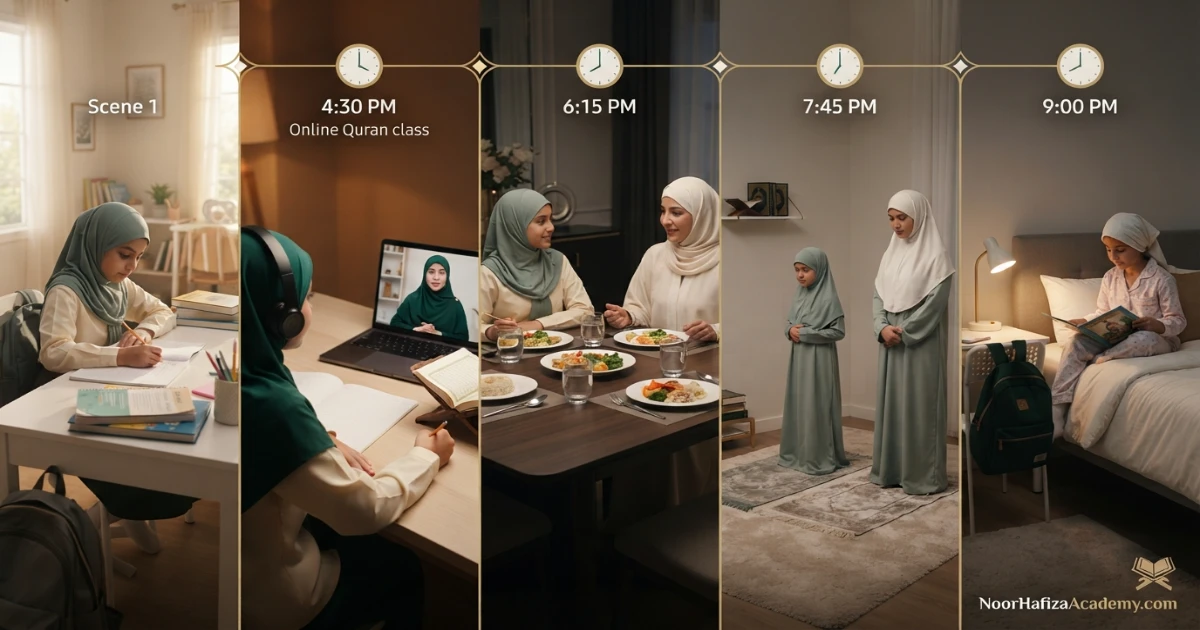
The Quran class should become part of the family routine, not a daily emergency inserted between competing duties. Decide which responsibilities are fixed and which can move. School pickup, prayer, and bedtime may be relatively fixed. Homework may vary by day. Dinner can sometimes shift within a window. Sports and tutoring may occupy certain evenings. A calendar that shows the entire family week makes these relationships visible.
For a younger child, placing class after a snack and before heavy homework may protect attention. For an older child with assignments due the next day, a slightly later class may work better after one focused homework block. Hifz students should not be scheduled so late that revision is attempted while exhausted. When a child repeatedly chooses between completing manzil and sleeping, the plan needs adjustment.
| School situation | Sample local-time routine | Why it may work | What to monitor |
|---|---|---|---|
| Early elementary dismissal | 3:15 home · 3:30 snack · 4:00 class · 4:30 play/homework | Class occurs before evening fatigue | Whether transition time is enough |
| Later bus arrival | 4:10 home · 4:45 homework · 5:30 class · 6:10 dinner | Urgent schoolwork begins first | Hunger and dinner pressure |
| Sports day | No weekday class · short review · weekend lesson | Avoids recurring lateness and exhaustion | Consistency of the short review |
| Older child with homework | 4:00 snack · 4:30 homework · 6:00 class · dinner afterward | Uses an alert early-evening window | Whether dinner and bedtime become too late |
| Hifz learner | Revision before school or after snack · teacher test early evening | Separates home revision from live testing | Total daily load and sleep |
Best online Hifz schedule for a child who attends school
A Hifz schedule must include home memorization and revision, not only the teacher appointment. The class is where the child recites, receives correction, and gets the next assignment. The learning is protected through daily sabaq, sabqi, and manzil work. Therefore, a parent should ask where revision will happen before selecting the class time.
Some children revise best in the morning and recite to the teacher after school. Others complete recent revision after a snack and use the online lesson as the day’s test. A child who has heavy evening homework may need shorter, more frequent classes on selected days rather than one long class. The teacher should reduce new memorization when school exams, illness, travel, or weak revision make the existing load unstable.
The weekly plan must include time to prepare the new lesson, strengthen recent memorization, rotate older revision, and sleep enough for the child to function at school.
Parents can use the related guides on a daily Hifz schedule for kids, Sabaq, Sabqi and Manzil, and how parents can help a child memorize the Quran.
Schedule Quran classes around sports and tutoring without making them optional
A child may have sports, tutoring, clubs, therapy, family responsibilities, or religious-community activities. The solution is not to place Quran class in whichever gap remains each week. Choose protected recurring days. When Tuesdays and Thursdays are consistently crowded, schedule Quran on Monday and Wednesday rather than repeatedly requesting changes. One stable weekend class can support the plan, but it should not become the only lesson if the course needs frequent correction.
During exam weeks, reduce the assignment rather than disappearing without communication. A short revision-only lesson may preserve continuity and provide encouragement. When the child returns to a normal school routine, increase gradually. Doubling new work after a busy week often creates more weakness.
How to schedule online Quran classes for two or more children
Back-to-back lessons can simplify family logistics, but each child should have an individual learning space, correct materials, and a short transition. Avoid asking one child to wait beside the learner for an entire class. The waiting child may interrupt, become restless, or hear constant corrections meant for a sibling. Prepare a quiet activity in another space where possible.
The youngest or most tired child may need the earlier slot. An older sibling with more homework may prefer the later lesson. When one child studies Hifz and another studies Qaida, identical class lengths may not be necessary. The family can also combine two weekday lessons with one weekend block rather than using every afternoon.
Sibling schedule checklist
- Give each child a named start and end time.
- Prepare each book, notebook, and headset separately.
- Use a five-minute transition for feedback and device changes.
- Do not make one sibling responsible for prompting another.
- Confirm whether the teacher remains the same or changes.
- Protect the second child from inheriting the first child’s delays.
Confirm the child’s class in the family’s local time zone
Families in the United States should provide the child’s city and state and save the recurring lesson in a time-zone-aware calendar. Writing only “USA time” is not enough. Eastern, Central, Mountain, Pacific, Alaska, and Hawaii schedules differ, and some regions handle daylight saving changes differently. International teacher availability should be converted once through the calendar rather than mentally before every lesson.
Review the separate guide to online Quran classes in the USA by time zone when selecting national schedule windows. Reconfirm the class before seasonal clock changes, travel, or a temporary stay in another state or country.
How to create the best school-friendly Quran class schedule in eight steps
Write the fixed school commitments
Add dismissal, transport, tutoring, sports, meals, prayer, and bedtime before searching for a teacher slot.
Identify the child’s alert windows
Note when the learner usually reads, talks, and follows directions most effectively.
Choose the course and frequency
Decide whether the child needs Qaida, reading, Tajweed, Hifz, Islamic Studies, or a carefully divided combination.
Select a starting lesson length
Use age and attention as a guide, then adjust according to active participation and teacher feedback.
Offer two or three local-time windows
Provide realistic alternatives rather than one narrow time the family can barely maintain.
Reserve home-practice space
Make sure there is time for the assignment, especially recent and older revision for Hifz.
Test the slot for two to four weeks
Track punctuality, energy, practice, school conflict, and whether the child can learn through the full class.
Review and refine
Keep a good schedule stable. Change it when a repeated pattern—not one unusual day—shows the fit is poor.
Test the teacher, lesson length, technology, and schedule together
A trial lesson is not only a demonstration of teaching style. It is also a test of the entire routine. Note when the child arrived, whether the snack and transition were enough, how long setup took, whether siblings interrupted, and whether the child remained responsive. Observe the final ten minutes carefully. A learner who begins well but loses attention may need a shorter lesson or an earlier time.
- Was the child ready five minutes before the lesson?
- Did school pickup or traffic create stress?
- Could the child hear and recite clearly?
- Was the lesson length appropriate?
- Did the teacher use age-appropriate correction?
- Was the home assignment clear?
- Could the child complete dinner, homework, prayer, and bedtime afterward?
- Can the family repeat this schedule for the next eight to twelve weeks?
Signs the Quran class time or frequency needs adjustment
| Repeated sign | Likely issue | Possible response |
|---|---|---|
| Child joins late and flustered | Slot is too close to school arrival or another activity | Move class later or choose a different day |
| Frequent yawning or poor responses | Class is too late or the day is overloaded | Try an earlier or shorter lesson |
| Homework remains unfinished | Class occupies the main schoolwork window | Move Quran class before homework or to another weekday |
| Assigned practice is rarely complete | Too many classes, too much new work, or no review window | Reduce load and reserve practice time |
| Parent reschedules most weeks | The recurring slot is unrealistic | Choose a stable time rather than relying on exceptions |
| Child progresses for part of class only | Lesson may be too long | Shorten the lesson or divide the course across more days |
Sample online Quran class schedules for different school-age learners
| Learner | Class schedule example | Home practice | Purpose |
|---|---|---|---|
| Age 6 · Qaida beginner | Mon, Wed, Fri · 20–25 minutes | 5 minutes on non-class days | Frequent letter and joining practice |
| Age 9 · Quran reading | Tue, Thu · 30 minutes + Sat review | 8–12 minutes most days | Fluency, pronunciation, and stopping |
| Age 10 · Tajweed | Mon, Thu · 30–35 minutes | One correction target inside daily reading | Application without rule overload |
| Age 11 · Beginner Hifz | Mon–Thu · 30–35 minutes | Sabaq, sabqi, and manzil at separate times | Frequent testing and controlled new work |
| Age 12 · Busy activities | Tue evening + Sat morning | Short independent review Wed and Fri | Stable classes around sports or clubs |
| Two siblings | Back-to-back Mon and Wed with transition | Separate assignments and quiet spaces | Family efficiency without shared prompting |
Adjust the schedule for exams, holidays, Ramadan, and summer break
The best schedule may change during the year. School exams can require shorter assignments or revision-only lessons. Summer offers more daytime flexibility but should not automatically produce an unsustainable increase in new work. Ramadan may affect meal, prayer, sleep, and energy patterns. Travel can change the time zone and internet environment. Families should communicate changes early rather than missing classes repeatedly.
Keep one element stable whenever possible: the teacher, lesson days, revision routine, or weekly check. Continuity helps the child return to the normal school schedule. After a long break, restart with assessment and review before increasing the lesson load.
Review the schedule using attendance, energy, practice, and progress evidence
Parents see the home routine, while the teacher sees learning behavior. Both perspectives matter. A child may appear willing at home but arrive unprepared. Another may complain before class yet participate strongly once connected. Review the schedule after two to four weeks using evidence rather than one mood.
- How many classes started on time?
- Was the correct book and assignment ready?
- Did the child remain engaged for the lesson length?
- Was home practice completed without excessive prompting?
- Did schoolwork or bedtime suffer repeatedly?
- Did the teacher notice better recall, reading, or correction?
- Does the child need an earlier time, shorter lesson, different frequency, or smaller assignment?

Prepare the learning space before the scheduled Quran lesson
Punctuality includes preparation. Charge the device, open the lesson link, test the microphone and headphones, and place the Mushaf or Qaida on a wooden rehal before class. Keep the notebook, pencil, and teacher-assigned page ready. A five-minute search for materials can consume a large part of a young child’s lesson.
Use a quiet place where the child can recite aloud. A mother or female guardian may remain nearby for safety, technology, and behavior support, especially for younger learners. She should not give every first word or correct over the teacher. The goal is to make the learner increasingly responsible for joining on time, preparing materials, and remembering the assignment.
How Noor Hafiza Academy can discuss a school-friendly Quran schedule
Noor Hafiza Academy offers live online Quran classes with female Quran teachers for children, girls, women, sisters, beginners, and returning learners. A suitable child schedule depends on age, reading level, course, school dismissal, local time zone, homework, activities, attention, and current teacher availability.
When contacting the academy, share the child’s age, city and time zone, school dismissal and arrival time, preferred days, two or three local-time windows, desired program, current level, and any regular activities. For Hifz, include existing memorization and the realistic time available for daily revision. Current teachers, exact lesson times, fees, trial arrangements, attendance rules, rescheduling options, and enrollment terms should be confirmed directly.
Example: “My daughter is 9, arrives home at 3:45 p.m. Central Time, and is available Monday, Wednesday, and Thursday between 4:45 and 6:30 p.m. She needs Quran reading and beginner Tajweed.”
FAQs about the best online Quran class schedule for school-age children
What is the best time for a child to take an online Quran class after school?
How long should an online Quran class be for a school-age child?
How many Quran classes should a child take each week?
Should Quran class come before or after school homework?
Are late-evening Quran classes suitable for children?
Can a child take Quran class before school?
What schedule is best for a school child doing Hifz?
Can siblings take online Quran classes back to back?
How do sports and tutoring affect Quran class scheduling?
How do I know the class time is not working?
Should the schedule change during school holidays or Ramadan?
What information should parents send when requesting a class schedule?
Choose a Quran class time your child can learn in and keep
Share the child’s age, local time zone, school arrival, current Quran level, preferred days, activities, bedtime, and two or three realistic time windows. Noor Hafiza Academy can discuss current female-teacher availability and a suitable starting schedule.