Online Quran Classes vs In-Person Madrasa: Pros and Cons
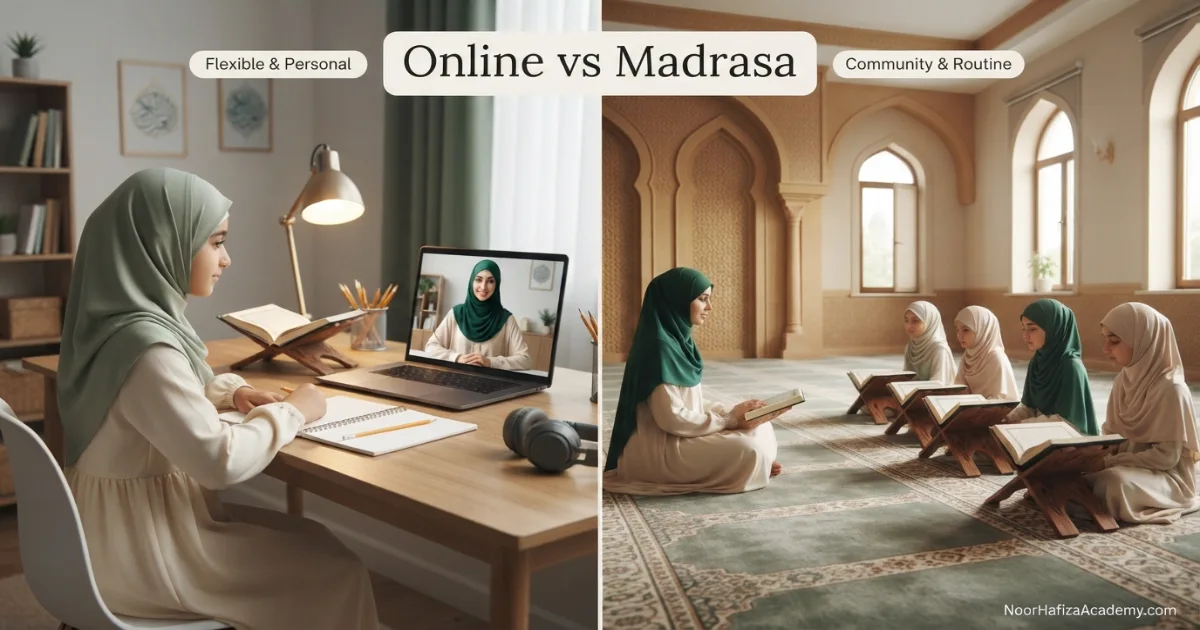
The choice between online Quran classes and an in-person madrasa is not simply a choice between technology and tradition. Families are comparing two learning environments, each with possible strengths and limitations. Online learning can provide flexible scheduling, access to female Quran teachers, one-to-one attention, and lessons without travel. A local madrasa can provide face-to-face interaction, mosque connection, group routines, and a visible community environment. The better option depends on the teacher, class size, curriculum, child’s age and personality, family schedule, safeguarding standards, home support, and whether the program produces accurate reading, Tajweed, Hifz retention, Islamic understanding, and a positive relationship with the Quran.
Are online Quran classes better than an in-person madrasa?
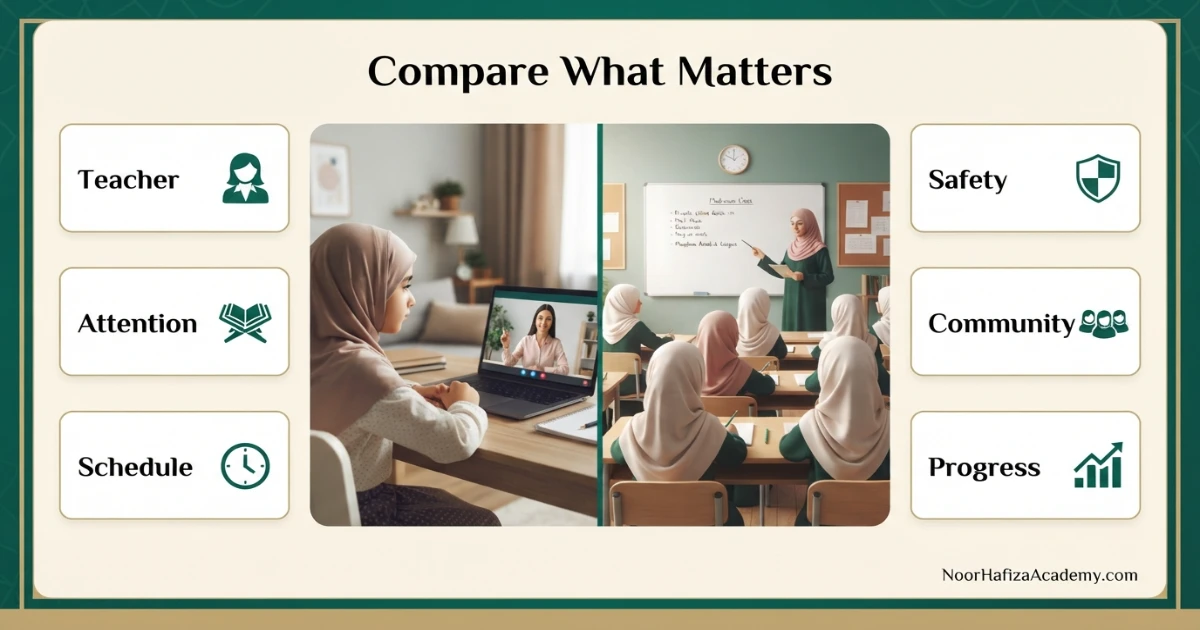
Neither format is automatically better for every child. Online Quran classes are often a strong choice when the family needs flexible scheduling, one-to-one instruction, access to a suitable female Quran teacher, lessons without travel, or close parent visibility. An in-person madrasa may be better when the child learns well in a physical classroom, benefits from mosque connection and peer routine, and has access to a qualified teacher with a manageable class size. Compare the actual teacher, curriculum, safeguarding, lesson length, class size, feedback, home practice, and progress tracking. Choose the format in which the child can attend consistently, receive accurate correction, practise independently, retain learning, and maintain a respectful, positive relationship with the Quran.
What are families really comparing?
The phrase “online Quran classes vs in-person madrasa” can make the decision appear simpler than it is. In practice, families may be comparing a private online lesson with a group madrasa class, a highly experienced local teacher with a new online tutor, a structured academy with an informal neighborhood program, or a child-friendly female teacher online with a large mixed-age class nearby. These are not equal comparisons.
A strong in-person madrasa can be more effective than a weak online course. A strong online academy can be more effective than an overcrowded local class. The delivery format affects access and learning conditions, but teacher quality, curriculum, class size, communication, supervision, and practice determine whether the child progresses.
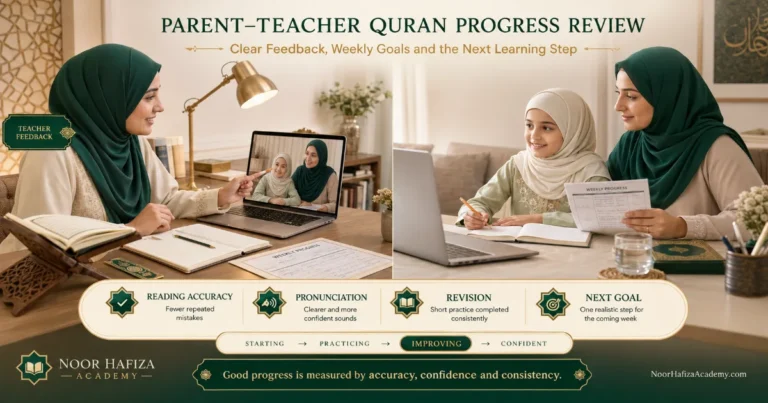
Look beyond convenience and reputation. Ask what the child will study, how errors will be corrected, how much independent recitation occurs, how progress will be tested, and how parents will receive feedback.
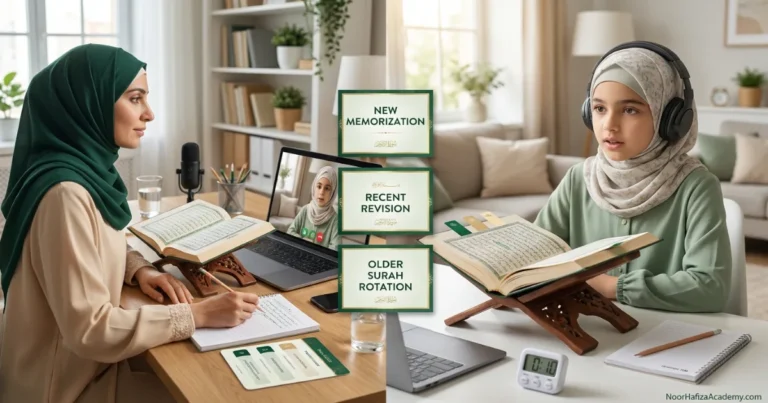
The family’s goal also changes the decision. A four-year-old beginning letter recognition needs short, engaging instruction. A ten-year-old repairing Quran fluency needs targeted correction. A serious Hifz student needs structured new memorization, recent revision, older revision, and live testing. A teen may need privacy, respectful communication, and a teacher who can explain Tajweed clearly. One format may suit one stage and not another.
Online Quran classes vs madrasa: key differences at a glance
| Factor | Online Quran classes | In-person madrasa | What parents should check |
|---|---|---|---|
| Teacher access | Can offer a wider choice across locations and time zones | Limited to teachers available locally | Qualifications, communication, age experience, and teacher fit |
| Class format | Often one-to-one or very small group | Often group-based, though private options may exist | Actual teacher-to-student ratio and independent recitation time |
| Schedule | Usually more flexible and easier to place around school | Usually follows fixed local days and times | Whether the child can attend reliably without harming sleep or homework |
| Travel | No commute; lessons happen at home | Requires transport, preparation, and pickup | Total door-to-door time, weather, and family logistics |
| Social environment | Less natural peer contact during one-to-one lessons | Can provide peer routine and mosque connection | Whether the group culture is supportive and supervised |
| Parent visibility | Parents can often observe or remain nearby | Parents may have less direct view of each lesson | Feedback systems, safeguarding, and communication |
| Technology | Requires stable internet, suitable audio, and a device | Less dependent on home technology | Audio quality, screen size, and backup arrangements |
| Learning environment | Familiar home setting but possible household distractions | Dedicated classroom but possible group noise | Where the child can focus and participate most consistently |
Pros of online Quran classes for children and families
1. Wider access to suitable Quran teachers
Online learning removes the family’s dependence on the nearest available class. Parents may search for a teacher who matches the child’s age, level, learning goal, language needs, and communication style. This can be especially valuable for families seeking a female Quran teacher, one-to-one Tajweed support, Hifz revision, beginner instruction, or a schedule that works across a particular U.S. time zone.
2. One-to-one attention is easier to arrange
Many online programs are built around private lessons. In a one-to-one class, the teacher can hear every line, identify the exact reading or pronunciation weakness, adjust the pace, and give the child more independent recitation time. A shy child may also feel more comfortable attempting difficult words without peers listening.
3. Flexible scheduling can improve attendance
The family may be able to choose an after-school, early-evening, weekend, or daytime slot. This is useful when school dismissal, sports, tutoring, work, transport, prayer, dinner, and bedtime make fixed local classes difficult. A schedule that fits the child’s energy can improve focus more than simply choosing the closest provider.
4. No travel is required
Removing the commute can save time several days each week. The child can begin after a short transition instead of travelling in traffic or difficult weather. Parents managing several children may find it easier to schedule back-to-back lessons at home.
5. Parents can remain close to the learning process
For younger children, a mother or female guardian can remain nearby, help with technology, see whether the child is participating, and understand the teacher’s assignment. This visibility can improve parent–teacher communication when it is used supportively rather than to answer for the child.
6. Lessons can continue during travel or relocation
A family moving between cities or visiting relatives may be able to keep the same teacher. The schedule still needs adjustment for local time, internet, and the child’s energy, but continuity can be easier than repeatedly changing local classes.

Cons and challenges of online Quran classes
1. The lesson depends on technology
Poor internet, weak microphones, audio delay, small screens, or an unstable camera can affect correction. Tajweed and Makharij require the teacher to hear the learner clearly. Families need a reliable device, usable audio, a stable connection, and a backup method for temporary problems.
2. Home distractions can reduce focus
Siblings, television, visitors, toys, notifications, and household movement may interrupt the lesson. The family should create a predictable learning space, prepare materials, and protect a quiet period. Online convenience does not remove the need for routine.
3. One-to-one classes provide less peer interaction
A private lesson does not naturally provide the same peer group, mosque environment, or shared classroom identity. Families may need to meet community needs through mosque programs, Islamic Studies circles, family activities, or supervised social opportunities outside the Quran lesson.
4. Younger children may need nearby adult support
A very young learner may need help joining the lesson, opening the correct page, staying seated, or resolving device issues. Online learning can reduce travel while increasing the parent’s need to prepare the session.
5. A weak online program can become passive screen time
The child should not spend the entire lesson only repeating after the teacher. Strong online teaching includes independent reading, live correction, recall, fresh examples, clear targets, and a realistic home assignment. Parents should observe whether the learner is actually doing the cognitive work.
Pros of an in-person madrasa
1. Face-to-face presence can support some learners
Some children respond well when the teacher is physically present. The classroom setting may make the routine feel more formal, and the teacher can notice posture, book handling, group participation, and attention without relying on a camera view.
2. Mosque and community connection
A madrasa attached to a mosque can help children become familiar with the masjid, local teachers, Muslim peers, congregational routines, and community events. This social and spiritual environment may be an important goal for the family beyond the technical Quran curriculum.
3. Peer learning and shared routine
Children may feel encouraged by learning beside others, hearing recitation, completing shared activities, and following a visible class routine. A supportive group can build belonging and responsibility.
4. Less dependence on home internet and devices
The family does not need to manage microphones, camera angles, lesson links, or screen restrictions during class. The learning materials and environment may already be prepared.
5. Opportunity for broader local activities
Some madrasas combine Quran reading with Islamic Studies, prayer practice, events, competitions, service, or family programs. A well-organized center may offer a wider community experience than a private lesson alone.

Cons and challenges of an in-person madrasa
1. Large classes can reduce individual correction
In a busy group, each child may receive limited recitation time. The teacher may need to manage attendance, behavior, and several levels at once. Parents should ask how often the child reads independently to the teacher and how mistakes are recorded.
2. Fixed schedules may conflict with family life
Local classes may operate only on specific evenings or weekends. The time may not suit the child’s schoolwork, sleep, activities, or parent transport. Repeated lateness or absence can reduce continuity.
3. Travel increases the total time commitment
A one-hour class may require additional preparation, driving, waiting, and pickup. Families should compare the full door-to-door commitment rather than only the advertised lesson length.
4. Teacher choice may be limited
The nearest madrasa may not have a teacher who matches the child’s level, language, gender preference, or learning needs. A family may accept a weak fit because alternatives are far away.
5. Group pressure can affect some children
A confident child may enjoy the group, while a shy learner may fear mistakes or comparison. Parents should review the class culture, discipline, teacher tone, and whether students are grouped appropriately by age and level.
6. Parents may receive limited lesson visibility
Some programs provide excellent reports and open communication; others give only general updates. Parents should ask how progress, homework, attendance, concerns, and safeguarding matters are communicated.
How class size changes the comparison
Many of the perceived differences between online classes and madrasas are actually differences between one-to-one and group teaching. A private online class naturally gives more recitation time. A small in-person tutorial can offer the same. A large online group may provide less individual attention than a small local madrasa.
| Learning need | One-to-one online lesson | Group madrasa class | Better fit may be |
|---|---|---|---|
| Complete beginner | Pace can follow exact letter and joining needs | Can work when levels are carefully grouped | Whichever provides frequent individual reading |
| Pronunciation repair | Targeted correction and repeated attempts | Correction time may be limited | Usually the format with more teacher listening time |
| Shy learner | Private space may reduce embarrassment | Supportive peers may build confidence | Depends on the child and class culture |
| Social motivation | Requires community opportunities elsewhere | Peers and shared routine may motivate | Often a healthy, well-managed group |
| Hifz testing | Teacher can test sabaq, sabqi, and manzil directly | Can be effective with enough individual testing time | The program with stronger revision accountability |
| Busy schedule | Usually easier to schedule | Fixed routine may support consistency | The schedule the family can sustain |
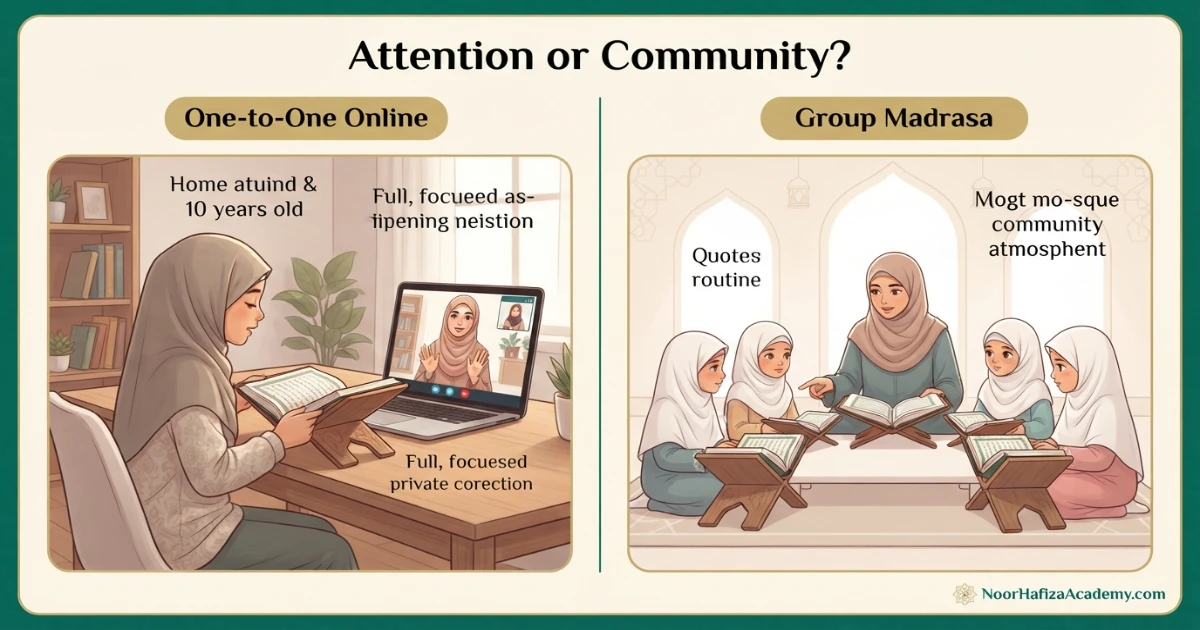
The detailed guide on one-to-one vs group Quran classes can help families separate the format question from the class-size question.
How to judge teaching quality in either format
A polished website, busy classroom, famous institution, or convenient schedule does not prove teaching quality. Parents should look for evidence inside the lesson.
Clear level assessment
The teacher identifies the learner’s actual Qaida, reading, Tajweed, or Hifz level before assigning a long-term plan.
Independent recitation
The child reads or recites without receiving every sound, word, or answer first.
Specific correction
The teacher identifies the exact error, models the correction, and checks whether it transfers.
Manageable assignment
Home practice is clear, level-appropriate, and small enough to complete consistently.
Progress evidence
The program tracks accuracy, independence, fluency, Tajweed application, retention, or understanding.
Respectful communication
The teacher maintains standards without shame, comparison, intimidation, or confusing feedback.
Safeguarding questions for online classes and local madrasas
Safety should be reviewed in both environments. Online does not automatically mean safer, and in-person does not automatically mean more supervised. Families need clear information about who teaches, who can access the learner, how communication occurs, and how concerns are reported.
For online Quran classes
- Who is the teacher, and how was she selected?
- Can a parent remain nearby for a child?
- How are lesson links and contact details managed?
- Are classes recorded, and what is the policy?
- How are concerns, replacements, and schedule changes handled?
- Does the child use a suitable shared family space?
For an in-person madrasa
- Who supervises arrival, class, breaks, and pickup?
- What are the teacher and volunteer policies?
- How are children grouped and attendance recorded?
- What is the communication and complaint process?
- Can parents observe or discuss a lesson?
- How are behavior and discipline managed?
Parents should confirm the current academy or madrasa policy directly rather than assuming that a general label guarantees a particular practice.
Which format fits school, work, prayer, meals, and sleep?
Consistency is one of the strongest predictors of useful progress. A theoretically excellent program will not help when the child arrives tired, misses frequently, or practises nothing between lessons. Families should compare the full weekly routine.
Family schedule checklist
- What time does school end, including transportation?
- Does the child need food, prayer, rest, or movement before class?
- How much travel is required for an in-person program?
- Can parents reliably provide transportation every week?
- Will the lesson interfere with homework, dinner, or bedtime?
- Is there a quiet online learning space at the chosen time?
- Can the family protect short practice on non-class days?
- What happens during travel, weather problems, illness, or school events?
For school-age scheduling, see best online Quran class schedules for school-age children.
How to compare the true cost of online Quran classes and madrasa
The advertised fee is only one part of the cost. Online classes may have higher private-lesson fees but no fuel, transport, or waiting time. A madrasa may have lower group tuition but require several weekly journeys, uniforms, books, registration, or event costs. Prices vary widely, so families should confirm current fees directly.
| Cost factor | Online class | In-person madrasa | Value question |
|---|---|---|---|
| Tuition structure | Often private or small-group pricing | Often group or term pricing | How many minutes of direct teaching does the child receive? |
| Travel | Usually none | Fuel, transit, parking, and parent time | What is the full door-to-door weekly commitment? |
| Technology | Device, internet, headphones if needed | Usually minimal home technology | Does the family already have suitable equipment? |
| Missed lessons | May offer rescheduling under policy | Group classes may continue without the child | What is the absence and makeup policy? |
| Learning value | Potentially high individual attention | Potentially strong community and group value | Is the child making measurable progress? |
Which children may benefit more from each format?
Online Quran classes may suit a child who:
- Needs one-to-one correction or a slower individual pace.
- Is shy about reading in front of a group.
- Has a busy school or activity schedule.
- Lives far from a suitable madrasa.
- Needs a female teacher who is not available locally.
- Is repairing a specific reading, Tajweed, or Hifz weakness.
- Benefits from parent visibility and a familiar home environment.
An in-person madrasa may suit a child who:
- Thrives in a structured physical classroom.
- Is motivated by peers and shared routines.
- Needs mosque and local community connection.
- Has access to a qualified teacher and manageable class size nearby.
- Finds screens difficult or home distractions hard to control.
- Benefits from broader local Islamic activities.
These are starting points, not rules. A shy child may flourish in a kind local group, and a social child may make faster technical progress in private online lessons while meeting peers elsewhere.
Which format works for Qaida, Quran reading, Tajweed, Hifz, and Islamic Studies?
Noorani Qaida
Qaida can work online or in person when the teacher hears each child frequently and checks independent decoding. Private online instruction may allow precise pacing. A well-grouped local class may add routine and peer encouragement. Avoid any program that advances pages without confirming letter recognition, joined forms, vowels, sukoon, shaddah, and blending.
Quran reading fluency
Fluency improves through repeated independent reading, specific correction, and transfer to unfamiliar text. One-to-one online lessons can maximize reading time. A small in-person class can be equally effective. Large groups require careful systems so each learner is heard.
Tajweed
Tajweed requires clear hearing, modeling, and application. Online audio quality must be strong. In-person teaching avoids internet delay but still requires individual correction. Choose the teacher who can explain simply and help the learner apply the rule inside connected recitation.
Hifz
Hifz success depends on consistent testing of new memorization, recent revision, and older revision. Online one-to-one lessons can provide focused testing. A strong madrasa may offer a disciplined Hifz environment and peer routine. In either format, ask how sabaq, sabqi, manzil, errors, prompts, and weak passages are tracked.
Islamic Studies
A local class may provide richer group discussion, activities, prayer practice, and community context. Online Islamic Studies can still be interactive through stories, questions, visuals, discussion, and family application. The best choice depends on the curriculum and teaching quality.
Can families combine online Quran classes with madrasa or mosque activities?
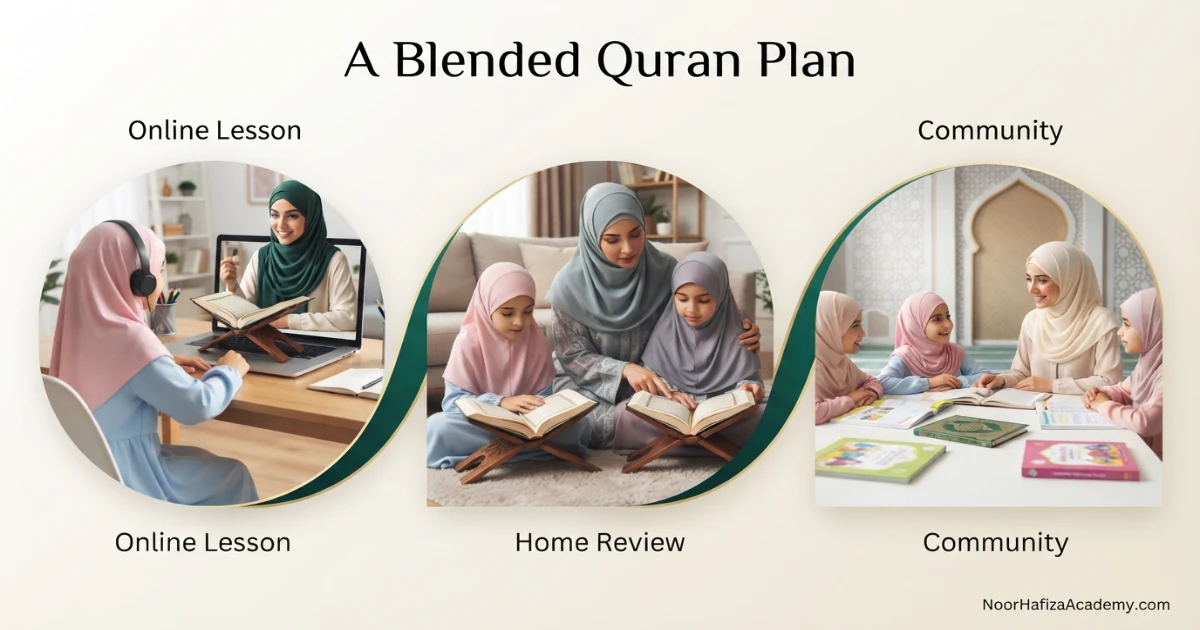
Yes. A blended plan can separate technical Quran instruction from community participation. For example, a child may take one-to-one online Qaida, Tajweed, or Hifz lessons during the week and attend a local mosque program for Islamic Studies, prayer, events, or peer connection. Another child may attend madrasa but use a short online lesson temporarily to repair pronunciation or prepare for an assessment.
The two programs should not create conflicting assignments or correction methods. Parents should clearly identify which teacher leads the main Quran curriculum. Share relevant goals, keep the workload manageable, and avoid giving the child two unrelated Hifz targets.
How to choose between online Quran classes and an in-person madrasa
Define the child’s main goal
Choose the immediate priority: Qaida, Quran reading, Tajweed, Hifz, revision, Islamic Studies, or a combination with one clear lead goal.
List the child’s learning needs
Consider age, attention, confidence, social preference, current errors, independence, and whether the child needs private correction or group motivation.
Compare actual teachers
Review qualifications, child experience, tone, explanation, correction method, language, gender preference, and availability.
Compare real weekly schedules
Include school, homework, travel, prayer, meals, activities, bedtime, parent work, and practice time.
Review safeguarding and communication
Confirm supervision, privacy, parent visibility, teacher contact, reporting, recording, pickup, and concern procedures.
Observe or trial the lesson
Watch whether the child understands instructions, reads independently, receives useful correction, and remains engaged.
Set a review period
Use four to eight weeks to review attendance, independent reading, Tajweed application, Hifz retention, confidence, and family stress.
Keep, adjust, or change based on evidence
Do not remain with a poor fit only because of habit, and do not change after one ordinary difficult lesson. Use patterns and progress.
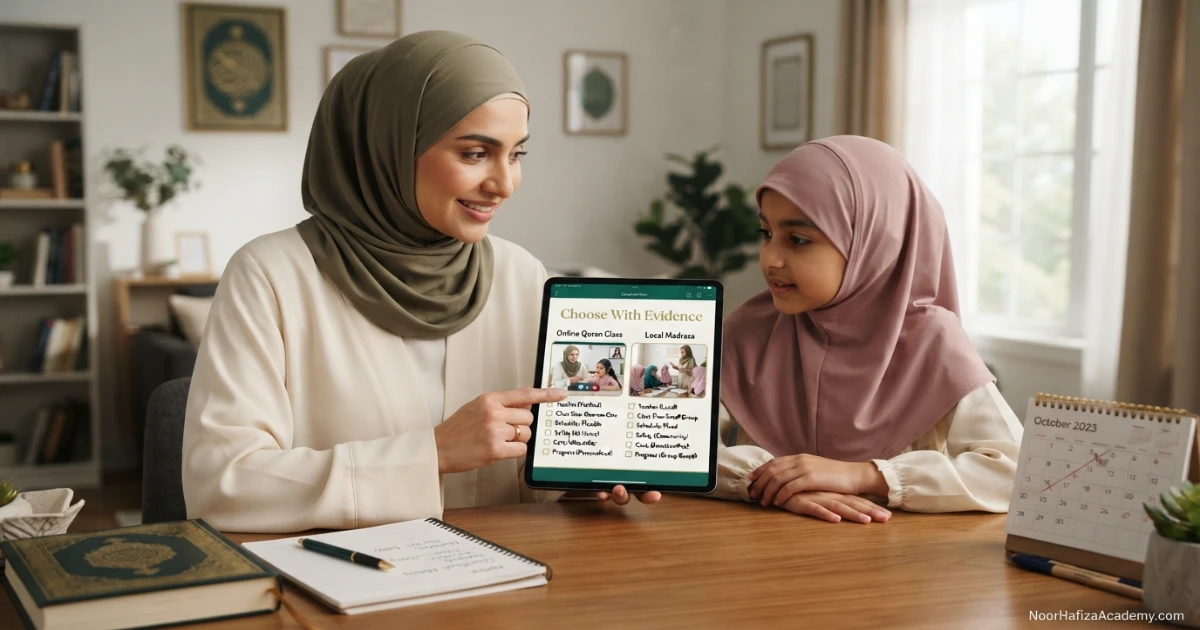
Questions for an online academy or local madrasa before enrolling
Teaching and curriculum
- How is the child’s starting level assessed?
- What curriculum or progression is used?
- How much independent recitation occurs?
- How are reading, Tajweed, or Hifz errors tracked?
- How is home practice assigned?
- When is progress formally reviewed?
Teacher and class fit
- Who will teach the child?
- What experience does the teacher have with this age and level?
- Is the lesson one-to-one, small group, or large group?
- Can the family request a teacher change?
- How are shy, distracted, or struggling learners supported?
- Can parents observe or trial a class?
Schedule and policies
- What days, times, and lesson lengths are available?
- What happens after absence, travel, illness, or internet failure?
- Are makeup lessons offered?
- How much notice is needed for schedule changes?
- What are the current fees and payment terms?
- How can the family pause or discontinue?
Safety and communication
- How are teachers selected and supervised?
- How does the academy communicate with parents?
- Who can contact the child?
- What is the recording or camera policy?
- How are concerns reported?
- What supervision is expected from parents?
Mistakes parents should avoid when comparing both options
Assuming online is always flexible
An academy may still have teacher availability limits, rescheduling policies, and fixed lesson commitments. Confirm the actual schedule.
Assuming madrasa always provides community
A child may sit in a group without meaningful peer connection. Review the class culture and broader activities.
Choosing only by price
A low fee may provide little individual teaching, while a higher fee may not guarantee quality. Compare learning value and progress.
Ignoring the child’s schedule
A good program at a poor time can create tiredness, resistance, lateness, and weak practice.
Changing too quickly
One difficult lesson is not enough evidence. Observe a pattern and discuss an adjustment before moving.
Staying too long with a poor fit
Repeated fear, confusion, no progress, weak communication, or unsuitable discipline should not be ignored because the program is familiar.
How to know whether the chosen Quran program is working
The final decision should be reviewed through evidence. Attendance matters, but attendance alone does not prove learning. The child should show progress in the specific goal.
| Area | Evidence of progress | Warning sign | Possible response |
|---|---|---|---|
| Qaida | More accurate recognition and joining with fewer prompts | Pages advance but decoding remains dependent | Return to the missing foundation |
| Quran reading | Fewer guesses, smoother phrases, better stopping | Only familiar passages sound fluent | Test short unfamiliar text |
| Tajweed | Corrections remain inside connected recitation | Rules are named but not applied | Reduce to one practical target |
| Hifz | Stable next-day recall and maintained older revision | New work grows while previous work weakens | Reduce new memorization and strengthen revision |
| Routine | Reliable attendance and manageable home practice | Repeated lateness, conflict, and missed review | Adjust timing, length, or frequency |
| Wellbeing | Child accepts correction and participates calmly | Persistent fear, shame, or avoidance | Review teacher fit and lesson design |
Online Quran classes with female teachers for children and families
Noor Hafiza Academy offers live online Quran classes for children, girls, women, sisters, beginners, Quran readers, Tajweed students, and Hifz learners with female Quran teachers. A suitable plan begins with the learner’s age, current level, goals, time zone, school schedule, preferred lesson length, previous experience, and available home practice.
Online classes may be considered when the family wants private attention, flexible scheduling, no commute, access to a female Quran teacher, or targeted support. Families should still compare the program carefully and confirm current teacher availability, schedules, course details, trial arrangements, fees, policies, and enrollment terms directly.
Share age, Quran level, course goal, school schedule, time zone, preferred lesson format, previous madrasa or online experience, and the support the child needs most.
FAQs about online Quran classes vs in-person madrasa
Are online Quran classes better than madrasa?
Do children learn Quran effectively online?
What are the main disadvantages of online Quran classes?
What are the main advantages of an in-person madrasa?
Is one-to-one Quran teaching better than a group class?
Which format is better for Noorani Qaida?
Which format is better for Hifz?
Are online Quran classes safer for children?
Are madrasas less flexible than online classes?
Can a child take online Quran lessons and attend mosque programs?
How should parents compare costs?
How long should families test a Quran program before deciding?
Choose the Quran learning format your child can attend, understand, and grow with
Share the learner’s age, current Quran level, course goal, school schedule, time zone, previous madrasa or online experience, preferred teacher, and the main difficulty you want to solve. Noor Hafiza Academy can discuss whether a private online plan may suit the family.