
How to Balance School and Hifz Without Overwhelming a Child

Balancing school and Hifz is not about squeezing two full-time workloads into one child’s day. A sustainable plan protects school responsibilities, Quran memorization, revision, sleep, play, family time, and the child’s emotional connection with the Quran. The right schedule changes across school terms, exam weeks, ages, reading levels, and memorization stages. This guide shows parents how to choose realistic Hifz targets, build short daily routines, separate new memorization from revision, coordinate with a Quran teacher, adjust during busy weeks, recover after missed days, and recognize when a plan needs to become lighter.
How can parents balance school and Hifz without overwhelming a child?
Use a small, repeatable Hifz routine that fits around the child’s real school timetable rather than an idealized one. On normal school days, keep new memorization short, review yesterday’s portion first, and maintain a rotating revision list of older Surahs. On homework-heavy or exam days, reduce or pause new Hifz and protect revision instead. Choose one primary Quran teacher, communicate school pressures early, and adjust weekly targets before the child falls behind in both areas. Progress should be measured by accurate recall and stable revision—not only by how many new verses were added. If the routine consistently pushes bedtime late, causes repeated conflict, or leaves no room for homework, meals, play, and rest, the Hifz target is too heavy for the current season and should be reduced.
Hifz should fit the child’s life—not compete with it
A child can love Quran memorization and still become tired when the schedule is unrealistic. School may already include commuting, lessons, homework, tests, projects, sports, tuition, family responsibilities, and an early start the next morning. Adding a large Hifz target every evening can turn a meaningful act of worship and learning into another deadline.
The goal is not to lower expectations until there is no progress. The goal is to set the amount of new memorization and revision at a level the child can perform with reasonable concentration. That target can increase when school is lighter and decrease during demanding periods. A flexible plan is not a weak plan; it is a plan designed to survive the full school year.
When choosing between “more new Hifz” and “keeping old Hifz strong,” protect retention first. A smaller amount remembered accurately is usually more useful than a larger amount that disappears because revision was squeezed out.
Map the child’s real weekly load first
Before deciding how many lines, verses, or Surahs a child should memorize, look at the week as it actually exists. Do not plan from a blank calendar. Start with fixed commitments, then find the calmest Quran-learning windows.
What must happen?
School hours, transport, homework, revision for tests, tuition, projects, reading assignments, and exam preparation.
What is already assigned?
New memorization, yesterday’s portion, recent Surah revision, older Surah rotation, Tajweed correction, and lesson preparation.
What protects consistency?
Sleep, meals, movement, play, family time, breaks after school, and at least some unstructured space in the week.
A schedule becomes more realistic when the family can see all three categories at once. If every weekday is already tightly packed, the answer may be a smaller Hifz target or using weekends for a longer revision block rather than adding another late-night session.

Use a short Hifz block with three clear parts
Many school-age children do better when Hifz is divided into a predictable sequence instead of one long session. The exact minutes can change, but the order helps protect retention.
Recent revision first
Start with yesterday’s portion or the most recent Surah. Ask the child to recite without looking before giving new material. If the recent Hifz is breaking down, repair it instead of automatically adding more.
Learn a small new portion
Listen to the teacher-approved model, read carefully when the child can follow the Arabic, repeat accurately, close the Mushaf, and test recall. The amount can be one short verse, a few words, or several lines depending on readiness.
Finish with one older review item
Recite an older Surah or passage from the weekly rotation. This prevents old memorization from becoming invisible while all attention goes to today’s assignment.

Morning, after school, or evening: which Hifz time is best?
There is no single best time for every child. The best time is the one the family can repeat consistently while the child is alert enough to learn accurately.
Good for fresh recall
A short session before school may work well for children who wake easily and have a calm morning routine. Keep it brief so breakfast, preparation, and school arrival do not become rushed.
Use a transition break first
Some children need food, movement, and a mental break before Quran work. Going directly from a long school day into memorization can reduce concentration.
Protect bedtime
Evening Hifz can work when homework is finished and the child is still alert. Avoid pushing memorization so late that sleep becomes the cost of keeping the target.
A family may also split the work: five minutes of revision in the morning and a short new-Hifz session later. Splitting the load can feel easier than one longer sitting.
Adjust expectations to the child’s age, reading level, and school stage
| Child profile | Possible weekday approach | Weekend approach | Main priority |
|---|---|---|---|
| Early primary | 5–15 focused minutes; tiny new portion | Short review plus teacher lesson | Positive routine, pronunciation, strong recall |
| Upper primary | 10–20 minutes around homework | Longer recent + old revision rotation | Consistency and independent recall |
| Secondary school | 15–25 minutes when school load allows | Repair weak portions and plan next week | Self-management and flexible exam planning |
| Strong reader / experienced memorizer | Can handle more if retention stays stable | Larger revision cycle | Prevent new Hifz from outrunning revision |
| Beginning reader | Very small listening-led Hifz plus reading practice | Teacher correction and repetition | Correct reading and pronunciation before volume |
These are planning examples, not fixed rules. A child with a heavy commute, learning support needs, intensive sports schedule, or difficult school term may need less. Another child with strong recall and a light school week may manage more.
Example weekly school-and-Hifz plan
A useful week does not need new memorization every day. Building in lighter days can make the routine more durable.
Families can move these days around. The important pattern is variation: several new-Hifz opportunities, at least one revision-heavy day, and a place to repair weaknesses before the next school week begins.

How much new Quran should a school child memorize each day?
Set the target according to retention, not ambition alone. A reasonable target is the amount the child can learn accurately, recall later without constant prompts, and still revise alongside school responsibilities.
The child learns the assigned portion in the planned time, recalls it the next day, older Surahs remain stable, homework is managed, and the routine does not repeatedly push bedtime later.
New Hifz needs many extra repetitions, recent memorization is becoming fragile, school assignments are increasing, or the child is repeatedly too tired to concentrate.
Old memorization is falling apart, exam preparation is urgent, the session regularly creates conflict, or school and sleep are being sacrificed to maintain the target.
Pausing new Hifz for a few days does not mean the Hifz journey has stopped. Revision is part of Hifz. During a demanding school week, maintaining already-memorized Quran can be the correct learning goal.
Separate new memorization from recent and older revision
One of the biggest scheduling mistakes is treating all Quran work as “today’s new lesson.” As memorization grows, revision must grow too. A child who is learning Juz Amma may need only a few minutes of older rotation at first, but that rotation becomes more important with every new Surah.
New Hifz
The verse or passage currently being memorized. This receives detailed repetition and teacher correction.
Recent revision
Material learned in recent days or weeks. Review it frequently until it survives a gap without heavy prompting.
Older revision
Stable Surahs rotate through the week. They may feel easy, but removing them from practice entirely can allow forgetting to grow unnoticed.
On school-heavy days, shorten Layer 1 before removing Layers 2 and 3. This keeps the child’s Hifz foundation stable even when the rate of new memorization slows.

What should happen when homework suddenly takes longer?
Do not force the normal Hifz target into a day that is clearly no longer normal. A project deadline, test revision, parent-teacher meeting, school event, or long commute can change the available time.
- Keep the Hifz session shorter rather than starting it very late.
- Review yesterday’s portion instead of adding new Hifz.
- Use one familiar Surah in Salah as part of revision.
- Message the Quran teacher before the lesson if the assignment needs to be reduced.
- Move detailed repair work to the weekend instead of creating a backlog of new material.
- Return to the usual target gradually after the busy period.
If a child misses three new-Hifz days, avoid doubling the next three assignments just to catch up with the calendar. Resume from the current level, repair revision, and let the teacher decide how quickly to rebuild momentum.
How to adjust Hifz during tests and exams
Exam periods are predictable in many schools, which means the family can plan before pressure peaks. Two or three weeks before major exams, tell the Quran teacher what is coming. Decide whether to reduce new Hifz, switch to revision-only days, or temporarily shorten lesson frequency.
| School period | New Hifz | Revision | Teacher focus |
|---|---|---|---|
| Normal week | Usual manageable target | Recent + old rotation | New lesson + corrections |
| Test-heavy week | Reduce | Protect core revision | Repair and maintain |
| Major exam week | Pause if needed | Very short maintenance | Light check-in or agreed break |
| First week after exams | Restart gently | Check what became weak | Reassessment before increasing |
The aim is continuity without overload. Even a five-minute revision habit during an exam period can preserve connection, but a child should not be expected to maintain the exact same new-Hifz pace through every academic season.
Parents and Quran teachers should work from the same schedule
A teacher sees recitation quality; a parent sees the rest of the day. Both perspectives matter. If the teacher only sees a missed target, they may not know that the child had a school assessment, returned home late, or spent two hours on homework. If the parent only sees tiredness, they may not know that the child’s old revision is weakening because it has been skipped for several weeks.
What parents should tell the Hifz teacher
- School finishing time and commute length.
- Normal homework window and busiest weekdays.
- Known exam, assessment, and project dates.
- How long home Hifz practice currently takes.
- Whether the child needs frequent prompts or can revise independently.
- Which part of the routine creates the most friction.
- Whether sleep or school preparation is being pushed later.
- Any planned travel, family commitments, or schedule changes.
The teacher can then adjust portion size, lesson frequency, revision expectations, or the order of goals. This is more effective than waiting until the child is several lessons behind.
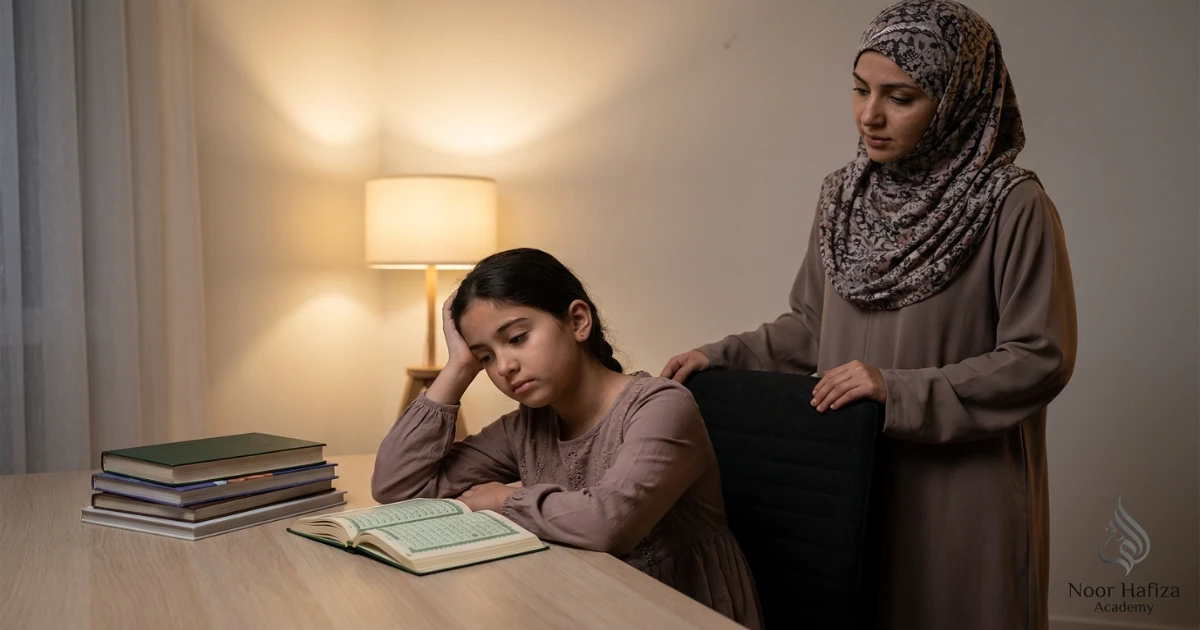
How parents can support Hifz without becoming the second examiner
Parents help most when they create the conditions for practice and reinforce the teacher’s current correction target. Home should not become a second high-pressure classroom every evening.
Create a predictable routine
Use the same general time and place, keep the Mushaf and materials ready, and reduce avoidable distractions during the short Hifz block.
Listen for the assigned target
If the teacher is working on one pronunciation issue or one weak transition, help the child remember that target instead of correcting ten unrelated things.
Comparing siblings or classmates
Different children have different reading levels, attention, school demands, memory strength, and revision histories. Comparison rarely reveals the right target.
Turning every mistake into a long lecture
Mark the point, repeat it correctly, and continue. A short correction is often more useful than extending a tired session because one verse was difficult.

How can you tell when school and Hifz are becoming too much?
One difficult day does not mean the plan has failed. Look for repeated patterns across several days or weeks. A schedule may need to become lighter when multiple parts of life are being squeezed at the same time.
Bedtime keeps moving later
Hifz is regularly happening after the child should already be preparing for sleep.
Homework is rushed
The child is trying to finish schoolwork quickly only to reach the memorization target.
Old Hifz is weakening
New portions continue, but previously memorized Surahs now require heavy prompting.
Every session becomes conflict
Resistance is persistent rather than occasional, and the family spends more time arguing than learning.
There is no recovery time
The child moves continuously from school to tuition, homework, Hifz, and bed with no realistic break.
Targets keep rolling forward
Missed work is added to the next day, creating an expanding backlog that the child cannot realistically clear.
When these patterns appear, reduce the new portion, protect revision, simplify the weekly schedule, and discuss the change with the teacher. If broader wellbeing, sleep, or school functioning is being significantly affected, parents should address that directly rather than treating the issue only as a memorization problem.
Mistakes that make school-and-Hifz balance harder
Same target every day
Monday and Saturday may not have the same school load. A flexible target can protect both consistency and accuracy.
New Hifz before fixing yesterday
Adding new material on top of weak recent memorization creates a bigger repair job later.
Using weekends only to catch up
If every weekend becomes a punishment for missed weekday targets, the child never gets a clean revision-and-reset day.
Ignoring school calendars
Exam dates and projects are often known in advance. Hifz targets can be reduced before pressure arrives.
Multiple correction systems
Parent, teacher, tutor, and video may all use different terminology. Choose one primary teaching method and reinforce it consistently.
Judging success only by pages
Retention, correct pronunciation, independent recall, and a positive routine matter more than page count alone.

How should a child restart Hifz after missed days?
Missed days are normal across a school year. Illness, travel, family events, tests, and unexpected homework can interrupt even a well-designed plan. The restart should be simple.
A four-step restart
- Do not add all missed new portions together.
- Test the most recent memorization and identify what became weak.
- Spend one or more sessions repairing recent and older revision.
- Restart new Hifz at the previous manageable amount, then increase only if recall remains stable.
This prevents the child from returning to Quran with an immediate backlog. The focus becomes rebuilding rhythm rather than paying off missed assignments.
Should siblings have the same Hifz target?
Usually no. Even siblings in the same home can differ in age, reading fluency, school workload, concentration, teacher level, memorization history, and interest. One child may retain a short Surah after several repetitions while another needs multiple days. Equal effort does not always produce equal speed.
Parents can keep the family routine equal—such as a shared Quran time after Maghrib—while making the actual assignments individual. One child may learn new verses; another may revise; a younger child may practise Arabic letters. Shared routine does not require identical targets.
How to motivate a child without making Hifz only about rewards
Simple recognition can help children notice their consistency. The reward does not need to be large, and it should not turn every verse into a transaction.
- Track completed practice days rather than only completed Surahs.
- Celebrate a week of strong revision.
- Notice when the child corrects a mistake independently.
- Let the child choose which strong Surah to recite in family prayer practice.
- Use a visual progress chart for routines, not competition.
- Mark milestones with family praise, a special activity, or a simple certificate.
The deeper goal is for the child to understand that Quran memorization is meaningful in itself. External rewards can support the routine, but they should not become the only reason to practise.
A four-week plan for families who already feel overloaded
| Week | Main action | New Hifz | Revision goal |
|---|---|---|---|
| Week 1 | Audit the schedule | Reduce by 25–50% | Find weak recent Surahs |
| Week 2 | Set a fixed short routine | Keep small | Daily recent review |
| Week 3 | Add older rotation | Increase only if stable | Recent + old layers |
| Week 4 | Review with teacher | Set next month target | Keep what worked |
This reset is especially useful when the family has been relying on late-night catch-up sessions. The first goal is not faster memorization; it is a routine the child can actually sustain alongside school.
Should children memorize much more during school holidays?
School holidays can provide extra time, but doubling or tripling the daily target immediately can create the same overload in a different season. A better approach is to use part of the extra time for deeper revision, pronunciation repair, reading practice, or strengthening weak Surahs before increasing new Hifz.
If the child handles the routine comfortably for several days, the teacher may increase the new portion. When school resumes, reduce the target before the first week becomes chaotic. The holiday pace should not become the new school-term expectation automatically.
Use the same learning skills across school and Quran study
Children benefit when study habits are simple and familiar. The same principles that help with school learning can support Hifz: short focused blocks, active recall, spaced review, clear correction, and stopping before attention is completely exhausted.
Close the Mushaf and retrieve
Repeating while looking can feel fluent. Testing without looking shows whether the portion is actually available from memory.
Return after a gap
Review later the same day, the next day, and again across the week instead of doing all repetitions in one sitting.
Fix the exact weak point
Isolate the difficult word or transition, repeat it correctly, reconnect it to the surrounding verse, and test again.
Know the week before it starts
Check school deadlines and Quran lesson days together so difficult weeks receive smaller targets in advance.
Online Hifz lessons that can adapt around a child’s school schedule
Noor Hafiza Academy provides live online Quran learning for children, girls, women, adults, beginners, and returning learners with female Quran teachers. For a child balancing school and Hifz, an assessment can review reading fluency, Makharij, current memorization, recent revision, older revision, lesson independence, and the amount of home practice the child can realistically manage.
A suitable plan can then use smaller weekday portions, stronger weekend review, reduced targets during exams, and teacher-parent checkpoints rather than forcing one fixed pace throughout the year. Current teacher availability, schedules, trial arrangements, fees, safeguarding practices, privacy policies, and enrollment terms should be confirmed directly with the academy.
Share the child’s age, school timings, time zone, current Surahs, reading level, lesson schedule, homework load, and where the routine feels most difficult.
FAQs about balancing school and Hifz
How many minutes should a school child spend on Hifz each day?
Should my child memorize new Quran every day?
What should come first: homework or Hifz?
Is it okay to reduce Hifz during exams?
Will my child forget if we pause new Hifz?
How do I know the Hifz target is too much?
Should weekends be used to catch up on missed Hifz?
Can my child do Hifz only on weekends?
What is more important: new Hifz or revision?
Should siblings follow the same memorization pace?
What if my child misses several Hifz days?
How often should parents speak with the Hifz teacher?
Help your child grow in school and Hifz with a routine that is steady, realistic, and sustainable
Protect revision, keep weekday targets manageable, adjust early for exams, and coordinate the home schedule with the Quran teacher instead of waiting until the child is overwhelmed.