Can Siblings Take Online Quran Classes Together?

Yes, siblings can take online Quran classes together, but sharing a lesson works best when their Quran reading level, age, pace, attention, and learning goals are reasonably similar. Two children who are both working through Noorani Qaida, or two readers who need the same Tajweed corrections, may benefit from a small sibling class. However, combining children simply because they live in the same home can create problems if one child is learning Arabic letters while the other is reading Quran fluently, memorizing, or studying advanced Tajweed. In those cases, separate lessons or back-to-back scheduling usually provides better individual correction without creating extra travel or family disruption. The right choice depends on the children, not the convenience of putting everyone on one screen. Current teacher availability, class formats, lesson lengths, fees, trials, sibling options, and policies should be confirmed directly.
When can siblings take online Quran classes together?
Siblings can share an online Quran class when they are close enough in Quran reading level, age or maturity, learning pace, attention span, and goals that the teacher can teach both without holding one child back or rushing the other. Shared lessons often work well for siblings learning the same Qaida stage, similar Quran-reading skills, or the same beginner Tajweed rules. Separate or back-to-back lessons are usually better when one child needs letter recognition while another needs fluent Quran reading, Tajweed, or Hifz; when one sibling dominates; when attention needs are very different; or when each child requires substantial one-to-one correction. A trial class is the best way to test whether the group actually works.
Shared lesson or separate lesson: what matters most?
Parents often begin with a practical question: can both children sit together so the family saves time? That is reasonable, but the educational question comes first. Can the teacher give both siblings enough active reading, correction, and challenge inside the same class?
A shared lesson is successful when both children benefit from the same teaching level. It becomes less effective when the teacher spends most of the lesson switching between two unrelated curricula.
Group siblings because their learning needs match, not only because their surname and schedule match.
Check these five things before putting siblings together
Reading level
Are both children at roughly the same stage of Qaida, Quran reading, Tajweed, or Hifz?
Learning pace
Does one child need repeated explanation while the other moves quickly?
Attention
Can both wait, listen, and stay engaged while the other sibling reads?
Goals
Are both working toward similar reading, Tajweed, memorization, or Islamic Studies outcomes?
The fifth factor is interaction. Some siblings encourage each other; others compete, interrupt, laugh, correct each other constantly, or become self-conscious. A shared lesson needs enough emotional comfort for both children to read aloud and make mistakes safely.
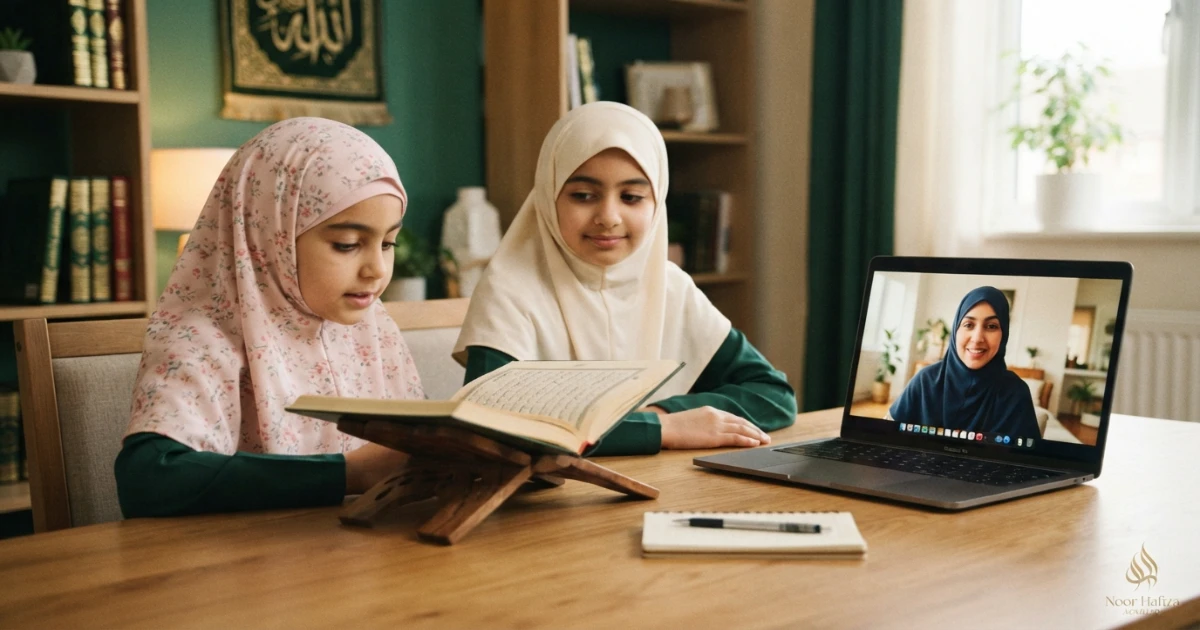
Situations where sibling Quran classes can work very well
Both children are learning similar letters, Harkaat, Sukoon, Shaddah, and blending skills.
Both read at a comparable pace and need similar pronunciation or fluency corrections.
Both are working on the same beginner rule such as Ghunnah, Qalqalah, Madd, or Waqf.
Both are memorizing or revising the same short Surahs and can be heard individually.
Both can wait, listen, and learn from the other child’s corrections.
One child’s success motivates the other instead of creating embarrassment or conflict.
When should siblings take separate Quran lessons?
Separate lessons are usually the stronger choice when the curriculum, pace, or correction needs are substantially different. The issue is not whether the siblings get along. The issue is whether one lesson can serve both well.
| Situation | Shared lesson risk | Better option | Why |
|---|---|---|---|
| Qaida beginner + fluent reader | Two unrelated curricula | Separate/back-to-back | Both need different teaching depth |
| Reader + Hifz student | One waits during long listening | Separate or partly shared | Hifz requires individual testing |
| Large age gap | Different attention and communication needs | Separate | Age-appropriate teaching differs |
| One needs intensive Makharij correction | Other child loses active time | Private correction | Technical feedback may take several minutes per sound |
| Frequent sibling competition | Embarrassment or arguments | Separate | Both need a safer learning space |

Can siblings of different ages still learn together?
Yes, if their reading level and learning style are close. Age is important, but it is not the only factor. A nine-year-old and eleven-year-old who are both reading the same Qaida stage may learn well together. A six-year-old and thirteen-year-old may struggle even if both are beginners because attention, communication, and lesson expectations are very different.
For a larger age gap, parents can ask whether part of the lesson can be shared—for example, a short dua, Islamic Studies discussion, or revision—while technical reading is taught separately.
What should a good shared sibling Quran lesson look like?
Short shared warm-up
Both review the same letters, Tajweed rule, or previous correction.
Individual reading turns
Each child reads while the teacher listens closely and gives direct correction.
Active listening
The waiting sibling has a simple task instead of sitting passively.
Separate exit goals
Each child leaves with one correction or homework target of her own.
The teacher should avoid letting one confident child answer for the other. Both learners need time to attempt independently, make mistakes, and receive feedback.
Shared class vs back-to-back sibling scheduling
Back-to-back lessons can preserve family convenience without forcing siblings into the same curriculum. One child may study from 4:00 to 4:30 and the next from 4:30 to 5:00. The same device, room, and teacher can still be used, but each learner receives a focused lesson.
Both children participate in the same level and same broad lesson goal.
Family keeps one scheduling block while each child receives separate instruction.
Share a short warm-up or Islamic Studies segment, then teach reading separately.
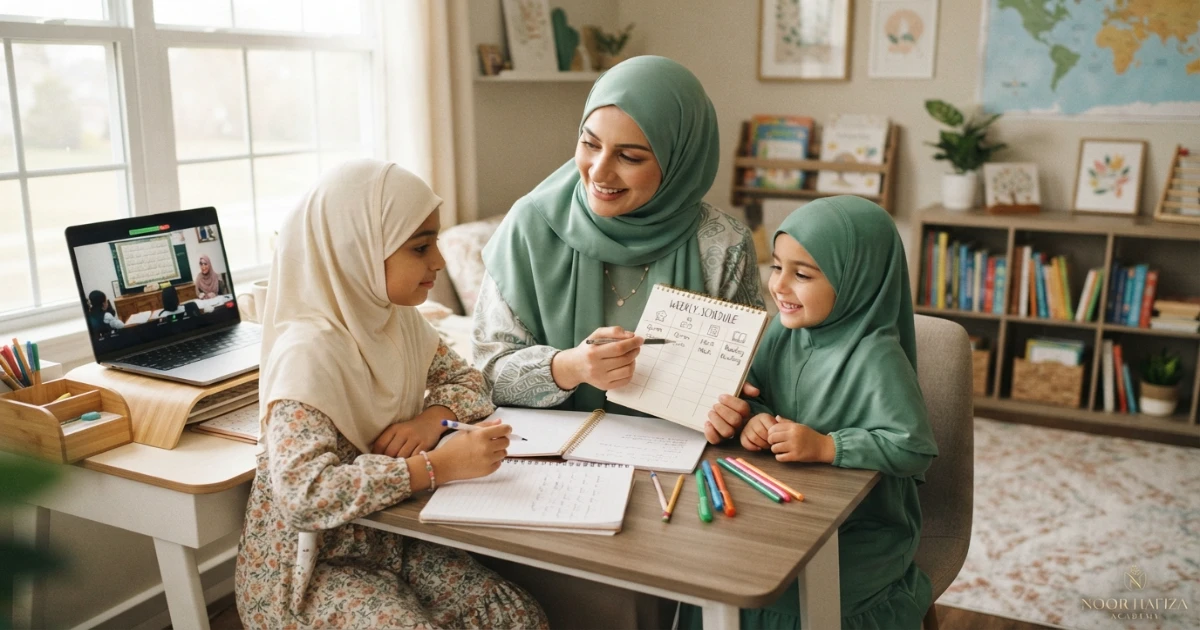
Can siblings learn Tajweed together?
Yes, especially when both can already read at a similar level and are working on the same rules. A teacher can explain Ghunnah, Qalqalah, Madd, Meem Sakinah, Noon Sakinah, or Waqf to both, then listen to each student individually.
The explanation can be shared, but pronunciation correction still needs to be individual. One sibling may produce Qāf accurately while the other replaces it with a lighter sound. One may hold Madd too long while the other shortens it. The teacher should not assume that one explanation creates identical performance.
Can siblings do Hifz together?
Siblings can memorize the same Surah or portion together, and that can make home revision easier. However, each child still needs an individual listening check. Hifz strength is personal: one child may remember new lines quickly but forget older revision, while another may memorize slowly but retain more strongly.
| Hifz element | Can be shared? | Should be individual? | Reason |
|---|---|---|---|
| New passage introduction | Often yes | Pronunciation check | Both can learn the same portion but may make different errors |
| Repetition routine | Yes | Not always | Family repetition can support consistency |
| New lesson test | No | Yes | Teacher must know what each child actually remembers |
| Old revision test | No | Yes | Retention weakness differs by learner |

Can brothers and sisters take the same online Quran class?
For younger children, families may find a shared sibling lesson practical when age, level, and class policies allow. As children grow, family preferences, privacy, teaching arrangements, and academy policies may change. Parents should confirm the academy’s current class-format and teacher policies directly, especially for older children and teenagers.
For teenage girls, some families prefer a female Quran teacher. The same quality checks still matter: accurate recitation, appropriate Tajweed knowledge, respectful communication, clear boundaries, and progress tracking.
How parents can prevent sibling comparison from hurting progress
One of the biggest risks in a shared class is comparison. Even siblings close in age can learn differently. One may read faster, another may pronounce difficult letters more accurately, and another may remember Hifz more consistently.
Compare each child with herself
Use previous recordings, teacher notes, and personal goals rather than sibling rankings.
Keep correction private when needed
A shy child may benefit from some one-to-one feedback outside the shared session.
Use different homework
Even inside one class, each learner can have a different practice target.
Watch emotional response
If one child becomes quiet, competitive, or embarrassed, review the class format.
Track sibling Quran progress separately
A shared class should not create one shared progress score. Each child should have individual indicators for reading, Tajweed, Hifz, attendance, independence, and home practice.
| Area | Sibling A | Sibling B | What parents should watch |
|---|---|---|---|
| Reading | Fewer pauses | Better letter accuracy | Different progress can still be equally meaningful |
| Tajweed | Madd more stable | Qalqalah improving | Keep correction targets individual |
| Hifz | New lesson strong | Old revision strong | Do not reward only speed |
| Independence | Needs reminders | Prepares alone | Support different maturity levels |

Common mistakes when siblings take Quran classes together
Grouping by age only
Two children are placed together because they are close in age even though reading levels are very different.
Letting one child dominate
The faster or more confident sibling answers first and receives most of the teacher’s attention.
Using one homework target
Both children receive identical review even when their repeated errors differ.
Ignoring sibling competition
Corrections turn into comparison, embarrassment, or arguments after class.
Combining unrelated curricula
The teacher must teach Qaida, fluent Quran reading, and Hifz inside one short lesson.
No active task while waiting
One sibling becomes bored every time the other child reads.
Choosing shared classes only to save time
Family convenience overrides evidence that both children need different instruction.
Never reviewing the format
A class that worked six months ago continues even after one sibling progresses much faster.
Use a trial class to test whether siblings should learn together
Watch these during the trial
- Can both siblings read at a reasonably similar level?
- Does each child receive enough active reading time?
- Can each wait while the other is being corrected?
- Does one child answer for the other?
- Is the teacher able to keep both engaged?
- Does each learner receive an individual correction target?
- Does the class feel too easy for one or too difficult for the other?
- Would separate or back-to-back lessons produce better progress?
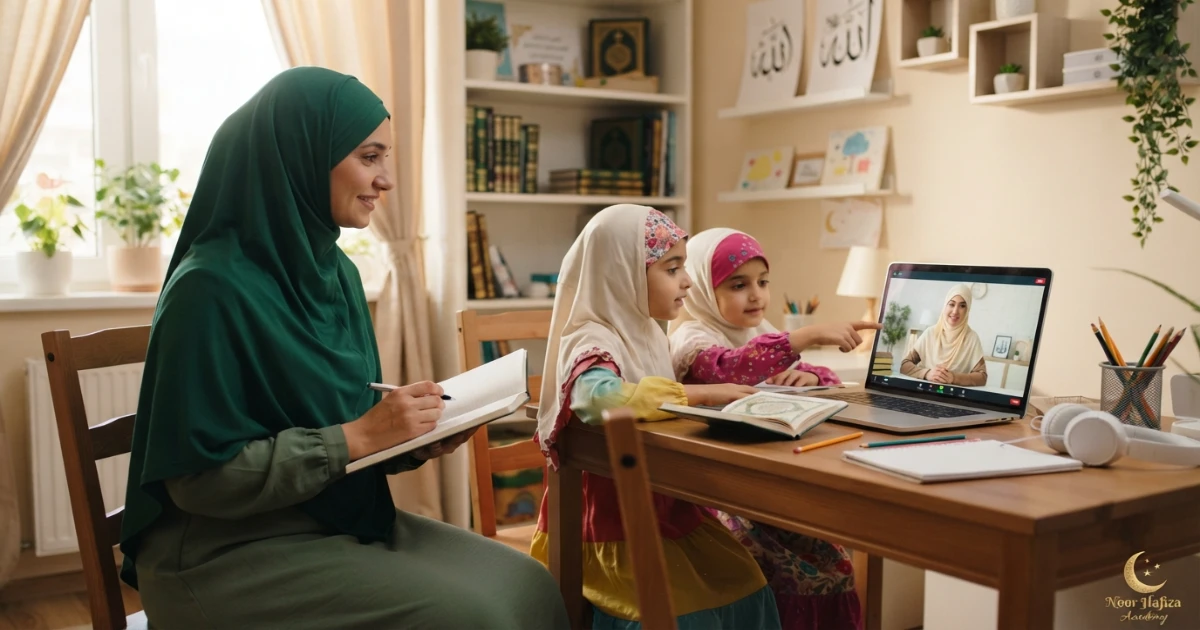
Questions parents should ask before booking sibling Quran classes
Use these before enrollment
- Will you assess each sibling separately before grouping them?
- How close do their reading levels need to be for a shared class?
- Can siblings have different homework inside the same lesson?
- How much individual recitation time will each child receive?
- Can we switch to separate lessons if one child progresses faster?
- Do you offer back-to-back lessons for siblings?
- Can Tajweed explanation be shared while pronunciation correction remains individual?
- How do you test Hifz separately?
- How do you handle sibling competition or one child answering for another?
- Are female Quran teachers available for our preferred family schedule?
- How do parents receive separate progress updates for each child?
- Can we test both shared and separate formats during a trial period?
Online Quran classes for siblings and families
Noor Hafiza Academy offers live online Quran learning for girls, women, children, adults, new Muslims, complete beginners, returning readers, and family learners with female Quran teachers. Siblings can be assessed for Noorani Qaida, Quran reading, Tajweed, Hifz support, and Islamic Studies according to current level and goals.
Where suitable, families can ask whether siblings may share a class, use back-to-back lessons, or follow separate schedules. Current teacher qualifications, sibling-class availability, lesson duration, group or private formats, fees, trial arrangements, rescheduling rules, privacy practices, policies, and enrollment terms should be confirmed directly.
Share each child’s age, current Quran level, reading pace, goals, preferred schedule, and whether you are considering a shared, separate, or back-to-back class.
FAQs about siblings taking online Quran classes together
Can siblings take online Quran classes together?
Should siblings be the same age to share a Quran class?
What if one sibling is in Qaida and the other reads Quran?
Can siblings learn Tajweed together?
Can siblings memorize Quran together?
Are back-to-back Quran classes good for siblings?
Can brothers and sisters share an online Quran class?
How can a teacher keep two siblings engaged?
What if one sibling progresses much faster?
Should parents compare sibling Quran progress?
How do I know whether a shared class is working?
What should I send when asking about sibling Quran classes?
Choose a sibling Quran class format that keeps both learners challenged, comfortable, and progressing
Share each child’s age, Quran level, reading pace, goals, preferred schedule, and whether you are considering a shared, separate, or back-to-back class.