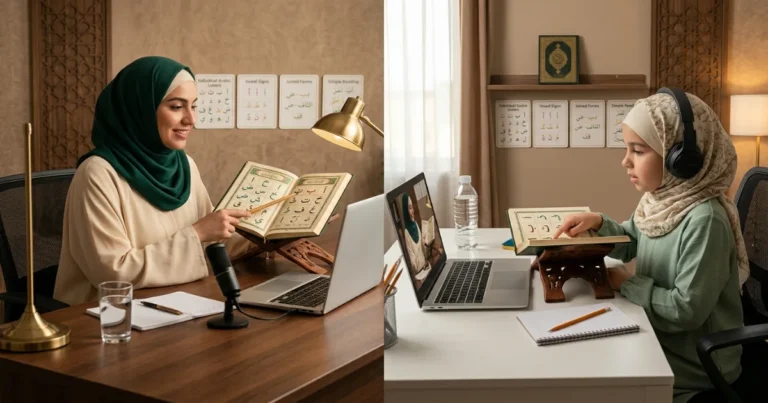
How to Use Listening and Repetition to Improve Quran Recitation

Listening and repetition can be powerful tools for improving Quran recitation, especially for pronunciation, rhythm, fluency, and confidence. But the method works best when listening supports active reading rather than replacing it. A learner who only copies a recording may memorize the sound of a familiar passage without becoming better at reading unfamiliar Quran text. A stronger method is to read a short phrase first, listen to a reliable reciter or teacher, notice the difference, repeat the phrase carefully, and then try again without the audio. Over time, this can help sharpen Makharij, stabilize Madd, improve Ghunnah and Qalqalah, reduce hesitation, and build a clearer sense of where phrases begin and end. Teacher feedback remains important because not every pronunciation error is obvious to the learner’s own ear.
How do you use listening and repetition to improve Quran recitation?
Use a four-step cycle: read first, listen, repeat, and retry independently. Choose one to three lines. Read them slowly without audio. Then listen to a reliable reciter or teacher while following the Arabic text. Repeat the same short phrase several times, paying attention to difficult letters, Madd, Ghunnah, Qalqalah, and stopping. Finally, turn off the audio and read the passage again yourself. If possible, record your recitation and compare it with the model. This method improves recitation more effectively than passive listening because it keeps your eyes, ears, tongue, and memory working together.
Why listening and repetition can improve Quran recitation
Quran recitation is a physical and auditory skill as well as a reading skill. Your eyes recognize the Arabic text, your brain interprets the signs, your tongue produces the sounds, and your ears monitor the result. Listening gives you a model of what accurate recitation should sound like, while repetition gives your mouth repeated practice producing the same pattern.
The benefit becomes much stronger when you compare your own recitation with the model. Without comparison, listening may remain passive. Without independent reading, repetition can turn into sound imitation rather than true decoding. The strongest routine therefore alternates between independent reading and careful listening.
If you can reproduce a memorized passage only while following a recording, test yourself on fresh Quran text to make sure the skill transfers.
The read–listen–repeat–retry method
Read first
Attempt the phrase yourself before hearing the model so you discover your real reading habits.
Listen carefully
Follow the Arabic text and notice pronunciation, lengthening, pauses, and phrase boundaries.
Repeat
Recite the same phrase several times while focusing on one or two specific corrections.
Retry alone
Turn off the recording and read the phrase independently to test whether the correction stayed.

Start with one to three lines, not an entire page
Short sections make it easier to hear detail. If you listen to a full page, you may remember the general rhythm but miss the exact place where your pronunciation differs. Short passages also make repetition less tiring and help you keep one clear correction target.
Work on one line or even part of a line if decoding is still slow.
Focus on smoother phrasing, Tajweed transfer, and Waqf.
Refine consistency, subtle pronunciation, breath control, and recitation flow.
Choose a passage that is challenging enough to reveal mistakes but not so difficult that every word becomes a struggle.

What should you listen for?
Do not try to monitor every Tajweed feature at once. Choose one or two listening targets in each practice session. Focused listening is more useful than simply letting recitation play in the background.
| Listening target | What to notice | Common problem | Practice cue |
|---|---|---|---|
| Makharij | Exact letter quality | Similar letters collapse together | Repeat the difficult word slowly |
| Madd | Relative length | Long vowels become inconsistent | Compare timing phrase by phrase |
| Ghunnah | Controlled nasal sound | Too short or exaggerated | Listen for the held nasal quality |
| Qalqalah | Clear bounce without extra vowel | A new vowel is added | Repeat the consonant in context |
| Waqf | Where the reciter stops | Stopping mid-meaning | Mark phrase boundaries |
What is Quran recitation shadowing?
Shadowing means reciting along with or immediately behind a model reciter. It can help learners copy rhythm, timing, and phrase flow. But it should be used carefully because a learner can sometimes hide mistakes under the audio.
Hear the phrase once or twice while following the Arabic text.
Recite just behind the model and focus on one target such as Madd or Makharij.
Turn the audio off and recite the same phrase independently.
If your recitation falls apart as soon as the audio stops, you need more independent reading rather than more shadowing.

Use recording to hear what you miss while reciting
When you are reading, your attention is divided between the text, pronunciation, breath, and Tajweed. A recording lets you listen afterward with full attention. This can reveal repeated hesitation, rushed Madd, unclear Qalqalah, or pronunciation that sounded correct while you were reading.
Record one passage
Use the same short section you practised with listening and repetition.
Compare
Listen to the model and then your own recording, focusing on one target.
Note the difference
Write one specific correction instead of a vague note such as “read better.”
Record again
Repeat the passage after correction and compare the new version.
Self-recording is useful, but it cannot replace teacher feedback. Some Makharij errors sound normal to the person who has repeated them for years.

How many times should you repeat a Quran phrase?
There is no universal number. The useful amount depends on the error and learner. Three careful repetitions can be more effective than twenty distracted ones. Stop repeating when the corrected form is stable enough to test in a fresh context.
| Situation | Suggested approach | Stop when… | Avoid |
|---|---|---|---|
| Simple pronunciation correction | 3–5 careful repetitions | The corrected sound becomes consistent | Repeating the wrong form |
| Difficult Makharij | Short word drills + phrase | The letter improves in context | Forcing the throat or tongue |
| Fluency problem | Repeat the phrase, then fresh text | The phrase is smoother without blind memorization | One page on loop for days |
| Hifz support | Accurate repetition before memorization | The wording and pronunciation are stable | Memorizing an error |
How listening helps Tajweed practice
Listening can make Tajweed rules audible. A learner may understand a definition but still not recognize the rule in live recitation. Hearing examples helps connect theory to sound. For example, Madd becomes easier to understand when the learner hears the relative length repeatedly in real words rather than only reading a number of counts on a worksheet.
However, do not assume that copying one reciter automatically teaches every rule. The learner still needs to understand what is happening in the text and receive correction on her own recitation.

How beginners should use listening without becoming dependent on audio
Beginners benefit from hearing accurate Arabic, but they also need to build visual decoding. If the learner always hears the word first, the ears may do the work that the eyes should be learning to do.
This keeps listening connected to Arabic-script reading instead of turning it into memorization by ear only.
For learners using Noorani Qaida, the same method works with letters and short combinations. Attempt the sound, listen to the teacher or accurate model, repeat, then identify the same pattern elsewhere. The aim is recognition plus correct sound, not imitation without understanding.
How listening and repetition support Quran memorization
Listening can support Hifz by strengthening the sound pattern of a passage. But pronunciation should be corrected before heavy repetition. Repeating an error twenty times makes the error easier to remember. Hifz students should therefore use listening as a quality-control tool as well as a memory aid.
Read the new lines to a teacher or compare carefully before memorizing.
Use short accurate phrases rather than rushing through a large target.
Test recall independently and use listening only to check difficult places.
A 15-minute listening and repetition routine
| Minutes | Task | Main purpose | Rule |
|---|---|---|---|
| 1–3 | Read without audio | Reveal real errors | Do not listen first |
| 4–6 | Listen carefully | Hear pronunciation and flow | Follow the Arabic text |
| 7–10 | Repeat short phrases | Train mouth and ear together | Focus on one target |
| 11–13 | Retry without audio | Test independence | No shadowing |
| 14–15 | Record / note correction | Track progress | Write one next-step target |
This routine can be shortened to five or ten minutes on busy days. The important part is preserving the sequence: independent attempt, focused listening, repetition, and independent retry.

How to know whether listening practice is actually working
The clearest test is transfer. Can you reproduce the correction without the recording? Can you apply the same Tajweed rule in a different passage? Can you read a fresh word containing the difficult letter more accurately?
| Area | Weak sign | Progress sign | Best test |
|---|---|---|---|
| Pronunciation | Correct only while shadowing | Correct without audio | Fresh word |
| Tajweed | Rule only works on memorized example | Rule appears in new text | Unfamiliar passage |
| Fluency | Needs recording to maintain flow | Phrases become smoother independently | No-audio reading |
| Self-correction | Cannot hear difference | Notices and retries own error | Self-recording |
Common mistakes in Quran listening and repetition practice
Listening before every attempt
The learner copies the sound instead of testing independent reading.
Using passages that are too long
Specific pronunciation differences become difficult to notice.
Repeating without a target
The same errors are practised again and again.
Shadowing all the time
The model reciter hides hesitation and weak decoding.
Using many reciters at once
The learner becomes distracted by differences in pace and style.
Chasing melody before accuracy
Performance style receives more attention than letters and Tajweed.
Skipping teacher correction
Some pronunciation errors remain invisible to self-listening.
Only practising memorized Surahs
Memory creates the illusion of stronger reading skill.
When should you use a Quran teacher with listening practice?
Teacher feedback becomes especially important when you keep repeating the same difficult letters, are unsure whether your Madd or Ghunnah is correct, cannot tell why your recitation sounds different from the model, or want to move from basic reading into structured Tajweed. A teacher can also choose the best listening target so you do not spend the whole session trying to fix everything at once.
Ask your teacher these questions
- Which pronunciation error should I listen for first?
- Which recitation sample should I use for home practice?
- Should I shadow the reciter or listen first and repeat afterward?
- How many lines should I practise at one time?
- Which letters need separate Makharij drills?
- Is my Madd timing consistent?
- Am I adding extra vowels in Qalqalah?
- Where should I pause and restart in this passage?
- Should I record my practice between lessons?
- How can I test whether the correction transfers to fresh text?
- When should I increase the length of the passage?
- What should I focus on before the next lesson?
Online Quran recitation practice with female teachers
Noor Hafiza Academy offers live online Quran learning for women, girls, children, adults, new Muslims, complete beginners, returning readers, teenagers, siblings, and homeschool families with female Quran teachers. Learners can ask about Quran reading, pronunciation correction, Tajweed, Hifz support, and recitation practice according to their current level.
A suitable practice plan may include short read–listen–repeat cycles, targeted Makharij correction, Tajweed drills, fresh-text reading, recordings, and progress checks. Current teacher qualifications, availability, class length, trial arrangements, fees, schedules, privacy practices, and enrollment terms should be confirmed directly.
Share the learner’s age, Quran level, main pronunciation or fluency problem, preferred schedule, and whether the priority is reading, Tajweed, Hifz, or recitation confidence.
FAQs about listening and repetition for Quran recitation
Can listening to Quran improve my recitation?
Should I listen before or after reading?
How many times should I repeat a Quran phrase?
What is Quran shadowing?
Should beginners use listening practice?
Can listening help with Tajweed?
Can I improve Quran pronunciation without a teacher?
Should I use the same reciter every day?
Can repetition help Quran memorization?
How long should listening practice take?
How do I know if listening practice is working?
What should I send when asking for recitation help?
Train your ears, tongue, and reading together so listening leads to independent recitation
Share the learner’s age, Quran level, main pronunciation or fluency challenge, Tajweed background, and preferred schedule.