
Ikhfa Rules in Tajweed: Letters, Examples and Practice

Ikhfa is one of the four main Tajweed rules for Noon Sakinah (نْ) and Tanween (ً ٍ ٌ). The word Ikhfa means concealment or hiding. In practice, the Noon sound is not pronounced with full clarity as in Izhar, and it is not completely merged into the next letter as in Idgham. Instead, the sound is held in a concealed position with Ghunnah and then moves into the following letter. The Ikhfa rule applies before 15 letters: ت ث ج د ذ ز س ش ص ض ط ظ ف ق ك. Unlike the common Noon Sakinah/Tanween Idgham rule, Ikhfa can occur inside the same word or across two words. This guide explains the 15 letters, how the sound works, examples with Noon Sakinah and Tanween, pronunciation, common mistakes, and a practical drill for beginners.
What are the Ikhfa rules in Tajweed?
Ikhfa happens when Noon Sakinah or Tanween is followed by one of 15 letters: ت ث ج د ذ ز س ش ص ض ط ظ ف ق ك. The Noon/Tanween is not read fully clearly and is not fully merged into the next letter. Instead, it is concealed with a nasal Ghunnah, commonly taught as about two counts, while the mouth prepares for the following letter. Ikhfa can happen inside the same word or between two words. A simple beginner method is: find Noon Sakinah or Tanween, check the next letter, and if it is one of the 15 Ikhfa letters, conceal the Noon sound and carry a controlled Ghunnah into the next letter.
What does Ikhfa mean in Tajweed?
Ikhfa means concealment. In the Noon Sakinah and Tanween chapter, the sound of Noon is partly hidden before certain letters. It is neither fully pronounced from the normal Noon articulation point nor completely absorbed into the following letter.
This middle position is what makes Ikhfa different. Beginners often try to turn every Noon rule into either “say the Noon” or “do not say the Noon.” Ikhfa sits between those two extremes. You retain the nasal quality of Noon while avoiding a complete Noon articulation.
Keep the nasal quality while your mouth prepares for the next letter instead of completing a full, clear Noon.
What are the 15 Ikhfa letters?
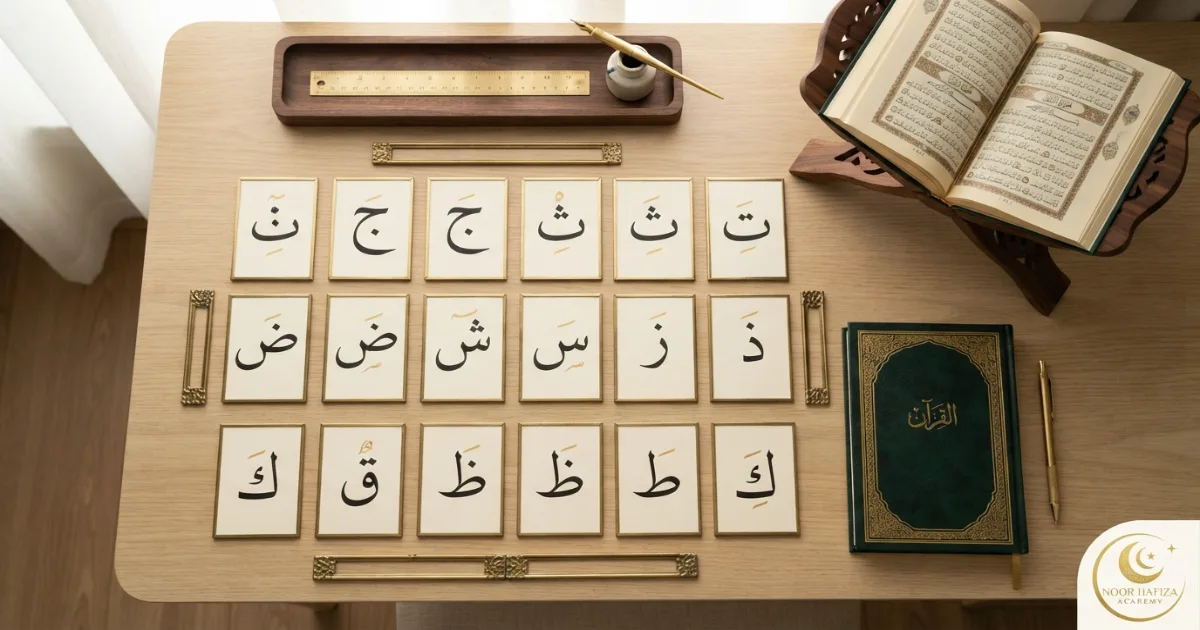
The 15 Ikhfa letters are:
These are the letters left after the Izhar, Idgham, and Iqlab letters are separated from the Noon Sakinah and Tanween rules. Some students memorize a classical mnemonic line; others learn the letters visually. Either approach works if the student can recognize the rule quickly while reading.
Ta
Concealed Noon with Ghunnah.
Tha
Concealed Noon with Ghunnah.
Jeem
Concealed Noon with Ghunnah.
Dal
Concealed Noon with Ghunnah.
Dhal
Concealed Noon with Ghunnah.
Zay
Concealed Noon with Ghunnah.
Seen
Concealed Noon with Ghunnah.
Sheen
Concealed Noon with Ghunnah.
Sad
Concealed Noon with Ghunnah.
Dad
Concealed Noon with Ghunnah.
Ta
Concealed Noon with Ghunnah.
Za
Concealed Noon with Ghunnah.
Fa
Concealed Noon with Ghunnah.
Qaf
Concealed Noon with Ghunnah.
Kaf
Concealed Noon with Ghunnah.
Ikhfa with Noon Sakinah
When Noon Sakinah is followed by one of the 15 Ikhfa letters, the Noon is concealed. The tongue should not complete a full Noon at its normal articulation point. Instead, the nasal sound remains while the mouth prepares for the following letter.
Hide the Noon and move into Ta with controlled Ghunnah.
Conceal the Noon before Qaf while preparing for Qaf’s deeper articulation.
Keep the nasal sound while preparing the tongue for Seen.
A short example such as مِنْ قَبْلِ shows the pattern: Noon Sakinah comes before Qaf, so the Noon is concealed with Ghunnah before Qaf.

Ikhfa with Tanween
The same 15-letter rule applies when a word ends with Tanween and the next word begins with an Ikhfa letter. The sign looks different, but the reading decision is identical: the final “n” quality of Tanween is concealed with Ghunnah before the next letter.
Hide the final “n” quality and carry Ghunnah into the next letter.
Avoid pronouncing a separate complete Noon.
Keep the nasal concealment before the following letter.
When practising Tanween, do not become distracted by the vowel type. First hear the ending “n” quality, then check whether the next letter belongs to the Ikhfa set.
How do you pronounce Ikhfa correctly?
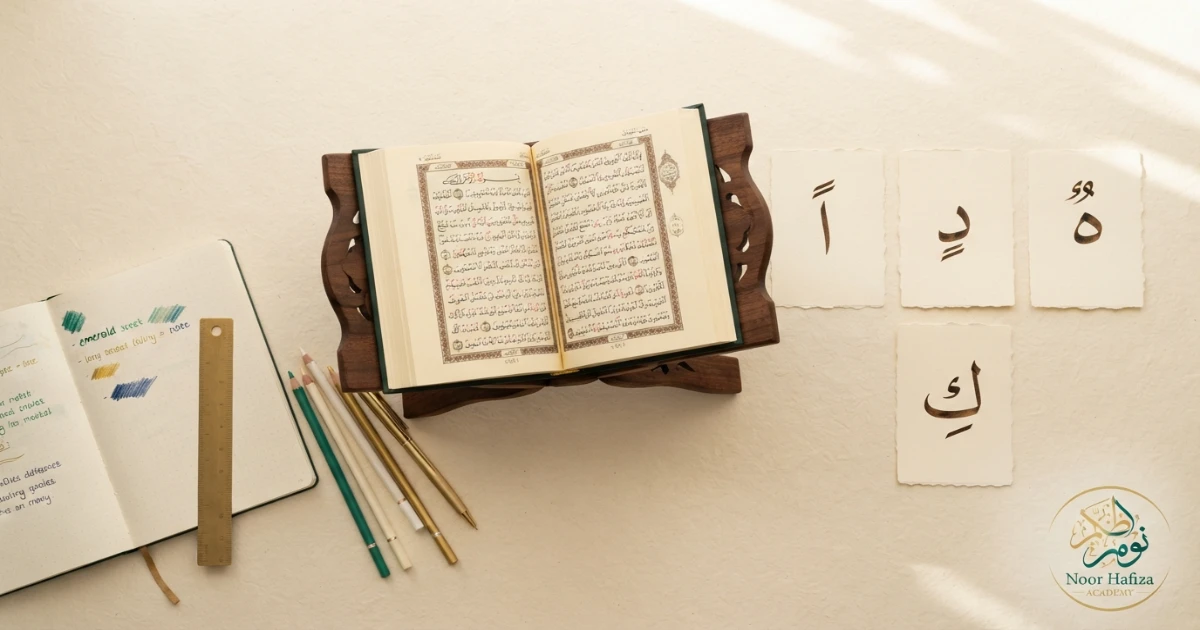
A useful beginner formula is: keep the Ghunnah, hide the full Noon, and prepare for the next letter. The tongue should not make the complete Noon contact used in clear pronunciation, but the nasal resonance should remain audible.
Avoid the firm Noon articulation that would turn the rule into Izhar.
The nasal resonance is the main audible feature of the hidden sound.
Move toward the following letter’s articulation while maintaining the concealed sound.
The following letter should still be pronounced clearly from its own Makhraj. Ikhfa should not distort Qaf into Kaf, Sad into Seen, or another letter into a nearby sound.

How long is the Ghunnah in Ikhfa?
In common beginner Tajweed teaching, the Ghunnah in Ikhfa is held for about two counts. Counts are relative recitation units, not exact clock seconds.
Aim for a steady length. If the Ghunnah is too short, Ikhfa can sound dry and rushed. If it is too long, it becomes exaggerated and disrupts recitation flow. Teacher-guided listening is important because written explanations cannot fully show nasal resonance or timing.
Can Ikhfa happen inside one word?
Yes. This is an important difference from the common Noon Sakinah/Tanween Idgham rule. Ikhfa can occur when Noon Sakinah and the Ikhfa letter are inside the same word, or when Noon Sakinah/Tanween comes at the end of one word and the Ikhfa letter begins the next word.
Do not copy the Idgham two-word rule
Ikhfa is not restricted to a word boundary. It can happen inside a single word.
Tanween still works across words
Because Tanween is word-final, its Ikhfa trigger is the first letter of the next word.
Does Ikhfa sound exactly the same before all 15 letters?
At beginner level, the main job is to conceal the Noon and keep the Ghunnah. More advanced Tajweed study explains that the quality of Ikhfa can vary slightly depending on how close the next letter’s articulation point is to Noon.
These are commonly taught as a stronger or closer Ikhfa because their articulation is nearer to Noon.
Use a balanced concealed sound with controlled Ghunnah.
The concealment may sound relatively more open because these articulation points are farther from Noon.
Beginners should not overthink these levels before mastering the basic rule. First learn correct concealment; then refine the sound through recitation with a teacher.
Simple Ikhfa examples for beginners
| Pattern | Rule | What to do | Common mistake |
|---|---|---|---|
| نْ + ق | Ikhfa | Conceal Noon with Ghunnah before Qaf | Clear Noon |
| نْ + ت | Ikhfa | Hide Noon and prepare for Ta | Full merge |
| نْ + س | Ikhfa | Keep nasal sound before Seen | Dropping Ghunnah |
| ٌ + ك | Ikhfa | Hide Tanween “n” before Kaf | Separate Noon |
| ٍ + ف | Ikhfa | Use controlled Ghunnah before Fa | Overlong nasal sound |
How to practise Ikhfa step by step
Find the trigger
Identify Noon Sakinah or Tanween first.
Look ahead
Check the next letter carefully.
Confirm Ikhfa
Match the next letter to the 15-letter list.
Hide the Noon
Avoid full Noon articulation.
Hold Ghunnah
Use a controlled nasal sound, commonly about two counts.
Move into the letter
Pronounce the next letter clearly from its own Makhraj.
Start with isolated patterns, then short phrases, then fresh Quran lines. If you only practise one memorized example, the rule may not transfer well to normal recitation.
Ikhfa vs Izhar, Idgham, and Iqlab
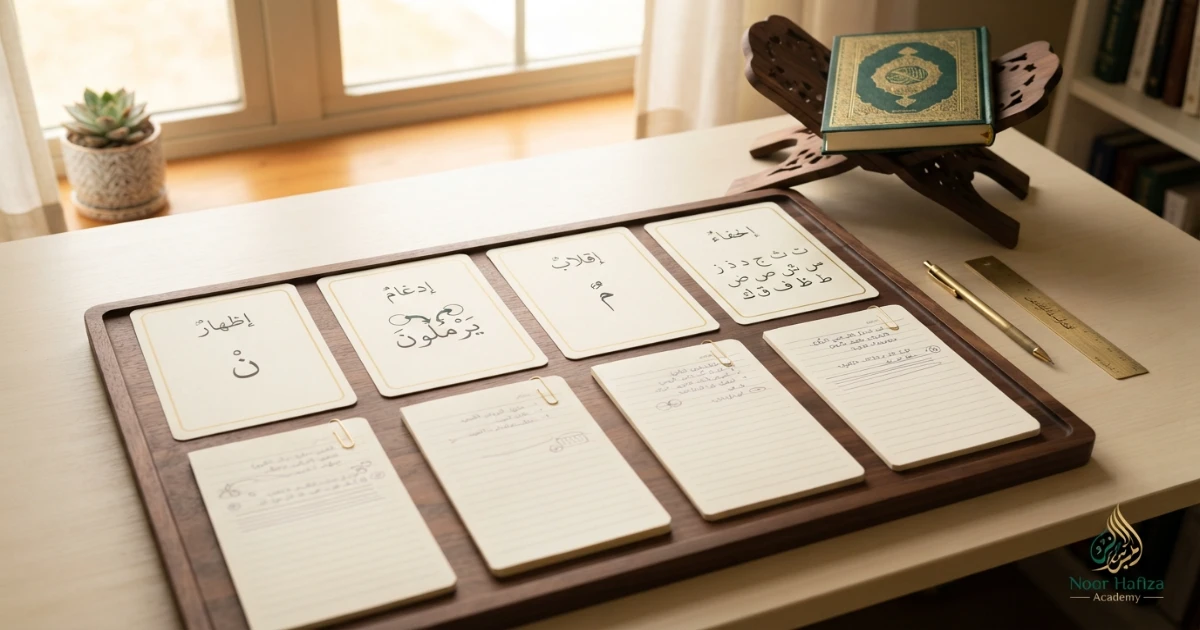
The easiest way to understand Ikhfa is to compare it with the other Noon Sakinah and Tanween rules.
| Rule | Core idea | Noon/Tanween sound | Beginner cue |
|---|---|---|---|
| Izhar | Clarity | Clear | Pronounce Noon distinctly |
| Idgham | Merging | Merged into next letter | Check يرملون |
| Iqlab | Conversion | Changes toward hidden Meem before ب | Only before ب |
| Ikhfa | Concealment | Hidden with Ghunnah | 15 Ikhfa letters |
Common Ikhfa mistakes beginners make
Pronouncing a full Noon
The learner turns Ikhfa into Izhar by making the Noon too clear.
Merging completely
The learner turns Ikhfa into Idgham and loses the concealed middle quality.
Dropping Ghunnah
The reading becomes dry because the nasal quality disappears.
Holding Ghunnah too long
The sound becomes exaggerated and interrupts recitation flow.
Same mouth shape every time
The learner ignores the need to prepare for the next letter’s Makhraj.
Forgetting same-word Ikhfa
The learner incorrectly assumes Ikhfa only happens between two words.
Memorizing letters without hearing
The student knows the list but cannot apply the sound while reading.
Skipping fresh-text practice
The learner performs drills correctly but misses Ikhfa in actual Quran reading.
Why teacher correction matters for Ikhfa
Ikhfa is difficult to master from written instructions because the difference between “clear,” “hidden,” and “merged” is mainly auditory. A student may think the Noon is concealed while still touching the full Noon articulation point.
A teacher can listen for Ghunnah length, tongue position, the transition into the next letter, and whether heavy letters such as ص, ض, ط, ظ, and ق are influencing the sound appropriately without distorting the next letter.
12-point Ikhfa practice checklist
Use this while reading a fresh Quran passage
- Can I identify Noon Sakinah correctly?
- Can I identify all three Tanween signs?
- What is the next letter after Noon or Tanween?
- Is it one of the 15 Ikhfa letters?
- Am I avoiding a fully clear Noon?
- Am I also avoiding a complete merge?
- Is the Ghunnah controlled and steady?
- Am I preparing my mouth for the next letter?
- Can I apply Ikhfa inside the same word when required?
- Can I apply it across two words with Tanween?
- Can I hear the difference between Ikhfa and Idgham?
- Can I find and read Ikhfa correctly in a fresh Quran line?

Learn Ikhfa and beginner Tajweed online
Noor Hafiza Academy offers live online Quran learning for children, girls, women, adults, beginners, returning readers, teenagers, siblings, and homeschool families with female Quran teachers. Learners can ask about Noorani Qaida, Quran reading, Tajweed, Makharij, Hifz, and pronunciation correction according to their current level.
A beginner Tajweed plan may include Noon Sakinah and Tanween rules, Meem Sakinah, Ghunnah, Qalqalah, Madd, Waqf, Makharij, and guided recitation. Current teacher qualifications, female-teacher availability, class length, trial arrangements, fees, schedules, privacy practices, safeguarding policies, and enrollment terms should be confirmed directly.
Share the learner’s age, Quran reading level, Tajweed background, main pronunciation difficulty, preferred schedule, and whether a female teacher is requested.
FAQs about Ikhfa rules in Tajweed
What is Ikhfa in Tajweed?
How many Ikhfa letters are there?
Does Ikhfa use Ghunnah?
Can Ikhfa happen with both Noon Sakinah and Tanween?
Can Ikhfa happen inside one word?
How is Ikhfa different from Idgham?
How is Ikhfa different from Izhar?
What is the easiest way to learn the 15 Ikhfa letters?
How long should the Ghunnah be in Ikhfa?
Does Ikhfa sound identical before every letter?
What is a common Ikhfa mistake?
How should beginners practise Ikhfa?
Master Ikhfa by learning the 15 letters, controlling Ghunnah, and practising the hidden Noon in real Quran recitation
Share the learner’s age, Quran level, Tajweed background, main pronunciation difficulty, and preferred class schedule.